273 Results for "

Inositol

" in MedChemExpress (MCE) Product Catalog:
Products (273)

273 Results for "Inositol" in MCE Product Catalog:

Cat. No.: HY-129035
CAS No.: 2173134-00-2
Purity:  99.92%
Synonyms: Vanin-1-IN-1
Target:  

Pantetheinase

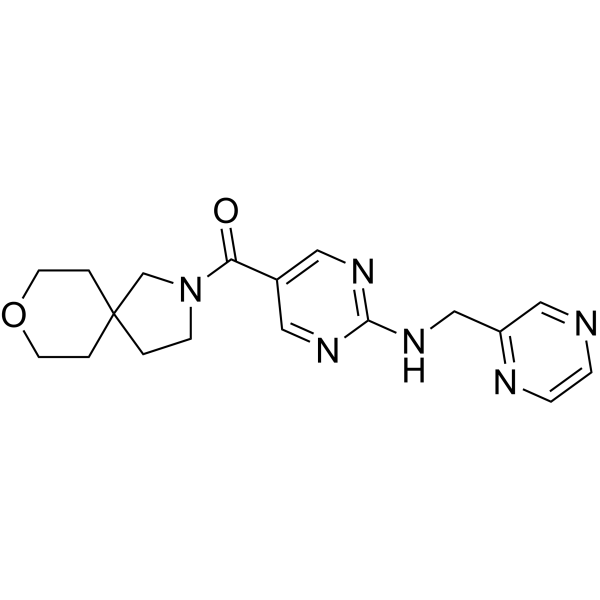
PFI-653 (Vanin-1-IN-1, compound 3), a chemical probe, is a vanin-1 inhibitor that binds to plasma vanin-1 from mouse, rat, dog, and human. Vanin-1 is a cell surface-associated inositol (GPi) -anchored protein that plays important roles in metabolism and inflammation. PFI-653 inhibits vanin-1 from different species with IC50s of 6.85 nM (human recombinant plasma vanin-1), 9.0 nM (human plasma vanin-1), 24.5 nM (mouse recombinant vanin-1), and 53.4 nM (mouse plasma vanin-1) .
loading...
    loading...
Cat. No.: HY-137608A
Synonyms: UDP-β-S trisodium
Uridine 5'-O-thiodiphosphate trisodium (UDP-β-S trisodium) is a P2Y6 receptor agonist with an EC50 of 25 nM. Uridine 5'-O-thiodiphosphate trisodium resists degradation by extracellular nucleotidases and stimulates the accumulation of inositol phosphates. Uridine 5'-O-thiodiphosphate trisodium stimulates contractile responses in endothelium-denuded rat mesenteric arteries. As a mitogen, Uridine 5'-O-thiodiphosphate trisodium stimulates DNA synthesis, [ 3H] thymidine incorporation, protein synthesis, [ 3H]leucine incorporation, and increases the number of vascular smooth muscle cells. Uridine 5'-O-thiodiphosphate trisodium can be used in the research of cardiovascular diseases such as atherosclerosis .
loading...
    loading...
Cat. No.: HY-W010178
CAS No.: 54947-74-9
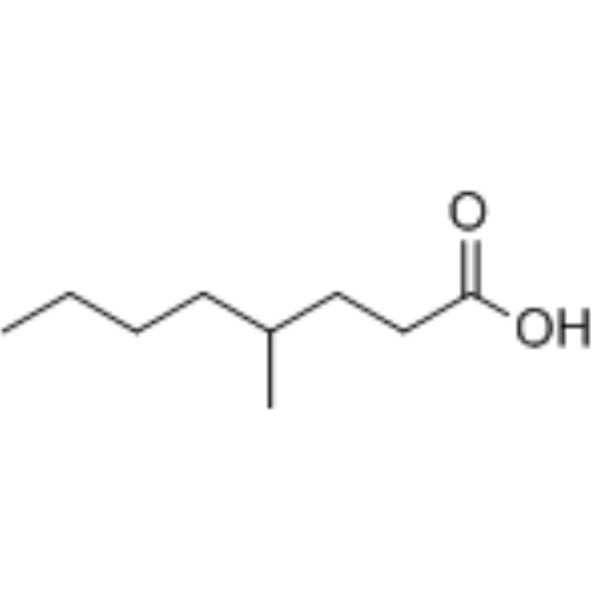
4-Methyloctanoic acid is an endogenous branched-chain medium-chain fatty acid and a negative regulator of the cAMP/PKA signaling pathway. 4-Methyloctanoic acid exerts antiepileptic effects by inhibiting epileptiform discharges and terminating behavioral and electroencephalographic seizures. 4-Methyloctanoic acid has neuroprotective effects; its polar metabolites can cross the blood-brain barrier, repair presynaptic release defects, improve motor function and alleviate neuromuscular degeneration in ALS models. 4-Methyloctanoic acid regulates phosphatidylinositol metabolism, reduces PIP/PIP2 levels and increases inositol levels. 4-Methyloctanoic acid can be used in studies related to epilepsy and amyotrophic lateral sclerosis .
loading...
    loading...
Cat. No.: HY-107664R
CAS No.: 184162-64-9
SR 142948 (Standard) is the analytical standard of SR 142948 (HY-107664). This product is intended for research and analytical applications. SR 142948 is an orally active and selective non-peptide neurotensin receptor (NT) antagonist with IC50s of 1.19 nM, 0.32 nM, 3.96 nM in h-NTR1-CHO cells, HT-29 cells, and adult rat brain, respectively. SR 142948 antagonizes NT-induced inositol monophosphate formation in HT-29 cells with an IC50 of 3.9 nM. SR 142948 blocks hypothermia, analgesia and steering behavior induced by NT in vivo. SR 142948 shows blood-brain permeability and can be used in study of psychiatric disorders .
loading...
    loading...
Cat. No.: HY-142117
CAS No.: 149091-92-9
Research Areas:  

Others

Adenophostin A is an IP3 receptor (inositol 1,4,5-trisphosphate receptors) modulator and Ca 2+ releaser, with an IC50 of 1.3 nM, an EC50 of 1.4 nM, and a Ki of 0.18 nM in rats, and an IC50 of 0.95 nM in humans. Adenophostin A activates IP3 receptors, stimulates Ca 2+ release from intracellular stores and microsomes, inhibits the binding of [ 3H]IP3 to plasma membrane receptors, and activates chloride channels. Adenophostin A resists phosphorylation and dephosphorylation by IP3 metabolic enzymes to maintain its activity, and increases cytoplasmic [Ca 2+] levels via calcium mobilization from the endoplasmic reticulum of vascular smooth muscle cells. Adenophostin A is applicable to research related to hemorrhagic shock .
loading...
    loading...
Cat. No.: HY-19633A
CAS No.: 216776-73-7
Target:  

Endogenous Metabolite

Research Areas:  

Neurological Disease

CS-003 is a triple neurokinin receptor antagonist with activity in inhibiting neurokinin-related respiratory diseases. CS-003 exhibits high affinity for human neurokinin 1, 2 and 3 receptors, withKi values of 2.3 nM, 0.54 nM and 0.74 nM respectively. The Ki values of CS-003 on the guinea pig neurokinin receptor are 5.2 nM, 0.47 nM and 0.71 nM respectively, showing superior inhibitory effect. CS-003 significantly inhibits the formation of inositol phosphate involving substance P, neurokinin A and neurokinin B through competitive antagonism. CS-003 significantly inhibits citric acid-induced cough, and its effect is better than other selective neurokinin receptor antagonists .
loading...
    loading...
Cat. No.: HY-P80828A
Synonyms: ERN1; IRE1; Serine/threonine-protein kinase/endoribonuclease IRE1; Endoplasmic reticulum-to-nucleus signaling 1; Inositol-requiring protein 1; hIRE1p; Ire1-alpha; IRE1a

Host:  

Rabbit

Application:  

WB, IP

Reactivity:  

Human

loading...
    loading...
Cat. No.: HY-P810538
Synonyms: 1 phosphatidylInositol 4,5 bisphosphate phosphodiesterase beta 1; 1-phosphatidyl-D-myo-Inositol-4,5-bisphosphate; 1-phosphatidylInositol 4; 1-phosphatidylInositol-4; 5-bisphosphate phosphodiesterase beta-1; EIEE12; Inositoltrisphosphohydrolase; MonophosphatidylInositol phosphodiesterase; Phosphb; Phosphoinositidase C

Host:  

Rabbit

Application:  

WB, IHC-P, ICC/IF, FC

Reactivity:  

Human, Mouse, Rat

loading...
    loading...
Cat. No.: HY-W010178R
CAS No.: 54947-74-9
4-Methyloctanoic acid (Standard) is the analytical standard of 4-Methyloctanoic acid (HY-W010178). This product is intended for research and analytical applications. 4-Methyloctanoic acid is an endogenous branched-chain medium-chain fatty acid and a negative regulator of the cAMP/PKA signaling pathway. 4-Methyloctanoic acid exerts antiepileptic effects by inhibiting epileptiform discharges and terminating behavioral and electroencephalographic seizures. 4-Methyloctanoic acid has neuroprotective effects; its polar metabolites can cross the blood-brain barrier, repair presynaptic release defects, improve motor function and alleviate neuromuscular degeneration in ALS models. 4-Methyloctanoic acid regulates phosphatidylinositol metabolism, reduces PIP/PIP2 levels and increases inositol levels. 4-Methyloctanoic acid can be used in studies related to epilepsy and amyotrophic lateral sclerosis .
loading...
    loading...
Cat. No.: HY-P73858
Purity:  ≥ 80%, as determined by reducing SDS-PAGE.
Synonyms: ERN1; Ire1-Alpha; Endoplasmic Reticulum To Nucleus Signaling 1; HIRE1p; IRE1; IRE1a; Serine/Threonine-Protein Kinase/Endoribonuclease IRE1; Endoplasmic Reticulum-To-Nucleus Signaling 1; IRE1P; Non-Specific Serine/Threonine Protein Kinase; Inositol-Requiri
Species:  
Human
Source:  
Sf9 insect cells
loading...
    loading...
Cat. No.: HY-P71045
Purity:  ≥ 95%, as determined by reducing SDS-PAGE.
Synonyms: VNN2; Vanin 2; FOAP-4; GPI-80; Glycosylphosphatidyl Inositol-Anchored Protein GPI-80; Vascular Non-Inflammatory Molecule 2; Pantetheine Hydrolase VNN2; Pantetheinase; cDNA FLJ55137, Highly Similar To Vascular Non-Inflammatory Molecule 2; Protein FOAP-4; Vannin 2; Vanin-2
Species:  
Human
Source:  
HEK293
loading...
    loading...
Cat. No.: HY-P73256
Purity:  ≥ 90%, as determined by reducing SDS-PAGE.
Synonyms: ERN1; Ire1-Alpha; Endoplasmic Reticulum To Nucleus Signaling 1; HIRE1p; IRE1; IRE1a; Serine/Threonine-Protein Kinase/Endoribonuclease IRE1; Endoplasmic Reticulum-To-Nucleus Signaling 1; IRE1P; Non-Specific Serine/Threonine Protein Kinase; Inositol-Requiri
Species:  
Human
Source:  
Sf9 insect cells
loading...
    loading...
Cat. No.: HY-117087
CAS No.: 1071544-43-8
Target:  

Phosphatase PANoptosis

Research Areas:  

Cancer

K103 is an inhibitor discovered from the screen that is an analog of the serotonin antagonist benzazocine. K103 exhibited inhibition of SHIP homologues, labelling it a pan-SHIP1/2 inhibitor, but the molecule had no effect on another 5' inositol phosphatase, OCRL. In line with the "two PIPs hypothesis", the molecule exhibited significant anti-tumour effects against a variety of cell lines, particularly breast cancer cells. Additional studies with K103 revealed that inhibition of SHIP1/2 in multiple myeloma cells resulted in G2/M cell cycle arrest followed by extensive apoptosis via activation of the caspase cascade. K103 fits the commonly used small molecule agent property profile, but while this work was being conducted, it was discovered that K103 caused psychoactive effects in mice, which limited the utility of the molecule in vivo. Therefore, certain synthetic studies were conducted on this tryptamine to identify the features that needed to be present in the molecule to maintain pan-SHIP1/2 inhibition in order to design an inhibitor with favourable pharmacodynamic properties and an improved side effect profile.
loading...
    loading...

