392 Results for "

Chelators

" in MedChemExpress (MCE) Product Catalog:
Products (392)

392 Results for "Chelators" in MCE Product Catalog:

Cat. No.: HY-B1005R
CAS No.: 148-24-3
Synonyms: 8-Quinolinol (Standard)
Research Areas:  

Cancer

8-Hydroxyquinoline (Standard) is the analytical standard of 8-Hydroxyquinoline. This product is intended for research and analytical applications. 8-Hydroxyquinoline (8-Quinolinol) is a lipophilic metal chelator that can be used as a fungicide .8-Hydroxyquinoline shows the MIC range of 27.56-55.11 μM (4-8 μg/mL) against the clinical isolates of Neisseria gonorrhoeae. 8-Hydroxyquinoline can bind to copper form complexes and transport copper into cells. 8-Hydroxyquinoline increases in the number of micronucleated polychromatic erythrocytes and can also make hair depigmented in mice .
loading...
    loading...
Cat. No.: HY-P11486
NOTA-RHAU18 is a conjugate of the chelator NOTA and the peptide RHAU18. NOTA-RHAU18 can be used to synthesize the radiolabeled peptide probe [ 18F]AlF-NOTA-RHAU18. [ 18F]AlF-NOTA-RHAU18 targets mitochondrial DNA G4. [ 18F]AlF-NOTA-RHAU18 can be used to visualize and detect solid tumors in homozygous mice. [ 18F]AlF-NOTA-RHAU18 can also be used in PET imaging studies .
loading...
    loading...
Cat. No.: HY-P11864
Research Areas:  

Cancer

DOTA-SMIC-1014 is a DOTA chelator-conjugated precursor of the c-Met-targeting peptide SMIC-1014 (HY-P11863). DOTA-SMIC-1014 binds to the extracellular domain of c-Met (Kd = 42.83 nM). After radiolabeling to [ 68Ga]Ga-SMIC-1014, DOTA-SMIC-1014 acts as a positron emission tomography (PET) probe that achieves specific tumor uptake in xenografts and functions as a diagnostic probe targeting c-Met. SMIC-1014 can be used in research related to colon cancer, hepatocellular carcinoma, and prostate cancer .
loading...
    loading...
Cat. No.: HY-W011060
CAS No.: 23978-09-8
Synonyms: 4,7,13,16,21,24-Hexaoxa-1,10-diazabicyclo[8.8.8]hexacosane
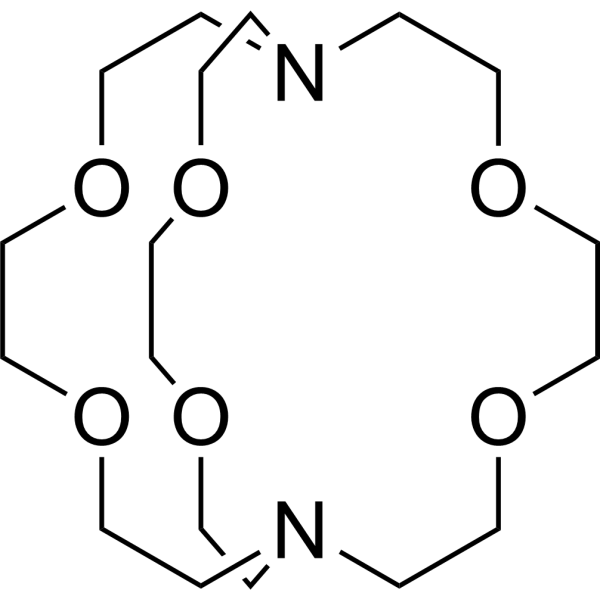
Cryptand 2.2.2 (4,7,13,16,21,24-Hexaoxa-1,10-diazabicyclo[8.8.8]hexacosane) is a metal ion chelator. Cryptand 2.2.2 forms stable mononuclear, protonated and dinuclear complexes with copper (II) ions; forms protonated complexes with hydrogen ions; and also forms stable complexes with Zn 2+, Co 2+, Ni 2+, Cd 2+, Hg 2+ and Pb 2+ ions. Cryptand 2.2.2 can be used for the preparation of nanoparticles, transition metal compounds, etc.
loading...
    loading...
Cat. No.: HY-W423191
CAS No.: 534-42-9
Synonyms: 4-O-α-D-Glucopyranosyl-D-gluconic acid
Maltobionic acid (4-O-α-D-Glucopyranosyl-D-gluconic acid) is an orally active oligosaccharide and iron chelator with antibacterial activity. Maltobionic acid inhibits the expression of NFATc1, suppresses osteoclast differentiation, inhibits bone resorption, and increases serum calcitonin levels. Maltobionic acid protects mammalian cells from hydrogen peroxide (H2O2)-induced oxidative damage; resists fermentation by the gut microbiota; and exhibits anti-digestive and anti-fermentative properties. Maltobionic acid can be used in research related to osteoporosis, bacterial infections, and constipation .
loading...
    loading...
Cat. No.: HY-136952
CAS No.: 1822331-55-4
p-SCN-Bn-HOPO is a bifunctional chelator that forms stable octadentate complexes with Zr (IV) and 89Zr 4+ via four 1,2-hydroxypyridone groups. p-SCN-Bn-HOPO conjugates with antibodies through the formation of thiourea bonds with lysine residues, and enables efficient 89Zr radiolabeling under mild conditions. p-SCN-Bn-HOPO inhibits bone uptake of free radiometals, stabilizes radiometal-antibody conjugates, and achieves PET imaging with low background and enhanced tumor-to-organ contrast. p-SCN-Bn-HOPO can be used in breast cancer-related research .
loading...
    loading...
Cat. No.: HY-144790
CAS No.: 2764664-52-8
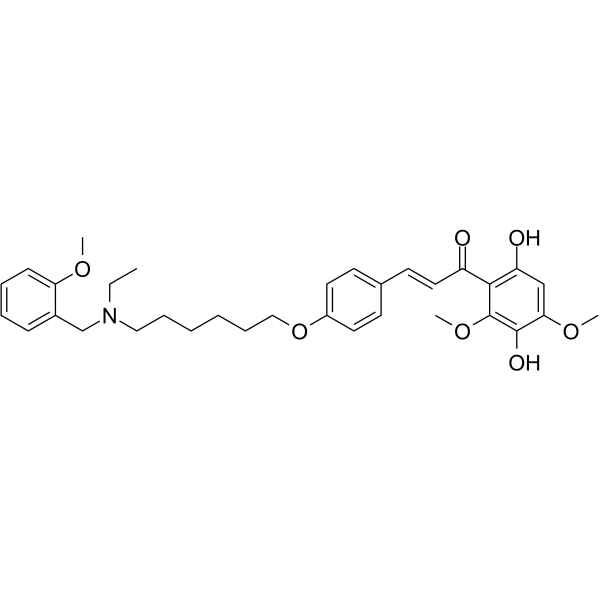
AChE-IN-12 is a potent and blood-brain barrier (BBB) penetrant acetylcholinesterase (AChE) with IC50s of 0.41 μM and 1.88 μM for rat AChE and electric eel AChE. AChE-IN-12 is also a good antioxidant (ORAC = 3.3 eq), selective metal chelator and huMAO-B inhibitor (IC50 = 8.8 μM). AChE-IN-12 has remarkable inhibition of self- and Cu 2+-induced Aβ1-42 aggregation, as well as exhibits a good neuroprotective effect. AChE-IN-12 can be used for researching Alzheimer’s disease .
loading...
    loading...
Cat. No.: HY-145536
CAS No.: 150399-99-8
α-D-Glucose-1-phosphate disodium tetrahydrate is a derivative of D-glucose (HY-B0389). α-D-Glucose-1-phosphate disodium tetrahydrate serves as a starting material for glucuronic acid synthesis. Glucuronic acid acts as a Ca 2+ chelator and also functions as a biosynthetic substrate for the production of linear maltooligosaccharides or α,α-trehalose. α-D-Glucose-1-phosphate disodium tetrahydrate can be used as a cytostatic compound, Antibiotic, and immunosuppressant essential for heart disease management. α-D-Glucose-1-phosphate disodium tetrahydrate is applicable to the research of heart disease .
loading...
    loading...
Cat. No.: HY-163879
hMAO-B-IN-9 (Compound 25c) is a non-competitive inhibitor for monoamine oxidase B (MAO-B) with an IC50 of 1.58 µM (hMAO-B). hMAO-B-IN-9 forms complex with iron ions as a chelator, and inhibits Erastin (HY-15763)-induced ferroptosis. hMAO-B-IN-9 exhibits antioxidant activity by downregulating the level of reactive oxygen species (ROS). hMAO-B-IN-9 improves cognitive function in mice, without significant toxicity (30 mg/kg). hMAO-B-IN-9 is blood-brain barrier permeable, according to the in silico prediction .
loading...
    loading...
Cat. No.: HY-165381
CAS No.: 71555-14-1
Research Areas:  

Cancer

ZMC2 is a thiosemicarbazone-class metal ion chelator and zinc ionophore with a human mutant p53 R175H binding Ka of 27.4 nM.ZMC2 binds Fe, Cu, Mn, Zn, and other transition metals.ZMC2 facilitates zinc transport across membranes.ZMC2 restores zinc binding to zinc-deficient p53 mutants, restoring wild-type structure and function, including site-specific DNA binding.ZMC2 generates reactive oxygen species (ROS).ZMC2 can be used for the research of cancer .
loading...
    loading...
Cat. No.: HY-187556
CAS No.: 2581199-68-8
Target:  

Bacterial

Research Areas:  

Infection

Antibiofilm agent-23 is a PqsR-targeting agent, iron chelator, biofilm inhibitor, biofilm dispersant, and anti-virulence agent. Antibiofilm agent-23 selectively binds to PqsR, disrupts the pqs quorum sensing pathway, restricts bacterial iron acquisition, induces intracellular iron deficiency, reduces pyocyanin, elastase, and rhamnolipid production, impairs biofilm formation, and disperses mature biofilms. Antibiofilm agent-23 exhibits low cytotoxicity and shows antibacterial synergy with Ciprofloxacin (HY-B0356) in Caenorhabditis elegans infection models. Antibiofilm agent-23 can be used for the research of biofilm-associated Pseudomonas aeruginosa infections .
loading...
    loading...
Cat. No.: HY-P10744
Research Areas:  

Cancer

BQ7859 is a probe targeting PSMA that contains a NOTA chelator and demonstrates excellent imaging performance. BQ7859 can be labeled with various radionuclides, such as 68Ga, 18F, 55Co, and 111In. In a mouse prostate cancer xenograft model, BQ7859 (labeled with 111In) efficiently accumulates in tumor regions in a PSMA-dependent manner and provides high-contrast tumor imaging. BQ7859 shows potential for research in prostate cancer imaging, particularly in positron emission tomography (PET) and single-photon emission computed tomography (SPECT) . BQ7859 can be used for the synthesis/research of Radionuclide-Drug Conjugates (RDCs).
loading...
    loading...
Cat. No.: HY-W1129940
CAS No.: 2417821-30-6
Research Areas:  

Cancer

p-SCN-Macropa is a bifunctional macrocyclic chelator featuring macrocyclic polyamine skeletons and thiocyanate (-SCN) reactive moieties. p-SCN-Macropa can conjugate with monoclonal antibodies including Nimotuzumab (HY-P9968), Rituximab (HY-P9913) and Trastuzumab (HY-P9907)-PEG6-DM1 for 225Ac radiolabeling to construct radioimmunoconjugates. p-SCN-Macropa is applicable for the research of colorectal cancer, HER2-positive breast cancer, TROP-2-positive cancers, and PSMA-positive cancers .
loading...
    loading...
Cat. No.: HY-153552
CAS No.: 2758337-19-6
Target:  

FAP

Research Areas:  

Cancer

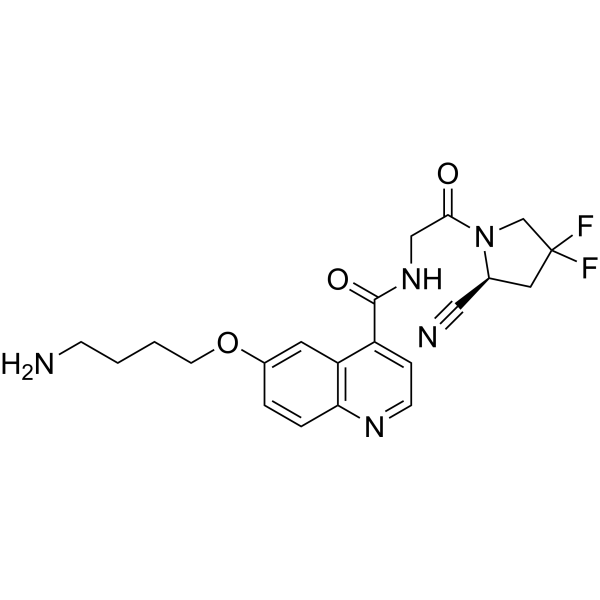
NH2-UAMC1110 is an aminobutoxy derivative of the fibroblast activation protein (FAP) inhibitor UAMC1110 (HY-100684), and is a precursor compound for the synthesis of FAP inhibitor probes, not directly used in bioactivity experiments. For example, NH2-UAMC1110 is involved in the synthesis of the radiotracer FAPI-QS, which exhibits high tumor selectivity and high dose-response, and has been used for tumor diagnosis. NH2-UAMC1110 introduces an active amino group into its structure, enabling it to form covalent bonds with various molecules (such as DOTA, DATA5m, radionuclide chelators, etc.), thereby synthesizing molecular imaging probes or targeted compounds with the ability to target FAP. NH2-UAMC1110 specifically binds to the FAP active site, inhibiting its proline-selective serine protease activity (including dipeptidyl peptidase and endopeptidase activity), blocking FAP-mediated tissue remodeling processes. Its key activity is high targeting and high affinity, and its core function is to be coupled with bifunctional chelators (such as DOTA, DATA5m) as a targeting module. NH2-UAMC1110 can be applied to diagnostic imaging studies of tumors expressing FAP (such as colorectal cancer, pancreatic cancer, etc.), and also provides molecular tools for targeted research of FAP-related diseases with high FAP expression, such as fibrosis and arthritis .
loading...
    loading...
Cat. No.: HY-153552A
CAS No.: 2990021-73-1
Purity:  99.89%
Target:  

FAP

Research Areas:  

Cancer

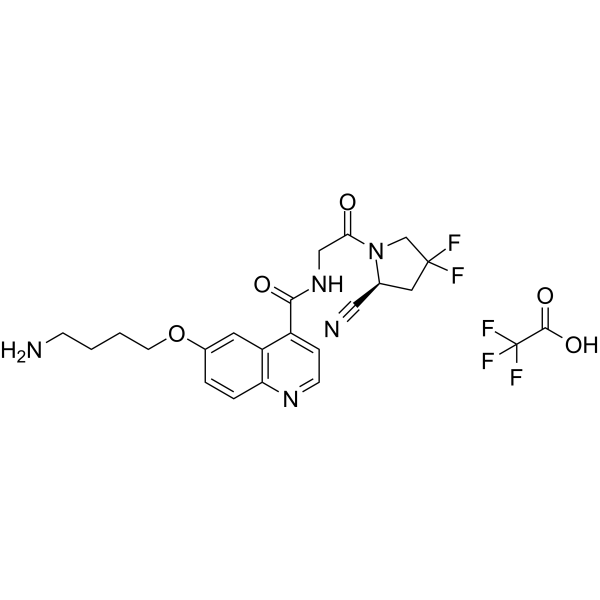
NH2-UAMC1110 TFA is an aminobutoxy derivative of the fibroblast activation protein (FAP) inhibitor UAMC1110 (HY-100684), and is a precursor compound for the synthesis of FAP inhibitor probes, not directly used in bioactivity experiments. For example, NH2-UAMC1110 TFA is involved in the synthesis of the radiotracer FAPI-QS, which exhibits high tumor selectivity and high dose effect, and has been used in tumor diagnosis. NH2-UAMC1110 TFA structurally incorporates an active amino group, allowing it to form covalent bonds with various molecules (such as DOTA, DATA5m, radionuclide chelators, etc.) to synthesize molecular imaging probes or targeted compounds with the ability to target FAP. NH2-UAMC1110 TFA specifically binds to the FAP active site, inhibiting its proline-selective serine protease activity (including dipeptidyl peptidase and endopeptidase activity), blocking FAP-mediated tissue remodeling-related processes. Its key activity is high targeting and high affinity, and its core function is to act as a targeting module coupled with bifunctional chelators (such as DOTA, DATA5m). NH2-UAMC1110 TFA can be applied to diagnostic imaging studies of tumors expressing FAP (such as colorectal cancer, pancreatic cancer, etc.), and also provides molecular tools for targeted research of FAP-related diseases with high FAP expression, such as fibrosis and arthritis .
loading...
    loading...
Cat. No.: HY-164576
CAS No.: 1374994-81-6
Synonyms: NODA-Bz-SCN
Research Areas:  

Cancer

NCS-MP-NODA (NODA-Bz-SCN) is a NODA-derived bifunctional chelator. NCS-MP-NODA can conjugate with biomolecules including the RGD tripeptide, and is used for aluminum-[ 18F] fluoride-based positron emission tomography (PET) radiolabeling. NCS-MP-NODA can conjugate with the free lysine amino group of the PD-L1-specific peptide DK221 to generate DK222, which can be radiolabeled with 18F to form [ 18F]DK222. NCS-MP-NODA can be used in studies related to triple-negative breast cancer, melanoma and colon cancer .
loading...
    loading...
Cat. No.: HY-177995
CAS No.: 142609-62-9
Synonyms: Monoisoamyl meso-2,3-dimercaptosuccinic acid
MiADMSA (Monoisoamyl meso-2,3-dimercaptosuccinic acid) is an orally active thiol chelator that can effectively remove heavy metals such as arsenic and lead from the body of animals. Arsenic binds with two vicinal sulfhydryl groups available in MiADMSA leading to marked reduction in body arsenic burden and also marked reduction in various oxidative stress parameters and antioxidant enzymes like-ROS, nitrite, TBARS, GSH, SOD and catalase. MiADMSA attenuates urinary bladder carcinogenesis, protects against oxidative stress, ameliorates copper-induced histopathology, reverses neurotoxicity, and is safe in animals. MiADMSA can be used in studies of bladder cancer, arsenic, and lead-induced developmental neurotoxicity .
loading...
    loading...
Cat. No.: HY-W035904R
CAS No.: 539-80-0
Synonyms: Cycloheptatrienone (Standard)
Tropone (Standard) (Cycloheptatrienone (Standard)) is the analytical standard of Tropone (HY-W035904). This product is intended for research and analytical applications. Tropone (Cycloheptatrienone) is a non-benzenoid aromatic natural product that acts as a membrane reverse transporter and metal chelator. Tropone disrupts the proton motive force by affecting the transmembrane proton gradient and functions as a quorum sensing signal through LuxR-type transcriptional regulators. Tropone exhibits broad-spectrum antibiotic, anticancer, algicidal, and probiotic activities. As a virulence factor toxic to rice seedlings, Tropone promotes biofilm formation in Burkholderia plantarii and induces neurotoxicity involving mitochondrial and cytoskeletal damage, increased Ca 2+ influx, and oxidative stress. Tropone is used in the study of bacterial infections .
loading...
    loading...
Cat. No.: HY-W068771R
CAS No.: 943-89-5
(E)-3-(4-Methoxyphenyl)acrylic acid (Standard) is the analytical standard of (E)-3-(4-Methoxyphenyl)acrylic acid (HY-W068771). This product is intended for research and analytical applications. (E)-3-(4-Methoxyphenyl)acrylic acid is an antioxidant and metal chelator that modulates E-NTPDase and Na +/K + ATPase activities in iron-induced testicular injury by scavenging DPPH (HY-112053) free radicals, reducing ferric iron, chelating Fe 2+, inhibiting lipid peroxidation, and enhancing GSH, SOD, and CAT activities. (E)-3-(4-Methoxyphenyl)acrylic acid can be used for research on iron-induced testicular injury .
loading...
    loading...
Cat. No.: HY-187430
CAS No.: 2977213-17-3
Dopamine D2 receptor agonist-4 is a blood-brain barrier permeable Dopamine D2 receptor agonist with an EC50 value of 0.03 nM. Dopamine D2 receptor agonist-4 reduces intracellular cAMP levels. Dopamine D2 receptor agonist-4 acts as a Ferroptosis inhibitor and iron chelator, selectively chelating iron ions, reducing intracellular ferrous ion levels, and exerting cytoprotective effects against iron-dependent ferroptosis in vitro. Dopamine D2 receptor agonist-4 improves motor dysfunction and exerts neuroprotective effects in mouse models of Parkinson's disease. Dopamine D2 receptor agonist-4 can be used in studies related to Parkinson's disease .
loading...
    loading...

