4383 Results for "

PBS

" in MedChemExpress (MCE) Product Catalog:
Products (4383)

4383 Results for "PBS" in MCE Product Catalog:

Cat. No.: HY-RS15177
Research Areas:  

Others

TSPO Human Pre-designed siRNA Set A contains three designed siRNAs for TSPO gene (Human), as well as a negative control, a positive control, and a FAM-labeled negative control.

loading...
    loading...
Cat. No.: HY-D1684
CAS No.: 125113-96-4
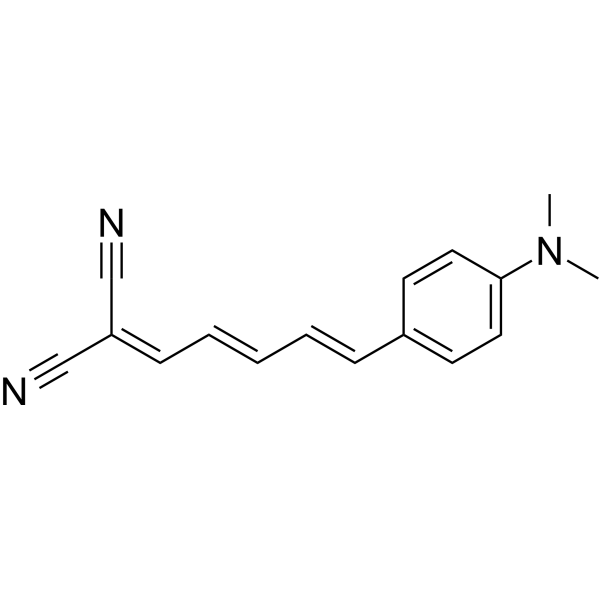
DCDAPH (Compound 2c) is a novel smart NIRF probe for detection of β-amyloid (Aβ) plaques (λex/λem=597/665 nm in PBS). DCDAPH shows high affinity for Aβ aggregates (Ki=37 nM, Kd=27 nM). DCDAPH shows good blood brain barrier permeation and can meet most of the requirements for the detection of Aβ plaques both in vitro and in vivo .
loading...
    loading...
Cat. No.: HY-P11457
CAS No.: 2378579-44-1
Target:  

Bacterial

Research Areas:  

Infection

cCBD-LL37 is a chimeric antimicrobial peptide modified with a collagen-binding domain (cCBD) (TKKTLRT). cCBD-LL37 has improved retention on collagen after PBS washing and varying electrostatic conditions. cCBD-LL37 binds to collagen involves both specific and non-specific interactions, initiated by long-range electrostatic forces that transitions to close range or hydrophobic interactions. cCBD-LL37 has potent antimicrobial activity with improved structural stability under different ionic strengths and pH conditions (pH 5.5-8). cCBD-LL37 can be used for biomaterials like collagen-based wound dressings research .
loading...
    loading...
Cat. No.: HY-L0116V
1,065 compounds

Macrocycles are promising scaffolds for the design of novel RNA targeting molecules. This collection of macrocycles for RNA consists of very diverse, drug-like molecules which incorporate certain known RNA-recognition elements (e.g. nucleobase ring systems and analogs) distributed within macrocyclic rings or peripheral fragments. As macrocyclic molecules tend to be larger than traditional screening molecules, it is vital to carefully assess and control their physicochemical properties. All macrocycles have been tested for aqueous and DMSO solubility with cutoffs applied at 10 mM in DMSO and 50 µM in PBS (pH 7.4); PAMPA permeability has also been tested for representative set of macrocycles.

Cat. No.: HY-P84170A
Synonyms: HM3; PBS; EGBRS; m3AChR

Host:  

Mouse

Application:  

IHC-P, ICC/IF, FC

Reactivity:  

Human, Mouse, Rabbit

loading...
    loading...
Cat. No.: HY-K3047

MCE Versene Solution is a gentle, enzyme-free, ready-to-use cell dissociation solution containing 0.02% (w/v) tetrasodium EDTA (EDTA-Na₄, 0.48 mM) in calcium- and magnesium-free D-PBS. This product is phenol red-free, animal component-free, and chemically defined.

loading...
    loading...
Cat. No.: HY-DY1086
CAS No.: 298-93-1
Synonyms: MTT (solution); Thiazolyl Blue Tetrazolium bromide (solution); Methylthiazolyldiphenyl-tetrazolium bromide (solution)
Thiazolyl Blue (solution) (MTT (solution)) is a cell-permeable and positively charged tetrazolium dye that is used to detect reductive metabolism in cells. Thiazolyl Blue is taken up by cells through the plasma membrane and then reduced to formazan by intracellular NAD (P) H-oxidoreductases. Thiazolyl Blue is frequently used in colorimetric assays to measure cell proliferation, cytotoxicity, and apoptosis .
Solvent and concentration: PBS: 5 mg/mL
loading...
    loading...
Cat. No.: HY-D3119
CAS No.: 2246946-49-4
Research Areas:  

Others

MitoAIE1 is a Fluorescent probe for mitochondrial viscosity detection. MitoAIE1 contains a pyridinium structural unit, which endows it with mitochondria-targeting specificity. The detection mechanism of this probe is based on aggregation-induced emission (AIE): in low-viscosity media such as PBS buffer, intramolecular rotation leads to non-radiative energy dissipation, resulting in only weak fluorescence; however, in high-viscosity environments such as the mitochondrial matrix or the vicinity of the inner mitochondrial membrane, such intramolecular motion is restricted, thereby significantly enhancing its fluorescent signal; in addition, this probe is not interfered by changes in microenvironment polarity and pH. Its emission wavelength is 625 nm, with absorption peaks at 325 nm and 450 nm; when transferred from low-viscosity PBS to high-viscosity 99% glycerol, its fluorescence intensity at 625 nm can be increased by 38-fold. It can be used to monitor changes in mitochondrial viscosity during processes such as Stauroporine (HY-15141)-induced apoptosis and starvation-induced mitophagy in live cells, and has good biocompatibility .
loading...
    loading...
Cat. No.: HY-P84170
Synonyms: HM3; PBS; EGBRS; m3AChR

Host:  

Mouse

Application:  

IHC-P, ICC/IF, FC

Reactivity:  

Human, Mouse, Rabbit

loading...
    loading...
Cat. No.: HY-D3121
CAS No.: 2763752-95-8
Target:  

Fluorescent Dye

Research Areas:  

Metabolic Disease

HOTPy is a mitochondria-targeted fluorescent viscosity probe with aggregation-induced emission properties, which responds to microenvironmental viscosity. HOTPy can recognize the abnormal increase in mitochondrial viscosity and capture dynamic viscosity changes in acute alcoholic liver injury models at both cellular and in vivo levels. The maximum absorption peak of HOTPy in PBS solution is at 379 nm; its maximum emission peak reaches 611 nm in a high-viscosity glycerol system. HOTPy can be used for the research of acute alcoholic liver injury .
loading...
    loading...
Cat. No.: HY-111090
CAS No.: 929095-23-8
Research Areas:  

Cancer

GSK461364 analogue 1 is a thiophene-based PLK1 inhibitor with a PLK1 IC50 of 2 nM and a PLK3 IC50 of 630 nM. GSK461364 analogue 1 also acts as an inhibitor of Nek2 kinase (IC50: 21 nM). GSK461364 analogue 1 has a solubility of ≥190 μM in pH 7.4 PBS and a human plasma protein binding rate of 91.5%. GSK461364 analogue 1 can be used in studies related to colon cancer, lung cancer, breast cancer and ovarian cancer .
loading...
    loading...
Cat. No.: HY-L0115V
10,091 compounds

ASINEX has elaborated a library of diverse macrocycles using an effective tool box of synthetic methods. The resulting scaffolds are novel, tremendously diverse, medchem-relevant, macrocyclic frameworks.

Macrocyles tend to be larger than traditional screening molecules which make them perfect discovery tools for targets with shallow or extended binding sites. At the same time, their unique character based on restricted flexibility and ability to form intra-molecular hydrogen bonds allows for design approaches effectively optimizing properties such asaqueous solubility and membrane permeability. Many of these macrocycles have been tested for aqueous and DMSO solubility with cut-offs applied at 10 mM in DMSO and 50 µM in PBS (pH 7.4) followed by PAMPA permeability assay.

Cat. No.: HY-P84056A

Host:  

Mouse

Application:  

WB, IHC-P, FC, ELISA

Reactivity:  

Human, Mouse, Monkey

loading...
    loading...
Cat. No.: HY-P84070A

Host:  

Mouse

Application:  

WB, IHC-P, FC, ELISA

Reactivity:  

Human, Mouse, Rat, Rabbit, Monkey

loading...
    loading...
Cat. No.: HY-P84911A

Host:  

Mouse

Application:  

WB, ELISA

Reactivity:  

Species independent

loading...
    loading...
Cat. No.: HY-134096
CAS No.: 78323-98-5
Synonyms: DNS-M
Target:  

Fluorescent Dye

Research Areas:  

Others

Dansyl-morpholine (DNS-M) is a Fluorescent probe for lipid droplet imaging, cancer cell discrimination, and real-time tracking of lipid droplet dynamics. As a solvatochromic probe with a donor-π-acceptor structure, it relies on hydrophobic interaction for its mechanism of action: its good lipophilicity, confirmed by an oil-water partition coefficient LogP = 2.35, allows it to rapidly penetrate cell membranes, and it specifically localizes to the hydrophobic core of lipid droplets; its fluorescence is strongly enhanced in the nonpolar environment of lipid droplets, while it emits very weak fluorescence in polar environments like PBS buffer, and it exhibits a bathochromic shift in emission wavelength with increasing solvent polarity. It has negligible cytotoxicity, with cell viability remaining over 95% after 24-hour incubation with 100 μM of the probe, and it possesses excellent photostability, retaining over 97% of initial fluorescence intensity after 60 continuous laser scans. For cell imaging applications, its excitation/emission wavelengths for lipid droplet labeling are Ex/Em = 405/480−540 nm, and in a simulative lipid environment O/W emulsion, it has an excitation wavelength of ~346 nm and emission wavelength of ~500 nm, giving a Stokes shift of 154 nm[1].
loading...
    loading...
Cat. No.: HY-P81064
Synonyms: Neomycin

Host:  

Rabbit

Application:  

ELISA

Reactivity:  

Species independent

loading...
    loading...
Cat. No.: HY-P81058
Synonyms: Salbutamol

Host:  

Rabbit

Application:  

ELISA

Reactivity:  

Species independent

loading...
    loading...
Cat. No.: HY-P80923A
Synonyms: TRKB

Host:  

Rabbit

Application:  

WB

Reactivity:  

Rat

loading...
    loading...
Cat. No.: HY-P81833A
Synonyms: PROLIDASE

Host:  

Rabbit

Application:  

WB

Reactivity:  

Human

loading...
    loading...

