474 Results for "

Insect

" in MedChemExpress (MCE) Product Catalog:
Products (474)

474 Results for "Insect" in MCE Product Catalog:

Cat. No.: HY-184009
CAS No.: 892237-40-0
Target:  

Insecticide

Research Areas:  

Infection

TBZ-15 is an orally active competitive Chitinase inhibitor and Insecticide, with an IC50 of 1.00 μM against Ostrinia furnacalis Chitinase-h and an IC50 of 1.01 μM against Ostrinia furnacalis Chitinase-I. TBZ-15 exhibits insecticidal activity against the Asian corn borer (O. furnacalis) and the diamondback moth (P. xylostella) .
loading...
    loading...
Cat. No.: HY-W108419A
CAS No.: 38421-90-8
Target:  

Sex Pheromone

Research Areas:  

Infection

trans-5-Decenyl acetate is a synthetic sex pheromone component. trans-5-Decenyl acetate attracts male Anarsia lineatella moths when used in a mixture with trans-5-decen-1-ol (HY-W127516). trans-5-Decenyl acetate can be used to monitor male Anarsia lineatella moth activity in peach and almond orchard field .
loading...
    loading...
Cat. No.: HY-B0874R
CAS No.: 67375-30-8
Synonyms: FMC 45497 (Standard); Fendona (Standard); WL 85871 (Standard)
Alpha-Cypermethrin (Standard) (FMC 45497 (Standard); Fendona (Standard); WL 85871 (Standard)) is the analytical standard of Alpha-Cypermethrin (HY-B0874). This product is intended for research and analytical applications. Alpha-Cypermethrin (FMC 45497; Fendona; WL 85871) is a type II pyrethroid insecticide. Alpha-Cypermethrin acts by delaying the inactivation of voltage-gated sodium channels, prolonging sodium tail currents, and triggering repetitive neural discharges. Alpha-Cypermethrin exhibits knockdown and lethal activity against target insects such as Musca domestica and Anopheles culicifacies. Alpha-Cypermethrin induces neurotoxicity in mammals, alters placental and fetal neurodevelopment, and causes acute mortality in fish. Alpha-Cypermethrin can be used in studies related to neurotoxicity, vector-borne diseases, and malaria .
loading...
    loading...
Cat. No.: HY-N6935R
CAS No.: 517-44-2
Sennidin B Standard is the analytical standard of Sennidin B (HY-N6935). This product is intended for research and analytical applications. Sennidin B is an anthraquinone compound isolated from Cassia angustifolia. Sennidin B is a DPP-4 inhibitor with an IC50 of 39.39 μM. Sennidin B is an insect chitinase inhibitor with a Ki of 80 nM against OfChi-h. Sennidin B competitively inhibits chitinase activity by forming π-π stacking interactions with key tryptophan residues in the active site through a folded conformation. Sennidin B activates PI3K/Akt to promote glucose uptake in adipocytes. Sennidin B can be used for the development of biopesticides and research on type 2 diabetes and metabolism-related signaling pathways .
loading...
    loading...
Cat. No.: HY-W017141R
CAS No.: 24683-00-9
2-Isobutyl-3-methoxypyrazine (Standard) is the analytical standard of 2-Isobutyl-3-methoxypyrazine. This product is intended for research and analytical applications. 2-Isobutyl-3-methoxypyrazine is a male-specific aggregation pheromone released by the Portuguese leaf beetle Labidostomis lusitanica. 2-Isobutyl-3-methoxypyrazine induces dose-dependent electroantennographic responses in the antennae of both male and female Labidostomis lusitanica, with the overall response intensity of females being higher than that of males. 2-Isobutyl-3-methoxypyrazine induces positive chemotactic behavior, and exerts a repellent effect on male Labidostomis lusitanica at high doses. 2-Isobutyl-3-methoxypyrazine can be used in insect ecology research .
loading...
    loading...
Cat. No.: HY-W017141S1
CAS No.: 3028868-76-7
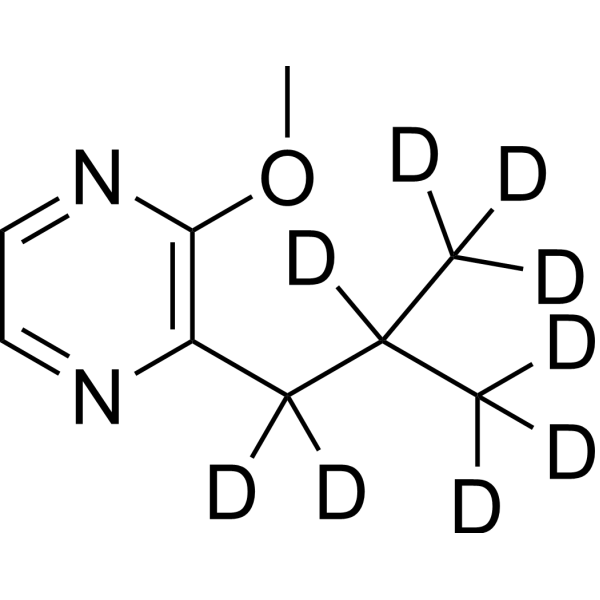
2-Isobutyl-3-methoxypyrazine-d9 is deuterated labeled 2-Isobutyl-3-methoxypyrazine (HY-W017141). 2-Isobutyl-3-methoxypyrazine is a male-specific aggregation pheromone released by the Portuguese leaf beetle Labidostomis lusitanica. 2-Isobutyl-3-methoxypyrazine induces dose-dependent electroantennographic responses in the antennae of both male and female Labidostomis lusitanica, with the overall response intensity of females being higher than that of males. 2-Isobutyl-3-methoxypyrazine induces positive chemotactic behavior, and exerts a repellent effect on male Labidostomis lusitanica at high doses. 2-Isobutyl-3-methoxypyrazine can be used in insect ecology research .
loading...
    loading...
Cat. No.: HY-E72112
Target:  

UGT

Research Areas:  

Cancer

Human UGT1A10 is a UDP-glucuronosyltransferase. UGT1A10 catalyzes the glucuronidation of Mycophenolic acid (HY-B0421). Human UGT1A10 mediates glucuronidation modification of 34 out of 42 tested bioflavonoids. Human UGT1A10 is applicable to relevant research on colorectal cancer .
loading...
    loading...
Cat. No.: HY-P5391
CAS No.: 717919-61-4
Target:  

BCRP

Research Areas:  

Cancer

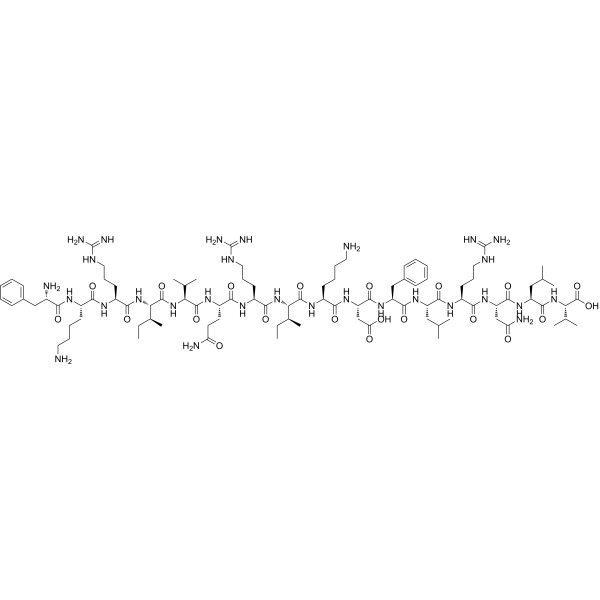
LL-37 (17-32) is an ABCG2 inhibitor. LL-37 (17-32) binds to ABCG2, inhibits its transport activity in a non-competitive manner, and downregulates ABCG2 protein expression via lysosomal degradation. LL-37 (17-32) increases the accumulation of Mitoxantrone (HY-13502) in cancer cells overexpressing ABCG2, thereby reversing mitoxantrone resistance. LL-37 (17-32) can be used in the research of multidrug-resistant cancers .
loading...
    loading...
Cat. No.: HY-E70277
CAS No.: 71425-89-3
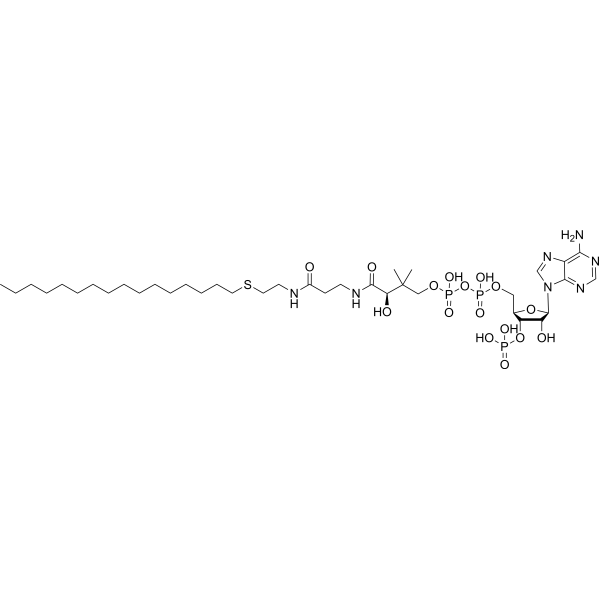
Hexadecyl-CoA is a non-hydrolyzable thioether analog of Palmitoyl-CoA. Hexadecyl-CoA competitively inhibits the acyl-CoA thioesterase activity of HNF-4α with a Ki of 0.3 μM, and inhibits DGAT2 activity with an IC50 of approximately 2 μM. Hexadecyl-CoA also inhibits ATGL activity and serves as a reference inhibitor for DGAT2 LC/MS enzyme activity assays. Hexadecyl-CoA can be used in studies related to lipid metabolism, triglyceride synthesis and lipolysis .
loading...
    loading...
Cat. No.: HY-W587734
CAS No.: 203312-38-3
Research Areas:  

Infection

Spirotetramat-enol, Spirotetramat (HY-120253) metabolite, is an insecticide. Spirotetramat-enol shows inhibitory activity against acetyl-CoA carboxylase. Spirotetramat-enol exerts insecticidal activity against Aphis craccivora Koch .
loading...
    loading...
Cat. No.: HY-16676
CAS No.: 153381-68-1
Synonyms: 4-epi-Docetaxel; 7-Epidocetaxel; 7-Epitaxotere
Research Areas:  

Cancer

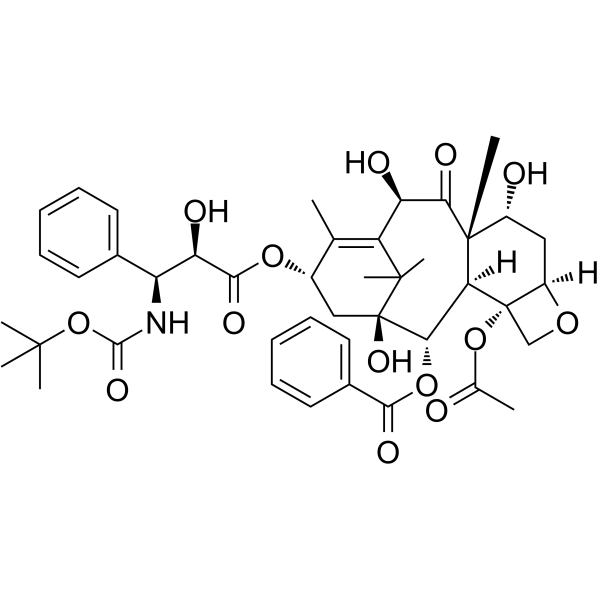
7-Epi-docetaxel (4-epi-Docetaxel; 7-Epidocetaxel; 7-Epitaxotere) is the major C7 epimeric impurity/in vivo metabolite of Docetaxel (HY-B0011). 7-Epi-docetaxel acts as a potent allosteric activator of rhCYP1B1. 7-Epi-docetaxel exhibits certain cell line-specific anti-migratory activity . 7-Epi-docetaxel can be used in research related to melanoma and lung adenocarcinoma .
loading...
    loading...
Cat. No.: HY-153507
CAS No.: 1137671-16-9
Target:  

Acyltransferase

Research Areas:  

Metabolic Disease

DGAT1-IN-4 is a potent, orally active, and selective DGAT1 inhibitor with an IC50 of 17 nM. DGAT1-IN-4 exhibits >588-fold selectivity over DGAT2. DGAT1-IN-4 suppresses intracellular triglyceride synthesis in mouse myoblast cells. DGAT1-IN-4 suppresses body weight gain in diet-induced obese dogs. DGAT1-IN-4 can be used for the research of obesity .
loading...
    loading...
Cat. No.: HY-L190
1,661 compounds

Miao medicine is an important part of Chinese medicine, which carries the profound cultural heritage and rich life wisdom of the Hmongb people. Miao people live in a concentrated community in the mountainous area of the southwest border of China, which has a unique natural environment. Complex and diverse geology, lush natural vegetation, rich animal and plant species, a large number of mineral resources which provide a wide range of species sources for miao ethnicity medicine. On the other hand, due to the characteristics of the living environment of the Hmongb people, Miao medicine has demonstrated its unique therapeutic effect in the treatment of some endemic diseases, infectious diseases, insect, snake and beast bites, rheumatism and other diseases. With the development of modern science and technology, the research and application of seedling medicine are also deepening. Through the systematic study of the chemical composition and pharmacological action of the seedling medicine, it can provide a new idea and method for modern medicine.

MCE included 1,661 natural products from traditional miao ethnicity medicine, including animal, plant and mineral sources.

Cat. No.: HY-171722
CAS No.: 1355681-08-1
Synonyms: Asc-C9
Target:  

Insecticide PGC-1α

Research Areas:  

Infection Cancer

Ascr#10 (Asc-C9) is an orally active thermogenesis inducer and insecticide that can be obtained from Monochamus alternatus. Ascr#10 binds to the insect adipokinetic hormone (AKH) receptor (Ka=272 µM) and stimulates mitochondrial biogenesis via the PGC1α-UCP4 axis. Consequently, Ascr#10 induces UCP4-mediated uncoupled respiration, reduces the ATP/ADP ratio and accelerates lipid mobilization, thereby driving the thermogenesis process. Ascr#10 delays pupation and exerts specific chemotaxis toward dispersive fourth-stage pinewood nematode LIV larvae. Ascr#10 promotes cold acclimation of Monochamus alternatus larvae through metabolic inhibition and cryoprotectant accumulation, enhancing their survival rate under cold stress. Ascr#10 also induces browning of white adipose tissue and activates brown adipose tissue in mice, thereby helping the body resist cold and tumor growth. Ascr#10 can be widely applied to research related to pine wilt disease, lung tumors and cold stress .
loading...
    loading...

