61 Results for "

dermal

" in MedChemExpress (MCE) Product Catalog:
Products (61)

61 Results for "dermal" in MCE Product Catalog:

Cat. No.: HY-107386
CAS No.: 1378524-25-4
Research Areas:  

Others

PF-03671148 is an ALK5 inhibitor. PF-03671148 can reduce TGFβ induced fibrotic gene expression in fibroblasts. PF-03671148 has potential utility for the prevention of dermal scarring .
loading...
    loading...
Cat. No.: HY-N12653
CAS No.: 99572-22-2
Synonyms: (-)-Exserohilone
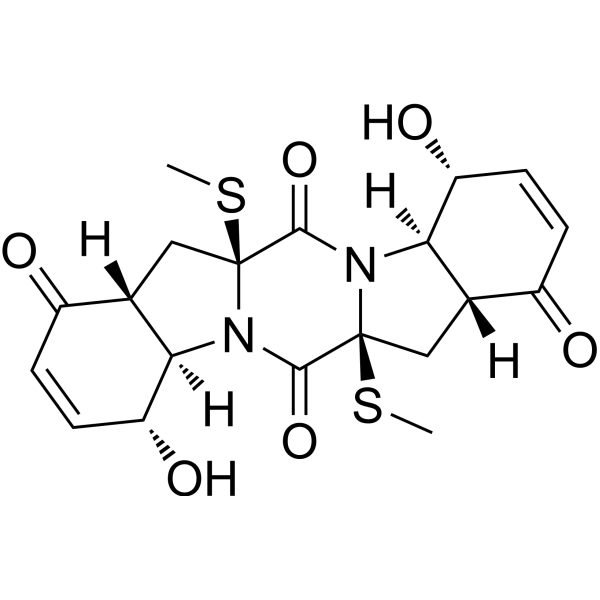
Exserohilone ((-)-Exserohilone) is a thiodiketopiperazine derivative that exhibits the inhibition of TNF-α-induced ROS generation and MMP-1 secretion. Exserohilone increases the procollagen type I α1 secretion in human dermal fibroblasts .
loading...
    loading...
Cat. No.: HY-120407
CAS No.: 14959-86-5
Synonyms: ENT-33266
Target:  

Insecticide

Research Areas:  

Others

Looplure (ENT-33266) is an insect attractant with acute toxicity studies in different animal models showing activity at oral and dermal median lethal doses (LD50) and median lethal concentrations (LC50) for fish with some values, and low toxicity in most cases except for some cases.
loading...
    loading...
Cat. No.: HY-18620R
CAS No.: 33231-14-0
DZ2002 (Standard) is the analytical standard of DZ2002. This product is intended for research and analytical applications. DZ2002 is an orally active, reversible and low-cytotoxic type III SAHH inhibitor (Ki=17.9 nM), with good immunosuppressive activity. DZ2002 prevents the development of experimental dermal fibrosis by reversing the profibrotic phenotype of various cell types. DZ2002 can be used in studies of autoimmune diseases such as lupus syndrome and systemic sclerosis .
loading...
    loading...
Cat. No.: HY-A0169
CAS No.: 33320-16-0
Research Areas:  

Cancer

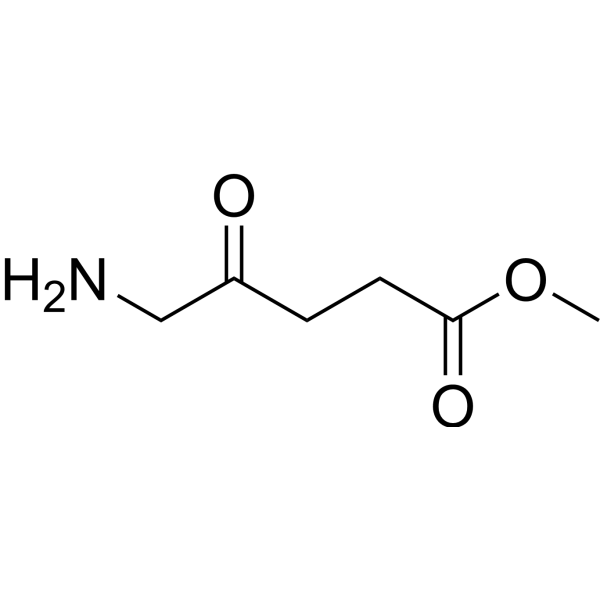
Methyl aminolevulinate is a sensitizer used in photodynamic therapy (PDT). Methyl aminolevulinate penetrates the skin and induces the production of photoactive porphyrins including protoporphyrin IX in cells; upon exposure to appropriate light, it generates ROS, which triggers cellular oxidation and cell death. Methyl aminolevulinate acts as a photo-damage reversing agent through epidermal reconstruction, cytokine-mediated activation of dermal fibroblasts, elastin breakdown, new collagen formation, and compression of dilated capillaries. Methyl aminolevulinate reduces the expression of the proliferation marker Ki-67 and the early skin carcinogenesis marker TP53. Methyl aminolevulinate delays the onset of ultraviolet-induced skin tumors and reduces tumor burden in hairless mice. Methyl aminolevulinate is applicable to research related to actinic keratosis and basal cell carcinoma .
loading...
    loading...
Cat. No.: HY-126236R
CAS No.: 1158-10-7
3,5-Diiodothyropropionic acid (Standard) is the analytical standard of 3,5-Diiodothyropropionic acid. This product is intended for research and analytical applications. 3,5-Diiodothyropropionic acid is a thyroid hormone analog, induces α-myosin heavy chain mRNA expression, binds to thyroid hormone receptor (TR), with Ka of 2.40 and 4.06 M -1 for TRα1 and TRβ1, respectively. 3,5-Diiodothyropropionic acid promotes angiogenesis in 3-D human dermal microvascular endothelial cell sprouting assay. 3,5-Diiodothyropropionic acid prevents myocardial arteriolar loss in thyroidectomized rats and enhances cardiac energy-generating capacity in postinfarction heart failure rats. 3,5-Diiodothyropropionic can be used in studies related to angiogenesis and heart failure .
loading...
    loading...
Cat. No.: HY-N2038R
CAS No.: 1178-24-1
3,​5,​6,​7,​8,​3',​4'-​Heptemthoxyflavone (Standard) is the analytical standard of 3,​5,​6,​7,​8,​3',​4'-​Heptemthoxyflavone (HY-N2038). This product is intended for research and analytical applications. 3,5,6,7,8,3',4'-Heptemthoxyflavone, a flavonoid from satsuma peel, is an orally available CREB activator with anti-tumor and anti-neuroinflammatory activity. 3,5,6,7,8,3',4'-Heptemthoxyflavone inhibits collagenase activity and increases the content of type I procollagen in human dermal fibroblast neoblast (HDFn) cells. 3,5,6,7,8,3',4'-Heptemthoxyflavone induces brain-derived neurotrophic factor (BDNF) expression through the cAMP/ERK/CREB signaling pathway and reduces phosphodiesterase activity in C6 glioma .
loading...
    loading...
Cat. No.: HY-N0113A
CAS No.: 62493-39-4
Synonyms: Ordenina sulfate; Peyocactine sulfate
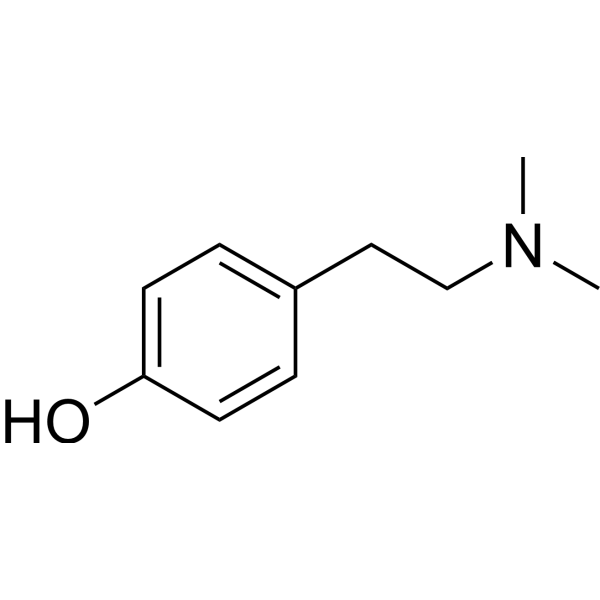
Hordenine sulfate (Ordenina sulfate; Peyocactine sulfate) is a multifunctional alkaloid with oral activity and blood-brain barrier penetration. Hordenine sulfate inhibits LPS-induced phosphorylation of p38, JNK, ERK1/2, p65, IκB, and AKT, prevents p65 nuclear translocation, and suppresses inflammatory cytokines and mediators. Hordenine sulfate promotes M2 macrophage polarization, restores blood-milk barrier integrity, alleviates oxidative stress by reducing ROS and MDA, and attenuates LPS-induced lung injury and pulmonary edema. Hordenine sulfate inhibits cAMP production, CREB phosphorylation, and MITF expression, thereby suppressing melanin synthesis in melanocytes and reconstructed epidermis. Hordenine sulfate activates the Wnt/β-catenin signaling pathway, promotes dermal papilla cell proliferation and hair shaft elongation, and accelerates hair regeneration. Hordenine sulfate activates DRD2, acts as a D3R partial agonist, α2A-AR full agonist, and 5-HT2A-R antagonist, and inhibits SERT and DAT. Hordenine sulfate inhibits α-synuclein accumulation and ameliorates motor deficits in Parkinson's disease models. Hordenine sulfate limits alcohol intake, reduces relapse drinking behavior, and modulates alcohol-induced conditioned place preference. Hordenine sulfate can be used for research on mastitis, skin pigmentation, acute lung injury, foodborne diseases, hair loss, Parkinson's disease, bacterial infections, and alcohol use disorder .
loading...
    loading...
Cat. No.: HY-N0113R
CAS No.: 539-15-1
Synonyms: Ordenina (Standard); Peyocactine (Standard)
Hordenine (Standard) (Ordenina (Standard); Peyocactine (Standard)) is the analytical standard of Hordenine (HY-N0113). This product is intended for research and analytical applications. Hordenine (Ordenina; Peyocactine) is a multifunctional alkaloid with oral activity and blood-brain barrier penetration. Hordenine inhibits LPS-induced phosphorylation of p38, JNK, ERK1/2, p65, IκB, and AKT, prevents p65 nuclear translocation, and suppresses inflammatory cytokines and mediators. Hordenine promotes M2 macrophage polarization, restores blood-milk barrier integrity, alleviates oxidative stress by reducing ROS and MDA, and attenuates LPS-induced lung injury and pulmonary edema. Hordenine inhibits cAMP production, CREB phosphorylation, and MITF expression, thereby suppressing melanin synthesis in melanocytes and reconstructed epidermis. Hordenine activates the Wnt/β-catenin signaling pathway, promotes dermal papilla cell proliferation and hair shaft elongation, and accelerates hair regeneration. Hordenine activates DRD2, acts as a D3R partial agonist, α2A-AR full agonist, and 5-HT2A-R antagonist, and inhibits SERT and DAT. Hordenine inhibits α-synuclein accumulation and ameliorates motor deficits in Parkinson's disease models. Hordenine limits alcohol intake, reduces relapse drinking behavior, and modulates alcohol-induced conditioned place preference. Hordenine can be used for research on mastitis, skin pigmentation, acute lung injury, foodborne diseases, hair loss, Parkinson's disease, bacterial infections, and alcohol use disorder .
loading...
    loading...
Cat. No.: HY-P11648
CAS No.: 292851-89-9
Target:  

Osteopontin

Research Areas:  

Inflammation/Immunology Cancer

SVVYGLR is an osteopontin-derived peptide. SVVYGLR can promote the differentiation of fibroblasts into myofibroblast-like cells and promote the production of type III collagen by cardiac fibroblasts. SVVYGLR can activate the adhesion, migration and tubule formation of endothelial cells in vitro. SVVYGLR promotes angiogenesis and wound healing and promotes the migration of dermal fibroblasts and keratinocytes. SVVYGLR can be used for research related to angiogenesis, dermal wounds and bone regeneration .
loading...
    loading...
Cat. No.: HY-D3047I
Target:  

Fluorescent Dye

Research Areas:  

Others

Rhodamine B-Dextran (chloride) (MW 500000) is a Rhodamine B (HY-Y0016)-labeled dextran with a molecular weight of 500000. Rhodamine B-Dextran (chloride) (MW 500000) is a fluorescent dye used to track the diffusion of macromolecules in ex vivo human skin. Rhodamine B-Dextran (chloride) (MW 500000) is delivered to skin layers via the Nanopatch microneedle array, which physically disrupts the stratum corneum and dermal-epidermal junction barriers to deposit the dye directly into epidermal and dermal regions; fluorescence is detected via multiphoton microscopy, and fluorescence intensity is assumed to be roughly proportional to dye concentration .
loading...
    loading...
Cat. No.: HY-125089
CAS No.: 1233114-22-1
Target:  

FLAP

Research Areas:  

Inflammation/Immunology

AM-643 is a FLAP inhibitor with human IC50 of 2 nM, oral activity, and dermal activity.AM-643 selectively inhibits FLAP, reduces leukotriene biosynthesis and reduces inflammatory ear swelling.AM-643 can be used for the research of skin disorders involving leukotriene production .
loading...
    loading...
Cat. No.: HY-P811745
Synonyms: CSN7A, DERP10, COPS7A, COP9 signalosome complex subunit 7a, SGN7a, Signalosome subunit 7a, dermal papilla-derived protein 10, JAB1-containing signalosome subunit 7a

Host:  

Rabbit

Application:  

WB, IHC-P, ICC/IF, IP, FC

Reactivity:  

Rat

loading...
    loading...
Cat. No.: HY-P811745A
Synonyms: CSN7A, DERP10, COPS7A, COP9 signalosome complex subunit 7a, SGN7a, Signalosome subunit 7a, dermal papilla-derived protein 10, JAB1-containing signalosome subunit 7a

Host:  

Rabbit

Application:  

WB, IHC-P, ICC/IF, IP, FC

Reactivity:  

Rat

loading...
    loading...
Cat. No.: HY-21197S
CAS No.: 2328024-55-9
Synonyms: Perfluoroheptanoic acid-13C4; Tridecafluoroheptanoic acid-13C4; PFHpA-13C4
Perfluoroenanthic acid- 13C4 (Perfluoroheptanoic acid- 13C4) is the 13C-labeled Perfluoroenanthic acid (HY-21197). Perfluoroenanthic acid (Perfluoroheptanoic acid) is a kind of perfluoroalkyl carboxylic acid organic pollutant. Perfluoroenanthic acid has environmental persistence and bioaccumulation, and exposure can occur via oral, dermal and other routes. Perfluoroenanthic acid exhibits reproductive toxicity, neurotoxicity, hepatotoxicity, immunotoxicity and endocrine-disrupting effects. Perfluoroenanthic acid exerts definite adverse effects on development, spermatogenesis, neuronal activity and liver tissue .
loading...
    loading...
Cat. No.: HY-N16691
CAS No.: 24177-16-0
Acrovestone (compound 4) is an Acronychia-type acetophenone dimer and a selective anticancer agent. Acrovestone has IC50 values ??of 0.38 μM and 0.93 μM against A2058 melanoma cells and DU145 prostate cancer cells, respectively. Acrovestone shows low inhibitory activity against normal human dermal fibroblasts (NHDF), with an IC50 >5 μM. Acrovestone can be used in anticancer research related to prostate cancer and melanoma. Acrovestone can be naturally extracted from the trunk bark of Acronychia pedunculata .
loading...
    loading...
Cat. No.: HY-185379
CAS No.: 3106554-00-8
Target:  

STING

Research Areas:  

Inflammation/Immunology

STING antagonist-3 is a potent STING antagonist with an IC50 of 2.3 nM against human wild-type STING. STING antagonist-3 inhibits human wild-type STING and the gain-of-function STING mutants N154S and V155M. STING antagonist-3 suppresses IFN‑α2a production in stimulated human whole blood. STING antagonist-3 inhibits IP-10 production in activated human dermal microvascular endothelial cells (HMVEC-d). STING antagonist-3 can be used for the research of autoimmune diseases, autoinflammatory diseases, interferonopathies, and fibrotic disorders .
loading...
    loading...
Cat. No.: HY-181431
CAS No.: 1253691-50-7
Target:  

TGF-beta/Smad

Research Areas:  

Inflammation/Immunology

PXS 64, a mannose-6-phosphate (M6P) analogue. a lipophilic prodrug of PXS 25 (HY-181430). PXS 64 is an effective anti-fibrotic agent by inhibiting the activation of latent TGF-β1. PXS64, inhibits fibrosis via TGF-β1 pathway in human lung fibroblasts. PXS 64 reduces TGFβ-mediated collagen IV, fibronectin, MCP-1, and phospho-smad2 expression in kidney cells. PXS 64 reduces collagen deposition in dermal scar fibroblasts. PXS 64 can be used for the research of chronic kidney disease, idiopathic pulmonary fibrosis, scarring .
loading...
    loading...
Cat. No.: HY-178721
CAS No.: 2768690-22-6
Lithocholic amide-C2-N(didecane) (Compound LC10) is a Lithocholic acid (HY-B0172) analogue. Lithocholic amide-C2-N(didecane) can form lipid nanoparticles spontaneously in the aqueous milieu, permeate through the skin, penetrate the deeper dermal layers, and exert anti-inflammatory effects against psoriasis-like chronic skin inflammations. Lithocholic amide-C2-N(didecane) can inhibit abnormal proliferation of keratinocytes, downregulate the mRNA expression of the psoriasis-associated receptor EphA2 and reduce serum levels of multiple pro-inflammatory factors such as IL-1α, IL-1β, and IFN-γ by inhibiting activation of the Th17/Th2 inflammatory pathway .
loading...
    loading...
Cat. No.: HY-A0169AR
CAS No.: 79416-27-6
Methyl aminolevulinate hydrochloride (Standard) is the analytical standard of Methyl aminolevulinate hydrochloride. This product is intended for research and analytical applications. Methyl aminolevulinate hydrochloride is a sensitizer used in photodynamic therapy (PDT). Methyl aminolevulinate hydrochloride penetrates the skin and induces the production of photoactive porphyrins including protoporphyrin IX in cells; upon exposure to appropriate light, it generates ROS, which triggers cellular oxidation and cell death. Methyl aminolevulinate hydrochloride acts as a photo-damage reversing agent through epidermal reconstruction, cytokine-mediated activation of dermal fibroblasts, elastin breakdown, new collagen formation, and compression of dilated capillaries. Methyl aminolevulinate hydrochloride reduces the expression of the proliferation marker Ki-67 and the early skin carcinogenesis marker TP53. Methyl aminolevulinate hydrochloride delays the onset of ultraviolet-induced skin tumors and reduces tumor burden in hairless mice. Methyl aminolevulinate hydrochloride is applicable to research related to actinic keratosis and basal cell carcinoma .
loading...
    loading...

