82 Results for "

electrostatic interactions

" in MedChemExpress (MCE) Product Catalog:
Products (82)

82 Results for "electrostatic interactions" in MCE Product Catalog:

Cat. No.: HY-120465
CAS No.: 1174905-91-9
Target:  

HIV

Research Areas:  

Infection

ZINC36617540 is a novel Nef protein inhibitor with anti-HIV activity. ZINC36617540 exhibits superior binding affinity by binding to Nef protein. ZINC36617540 shows a similar binding mode to the prototype molecule B9 in molecular docking. The mechanism of action of ZINC36617540 mainly depends on its hydrophobic and electrostatic interactions with Nef protein .
loading...
    loading...
Cat. No.: HY-110147A
CAS No.: 2320930-10-5
Target:  

Furin

Research Areas:  

Infection

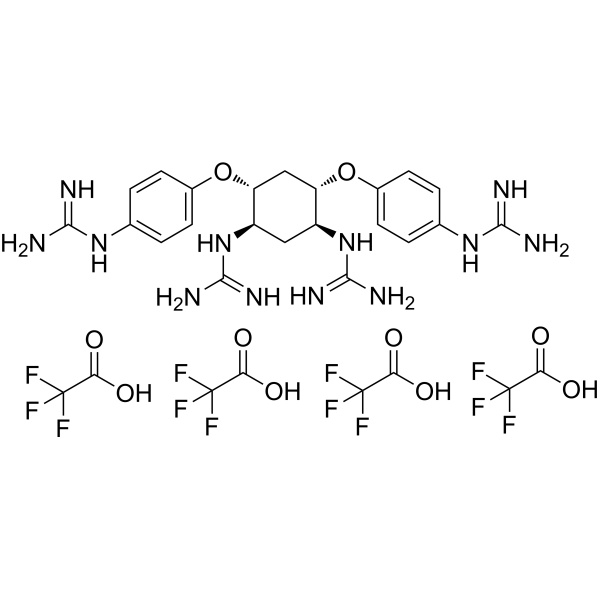
SSM-3 tetraTFA is a potent furin inhibitor with an EC50 of 54 nM. SSM-3 tetraTFA uses its positively charged guanidyl group to form strong electrostatic interactions with the negatively charged residues in the catalytic center of furin, thereby competitively occupying and blocking the active site. SSM-3 tetraTFA can be used in the research of anthrax and avian influenza .
loading...
    loading...
Cat. No.: HY-159893
Target:  

Smo Hedgehog Apoptosis

Research Areas:  

Cancer

SMO-IN-5 ((Compound 25(B31)) is a potent and competitive inhibitor of smoothened (SMO) that can inhibit Hedgehog (Hh) signaling. SMO-IN-5 interacts with Smo through hydrogen bonds, hydrophobic interactions, and electrostatic forces. SMO-IN-5 inhibits PC cell proliferation, migration, and induces apoptosis by suppressing Gli1 expression. SMO-IN-5 exhibits antitumor activity in pancreatic cancer. .
loading...
    loading...
Cat. No.: HY-W284558S
CAS No.: 2708287-31-2
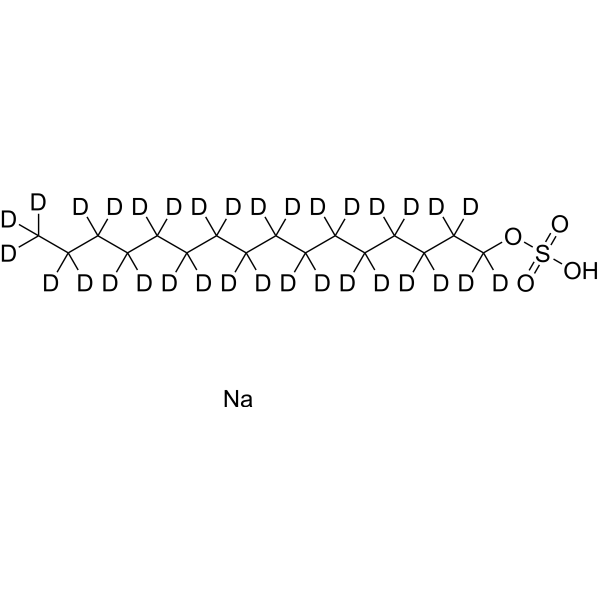
Sodium hexadecyl sulfate-d33 is the deuterium labeled Sodium hexadecyl sulfate. Sodium hexadecyl sulfate is a long-chain anionic surfactant. Sodium hexadecyl sulfate can act as an interface-regulating substance to form a soft layer on the surface of carbon nanotubes, guide proteins to adsorb in the correct orientation with active sites facing outward through electrostatic interactions, and significantly enhance the activity of immobilized enzymes. Sodium hexadecyl sulfate can replace or supplement SDS (HY-Y0316) in capillary gel electrophoresis (CGE) .
loading...
    loading...
Cat. No.: HY-W928617
CAS No.: 64058-48-6
Target:  

Antibiotic Bacterial

Research Areas:  

Infection

Spectinomycin sulfate hydrate is a broad-spectrum antibiotic and inhibits the growth of a variety of gram-positive and gram-negative organisms. Spectinomycin sulfate hydrate acts by selectively targeting to the bacterial ribosome and interrupting protein synthesis. Spectinomycin sulfate hydrate is also a noncompetitive inhibitor of td intron RNA with an Ki value of 7.2 mM - .
loading...
    loading...
Cat. No.: HY-B0438R
CAS No.: 21736-83-4
Spectinomycin (dihydrochloride) (Standard) is the analytical standard of Spectinomycin (dihydrochloride). This product is intended for research and analytical applications. Spectinomycin dihydrochloride is a broad-spectrum antibiotic and inhibits the growth of a variety of gram-positive and gram-negative organisms. Spectinomycin dihydrochloride acts by selectively targeting to the bacterial ribosome and interrupting protein synthesis. Spectinomycin dihydrochloride is also a noncompetitive inhibitor of td intron RNA with an Ki value of 7.2 mM[1]-[5].
loading...
    loading...
Cat. No.: HY-D3310
CAS No.: 936107-90-3
Fluorescein-12-dGTP is a fluorescein-labeled deoxyguanosine triphosphate. Fluorescein-12-dGTP incorporates into complementary allele-specific primers at SNP sites, enabling FRET with cationic conjugated polymer PFP via DNA-PFP electrostatic interactions. Fluorescein-12-dGTP incorporates into G-allele-specific primers for homozygous G/G SNP genotypes to enable genotype discrimination. Fluorescein-12-dGTP serves as a fluorescently labeled nucleotide for homogeneous solution-based SNP and FRET genotyping assays (Ex/Em = 498/517 nm) .
loading...
    loading...
Cat. No.: HY-180545
Target:  

DNA/RNA Synthesis

Research Areas:  

Neurological Disease

S-Chromene is a selective DNA polymerase-β (DNA pol-β) inhibitor. S-Chromene exhibits strong electrostatic complementarity with DNA pol-β but weak interaction with primase p58 .
loading...
    loading...
Cat. No.: HY-186158
CAS No.: 1002722-97-5
Target:  

Drug Intermediate

Research Areas:  

Cancer

HOOC-OXA-COOH is an anionic prodrug of Oxaliplatin (HY-17371). HOOC-OXA-COOH can be loaded onto nanomotors via electrostatic interaction, and undergoes cascade activation by H2S and endogenous glutathione in the tumor microenvironment to release cytotoxic Pt 2+. HOOC-OXA-COOH can be used in the research of colon cancer .
loading...
    loading...
Cat. No.: HY-187677
CAS No.: 94159-34-9
Target:  

PCSK9 LDLR

Research Areas:  

Metabolic Disease

PCSK9-IN-36 is a PCSK9 inhibitor and a flavonoid glycoside derivative. PCSK9-IN-36 binds stably within the surface groove of PCSK9 through hydrophobic interactions involving its flavonoid scaffold and an electrostatic hydrogen-bonding network formed by its polar glycosidic group, thereby competitively blocking the interaction between PCSK9 and the low-density lipoprotein receptor (LDLR). PCSK9-IN-36 can be used for research on hypercholesterolemia .
loading...
    loading...
Cat. No.: HY-N21759
CAS No.: 503443-09-2
Dendroside D is a sesquiterpenoid compound. Dendroside D binds to the RNA site of RNA-dependent RNA polymerase and the active site of SARS-CoV-2 main protease through hydrogen bonds, electrostatic interactions, and hydrophobic interactions, thereby blocking viral replication. Dendroside D stimulates the proliferation of mouse T and B lymphocytes, promotes T and B lymphocyte proliferation, and exhibits immunomodulatory activity. Dendroside D can be used for viral infection and immune-related research .
loading...
    loading...
Cat. No.: HY-110147
CAS No.: 922732-52-3
Target:  

Furin

Research Areas:  

Infection

SSM-3 is a potent furin inhibitor with an EC50 of 54 nM. SSM-3 uses its positively charged guanidyl group to form strong electrostatic interactions with the negatively charged residues in the catalytic center of furin, thereby competitively occupying and blocking the active site. SSM-3 can be used in the research of anthrax and avian influenza .
loading...
    loading...
Cat. No.: HY-139200A
CAS No.: 2101981-60-4
Target:  

Liposome

Research Areas:  

Cancer

(R)-DOTMA is a cationic lipid that can be used to construct lipid nanoparticles and lipoplexes. (R)-DOTMA binds nucleic acid molecules such as mRNA through electrostatic interactions, facilitating nucleic acid encapsulation and cellular delivery. (R)-DOTMA can form lipid systems with DOPE (HY-112005) or cholesterol (HY-N0322). (R)-DOTMA is applicable to mRNA delivery, vaccine development, cancer immunotherapy and gene editing research .
loading...
    loading...
Cat. No.: HY-183427
CAS No.: 2660138-04-3
Research Areas:  

Cancer

KBJK557 is a Plk1 PBD inhibitor with a human-derived IC50 value of 3.05 μM. KBJK577 binds to Plk1 PBD through electrostatic interactions, π-π stacking, hydrogen bonds, salt bridges and hydrophobic interactions, thereby disrupting the subcellular localization and function of Plk1. KBJK557 induces mitotic arrest, S-phase delay, G2/M-phase arrest and apoptosis, and inhibits cancer cell proliferation. KBJK557 can be used in research related to cancer and non-small cell lung cancer .
loading...
    loading...
Cat. No.: HY-N8075
CAS No.: 123549-17-7
Artonin U is an artonin. Artonin U can be isolated from Artocarpus species. Artonin U binds to hERα, as measured by docking score and Prime MM-GBSA binding free energy evaluation. Artonin U can be used in breast cancer research .
loading...
    loading...
Cat. No.: HY-186313
CAS No.: 3079914-21-6
Research Areas:  

Cancer

PTC-IN-1 is a human ribosomal peptidyl transferase center (PTC) inhibitor. PTC-IN-1 forms stable interactions with 28S rRNA and undergoes steric-hindrance electrostatic interactions with nascent polypeptide chains, thereby inducing context-dependent translation arrest. PTC-IN-1 activates the ribotoxic stress response through phosphorylation of p46 and p54 JNK, triggers ribosome collisions, and activates the integrated stress response via phosphorylation of eIF2α. PTC-IN-1 inhibits the proliferation of cancer cells. PTC-IN-1 can be used in the research of triple-negative breast cancer, prostate cancer, colorectal cancer .
loading...
    loading...
Cat. No.: HY-108190
CAS No.: 33103-21-8
Target:  

Antibiotic Bacterial

Research Areas:  

Infection

Tuberactinomycin A is a basic cyclic peptide antibiotic and a group I intron RNA splicing inhibitor, with an IC50 of 10 μM against the G-binding site of bacteriophage T4 group I intron RNA. Tuberactinomycin A exerts antibacterial effects by acting on the initiation and elongation steps of bacterial bacteria ribosomes to inhibit prokaryotic protein synthesis. Tuberactinomycin A competes with guanosine cofactors for binding to the G-binding site of group I intron RNA, forms electrostatic interactions with the RNA backbone, and inhibits the self-splicing of bacteriophage T4 td and sunY group I introns, and its inhibitory activity depends on Mg 2+ concentration. Tuberactinomycin A can be used in studies related to bacterial infections .
loading...
    loading...
Cat. No.: HY-178383
Target:  

Glycosidase

Research Areas:  

Metabolic Disease

α-Glucosidase-IN-98 is a potent orally active α-Glucosidase inhibitor with an IC50 of 18.1 μM. α-Glucosidase-IN-98 reversibly binds with α-Glucosidase via hydrogen bonds, electrostatic interactions and hydrophobic effects, which induces significant conformational alterations in the secondary structure of α-Glucosidase. α-Glucosidase-IN-98 decreases postprandial hyperglycemia in Starch (HY-B2225B)/Sucrose (HY-B1779)-challenged mice. α-Glucosidase-IN-98 can be used for type 2 diabetes mellitus (T2DM) research .
loading...
    loading...
Cat. No.: HY-184611
Selenium (Se) is an essential trace element for the human body, playing a vital role in various physiological activities. In the body, selenium is bound to selenocysteine, an amino acid used to synthesize several selenoproteins. Selenium is often the active site of these proteins, playing a crucial role in maintaining intracellular redox balance. Chitosan-stabilized selenium nanoparticles (CS-SeNPs) are nanomaterials using the biopolymer chitosan (CS) as a stabilizer. Through electrostatic interactions, chitosan coats the surface of selenium nanoparticles (Se NPs), improving their dispersibility, stability, and biocompatibility. Se NPs themselves are characterized by low toxicity and high bioactivity, and the introduction of chitosan further enhances their functionality and application potential, making them widely recognized in biomedicine, food, and agriculture.
loading...
    loading...
Cat. No.: HY-181714
CAS No.: 3105969-17-0
Target:  

EGFR

Research Areas:  

Cancer

EGFR-IN-203 is a EGFR kinase domain inhibitor targeting EGFR T790M/C797S/V948R. EGFR-IN-203 stably binds to the allosteric pocket of EGFR in an inactive conformation. EGFR-IN-203 can be used in research related to cancers such as non-small cell lung cancer .
loading...
    loading...

