97 Results for "

Probe substrate

" in MedChemExpress (MCE) Product Catalog:
Products (97)

97 Results for "Probe substrate" in MCE Product Catalog:

Cat. No.: HY-105124AR
CAS No.: 60398-91-6
Synonyms: Ro 3-4787 hydrochloride (Standard)
Bufuralol (hydrochloride) (Standard) is the analytical standard of Bufuralol (hydrochloride). This product is intended for research and analytical applications. Bufuralol (Ro 3-4787) hydrochloride is a potent non-selective, orally active β-adrenoreceptor antagonist with partial agonist activity. Bufuralol hydrochloride is a CYP2D6 probe substrate .
loading...
    loading...
Cat. No.: HY-138241
CAS No.: 148185-52-8
Target:  

Fluorescent Dye

Research Areas:  

Others

PBD-BODIPY is a probe for the spectrophotometric measurement of autoxidation reactions. Co-autoxidation of the PBD-BODIPY signal carrier and a hydrocarbon co-substrate can be quantified by monitoring loss of absorbance at 591 nm. PBD-BODIPY has been used to measure the activity of radical-trapping antioxidants in cell-free assays. It has also been used as a fluorescent probe for the detection of epoxidation activity.
loading...
    loading...
Cat. No.: HY-131838A
Synonyms: 6-AB-ADP trisodium
N6-4-aminobutyl-ADP (6-AB-ADP) trisodium is an ADP derivative that can be used as a nucleotide mimetic or coupling agent for labeling enzyme substrates (such as kinases), constructing biological probes, or functionalizing nucleotide chains .
loading...
    loading...
Cat. No.: HY-P2608
CAS No.: 135662-04-3
Target:  

Fluorescent Dye

Research Areas:  

Others

DNP-Pro-Leu-Ala-Leu-Trp-Ala-Arg-OH is the substrate for matrix metalloproteinase MMP-1, with a Km of 26.61 μM. DNP-Pro-Leu-Ala-Leu-Trp-Ala-Arg-OH is utilized as fluorescence probe for detecting protein activity .
loading...
    loading...
Cat. No.: HY-P10028
CAS No.: 2388988-70-1
Target:  

Fluorescent Dye

Research Areas:  

Cancer

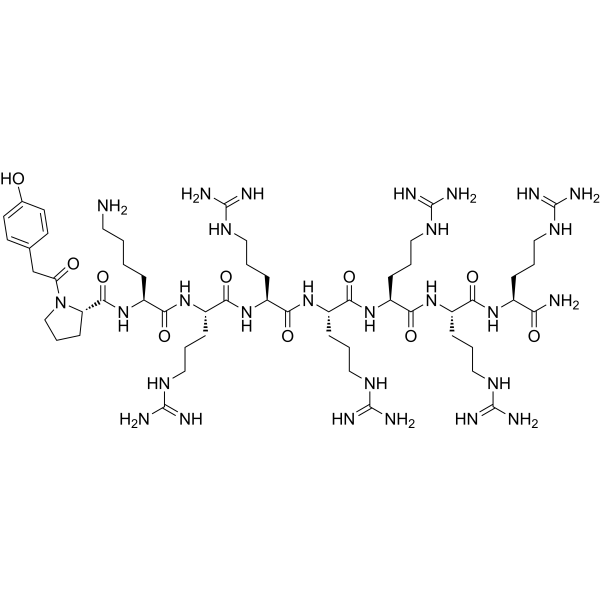
HCT116 is a peptidomimetic inhibitor of N-terminal methyltransferase 1/2 (NTMT1/2) with an IC50 of 54 nM. HCT116 can inhibit the N-terminal methylation level of NTMT1/2 substrates in HCT116 cells, and is used for the study of NTMT1/2 probes.
loading...
    loading...
Cat. No.: HY-108286S
CAS No.: 1215343-94-4
(Rac)-Talinolol-d5 is the racemate of Talinolol. Talinolol (Cordanum) is a long-acting, cardioselective β1-adrenergic receptor blocker. Talinolol exhibits cardioprotective and antihypertensive activities. Talinolol is also a well-known and frequently used probe substrate for P-glycoprotein (P-gp) activity .
loading...
    loading...
Cat. No.: HY-D0092R
CAS No.: 87-05-8
7-Ethoxy-4-methylcoumarin (Standard) is the analytical standard of 7-Ethoxy-4-methylcoumarin. This product is intended for research and analytical applications. 7-Ethoxy-4-methylcoumarin is a coumarin derivative and can be used as a substrate probe of mammalian cytochromes P450 1A1, 2B4 and 2B6 .
loading...
    loading...
Cat. No.: HY-D2379A
CAS No.: 7449-51-6
Target:  

Fluorescent Dye

Research Areas:  

Others

closed-HMRG is an HMRG (HY-D2379) with a closed spiro-ring structure. HMRG is a fluorescent dye, which serves as the fluorescent active product generated by enzyme-activated fluorescent probes targeting proteases and glycosidases. Its detection mechanism relies on the intramolecular spirocyclization equilibrium: HMRG itself exists in an open non-spirocyclic structure under physiological pH, which maintains a conjugated π system and produces strong fluorescence; whereas its probe precursors (such as Leu-HMRG, Ac-GlyPro-HMRG and βGal-HMRG) exist in a closed spirocyclic form and show no fluorescence due to the disruption of the π-conjugated system; when the target enzyme cleaves the substrate fragment linked to the probe precursor, the closed spirocyclic structure converts to the open structure of HMRG, restoring the conjugated system and generating a strong fluorescent signal. Its detection wavelength is Ex/Em = 501/524 nm .
loading...
    loading...
Cat. No.: HY-115692
CAS No.: 1887057-34-2
2-Coumaranone-1-L serves as a chemiluminescent probe. Under alkaline conditions and in the presence of oxygen, 2-Coumaranone-1-L is capable of undergoing chemiluminescence, which enables its application as a chemiluminescent substrate in biochemical assays. 2-Coumaranone-1-L exhibits its maximum emission wavelength at 442 nm. 2-Coumaranone-1-L is utilized in research within the realm of bioanalysis .
loading...
    loading...
Cat. No.: HY-D2984
CAS No.: 1308789-62-9
Synonyms: SNAP-PEG-NH2
Target:  

Fluorescent Dye

Research Areas:  

Others

BG-PEG-NH2 (SNAP-PEG-NH2) is an amino-terminal fluorescent probe building block and a precursor for site-specific labeling of SNAP-tag fusion proteins. BG-PEG-NH2 undergoes one-step coupling with activated carboxyl esters to form customized SNAP-tag substrates, which covalently bind to SNAP tags via a thioether bond formed at the Cys145 site. After coupling with a caged carboxyfluorescein, BG-PEG-NH2 forms a probe with Ex/Em = 500/524 nm following ultraviolet uncaging. Coupling of BG-PEG-NH2 with SeTau-647-NHS enables visualization of GPCR signal transduction. BG-PEG-NH2 is suitable for coupling reactions in aqueous phases or buffers, conjugation of labels, and labeling of intracellular or cell-surface proteins .
loading...
    loading...
Cat. No.: HY-D2477
CAS No.: 1974271-78-7
Target:  

Fluorescent Dye

Research Areas:  

Cancer

Sulfo-QSY21-NHS is an N-hydroxysuccinimide ester derivative fluorescent quencher that reduces the fluorescence intensity of paired fluorophores via proximity effect and relieves quenching after linker extension induced by mechanical force. Sulfo-QSY21-NHS can label streptavidin through NHS ester bioconjugation and be integrated into fluorescence-based molecular tension sensors to map the mechanical forces of cell surface receptors. Sulfo-QSY21-NHS also serves as a quencher for cysteine cathepsin-targeted quenched fluorescent substrate probes, and is widely used in studies related to breast cancer, colorectal cancer and lung adenocarcinoma .
loading...
    loading...
Cat. No.: HY-W205529
CAS No.: 87235-61-8
Target:  

Fluorescent Dye

Research Areas:  

Neurological Disease

RO 16-6491 Free base is a selective, reversible inhibitor of monoamine oxidase type B (MAO-B), exhibiting high affinity and specificity for binding sites in human frontal cortex mitochondria and platelet membranes. RO 16-6491 demonstrates a fast dissociation of bound radioactivity at 20 degrees C, indicating its dynamic binding properties. RO 16-6491 also acts as a substrate for MAO-B, suggesting that its oxidation may produce a stable intermediate responsible for its potent inhibitory effects. RO 16-6491 serves as an excellent radioligand probe for investigating the regional tissue distribution of MAO-B in various physiological and pathological states.
loading...
    loading...
Cat. No.: HY-W357142
CAS No.: 20943-16-2
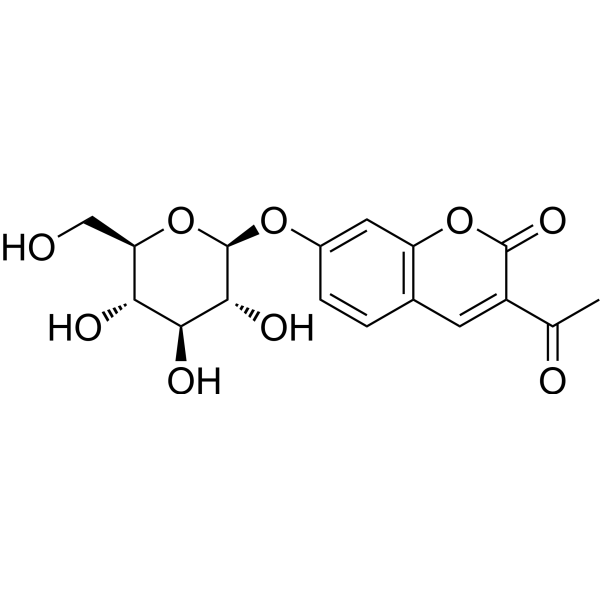
3-Acetylumbelliferyl β-D-Glucopyranoside is a fluorogenic substrate for β-glucosidase and can be used as a positive control substrates for β-D-glucosidase .
loading...
    loading...
Cat. No.: HY-D3239
Synonyms: AF405; Alexa Fluor 405 succinimidyl ester
AF405 NHS Ester (AF405) is a Fluorescent probe substrate, as well as a substrate for OATP1B1, OATP1B3 and OATP2B1 .
loading...
    loading...
Cat. No.: HY-105124R
CAS No.: 54340-62-4
Synonyms: Ro 3-4787 (Standard)
Bufuralol (Standard) is the analytical standard of Bufuralol (HY-105124). This product is intended for research and analytical applications. Bufuralol (Ro 3-4787) is a potent non-selective, orally active β-adrenoreceptor antagonist with partial agonist activity. Bufuralol hydrochloride is a CYP2D6 probe substrate .
loading...
    loading...
Cat. No.: HY-DY1080
CAS No.: 10121-91-2
Synonyms: Monodansyl cadaverine (solution)
Dansylcadaverine (solution) (Monodansyl cadaverine (solution)) is an autofluorescent compound used for the labeling of autophagic vacuoles. Dansylcadaverine, a high affinity substrate of transglutaminases, can block the receptor-mediated endocytosis of many ligands .
Solvent and concentration: DMSO: 10 mM
loading...
    loading...
Cat. No.: HY-D3141
DR probe is a "dual-key-and-lock" fluorescent probe designed based on the Resorufin (HY-123533) scaffold (Ex/Em = 647 nm/663-738 nm). DR probe can be sequentially activated by hydrogen peroxide to form the intermediate SR, which acts as a tyrosinase substrate to trigger a fluorescence turn-on signal. DR probe can distinguish normal melanocytes from melanoma cells. DR probe supports cell imaging and can be applied to mouse melanoma models to achieve melanoma diagnosis with higher accuracy and lower false-positive rates. DR probe is applicable to relevant research on melanoma .
loading...
    loading...
Cat. No.: HY-185447
CAS No.: 3086566-93-7
Target:  

PD-1/PD-L1

Research Areas:  

Cancer

Biotin-itaconate is a biotin-labeled itaconic anhydride that targets PD-L1. Biotin-itaconate acts as a biotin probe for in vitro alkylation assays to identify itaconate-modified protein substrates-typically substrates containing cysteine ​​residues. Biotin-itaconate is applicable to cancer research .
loading...
    loading...
Cat. No.: HY-P3818A
Target:  

PKC

Research Areas:  

Others

PKCδ Peptide Substrate acetate is a highly selective peptide substrate targeting PKCδ. PKCδ Peptide Substrate acetate can only be efficiently catalyzed for phosphorylation modification by PKCδ, and Thr431 is the sole phosphorylation site. PKCδ Peptide Substrate acetate binds to the catalytic pocket of PKC in a competitive manner, but exhibits no PKC agonistic or inhibitory activity. PKCδ Peptide Substrate acetate is a dedicated biochemical probe for the quantitative detection of PKCδ in vitro, and can be used for studies on PKCδ-related pathways .
loading...
    loading...
Cat. No.: HY-D3442
CAS No.: 3121565-89-4
ALDH2 probe 5 is a ALDH2 isoform-selective fluorescent probe with an emission wavelength centered at 494 nm. ALDH2 probe 5 is a turn-on fluorescent substrate for ALDH2; in its unreacted aldehyde form, twisted intramolecular charge transfer (TICT) occurs, resulting in fluorescence quenching. After ALDH2 probe 5 is catalytically oxidized to carboxylate by ALDH2, TICT is inhibited and fluorescence is significantly enhanced. ALDH2 probe 5 enables highly sensitive quantitative imaging of ALDH2 activity in recombinant enzymes, live cells, blood, tissue homogenates, and the brains of living mice. ALDH2 probe 5 can be used for studies related to neuroinflammation .
loading...
    loading...

