127 Results for "

Copolymer

" in MedChemExpress (MCE) Product Catalog:
Products (127)

127 Results for "Copolymer" in MCE Product Catalog:

Cat. No.: HY-179073B
TRITC-Polysucrose 70 is TRITC-labeled Polysucrose 70 (HY-131960A). Polysucrose 70 is a high molecular weight branched polysaccharide polymer. Polysucrose 70 is a copolymer of sucrose and epichlorohydrin and can be used for cell separation. TRITC-Polysucrose 70 is mainly used for permeability and microcirculation studies (Ex/Em = 544/570 nm) .
loading...
    loading...
Cat. No.: HY-W010708R
CAS No.: 601-34-3
Cholesteryl palmitate (Standard) is the analytical standard of Cholesteryl palmitate. This product is intended for research and analytical applications. Cholesteryl palmitate is the main cholesterol ester found in human blephariol and has been used to form a stable tear film to study amphiphilic block copolymers as surfactants for dry eye syndrome. Cholesteryl palmitate can be used as a predictor of fetal lung maturity. Cholesteryl palmitate can be used as a prognostic biomarker for chronic interstitial pneumonia.
loading...
    loading...
Cat. No.: HY-W723152
CAS No.: 26780-50-7
Target:  

Drug Intermediate

Domaines de recherche:  

Inflammation/Immunology

Poly(D,L-lactide-co-glycolide) is a biodegradable polymer copolymer. Poly(D,L-lactide-co-glycolide) undergoes degradation through ester bond hydrolysis into lactic acid and glycolic acid. These two products can be naturally eliminated through metabolism in the body (such as the tricarboxylic acid cycle), without the risk of long-term accumulation. Poly(D,L-lactide-co-glycolide) can be used in medical sutures, implants, and drug delivery systems .
loading...
    loading...
Cat. No.: HY-D1005A4
CAS No.: 9003-11-6
Synonyms: PEG-PPG-PEG, 1630 (Average)
Poloxamer 122 L42 (PEG-PPG-PEG, 1630 (Average)) is a synthetic nonionic triblock copolymer composed of polyoxyethylene-polyoxypropylene, with emulsifying and wetting properties. Poloxamer 122 L42 forms large spherical aggregates in aqueous solutions near its cloud point,. Poloxamer 122 L42 can form thermoreversible hydrogels, and is also used in research related to serving as a drug delivery carrier in the fields of food additives, cosmetics, pharmaceutical preparations and tissue engineering .
loading...
    loading...
Cat. No.: HY-W115727D
CAS No.: 9003-05-8
Synonyms: PAM,average Mn 40000
Polyacrylamide (PAM), average Mn 40000 is a versatile, high-molecular-weight polyacrylamide copolymer. Polyacrylamide series materials can maintain enzyme activity in enzyme immobilization, act as drug carriers to achieve controlled release, serve as smart materials responding to temperature/pH stimuli, and be used for in vitro toxin adsorption and soft tissue filling through mechanisms such as physical entrapment, covalent binding or chemical crosslinking. Polyacrylamide finds applications in biomedical engineering, environmental management and industrial applications .
loading...
    loading...
Cat. No.: HY-116544
CAS No.: 133978-15-1
Pureté:  ≥98.0%
Domaines de recherche:  

Others

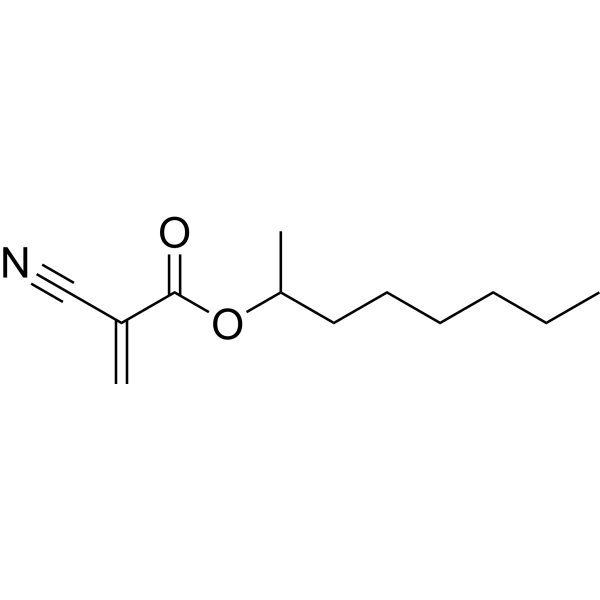
Octan-2-yl 2-cyanoacrylate is an alkyl cyanoacrylate monomer, base-sensitive monofunctional 1,1-disubstituted electron-deficient olefin, polymerizable and copolymerizable monomer. Octan-2-yl 2-cyanoacrylate undergoes homopolymerization via nucleophilic initiation with pyridine as initiator. Octan-2-yl 2-cyanoacrylate forms true copolymers with ethyl 2-cyanoacrylate via nucleophilic initiation with pyridine as initiator .
loading...
    loading...
Cat. No.: HY-158255
Pureté:  ≥95.0%
Domaines de recherche:  

Others

mPEG-PLGA (2000-80000) (LA/GA 50:50) is a copolymer, which consists of hydrophilic mPEG and biodegradable PLGA (molar ratio is 50:50) with a molecular weight of 2000 (mPEG) + 80000 (PLGA). mPEG-PLGA (2000-80000) (LA/GA 50:50) forms nanoparticles or microparticles, which is stable in aqueous solution at different pH values and elevated temperatures as well as in serum. mPEG-PLGA (2000-80000) (LA/GA 50:50) is utilized as carrier material in drug delivery systems .
loading...
    loading...
Cat. No.: HY-D1005A10
CAS No.: 9003-11-6
Synonyms: PEG-PPG-PEG, 2900 (Average)
Poloxamer 184 L64 is a block copolymer of polyethylene oxide and polypropylene oxide with an average molecular weight of 2900. Poloxamer has the ability to inhibit P-gp. Poloxamer 184 exhibits short-term skin toxicity, characterized by mild erythema and intradermal inflammatory reactions. Poloxamer 184 has antimicrobial activity, inhibiting 60% of Mycobacterium avium at a concentration of 1 mg/mL. Poloxamer 184 forms a thermoreversible hydrogel and is used as a food additive and as a drug delivery carrier in cosmetics and tissue engineering .
loading...
    loading...
Cat. No.: HY-W016979R
CAS No.: 705-86-2
δ-Decalactone (Standard) is the analytical standard of δ-Decalactone (HY-W016979 ). This product is intended for research and analytical applications. δ-Decalactone is a hydrophobic natural cyclic lactone aroma compound with a creamy-coconut-peach aroma. It serves as a flavoring agent and a renewable monomer for ring-opening polymerization to prepare homopolymers and amphiphilic block copolymers, and it can self-assemble into degradable micelles for the encapsulation of hydrophobic molecules. δ-Decalactone is used in food flavoring and polymer materials research .
loading...
    loading...
Cat. No.: HY-W115727C
CAS No.: 9003-05-8
Synonyms: Acrylamide polymer,Nonionic,Mw 5-6 million
Polyacrylamide (Acrylamide polymer),Nonionic,Mw 5-6 million is a multifunctional, high-molecular-weight nonionic polyacrylamide copolymer. Polyacrylamide-based materials can maintain enzyme activity in enzyme immobilization, act as drug carriers for controlled release, function as smart materials responsive to temperature/pH stimuli, and be applied in in vitro toxin adsorption and soft tissue filling, through action mechanisms such as physical entrapment, covalent binding or chemical crosslinking. Polyacrylamide finds applications in biomedical engineering, environmental management and industrial applications .
loading...
    loading...
Cat. No.: HY-W115727E
CAS No.: 9003-05-8
Synonyms: PAM,average Mn 150000
Polyacrylamide, average Mn 150000 (PAM, average Mn 150000) is a versatile, high-molecular-weight polyacrylamide copolymer. Polyacrylamide series materials can maintain enzyme activity in enzyme immobilization, act as drug carriers to achieve controlled release, serve as smart materials responding to temperature/pH stimuli, and be used for in vitro toxin adsorption and soft tissue filling through mechanisms such as physical entrapment, covalent binding or chemical crosslinking. Polyacrylamide finds applications in biomedical engineering, environmental management and industrial applications .
loading...
    loading...
Cat. No.: HY-W591632
CAS No.: 24991-53-5
Synonyms: Poly(ethylene glycol)-bis-amine 1000
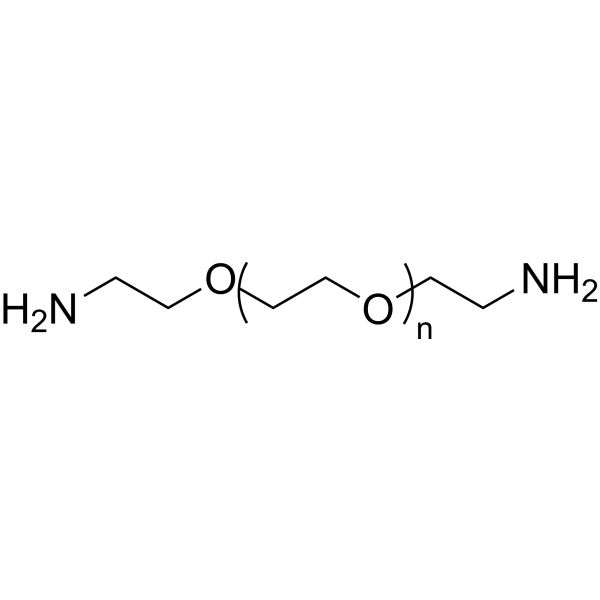
PEG1000-bis-amine (Poly (ethylene glycol)-bis-amine 1000) is a polyethylene glycol-based diamine linker/spacer. PEG-bis-amine can be used to synthesize CS-PEG-PLGA copolymers, which are further employed to prepare 5-fluorouracil (HY-90006)-loaded nanoparticles. PEG-bis-amine facilitates the formation of amino-terminated PLGA-PEG-NH2 for conjugation with Chondroitin sulfate (HY-B2162) .
loading...
    loading...
Cat. No.: HY-179260A
PDLLA3000-mPEG2000, PDI≤1.25 is an amphiphilic block copolymer composed of methoxy poly(ethylene glycol) and poly(D,L-lactide). PDLLA3000-mPEG2000, PDI≤1.25 functions as a self-assembled polymeric micelle component to enhance aqueous solubility and oral bioavailability in bioactive substances. PDLLA3000-mPEG2000, PDI≤1.25 can be used in the study of drug delivery .
loading...
    loading...
Cat. No.: HY-W1123936D
Synonyms: DBCO-PEG3400-Folate
DBCO-PEG-FA (DBCO-PEG-Folate) (MW 3400) is a multifunctional bioconjugation reagent, which is a copolymer of DBCO and Folic acid (FA) (HY-16637) and can target folate receptors (FR). Folate receptors are highly overexpressed on the surface of many cancer cells (such as lung cancer, nasopharyngeal cancer, ovarian cancer, etc.), but exhibit extremely low expression levels in normal tissues. DBCO-PEG-FA can be used for click chemistry conjugation via its DBCO terminal, and thus applies to various bioconjugation and drug delivery applications .
loading...
    loading...
Cat. No.: HY-135721
CAS No.: 13304-62-6
Synonyms: Benzyl acrylamide
Domaines de recherche:  

Others

N-Benzylacrylamide (Benzyl acrylamide) is a hydrophobic monomer. N-Benzylacrylamide can form hydrophobic microdomains that act as physical cross-linking sites to connect polymer chains to each other into a three-dimensional network; dynamically reversible hydrophobic interactions enable the spontaneous reformation of physical cross-linking sites after contact of fractured surfaces, thereby achieving autonomous self-healing. N-Benzylacrylamide can promote the synthesis of carboxymethyl cellulose-modified amphiphilic copolymers, and enhance the intermolecular association, viscoelasticity, thermal stability, as well as fire resistance/fire extinguishing performance of the resulting hydrogels .
loading...
    loading...
Cat. No.: HY-W1123936B
Synonyms: DBCO-PEG1000-Folate
DBCO-PEG1000-FA (DBCO-PEG1000-Folate) is a multifunctional bioconjugation reagent, which is a copolymer of DBCO and Folic acid (FA) (HY-16637) and can target folate receptors (FR). Folate receptors are highly overexpressed on the surface of many cancer cells (such as lung cancer, nasopharyngeal cancer, ovarian cancer, etc.), but exhibit extremely low expression levels in normal tissues. DBCO-PEG-FA can be used for click chemistry conjugation via its DBCO terminal, and thus applies to various bioconjugation and drug delivery applications .
loading...
    loading...
Cat. No.: HY-W1123936C
Synonyms: DBCO-PEG2000-Folate
DBCO-PEG2000-FA (DBCO-PEG2000-Folate) is a multifunctional bioconjugation reagent, which is a copolymer of DBCO and Folic acid (FA) (HY-16637) and can target folate receptors (FR). Folate receptors are highly overexpressed on the surface of many cancer cells (such as lung cancer, nasopharyngeal cancer, ovarian cancer, etc.), but exhibit extremely low expression levels in normal tissues. DBCO-PEG-FA can be used for click chemistry conjugation via its DBCO terminal, and thus applies to various bioconjugation and drug delivery applications .
loading...
    loading...
Cat. No.: HY-W1123936E
Synonyms: DBCO-PEG5000-Folate
DBCO-PEG5000-FA (DBCO-PEG5000-Folate) is a multifunctional bioconjugation reagent, which is a copolymer of DBCO and Folic acid (FA) (HY-16637) and can target folate receptors (FR). Folate receptors are highly overexpressed on the surface of many cancer cells (such as lung cancer, nasopharyngeal cancer, ovarian cancer, etc.), but exhibit extremely low expression levels in normal tissues. DBCO-PEG-FA can be used for click chemistry conjugation via its DBCO terminal, and thus applies to various bioconjugation and drug delivery applications .
loading...
    loading...
Cat. No.: HY-W1123936H
Synonyms: DBCO-PEG10000-Folate
DBCO-PEG10000-FA (DBCO-PEG10000-Folate) is a multifunctional bioconjugation reagent, which is a copolymer of DBCO and Folic acid (FA) (HY-16637) and can target folate receptors (FR). Folate receptors are highly overexpressed on the surface of many cancer cells (such as lung cancer, nasopharyngeal cancer, ovarian cancer, etc.), but exhibit extremely low expression levels in normal tissues. DBCO-PEG-FA can be used for click chemistry conjugation via its DBCO terminal, and thus applies to various bioconjugation and drug delivery applications .
loading...
    loading...
Cat. No.: HY-W888515
Domaines de recherche:  

Neurological Disease

mPEG-PCL is an amphiphilic biodegradable block copolymer composed of hydrophilic methoxy poly (ethylene glycol) (mPEG) and hydrophobic poly (ε-caprolactone) (PCL). mPEG-PCL possesses excellent biocompatibility and can form delivery carriers such as micelles and nanoparticles. Through its amphiphilic block structure, mPEG-PCL forms nanocarriers and encapsulates hydrophobic molecules, thereby enhancing the loading capacity of hydrophobic molecules, reducing burst release, and achieving sustained release. mPEG-PCL can be used in research on nanodelivery, tissue engineering, and ocular delivery systems related to age-related macular degeneration (AMD) .
loading...
    loading...

