141 Results for "

HT29 cells

" in MedChemExpress (MCE) Product Catalog:
Products (141)

141 Results for "HT29 cells" in MCE Product Catalog:

Cat. No.: HY-146366
CAS No.: 2379241-70-8
Target:  

Microtubule/Tubulin

Research Areas:  

Cancer

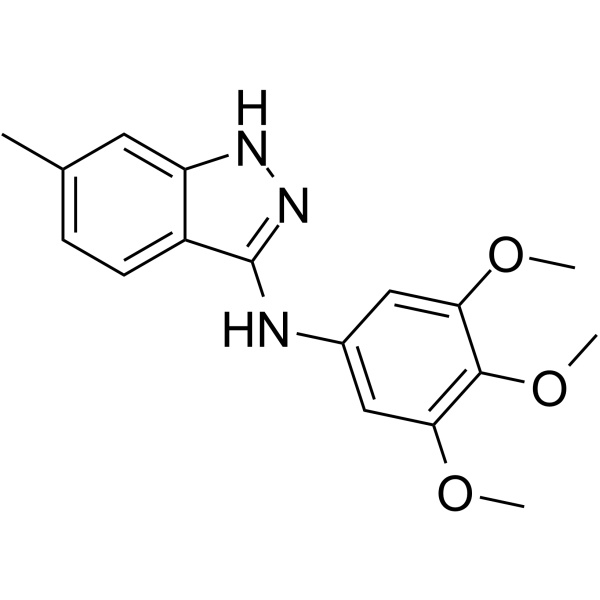
Tubulin inhibitor 26 (compound 3c) is a potent inhibitor of tubulin. Tubulin inhibitor 26 is an indazole derivative compound. Tubulin inhibitor 26 shows noteworthy low nanomolar potency against HepG2, HCT116, SW620, HT29 and A549 cancer cell lines. Tubulin inhibitor 26 arrests tumor cell in G2/M phase and induced cell apoptosis. Tubulin inhibitor 26 suppresses tumor growth in vivo without affecting the mice body weight .
loading...
    loading...
Cat. No.: HY-175852
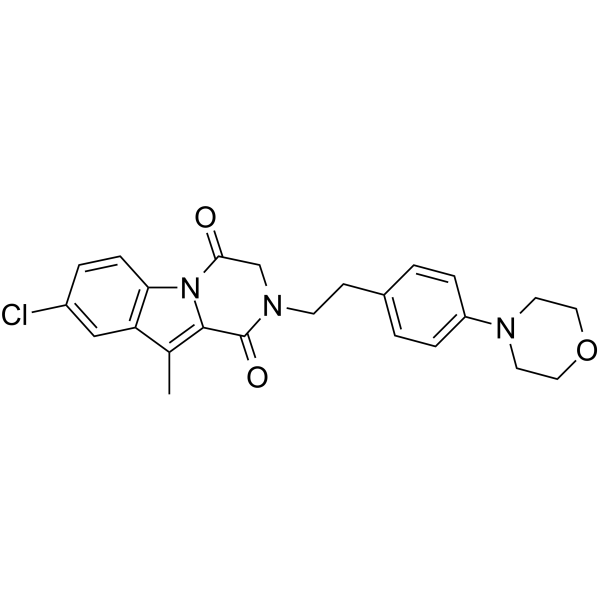
Ferroptosis inducer-11 is a ferroptosis inducer. Ferroptosis inducer-11 exhibits potent cytotoxicity against HCT-116, NCM-60 and HT-29 cells with IC50 values of 0.43 μM, 3.14 μM and 0.48 μM, respectively. Ferroptosis inducer-11 strongly suppresses GPX4 enzymatic activity with an IC50 of 1.86 μM. Ferroptosis inducer-11 induces ferroptosis, as well as increases intracellular lipid ROS, malondialdehyde (MDA), and Fe 2+ levels, while decreasing glutathione (GSH) levels in colon cancer cells. Ferroptosis inducer-11 can be used for the study of colon cancer .
loading...
    loading...
Cat. No.: HY-N6002R
CAS No.: 475231-21-1
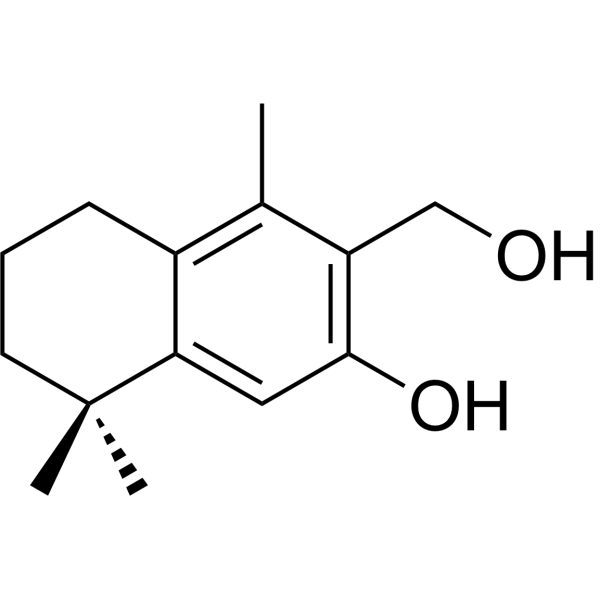
3'-Hydroxypterostilbene (Standard) is the analytical standard of 3'-Hydroxypterostilbene (HY-N6002). This product is intended for research and analytical applications. 3'-Hydroxypterostilbene is a Pterostilbene (HY-N0828) analogue. 3'-Hydroxypterostilbene inhibits the growth of COLO 205, HCT-116 and HT-29 cells with IC50s of 9.0, 40.2 and 70.9 μM, respectively. 3'-Hydroxypterostilbene significantly down-regulates PI3K/Akt and MAPKs signaling pathways and effectively inhibits the growth of human colon cancer cells by inducing apoptosis and autophagy. 3'-Hydroxypterostilbene can be used for the research of cancer .
loading...
    loading...
Cat. No.: HY-171906
CAS No.: 65446-08-4
Synonyms: 1-Arachidonoyl-sn-glycerol 3-phosphate; 1-Arachidonoyl LPA; LPA (20:4)
Target:  

LPL Receptor

Research Areas:  

Inflammation/Immunology

1-Arachidonoyl-2-hydroxy-sn-glycero-3-PA is a phospholipid containing arachidonic acid at the sn-1 position. It is a precursor to 1-arachidonoyl glycerol (1-Monoarachidin; HY-130567) . 1-Arachidonoyl-2-hydroxy-sn-glycero-3-PA binds to the LPA2/EDG4 receptor with an EC50 value of approximately 10 nM . It prevents TNF-α and IL-6 secretion in wild-type but not Lpa2-/- dendritic cells stimulated by LPS . It also decreases differentiation of HT-29 human colon carcinoma cells to goblet cells in the presence of sodium butyrate .
loading...
    loading...
Cat. No.: HY-180806
CAS No.: 3065634-42-3
RIPK1-IN-39 (compound 2) is a potent and selective RIPK1 inhibitor (IC50 = 69.40 nM) exhibiting >100-fold selectivity over RIPK3 (IC50 = 6946 nM). RIPK1-IN-39 protects HT-22 and HT-29 cells from necroptosis by inhibiting the phosphorylation and activation of the RIPK1-RIPK3-MLKL pathway. RIPK1-IN-39 demonstrates neuroprotective effects in a rat model of middle cerebral artery occlusion (MCAO). RIPK1-IN-39 can be used for acute ischemic stroke (AIS) research .
loading...
    loading...
Cat. No.: HY-172617
CAS No.: 877810-03-2
Research Areas:  

Cancer

APD-94 is a dual inhibitor targeting tubulin and Bmi-1. APD-94 interfers tubulin normal polymerization. APD-94 suppresses the expression of Bmi-1. APD-94 causes cell cycle arrest at the G2/M phase in cancer cells and induces apoptosis, thus inhibiting cancer cell proliferation. APD-94 represses the growth of HT29 cell xenografts in NOD/SCID mice. APD-94 can be used for colorectal cancer study .
loading...
    loading...
Cat. No.: HY-100753R
CAS No.: 2059952-75-7
Research Areas:  

Cancer

STAT3-IN-1 (Standard) is the analytical standard of STAT3-IN-1 (HY-100753). This product is intended for research and analytical applications. STAT3-IN-1 (compound 7d) is an excellent, selective and orally active STAT3 inhibitor, with IC50 values of 1.82 μM and 2.14 μM in HT29 and MDA-MB 231 cells, respectively. STAT3-IN-1 (compound 7d) induces tumor cells apoptosis .
loading...
    loading...
Cat. No.: HY-14909R
CAS No.: 218600-44-3
Synonyms: CDDO (Standard); RTA 401 (Standard)
Bardoxolone (Standard) is the analytical standard of Bardoxolone (HY-14909). This product is intended for research and analytical applications. Bardoxolone is an orally active activator of nuclear regulatory factor (NRf-2) and an inhibitor of SARS-CoV-2 3CL protease. Bardoxolone inhibits SARS-CoV-2 3CL protease with an EC50 value of 0.43 μM in vero cells. Bardoxolone also inhibits necroptosis in HT-29 cells with an EC50 value of 1.30 μM by blocking necrosome formation through inhibiting phosphorylation of RIPK1 and RIPK3. Bardoxolone can be used in research on COVID-19, TNF-induced systemic inflammatory response syndrome (SIRS), and cerebral ischemia-reperfusion injury .
loading...
    loading...
Cat. No.: HY-147825
CAS No.: 2492429-45-3
Target:  

EGFR Raf Apoptosis

Research Areas:  

Cancer

EGFR/BRAFV600E-IN-1 (Compound 23) is a potent EGFR and BRAF V600E dual inhibitor with IC50s of 0.08 and 0.15 µM, respectively. EGFR/BRAFV600E-IN-1 induces apoptosis and cell cycle arrest in both pre-G1 and G2/M phases. EGFR/BRAFV600E-IN-1 exhibits antiproliferative activity againist A-549, MCF-7, Panc-1, HT-29 with IC50s of 1.2, 0.79, 1.3, and 1.23 µM, respectively .
loading...
    loading...
Cat. No.: HY-170966
Target:  

HDAC

Research Areas:  

Cancer

HDAC1-IN-9 (13c) is a HDAC1 inhibitor. HDAC1-IN-9 inhibits HDAC1 enzyme with an IC50 of 1.07 µM. HDAC1-IN-9 exhibits the highest anti-proliferative effect against HT-29 (human colon adenocarcinoma), with anIC50 of 1.78 μM. HDAC1-IN-9 induces substantial Apoptosis in HCT-116 (human colon cancer) cells. HDAC1-IN-9 possesses antiangiogenic property. HDAC1-IN-9 reduces the expression levels of VEGFR-2 and phosphorylated VEGFR-2 (pVEGFR-2) by approximately 80 % .
loading...
    loading...
Cat. No.: HY-123237
CAS No.: 1146944-35-5
Research Areas:  

Cancer

KRC-108, an aminopyridine, is an orally active multiple kinase inhibitor with IC50s of 80 nM, 23 nM, 3 nM, 70 nM, 30 nM, 39 nM for c-Met, c-Met M1250T, c-Met Y1230D, Ron, Flt3 and TrkA, respectively. KRC-108 induces cell cycle arrest, apoptotic cell death, and autophagy. KRC-108 exhibits anti-tumor activity in vivo in HT29 colorectal cancer, NCI-H441 lung cancer xenograft models in athymic BALB/c nu/nu mice .
loading...
    loading...
Cat. No.: HY-125387
CAS No.: 1628439-59-7
Target:  

Src

Research Areas:  

Inflammation/Immunology

TOP1210 is a narrow-spectrum tyrosine kinase inhibitor with potent inhibitory activity against P38α, Src, and Syk kinases. TOP1210 effectively reduced proinflammatory cytokines released by peripheral blood monocytes, primary macrophages, HT29 cells, inflammatory cells in ulcerative colitis (UC) biopsies, and myofibroblasts isolated from inflamed colonic UC mucosa. TOP1210 showed significant anti-inflammatory effects in cell experiments and UC biopsies, superior to some selective kinase inhibitors. The multi-kinase inhibition of TOP1210 provides the possibility of obtaining a wider range of therapeutic effects, especially in the regulation of autoimmune responses .
loading...
    loading...
Cat. No.: HY-149523
Research Areas:  

Inflammation/Immunology Cancer

Anticancer agent 157 (compound 15) is a NO inhibitor (IC50=0.62 μg/mL) with anti-inflammatory and anticancer activities. Anticancer agent 157 can bind to iNOS (inducible NO synthase) and caspase 8, causing nuclear fragmentation and chromatin condensation, inducing apoptosis. Anticancer agent 157 inhibits HT29 colon cancer cells (IC50=2.45 μg/mL), Hep-G2 liver cancer cells (IC50=3.25 μg/mL), and B16-F10 murine melanoma cells (IC50=3.84 μg/mL) .
loading...
    loading...
Cat. No.: HY-179021
CAS No.: 1860810-23-6
Target:  

COX Lipoxygenase

Research Areas:  

Cancer

COX-2/15-LOX-IN-7 is a potent, selective and orally active dual inhibitor of COX-2 and 15-LOX with IC50 values of 0.022 and 1.19 μM. COX-2/15-LOX-IN-7 also inhibits COX-1 with an IC50 value of 28.081μM. COX-2/15-LOX-IN-7 has low cytotoxicity against human colorectal cancer HT-29 and HCT116 cell lines (IC50 >100 μM for both). COX-2/15-LOX-IN-7 exhibits non-ulcerogenic performance. COX-2/15-LOX-IN-7 can be used for the research of cancer .
loading...
    loading...
Cat. No.: HY-178960
Research Areas:  

Cancer

Tubulin-IN-59 (Compound 8g) is an orally active Tubulin inhibitor. Tubulin-IN-59 exhibits potent anti-proliferative activity against HCT116 colorectal cancer, HeLa cervical cancer, and HepG2 liver cancer cell lines, with its IC₅₀ value ranging from 16 to 35 nM. Tubulin-IN-59 arrests HeLa cells in the G2/M phase and induces cell apoptosis. Tubulin-IN-59 demonstrates significant anti-tumor activity in the HT29 human colon cancer mouse xenograft model. Tubulin-IN-59 can be used for the study of colorectal cancer and cervical cancer .
loading...
    loading...
Cat. No.: HY-161863
Tubulin polymerization-IN-67 (Compound 5h) is an inhibitor for tubulin polymerization on colchicine binding site with an IC50 of 2.92 μM. Tubulin polymerization-IN-67 inhibits the proliferation of cancer cells HT29, A549, U2OS, MG-63 and HeLa with IC50s of 0.12-4.13 μM. Tubulin polymerization-IN-67 arrests the cell cycle at G2/M phase, induces apoptosis in cell U2OS, inhibits the cell migration of A549. Tubulin polymerization-IN-67 reduces the mitochondrial membrane potential (MMP) and increase intracellular ROS, inhibits the angiogenesis in HUVECs. Tubulin polymerization-IN-67 exhibits antitumor efficacy in mice
loading...
    loading...
Cat. No.: HY-162927
CAS No.: 1054506-59-0
Target:  

MDM-2/p53 Apoptosis

Research Areas:  

Cancer

p53-MDM2-IN-6 (Compound 10a), a LSM-83177 hydrazone analog, is a potent p53-MDM2 inhibitor with an IC50 value of 11.08 µg/mL. p53-MDM2-IN-6 arrests the cell cycle in the S phase and induces early and late Apoptosis with antiproliferative activity against HT29 cell lines with an IC50 value of 10.44 µg/mL. p53-MDM2-IN-6 inhibits p53-MDM2 interaction with increment in p-53 level and decrease the expression of GST enzymes. p53-MDM2-IN-6 is promising for research of colorectal cancer .
loading...
    loading...
Cat. No.: HY-170932
Target:  

EGFR COX Apoptosis

Research Areas:  

Cancer

EGFR/COX-2-IN-1 is an EGFR/COX-2 inhibitor. EGFR/COX-2-IN-1 inhibits EGFR WT, EGFR T790M, COX-1 and COX-2 with IC50s of 0.12, 0.076, 20.1 and 1.52 μM respectively. EGFR/COX-2-IN-1 inhibits and with IC50s of , respectively. EGFR/COX-2-IN-1 inhibits MCF-7, HT-29 and A-549 with IC50s of 1.20, 5.14 and 14.81 μM, respectively. EGFR/COX-2-IN-1 displays Apoptosis induction by up-regulating Bax and down-regulating Bcl-2 protein levels. EGFR/COX-2-IN-1 results in a significant increase in the percentage of cells at the G2/M in MFC-7 cells. EGFR/COX-2-IN-1 exhibits broad-spectrum antitumor effects .
loading...
    loading...
Cat. No.: HY-120339
CAS No.: 1578247-29-6
STK899704 is a tubulin polymerization inhibitor. STK899704 exhibits broad-spectrum inhibitory activity against various cancer cell lines with IC50 values ​​ranging from 0.2 to 1.0 μM. STK899704 disrupts the mitotic spindle structure, inducing G2/M phase cell cycle arrest. STK899704 inhibits the migration ability of HT29 cells by downregulating the FAK-MEK-ERK signaling pathway, thereby suppressing the expression and activity of MMP-2 and MMP-9. STK899704 activates caspase-3/7/8/9, leading to PARP cleavage and inducing apoptosis. STK899704 induces cellular senescence through the p53 pathway. STK899704 can be used in research on skin cancer, lung cancer, colon cancer, and other cancers .
loading...
    loading...
Cat. No.: HY-171906A
Synonyms: 1-Arachidonoyl-sn-glycerol 3-phosphate sodium; 1-Arachidonoyl LPA sodium; LPA (20:4) sodium
Target:  

LPL Receptor

Research Areas:  

Cancer

1-Arachidonoyl-2-hydroxy-sn-glycero-3-PA (sodium) (1-Arachidonoyl-sn-glycerol 3-phosphate (sodium)) is a phospholipid with arachifonic acid at the sn-1 position. 1-Arachidonoyl-2-hydroxy-sn-glycero-3-PA (sodium) binds to the LPA2/EDG4 receptor (EC50 of 10 nM). 1-Arachidonoyl-2-hydroxy-sn-glycero-3-PA (sodium) can be found in rat brain as 37% of the arachidoinic acid-containing lysophosphatidic acid species. 1-Arachidonoyl-2-hydroxy-sn-glycero-3-PA (sodium) is the precursor to 1-arachidonoyl glycerol. 1-Arachidonoyl-2-hydroxy-sn-glycero-3-PA (sodium) can prevent TNF-α and IL-6 secretion in wild type LPS-stimulated dendritic cells. 1-Arachidonoyl-2-hydroxy-sn-glycero-3-PA (sodium) reduces differentiation of HT-29 colon carcinoma cells into goblet cells when sodium butyrate is present .
loading...
    loading...

