
132 Results for "

T4

" in MedChemExpress (MCE) Product Catalog:
Products (132)

132 Results for "T4" in MCE Product Catalog:

Cat. No.: HY-P84994
Synonyms: T-cell surface glycoprotein CD4; T-cell surface antigen T4/Leu-3; CD antigen CD4; CD4 nanobody;

Host:  

Mouse

Application:  

FC

Reactivity:  

Human

loading...
    loading...
Cat. No.: HY-P99436
CAS No.: 1370261-50-9
Synonyms: ABR-214936
Anatumomab mafenatox (ABR-214936) is a 73 KDa recombinant protein to recognize the tumor-associated antigen 5T4, which is widely expressing in malignancy. Anatumomab mafenatox is between a modified form of SEA and a murine Fab. The main side effects of Anatumomab mafenatox are reported to include fever, low blood pressure, pain, nausea and drowsiness .
loading...
    loading...
Cat. No.: HY-12926
CAS No.: 1428535-92-5
Target:  

HIV HDAC DNA/RNA Synthesis

Research Areas:  

Infection

ST7612AA1 is a histone deacetylase (HDAC) inhibitor that controls chromatin condensation and DNA transcription by removing acetyl groups from histones. ST7612AA1 is also a potent HIV reactivation inducer, and its reactivation activity is exerted without activating or proliferating CD4+T cells, and can be used in the study of HIV reactivation strategies and elimination of viral reservoirs .
loading...
    loading...
Cat. No.: HY-P86915
Synonyms: CD 4 antibody; CD4 (L3T4) antibody; CD4 antibody; CD4 antigen (p55) antibody; CD4 antigen antibody; CD4 molecule antibody; CD4 receptor antibody; CD4+ Lymphocyte deficiency, included antibody; CD4_HUMAN antibody; CD4mut antibody; CD 4 antibody; CD4 (L3T4) antibody; CD4 antibody; CD4 antigen (p55) antibody; CD4 antigen antibody; CD4 molecule antibody; CD4 receptor antibody; CD4+ Lymphocyte deficiency, included antibody; CD4_HUMAN antibody; CD4mut antibody; L3T4 antibody; Leu3 antibody; Ly-4 antibody; Lymphocyte antigen CD4 antibody; MGC165891 antibody; OTTHUMP00000238897 antibody; p55 antibody

Host:  

Mouse

Application:  

IHC-P, IF-Tissue

Reactivity:  

Human

loading...
    loading...
Cat. No.: HY-P7630
Purity:  ≥ 95%, as determined by reducing SDS-PAGE.
Synonyms: B4GALT4; Beta-1,4-GalTase 4; Beta-1,4-Galactosyltransferase 4; Nal Synthase; Beta4Gal-T4; B4Gal-T4; UDP-Galactose:Beta-N-Acetylglucosamine Beta-1,4-Galactosyltransferase 4; Beta-N-Acetylglucosaminyl-Glycolipid Beta-1,4-Galactosyltransferase 4; UDP-Gal:Bet
Species:  
Human
Source:  
HEK293
loading...
    loading...
Cat. No.: HY-P72068
Purity:  ≥ 90%, as determined by reducing SDS-PAGE.
Synonyms: ABAT; GABA-T; 4-Aminobutyrate Aminotransferase; Gamma-Aminobutyrate Aminotransferase; GABAT; 4-Aminobutyrate Transaminase; 4-Aminobutyrate Aminotransferase, Mitochondrial; GABA-AT; (S)-3-Amino-2-Methylpropionate Transaminase; L-AIBAT; Gamma-Amino-N-Butyra
Species:  
Human
Source:  
E. coli
loading...
    loading...
Cat. No.: HY-150684
CAS No.: 3031654-49-3
Research Areas:  

Cancer

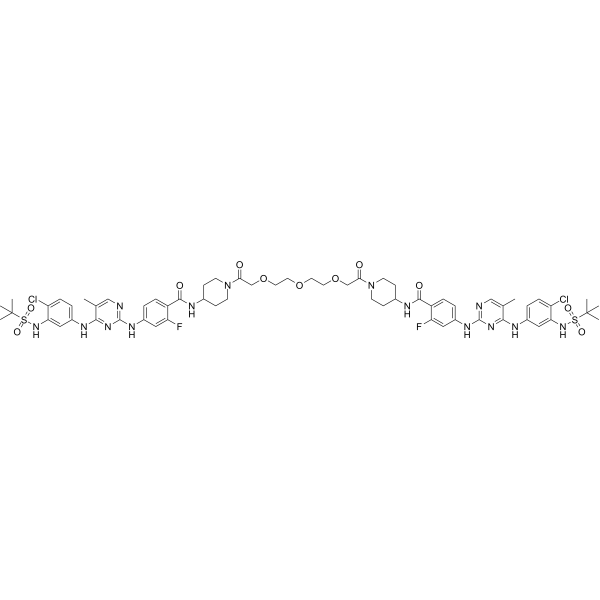
GXH-II-052 is a potent bivalent bromodomain and extraterminal domain (BET) inhibitor. GXH-II-052 shows binding potential for BRD4-1, BRD4-2, BRD4-T, BRDT-1, BRDT-2, BRDT-T with Kd values of 28, 9.1, 4.8, 0.6, 8.4, 2.6 nM, respectively. GXH-II-052 shows antiproliferative activity. GXH-II-052 decreases the expression of c-Myc .
loading...
    loading...
Cat. No.: HY-150683
CAS No.: 3031654-46-0
Research Areas:  

Cancer

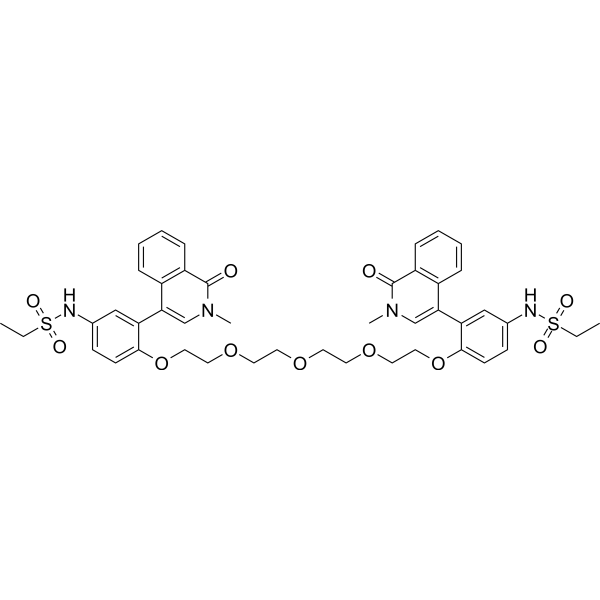
NC-III-49-1 is a potent bivalent bromodomain and extraterminal domain (BET) inhibitor. NC-III-49-1 shows binding potential for BRD4-1, BRD4-2, BRD4-T, BRDT-1, BRDT-2, BRDT-T with Kd values of 0.095, 0.32, 0.29, 0.089, 5.5, 0.058 nM, respectively. NC-III-49-1 shows antiproliferative activity. NC-III-49-1 decreases the expression of c-Myc .
loading...
    loading...
Cat. No.: HY-W181026
CAS No.: 1197834-98-2
Target:  

Fluorescent Dye

Research Areas:  

Inflammation/Immunology

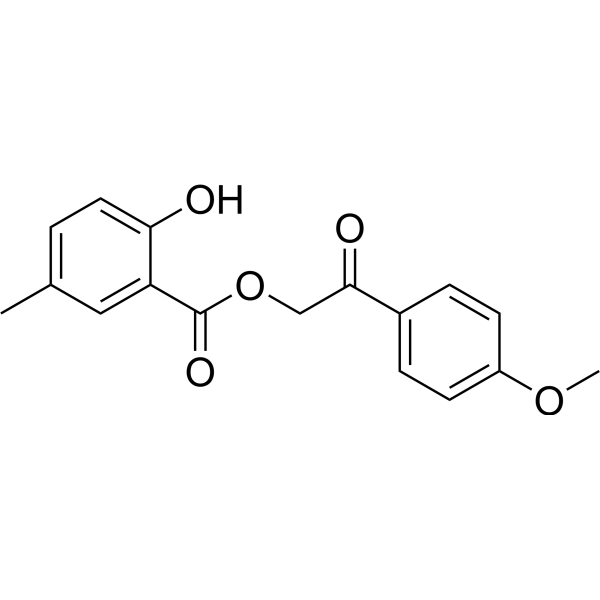
KLF10-IN-1 (#48-15) is a KLF10 inhibitor with an IC50 value of 40 μM for KLF10 reporter gene. KLF10-IN-1 can inhibit KLF10-DNA binding and transcriptional activity, block the conversion of CD4+CD25 T cells to CD4+CD25+T regulatory cells, and inhibit the expression of KLF10 target genes. KLF10-IN-1 can be used as a useful mechanistic probe to study KLF10-mediated effects and T regulatory cell biology .
loading...
    loading...
Cat. No.: HY-145149
CAS No.: 2124210-34-8
Purity:  99.76%
Target:  

ADC Payloads

Research Areas:  

Cancer

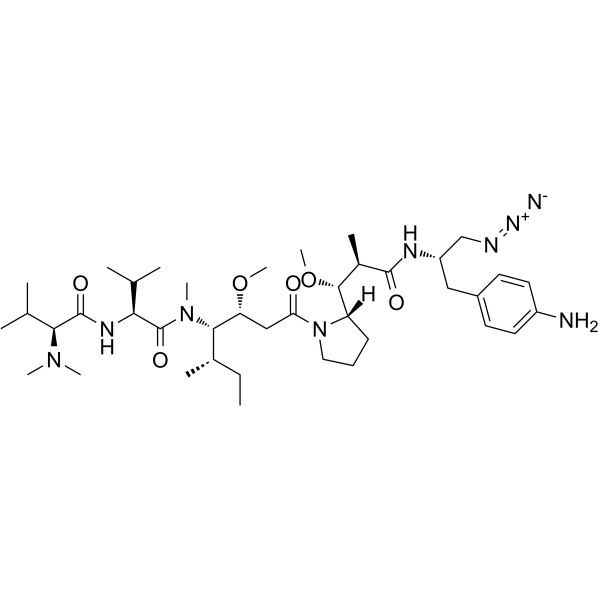
Duostatin 5 is a ADC Cytotoxin designed based on MMAF (HY-15579) and can be used to synthesize ADCs. The preparation of Duostatin 5 has the advantages of fewer synthetic steps, simple operation, less difficulty in quality control, and more stable chemical synthesis process. Duostatin 5 can be linked to the antibody targeting 5T4 (ZV05) by cross-linking with interchain cysteines through a disubstituted C-Lock linker. Duostatin 5 is a click chemistry reagent. It contains an azide group and can undergo copper-catalyzed azide-alkyne cycloaddition (CuAAc) with molecules containing alkyne groups. It can also undergo ring strain-driven alkyne-azide cycloaddition (SPAAC) with molecules containing DBCO or BCN groups[1][2].
loading...
    loading...
Cat. No.: HY-P71142
Purity:  ≥ 95%, as determined by reducing SDS-PAGE.
Synonyms: SERPINB3; Serpin Peptidase Inhibitor, Clade B (Ovalbumin), Member 3; Prev. SCCA1; Serpin B3; Prev. SCC; SCCA-1; Squamous Cell Carcinoma Antigen 1; SCCA-PD; HsT1196; SSCA1; T4-A; SCCA; Serine (Or Cysteine) Proteinase Inhibitor, Clade B (Ovalbumin), Member
Species:  
Human
Source:  
HEK293
loading...
    loading...
Cat. No.: HY-145149S
Duostatin 5- 13C,d3 is the 13C-labeled Duostatin 5 (HY-145149). Duostatin 5 is a ADC Cytotoxin designed based on MMAF (HY-15579) and can be used to synthesize ADCs. The preparation of Duostatin 5 has the advantages of fewer synthetic steps, simple operation, less difficulty in quality control, and more stable chemical synthesis process. Duostatin 5 can be linked to the antibody targeting 5T4 (ZV05) by cross-linking with interchain cysteines through a disubstituted C-Lock linker. Duostatin 5 is a click chemistry reagent. It contains an azide group and can undergo copper-catalyzed azide-alkyne cycloaddition (CuAAc) with molecules containing alkyne groups. It can also undergo ring strain-driven alkyne-azide cycloaddition (SPAAC) with molecules containing DBCO or BCN groups[1][2].
loading...
    loading...

