149 Results for "

apps

" in MedChemExpress (MCE) Product Catalog:
Products (149)

149 Results for "apps" in MCE Product Catalog:

Cat. No.: HY-P3779
CAS No.: 155178-13-5
Synonyms: Aβ(17-42)
Target:  

Apoptosis

Research Areas:  

Neurological Disease

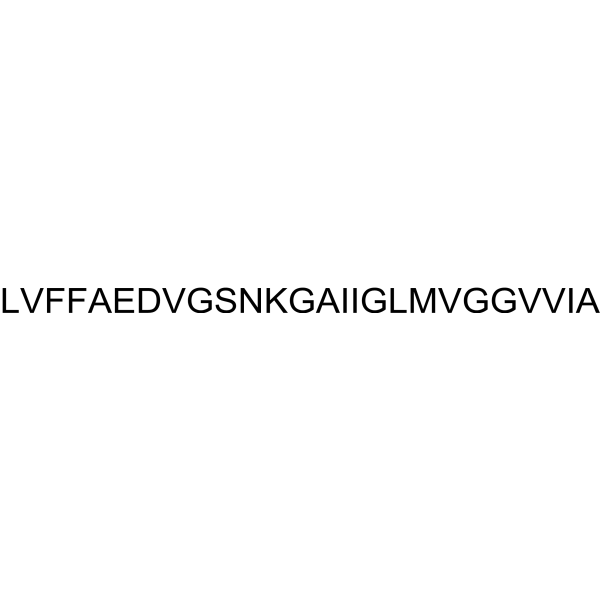
Amyloid 17-42 (Aβ(17-42)) is a major constituent of diffuse plaques in Alzheimer's disease and cerebellar pre-amyloid in Down's syndrome, derived by alpha- and gamma-secretase cleavage of the amyloid precursor protein (APP). Amyloid 17-42 can induce neuronal apoptosis via a Fas-like/caspase-8 activation pathway .
loading...
    loading...
Cat. No.: HY-108041
CAS No.: 820244-38-0
Synonyms: BCI 838
Target:  

mGluR

Research Areas:  

Neurological Disease

MGS 0210 (BCI 838) is an orally active metabolite of glutamate receptor 2/3 (mGluR2/3) agonists. MGS 0210 improves amnesia and reduces anxiety in APP mice. MGS 0210 improves PTSD-related behaviors in a mouse model of post-traumatic stress disorder (PTSD). MGS 0210 can be used in research on neurological disorders such as Alzheimer's disease and major depressive disorder .
loading...
    loading...
Cat. No.: HY-401209
CAS No.: 613226-91-8
Research Areas:  

Neurological Disease

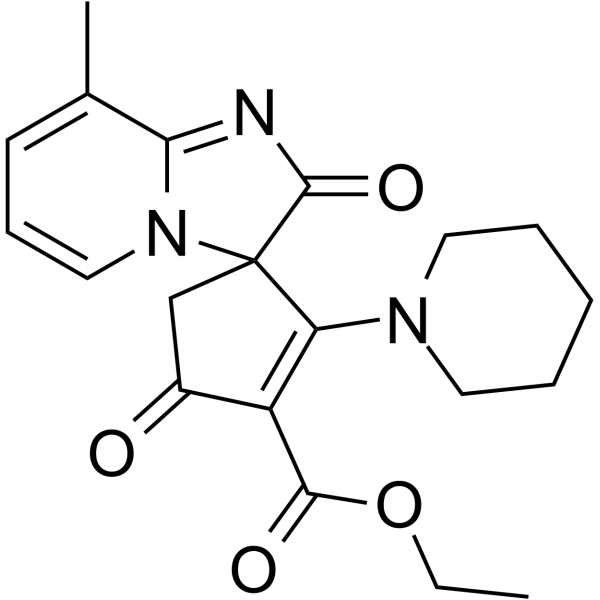
Synucleozid-2.0 is a blood-brain barrier-permeable inhibitor that binds to the IRE of SNCA mRNA, with a EC50 of 2.9 µM and a Kd value of 1.8 µM. Synucleozid-2.0 selectively binds to and stabilizes the A bulge and adjacent closed base pairs in the 5' UTR IRE of SNCA mRNA, blocks the translation process and reduces intracellular levels of α-synuclein. Synucleozid-2.0 exerts cytoprotective effects against cytotoxicity induced by α-synuclein preformed fibrils. Synucleozid-2.0 is applicable to the research of Parkinson's disease .
loading...
    loading...
Cat. No.: HY-103374B
CAS No.: 159652-53-6
Synonyms: (±)-Eseroline phenylcarbamate
Research Areas:  

Neurological Disease

(±)Phenserine ((±)-Eseroline phenylcarbamate) is the racemic form of Phenserine (HY-103374). Phenserine is a derivative of Physostigmine (HY-N6608) and is an effective, non-competitive, long-acting and selective AChE inhibitor. Phenserine can reduce the formation of β-amyloid precursor protein (APP) and β-amyloid peptide (). Phenserine can improve cognitive ability and slow down the progression of Alzheimer's disease .
loading...
    loading...
Cat. No.: HY-180997
Target:  

Amyloid-β

Research Areas:  

Neurological Disease

Aβ aggregation-IN-5 is a brain-penetrant amyloid-β aggregation inhibitor. Aβ aggregation-IN-5 inhibits Aβ aggregation/oligomerization, rescues cells from AB/ROS toxicity and reduces microglial activation/NO production. Aβ aggregation-IN-5 reduces amyloid burden, neuroinflammation, microglial activation in APP/PSEN1 mice. Aβ aggregation-IN-5 can be used for the research of Alzheimer's disease .
loading...
    loading...
Cat. No.: HY-120597
CAS No.: 1256269-87-0
Purity:  99.80%
Target:  

Calcium Channel

Research Areas:  

Neurological Disease

SAK3 is a potent T-type voltage-gated Ca 2+ channels (T-VGCCs) enhancer. SAK3 enhances Cav3.1 and Cav3.3 T-type Ca 2+ channel currents. Acute SAK3 administration improves memory deficits in olfactory-bulbectomized mice . SAK3 inhibits amyloid β plaque formation in APP-KI mice by activating the proteasome activity .
loading...
    loading...
Cat. No.: HY-185723
Target:  

PROTACs G-quadruplex

Research Areas:  

Others

rG4 WT_AHPC_PEG2 is a selective RNA G-quadruplex-based DHX36 PROTAC degrader with a Kd value of 79.7 nM. rG4 WT_AHPC_PEG2 degrades DHX36 via a proteasome-dependent mechanism, without significantly degrading other G4-binding proteins including NCL, DHX9, hnRNP, SRSF and FMR1 .
loading...
    loading...
Cat. No.: HY-125405
CAS No.: 1260248-03-0
Research Areas:  

Neurological Disease

AZ3971 is an orally active, blood-brain barrier permeable BACE1 inhibitor that does not affect the activity of γ-secretase. AZ3971 reduces the production of . AZ3971 can be used for the research of Alzheimer's disease .
loading...
    loading...
Cat. No.: HY-P4919
CAS No.: 1802078-31-4
Target:  

Beta-secretase

Research Areas:  

Others

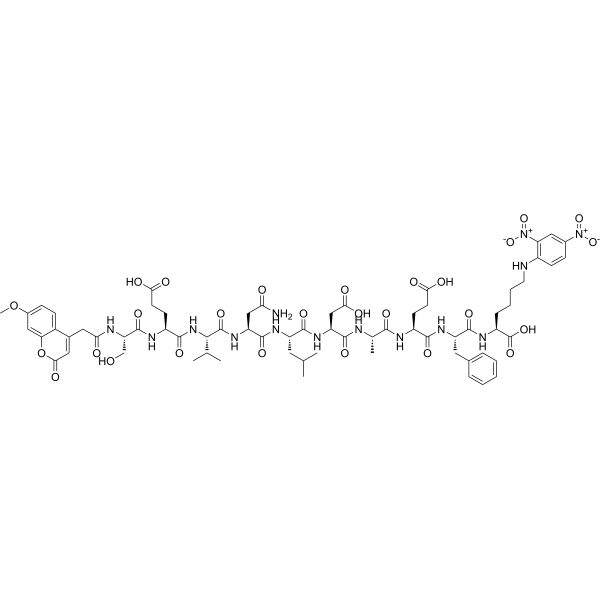
Mca-SEVNLDAEFK(Dnp) is a Beta-secretase 1 (BACE-1) peptide FRET substrate, containing the 'Swedish' Lys-Met/Asn-Leu mutation of the amyloid precursor protein (APP) β-secretase cleavage site. Cleavage at -Leu-Asp- of Mca-SEVNLDAEFK(Dnp) liberates the highly fluorescent 7-methoxycoumarin (Mca) fragment from the proximity quenching effect of the 2,4-dinitrophenyl (Dnp) internal quencher resulting in a large and easily detectable increase in fluorescence intensity.
loading...
    loading...
Cat. No.: HY-P5331
Target:  

Inhibitory Antibodies

Research Areas:  

Others

[Asn23]-beta-Amyloid (1-42), iowa mutation is a biological active peptide. (Several mutations in the beta amyloid precursor gene cause autosomal dominant Alzheimer's Disease in a number of kindreds. The Iowa mutation, where Asp 23 is replaced with Asn, is associated with severe cerebral amyloid beta-protein angiopathy (CAA). The affected individuals share a missense mutation in APP at position 694. The mutated beta-amyloid peptide aggregates more rapidly and forms toxic fibrils.)
loading...
    loading...
Cat. No.: HY-P5365
CAS No.: 374796-72-2
Target:  

Inhibitory Antibodies

Research Areas:  

Others

[Asn23] β-Amyloid (1-40), Iowa mutation is a biological active peptide. (Several mutations in the beta amyloid precursor gene cause autosomal dominant Alzheimer's Disease in a number of kindreds. The Iowa mutation, where Asp 23 is replaced with Asn, is associated with severe cerebral amyloid beta-protein angiopathy (CAA). The affected individuals share a missense mutation in APP at position 694. The mutated beta-amyloid peptide aggregates more rapidly and forms toxic fibrils.)
loading...
    loading...
Cat. No.: HY-161723
CAS No.: 2358754-22-8
Research Areas:  

Neurological Disease

LH2-051, a lysosome-enhancing compound (LYEC), is a brain-penetrant dopamine transporter (DAT) inhibitor (Ki: 0.95 μM). LH2-051 inhibits DAT-mediated dopamine uptake with an IC50 of 3.0 μM. LH2-051 promotes nuclear translocation of TFEB and lysosome biogenesis. LH2-051 improves the memory of amyloid precursor protein (APP)/Presenilin 1 (PS1) mice. LH2-051 can be used for the study of Alzheimer’s disease .
loading...
    loading...
Cat. No.: HY-168859
Target:  

JNK GSK-3 Amyloid-β

Research Areas:  

Neurological Disease

JNK3 inhibitor-9 (Compound 24a) is a potent, selective and BBB-permeable JNK3 inhibitor with an IC50 value of 12 nM. JNK3 inhibitor-9 also potently inhibits GSK3α/β (IC50s: 14 and 35 nM, respectively) involved in Tau phosphorylation. JNK3 inhibitor-9 reduces c-Jun and APP phosphorylation. JNK3 inhibitor-9 protects neurons from 1-42 toxicity .
loading...
    loading...
Cat. No.: HY-147927A
CAS No.: 1802891-23-1
Target:  

Enteropeptidase

Research Areas:  

Metabolic Disease

(S)-Human enteropeptidase-IN-1 (Compound 6c) is an orally active enteropeptidase inhibitor with low systemic exposure (IC50 (initial): 26 nM; IC50 (app): 1.8 nM). (S)-Human enteropeptidase-IN-1 promotes increased fecal protein output and effectively reduces body weight in a diet-induced obese (DIO) rat model. (S)-Human enteropeptidase-IN-1 inhibits enteropeptidase via a reversible covalent mechanism and prolongs the enzyme inactivation time. (S)-Human enteropeptidase-IN-1 can be used in anti-obesity research .
loading...
    loading...
Cat. No.: HY-152846
CAS No.: 2268739-68-8
Synonyms: GDC-8264
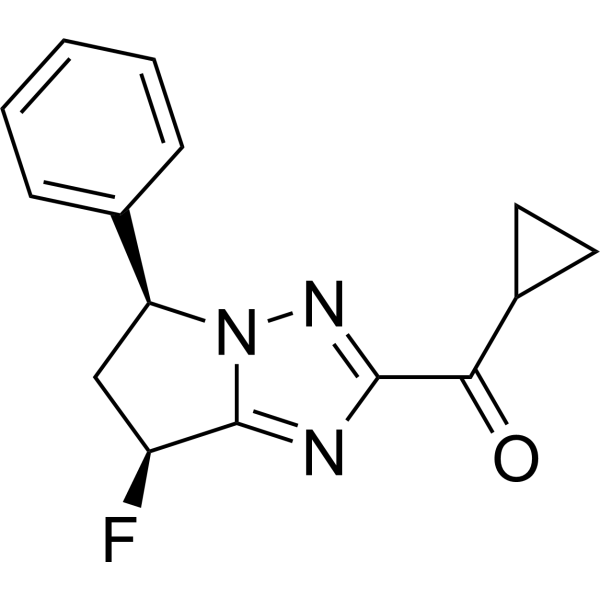
Flizasertib (GDC-8264) is an orally active, reversible and selective RIP1 inhibitor with Ki app values of 0.00071 μM and 0.0013 μM for human and cynomolgus monkey RIP1 kinase, respectively. Flizasertib blocks RIP1 autophosphorylation but does not affect RIP1 protein stability. Flizasertib inhibits pro-inflammatory cytokines (CCL3, CCL4, and IL-1β) production. Flizasertib results in inhibition of colitis and ileitis. Flizasertib can be used in the research of cardiac surgery-associated acute kidney injury .
loading...
    loading...
Cat. No.: HY-168241
CAS No.: 1639925-34-0
Research Areas:  

Infection

Flucopride (Compound 4a) is an AChE inhibitor (IC50: 24 nM), and a partial 5-HT4R agonist (Ki: 9.6 nM for (h)5-HT4R). Flucopride promotes the non-amyloidogenic processing of APP in COS-7 transiently expressing (h)5-HT4R (EC50: 23.0 nM). Flucopride may has good gastrointestinal track (GIT) penetration, and blood-brain barrier (BBB) cross-membrane penetration (PAMPA assay) .
loading...
    loading...
Cat. No.: HY-N13064
CAS No.: 123702-96-5
2,2′,4,4′-Tetrahydroxychalcone (Compound 18) is a selective and potent BACE1 inhibitor with an IC50 of 0.62 μM. 2,2′,4,4′-Tetrahydroxychalcone is a derivative of Isoliquiritigenin (HY-N0102) found in Glycyrrhiza uralensis. 2,2′,4,4′-Tetrahydroxychalcone can block the β-cutting step of amyloid precursor protein (APP), thereby reducing the production of β-amyloid () peptide. 2,2′,4,4′-Tetrahydroxychalcone can be used for research of Alzheimer’s disease .
loading...
    loading...
Cat. No.: HY-W747599
CAS No.: 68652-37-9
Synonyms: ​Tetrasialoganglioside GQ1b sodium
Ganglioside GQ1b (​Tetrasialoganglioside GQ1b) (bovine) sodium is a central and peripheral nervous system ganglioside and an immunostimulator. Ganglioside GQ1b (bovine) sodium modulates NMDA receptor signaling via ERK1/2, PKA, CREB, NR2A, NR2B, and GSK3β, and increases BDNF expression. Ganglioside GQ1b (bovine) sodium reduces pathology, tau phosphorylation, and APP levels. Ganglioside GQ1b (bovine) sodium can be used for the research of Alzheimer’s disease .
loading...
    loading...
Cat. No.: HY-161953
Target:  

OGA

Research Areas:  

Neurological Disease

O-GlcNAcase-IN-2 (compound 81) is an orally effective, blood-brain barrier-permeable OGA inhibitor (IC50=4.93 nM). O-GlcNAcase-IN-2 can increase the O-GlcNAcylation level of proteins and phosphorylation of tau (p-Ser199, p-Thr205 and p-Ser396) in the OA-damaged SH-SY5Y cell model. O-GlcNAcase-IN-2 can also improve cognitive impairment in APP/PS1 mice and has potential anti-Alzheimer's disease (AD) effects .
loading...
    loading...
Cat. No.: HY-13438A
CAS No.: 1421852-78-9
Target:  

Beta-secretase

Research Areas:  

Cancer

AZD3839 fumarate is an orally available, selective, reversible inhibitor of the β-site amyloid precursor protein cleaving enzyme BACE1 that can cross the blood-brain barrier. AZD3839 fumarate inhibits recombinant human BACE1 with a Ki=26.1 nM. AZD3839 fumarate inhibits A40 production in SH-SY5Y cells with an IC50 of 4.8 nM. AZD3839 fumarate binds to BACE1 and reduces the Aβ amyloid produced by the cleavage of amyloid precursor protein (APP) by BACE1 and γ-secretase. AZD3839 fumarate can be used in the field of Alzheimer's disease research .
loading...
    loading...