177 Results for "

auto-phosphorylation

" in MedChemExpress (MCE) Product Catalog:
Products (177)

177 Results for "auto-phosphorylation" in MCE Product Catalog:

Cat. No.: HY-W751180
Synonyms: CGP52421-13C6
3-Hydroxy Midostaurin- 13C6 (CGP52421- 13C6) is the 13C-labeled 3-Hydroxy Midostaurin (HY-108263). 3-Hydroxy Midostaurin (CGP 52421), a metabolite of PKC412, effectively inhibits FMS-like tyrosine kinase-3 (FLT3) autophosphorylation with IC50s of approximately 132 nM and 9.8 μM in culture medium and plasma, respectively. 3-Hydroxy Midostaurin is less selective but more cytotoxic than PKC412 .
loading...
    loading...
Cat. No.: HY-112345
CAS No.: 179343-17-0
Purity:  98.07%
Target:  

FGFR PDGFR EGFR Src

Research Areas:  

Cancer

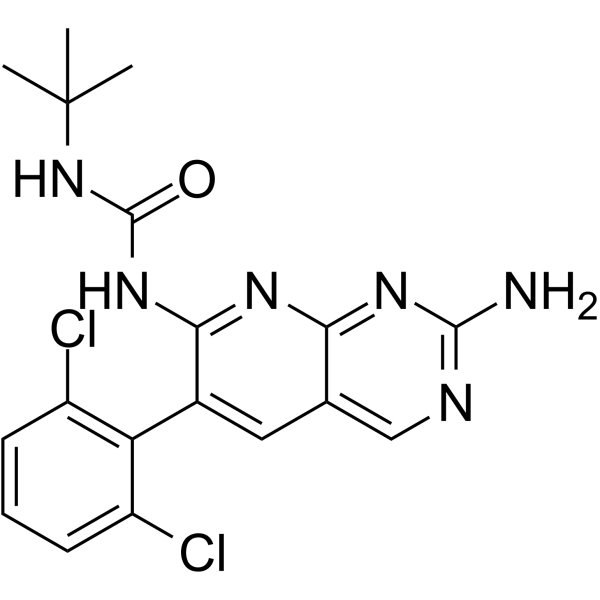
PD-089828 is an ATP competitive inhibitor of FGFR-1, PDGFR-β and EGFR (IC50s=0.15, 1.76, and 5.47 µM, respectively) and a noncompetitive inhibitor of c-Src tyrosine kinase (IC50=0.18 µM). PD-089828 also inhibits MAPK with an IC50 of 7.1 µM. PD-089828 inhibits PDGF-, EGF- and bFGF-mediated tyrosine kinase receptor autophosphorylation in vitro. PD-089828 has a long-lasting cellular activity .
loading...
    loading...
Cat. No.: HY-113787
CAS No.: 1655527-68-6
Purity:  99.51%
(R)-9b is an ATP-competitive kinase inhibitor. (R)-9b binds to the ATP-binding site of ACK1/TNK2, inhibiting their kinase activity and autophosphorylation, with a human IC50 of 56 nM. (R)-9b also inhibits JAK2, Tyk2, ALK, c-Src, ABL1, CHK1, FGFR1, LCK, and ROS/ROS1. (R)-9b can be used for research on prostate cancer .
loading...
    loading...
Cat. No.: HY-118304A
CAS No.: 1175017-91-0
Target:  

FLT3 Apoptosis Caspase

Research Areas:  

Cancer

AKN-028 TFA, a novel tyrosine kinase (TK) inhibitor, is a potent, orally active FMS-like receptor tyrosine kinase 3 (FLT3) inhibitor with an IC50 value of 6 nM. AKN-028 TFA inhibits FLT3 autophosphorylation. AKN-028 TFA induces dose-dependent cytotoxic response (mean IC50=1 μM). AKN-028 TFA induces apoptosisby activation of caspase 3. AKN-028 TFA can be used in research of acute myeloid leukemia (AML) .
loading...
    loading...
Cat. No.: HY-152846
CAS No.: 2268739-68-8
Synonyms: GDC-8264
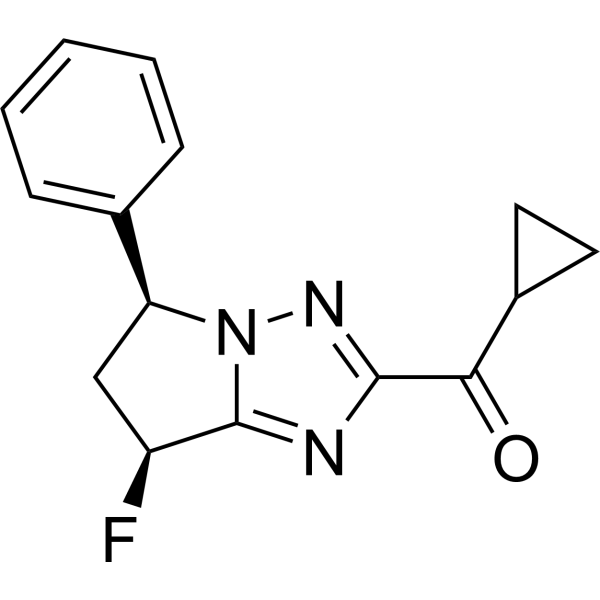
Flizasertib (GDC-8264) is an orally active, reversible and selective RIP1 inhibitor with Ki app values of 0.00071 μM and 0.0013 μM for human and cynomolgus monkey RIP1 kinase, respectively. Flizasertib blocks RIP1 autophosphorylation but does not affect RIP1 protein stability. Flizasertib inhibits pro-inflammatory cytokines (CCL3, CCL4, and IL-1β) production. Flizasertib results in inhibition of colitis and ileitis. Flizasertib can be used in the research of cardiac surgery-associated acute kidney injury .
loading...
    loading...
Cat. No.: HY-118084
CAS No.: 368836-72-0
Synonyms: Tyrene CR-4
LS-104 (Tyrene CR-4) is a non-ATP-competitive kinase inhibitor against JAK2, Bcr-Abl and FLT3. LS-104 potently induces apoptosis in JAK2V617F-positive cells and inhibits JAK2 autophosphorylation and downstream signal transduction. LS-104 also inhibits proliferation and induces potent cytotoxic effects in FLT3 expressing leukemic cells. LS-104 is a hydroxystyryl-acrylonitrile compound, which is promising for research of myeloproliferative disorders and refractory/relapsed hematologic malignancies .
loading...
    loading...
Cat. No.: HY-164469
CAS No.: 2479290-65-6
Target:  

Bcr-Abl Apoptosis STAT

Research Areas:  

Cancer

CHMFL-48 is an orally active BCR-ABL kinase inhibitor targeting both wild-type (wt) and various imatinib-resistant mutants. The IC50 values for CHMFL-48 against ABL wild-type and ABL T315I mutant are 1 nM and 0.8 nM, respectively. CHMFL-48 exerts its effects by blocking the autophosphorylation of BCR-ABL wild-type and mutant forms, which impacts downstream signaling mediators such as STAT5 and CRKL, leading to cell cycle arrest and induction of apoptosis. CHMFL-48 holds potential for research into chronic myeloid leukemia (CML) .
loading...
    loading...
Cat. No.: HY-185227
CAS No.: 1394837-94-5
Research Areas:  

Cancer

EphB4-IN-1 is a selective EphB4 tyrosine kinase inhibitor with IC50 values of 0.16-0.30 μM. EphB4-IN-1 binds to the ATP binding site of EphB4 in a DFG-in conformation, forming four stable intermolecular hydrogen bonds. EphB4-IN-1 also inhibits Src, Abl1, Lck, and EGFR kinases. EphB4-IN-1 inhibits EphB4 autophosphorylation. EphB4-IN-1 can be used for the research of cancer, such as non small cell lung cancer .
loading...
    loading...
Cat. No.: HY-189065
CAS No.: 2765654-79-1
Target:  

LRRK2

Research Areas:  

Neurological Disease

STF-3600 is a LRRK2 G2019S inhibitor with an IC50 of 0.9 nM against the human target. It has oral activity and can cross the blood-brain barrier. STF-3600 selectively inhibits kinase activity, including autophosphorylation at Ser935 and Ser1292, as well as phosphorylation of the endogenous substrate Rab10 at Thr73. STF-3600 inhibits vacuolization of type II pulmonary epithelial cells in wild-type/heterozygous mice, while it induces this vacuolization phenotype in homozygous mice. STF-3600 can be used in Parkinson's disease research .
loading...
    loading...
Cat. No.: HY-189651
Research Areas:  

Cancer

c-Met-IN-32 is an orally active c-Met inhibitor with an IC50 of 18 nM, blocking autophosphorylation and downstream PI3K/AKT and RAS/ERK signaling pathways. c-Met-IN-32 inhibits MER, FYN, and SRC kinases. c-Met-IN-32 induces apoptosis, inhibits migration and invasion, suppresses the proliferation of MET-amplified cancer cells, and exhibits selectivity against non-MET-dependent cancer cell lines. c-Met-IN-32 can be used for research on non-small cell lung cancer .
loading...
    loading...
Cat. No.: HY-135167
CAS No.: 867178-11-8
Target:  

CaMK

Research Areas:  

Neurological Disease

HOCPCA is a compound with neuroprotective activity that improves sensorimotor function in mice after experimental stroke. HOCPCA selectively binds to the CaMKIIα hub domain, modulates signaling of different CaMKII pools, and alleviates abnormal CaMKII signaling after cerebral ischemia. HOCPCA promotes hippocampal neuronal activity and enhances working memory. HOCPCA also normalizes Thr286 autophosphorylation in the cytoplasm after ischemia and downregulates ischemia-specific expression of active CaMKII enzymatic cleavage fragments. HOCPCA binds to the GHB binding site with 27-fold higher affinity than GHB and has good blood-brain barrier penetration ability .
loading...
    loading...
Cat. No.: HY-176556
CAS No.: 3052761-67-5
Target:  

EGFR

Research Areas:  

Cancer

EGFR-IN-1671 is a selective EGFR inhibitor with an IC50 of 0.19 nM. EGFR-IN-167 exhibits good potency against various EGFR mutants (IC50 = 0.109 nM, 0.75 nM and <0.05 nM against EGFR (L858R), EGFR (C797S) and EGFR (del19), respectively). EGFR-IN-1671 covalently engages the catalytically conserved lysine of EGFR in live mammalian cells. EGFR-IN-1671 demonstrates excellent anti-proliferative activity by inhibiting EGFR autophosphorylation. EGFR-IN-1671 can be used for the study of non-small-cell lung carcinomas (NSCLC), glioblastoma and many solid tumors .
loading...
    loading...
Cat. No.: HY-124865
CAS No.: 2113617-02-8
Target:  

MAP3K IKK

Research Areas:  

Cancer

MAP3K14-IN-1 (Compound 173) is a MAP3K14 (NIK kinase) inhibitor with an IC50 of 1.8 nM. MAP3K14-IN-1 inhibits the autophosphorylation of MAP3K14 kinase. MAP3K14-IN-1 reduces the level of phosphorylated IKKα in cancer cells. MAP3K14-IN-1 inhibits the proliferation of multiple myeloma cells. MAP3K14-IN-1 can be used in research related to multiple myeloma .
loading...
    loading...
Cat. No.: HY-160096
CAS No.: 1360628-91-6
Research Areas:  

Cancer

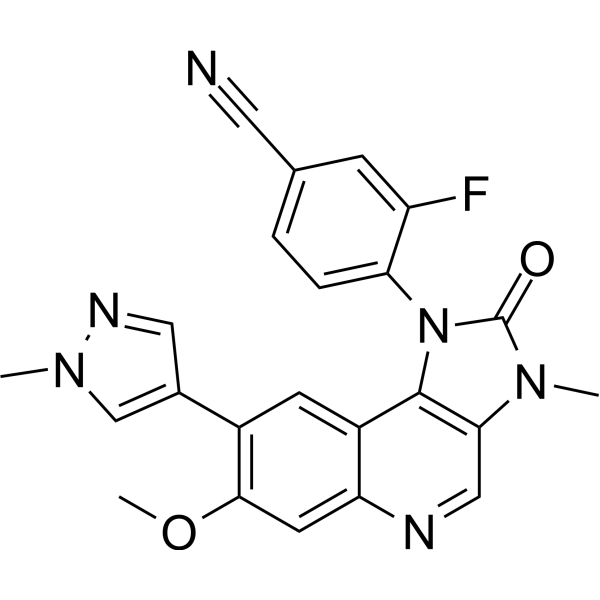
M3541 is an orally effective DNA-dependent protein kinase (DNA-PK) inhibitor . M3541 inhibits ionizing radiation-induced ATM autophosphorylation and phosphorylation of downstream substrates (KAP1, CHK2, p53), blocks DSB end resection and homologous recombination repair, and simultaneously induces non-homologous end joining, G2-M phase arrest, polyploidization, and cell death. M3541 can be used for research on solid tumors, acute myeloid leukemia, non-small cell lung cancer, triple-negative breast cancer, etc. .
loading...
    loading...
Cat. No.: HY-184161
Target:  

FLT3 STAT Akt ERK Apoptosis

Research Areas:  

Cancer

FYJ-195 is a potent orally active FLT3 inhibitor targeting FLT3 and its variants FLT3-ITD, FLT3-F691L, FLT3-D835V, FLT3-D835Y. FYJ-195 blocks FLT3 autophosphorylation and downstream STAT5, AKT, ERK signaling pathways, and induces apoptosis. FYJ-195 induces tumor regression in mouse acute myeloid leukemia (AML) xenograft models. FYJ-195 can be used for the research of AML .
loading...
    loading...
Cat. No.: HY-162888
CAS No.: 2376694-72-1
Target:  

PDGFR ERK

Research Areas:  

Cardiovascular Disease

WQ-C-401 is an orally active platelet-derived growth factor receptor (PDGFR) inhibitor. WQ-C-401 inhibits cell proliferation by blocking PDGFR autophosphorylation in a concentration-dependent manner, with EC50 values of 3.5 nM for PDGFRα Y849 and 5.8 nM for PDGFRβ Y1021. Additionally, WQ-C-401 can inhibit PASMCs proliferation and migration by blocking PDGF-BB-induced ERK1/2 phosphorylation, reducing collagen I synthesis, and increasing α-SMA expression, thereby preventing pulmonary vascular remodeling. WQ-C-401 holds promise for research in the field of pulmonary arterial hypertension .
loading...
    loading...
Cat. No.: HY-182937
CAS No.: 3100242-36-9
Research Areas:  

Cancer

FLC-8 is an orally active FLT3 inhibitor with IC50 values of 10.2 nM, 11.6 nM and 24.10 nM against human FLT3-WT, FLT3-G697R and FLT3-N676D, respectively. FLC-8 inhibits FLT3 autophosphorylation and downstream STAT5, AKT and ERK signaling pathways, and induces apoptosis in acute myeloid leukemia (AML) cells. FLC-8 exhibits potent antitumor activity in the MV4-11 xenograft model. FLC-8 can be used for the research of acute myeloid leukemia .
loading...
    loading...
Cat. No.: HY-10325R
CAS No.: 194423-06-8
Synonyms: EKI-785 (Standard); WAY-EKI 785 (Standard)
Research Areas:  

Endocrinology Cancer

CL-387785 (EKI-785; WAY-EKI 785) (Standard) is the analytical standard of CL-387785 (HY-10325). This product is intended for research and analytical applications. CL-387785 is an orally active EGFR inhibitor with an IC50 of 370 pM. CL-387785 inhibits EGF-stimulated EGFR autophosphorylation with an IC50 of approximately 5 nM. CL-387,785 exerts selective inhibition on cell lines overexpressing EGFR or c-erbB-2, whereas it shows weak inhibitory effects on cell lines with low expression of these two receptors. CL-387785 effectively induces cell cycle arrest and apoptosis. CL-387785 can be used for the research of non-small cell lung cancer and autosomal recessive polycystic kidney disease.
loading...
    loading...
Cat. No.: HY-178343
Target:  

Aurora Kinase Apoptosis

Research Areas:  

Cancer

Aurora A-IN-5 is a potent and highly selective Aurora A inhibitor (IC50 = 0.02 μM), showing 362-fold selectivity for over Aurora B. Aurora A-IN-5 shows its selectivity through unique C−H/π interactions, enhanced hydrophobic contacts, an open binding pocket, and tighter protein packing. Aurora A-IN-5 suppresses Aurora A autophosphorylation, thereby inhibiting cancer cell proliferation by inducing G2/M phase arrest, triggering apoptosis, and suppressing colony formation. Aurora A-IN-5 inhibits tumor growth in MDA-MB-231 xenograft mouse models. Aurora A-IN-5 can be used for breast, cervical, prostate, and lymphoma cancer research .
loading...
    loading...
Cat. No.: HY-109566R
CAS No.: 2089288-03-7
Synonyms: AZD1390 (Standard)
Elrelesertib (Standard) (AZD1390 (Standard)) is the analytical standard of Elrelesertib (AZD1390) (HY-109566). This product is intended for research and analytical applications. Elrelesertib (AZD1390) is an orally active, brain-penetrant ATM kinase inhibitor with IC50 values of 0.78 nM. Elrelesertib blocks ATM-dependent DNA damage response, inhibits ATM autophosphorylation and downstream Chk2, Rad50 phosphorylation, and accumulates at DNA breaks. Elrelesertib acts as a radiosensitizer, induces apoptosis, genomic instability, G2-M cell cycle arrest, ROS elevation, and mitochondrial membrane potential alteration. Elrelesertib has low efflux liability against P-gp and BCRP. Elrelesertib can be used for the research of central nervous system malignancies, glioblastoma multiforme, glioma, lung cancer brain metastases, and breast cancer .
loading...
    loading...

