

12 Results for "

β-sheet protein

" in MedChemExpress (MCE) Product Catalog:
Products (12)

12 Results for "β-sheet protein" in MCE Product Catalog:

1
1 Cited Publications
Cat. No.: HY-W105970
CAS No.: 7758-16-9
Synonyms: Disodium pyrophosphate; Sodium acid pyrophosphate; SAPP
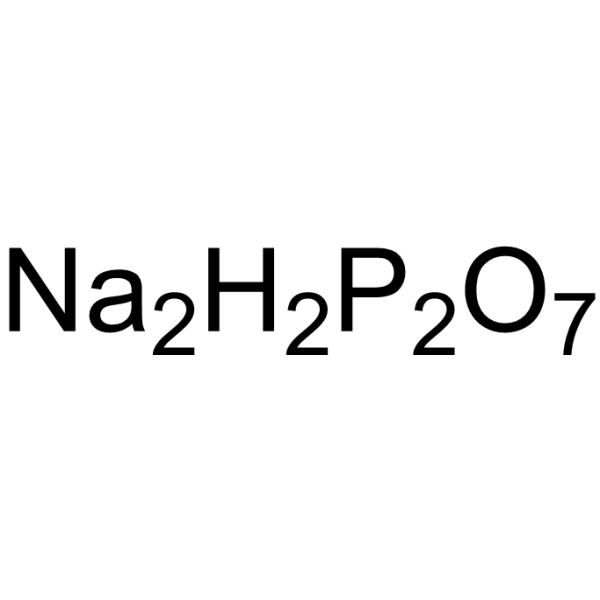
Sodium pyrophosphate (Disodium pyrophosphate) is an orally active reverse transcriptase ribonuclease H inhibitor. Sodium pyrophosphate forms soluble complexes with iron from ferric pyrophosphate to promote intestinal iron absorption. Sodium pyrophosphate increases the β-sheet content of oxidatively damaged myofibrillar protein gels and enhances the gastric digestibility and antioxidant activity of their digestion products. Sodium pyrophosphate prevents the degradation of RNA-DNA hybrids, inhibits antisense complementary DNA synthesis, induces phage DNA leakage, and causes random mutations in temperate phages .
loading...
    loading...
Cat. No.: HY-137557
CAS No.: 1565797-16-1
Synonyms: APN1607; PM-PBB3
Target:  

Tau Protein

Research Areas:  

Neurological Disease

Florzolotau (APN1607) is a positron emission tomography (PET) ligand that can be used for the detection of Alzheimer's disease (AD) and other tau proteinopathies. Its binding sites are located in the β-sheet of paired helical filaments (PHFs) and straight filaments (SFs) of tau protein, as well as in the C-shaped cavity of SFs. In addition, APN-1607 binds to intraneuronal inclusions in Alzheimer's disease (AD), primary age-related tauopathy (PART) and posterior cortical atrophy (PCA). Florzolotau shows promise for PET imaging studies of neurological disorders, particularly tau proteinopathies .
loading...
    loading...
Cat. No.: HY-P1889
CAS No.: 721885-31-0
Target:  

Bcl-2 Family Amyloid-β

Research Areas:  

Neurological Disease

Bim BH3, Peptide IV is an Aβ42-binding peptide and the pro-apoptotic BH3 domain of the BIM protein. Bim BH3, Peptide IV binds Aβ42 with a Kd of 7.1 μM. Bim BH3, Peptide IV modulates Aβ42 structure, fibrillization pathways, aggregate morphology, and membrane interactions, inhibiting fibril formation while enhancing protofibril assembly. Bim BH3, Peptide IV promotes Aβ42 β-sheet formation and accelerates aggregation. Bim BH3, Peptide IV enhances Aβ42 membrane internalization and bilayer stiffening. Bim BH3, Peptide IV induces neuronal cell death by enhancing BH3-induced membrane interactions of Aβ42 prefibrillar species. Bim BH3, Peptide IV can be used for research on Alzheimer's disease .
loading...
    loading...
Cat. No.: HY-W835959
CAS No.: 2361566-66-5
Target:  

Tau Protein

Research Areas:  

Neurological Disease

ACI-3024 is an an orally active and highly selective Tau protein aggregation inhibitor. ACI-3024 decrease the β-sheet content and seeding properties of pathological Tau from different Tauopathies, leading to a significant rescue of the Tau-induced neurodegeneration and neuroinflammation in a cellular model. ACI-3024 is promising for research of neurodegenerative diseases .
loading...
    loading...
Cat. No.: HY-P4882
CAS No.: 183449-57-2
Target:  

Amyloid-β Tau Protein

Research Areas:  

Neurological Disease

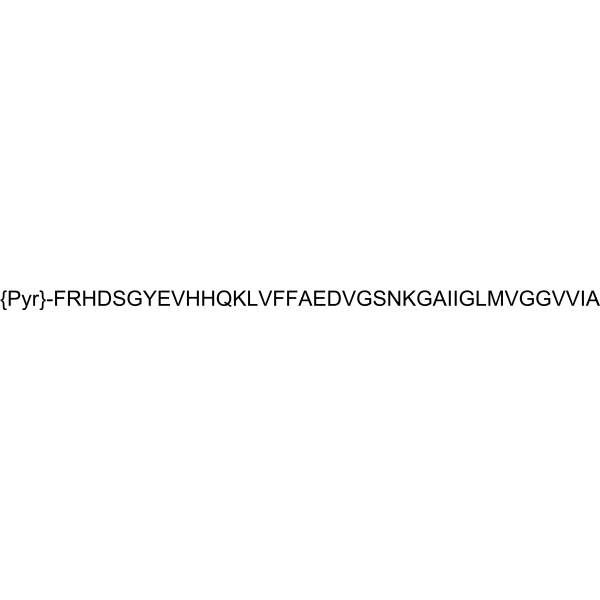
(Pyr3)-Amyloid β-Protein (3-42) is an N-terminally truncated pyroglutamylated β-amyloid peptide. (Pyr3)-Amyloid β-Protein (3-42) forms stable β-sheet structures across different pH values, co-oligomerizes with Aβ1-42 to form cytotoxic oligomers, induces tau-dependent cytotoxicity and neuronal loss, inhibits hippocampal LTP, and exhibits stronger protease resistance. (Pyr3)-Amyloid β-Protein (3-42) exists in the brain tissues of human Alzheimer's disease patients, correlates with the pathogenesis of Alzheimer's disease, and follows a unique, faster oligomerization pathway. (Pyr3)-Amyloid β-Protein (3-42) can be used in Alzheimer's disease-related research .
loading...
    loading...
Cat. No.: HY-P4873
CAS No.: 118068-30-7
Target:  

Amylin Receptor

Research Areas:  

Neurological Disease

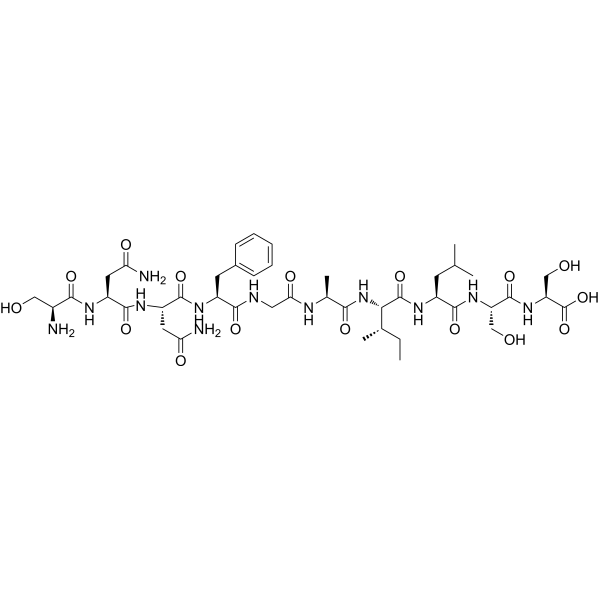
Amylin (20-29) (human) is the fragment of human islet amyloid polypeptide (hIAPP) or Amylin. Amylin is a 37-residue hormone. Amylin (20-29) (human) is responsible for the amyloidogenic propensities of the full length protein. Amylin (20-29) (human) can be transformed into its corresponding peptoid and retropeptoid sequences, to obtain beta-sheet breaker peptides as amyloid inhibitors .
loading...
    loading...
Cat. No.: HY-P1889A
Target:  

Bcl-2 Family Amyloid-β

Research Areas:  

Neurological Disease

Bim BH3, Peptide IV TFA is an Aβ42-binding peptide and the pro-apoptotic BH3 domain of the BIM protein. Bim BH3, Peptide IV TFA binds Aβ42 with a Kd of 7.1 μM. Bim BH3, Peptide IV TFA modulates Aβ42 structure, fibrillization pathways, aggregate morphology, and membrane interactions, inhibiting fibril formation while enhancing protofibril assembly. Bim BH3, Peptide IV TFA promotes Aβ42 β-sheet formation and accelerates aggregation. Bim BH3, Peptide IV TFA enhances Aβ42 membrane internalization and bilayer stiffening. Bim BH3, Peptide IV TFA induces neuronal cell death by enhancing BH3-induced membrane interactions of Aβ42 prefibrillar species. Bim BH3, Peptide IV TFA can be used for research on Alzheimer's disease .
loading...
    loading...
Cat. No.: HY-P5340
CAS No.: 339091-39-3
Target:  

Inhibitory Antibodies

Research Areas:  

Others

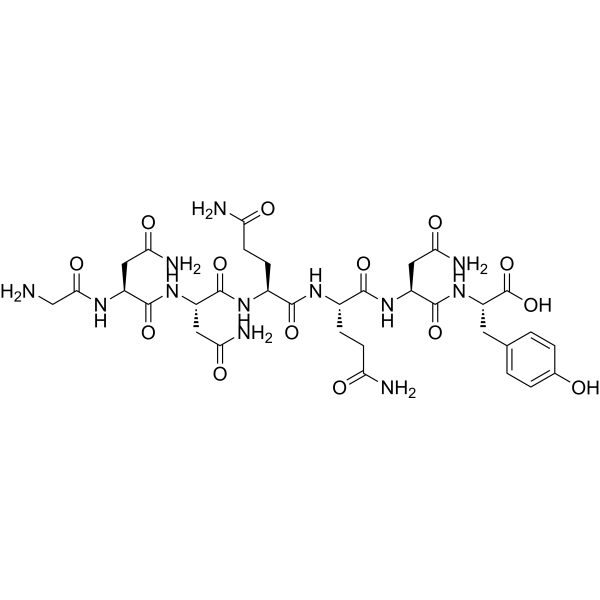
Amyloid-Forming peptide GNNQQNY is a biological active peptide. (This is a heptapeptide from the N-terminal prion-determining domain of the yeast protein Sup35 that forms amyloid fibrils. The availability of its detailed atomic oligomeric structure makes it a good model for studying the early stage of aggregation. The GNNQQNY dimer forms three stable sheet structures. in-register parallel, off-register parallel, and anti-parallel. The in-register parallel dimer, which is close to the amyloid beta-sheet structure, has few interpeptide hydrogen bonds, making hydrophobic interactions more important and increasing the conformational entropy compared to the anti-parallel sheet.)
loading...
    loading...
Cat. No.: HY-D3430
PTPA-QM is a low-cytotoxicity Aβ protein probe that can be used for live-cell imaging and tissue section staining (Lys. Ex/Em = 385/615 nm). PTPA-QM can intercalate into the β-sheet layered structure of β-amyloid fibrils, form intermolecular interactions with amino acid residues, restrict intramolecular rotation and trigger fluorescence activation for imaging purposes. PTPA-QM is applicable to Alzheimer's disease-related research. Maximum excitation/emission wavelength: 448/605 nm .
loading...
    loading...
Cat. No.: HY-P11908
PQK7 is an α-synuclein (α-synuclein) binder with a Kd value of 4 μM. PQK7 binds to key residues in the NAC region of ⍺-Syn, enhances the fluctuation of ⍺-Syn, reduces β-sheet content, maintains the solubility of ⍺-Syn monomers, and preserves the normal function of the protein. PQK7 reduces the toxicity of ⍺-Syn aggregates, restores cell cycle progression, decreases apoptosis (apoptosis), and inhibits ROS production. PQK7 can be used for the research of Parkinson's disease .
loading...
    loading...
Cat. No.: HY-167189
CAS No.: 682763-67-3
Target:  

Tau Protein Amyloid-β

Research Areas:  

Neurological Disease

BF-158 is a quinoline-based Tau Protein fluorescent imaging probe that produces specific staining by recognizing the β-sheet structure of paired helical filaments (PHF)/neurofibrillary tangles (NFT) in tau aggregates, with EC50 values of 399 nM and 659 nM for tau fibrils and Aβ1-42 fibrils, respectively. BF-158 preferentially labels NFTs, neuropil threads, and PHF-type neurites. BF-158 is useful for the study and imaging of tau pathology in Alzheimer's disease .
loading...
    loading...
Cat. No.: HY-137557A
Synonyms: (E/Z)-APN1607; (E/Z)-PM-PBB3
Target:  

Tau Protein

Research Areas:  

Neurological Disease

(E/Z)-Florzolotau ((E/Z)-APN1607) is a mixed configuration or unspecified configuration of Florzolotau (HY-137557). Florzolotau (APN1607) is a positron emission tomography (PET) ligand that can be used for the detection of Alzheimer's disease (AD) and other tau proteinopathies. Its binding sites are located in the β-sheet of paired helical filaments (PHFs) and straight filaments (SFs) of tau protein, as well as in the C-shaped cavity of SFs. In addition, APN-1607 binds to intraneuronal inclusions in Alzheimer's disease (AD), primary age-related tauopathy (PART) and posterior cortical atrophy (PCA). Florzolotau shows promise for PET imaging studies of neurological disorders, particularly tau proteinopathies .
loading...
    loading...
  • 1

