9 Results for "

BRCA mutated cancers

" in MedChemExpress (MCE) Product Catalog:
Products (9)

9 Results for "BRCA mutated cancers" in MCE Product Catalog:

3
3 Cited Publications
Cat. No.: HY-122639
CAS No.: 591239-68-8
Purity:  99.33%
Target:  

NEKs

Research Areas:  

Cancer

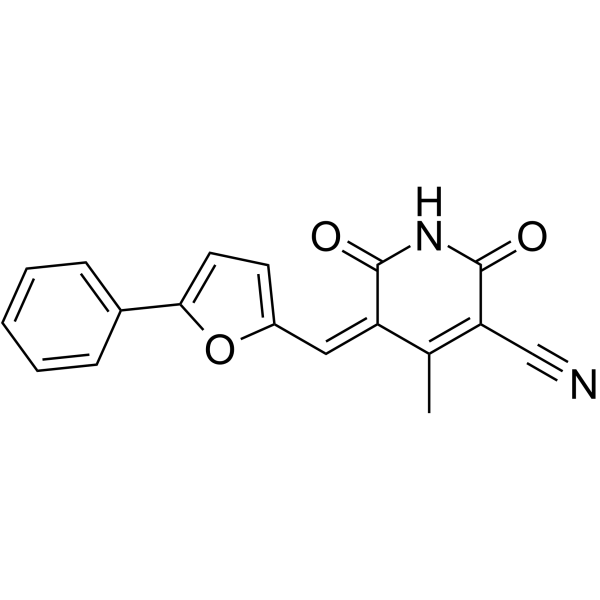
ZINC05007751 is a potent NIMA-related kinase NEK6 inhibitor with an IC50 of 3.4 μM. ZINC05007751 shows antiproliferative activity against a panel of human cancer cell lines, and displays a synergistic effect with Cisplatin and Paclitaxel in a BRCA2 mutated ovarian cancer cell line. ZINC05007751 is very selective against NEK1 and NEK6 with no significant activity was observed against NEK2, NEK7, and NEK9 .
loading...
    loading...
Cat. No.: HY-179219S
CAS No.: 3035072-99-9
RTx-303 is an orally active, selective DNA polymerase θ (Polθ) inhibitor (IC50 = 5.1 nM). RTx-303 exhibits significantly high cellular potency and strongly potentiates PARPi in BRCA1/2 mutant cells and patient-derived xenograft models. RTx-303 can be used for the study of BRCA2-mutated breast cancer .
loading...
    loading...
Cat. No.: HY-171543
CAS No.: 952474-39-4
Target:  

PARP

Research Areas:  

Cancer

PARP1-IN-37 (Compound 8) is an orally active and selective poly(ADP-ribose) polymerase 1 and 2 (PARP1/2) inhibitor with an IC50 value of 24 nM for PARP1. PARP1-IN-37 inhibits PARP activity in cells with an EC50 value of 3.7 μM. PARP1-IN-37 is promising for research of BRCA-mutated tumors, such as breast and ovarian cancers .
loading...
    loading...
Cat. No.: HY-161934
Research Areas:  

Cancer

PARP1-IN-27 (Compound 9B) is the inhibitor for PARP1 and PARP2, with IC50 of 2.53 nM and 6.45 nM in cell SUM149PT. PARP1-IN-27 inhibits the proliferation of BRCA-mutated cancer cells SUM149PT, HCC1937 and Capan-1, with IC50 of 0.62, 1.91 and 4.26 μM respectively. PARP1-IN-27 aggravates DNA double-strand breaks, increases ROS generation, arrests cell cycle at G2/M phase, and induces apoptosis in SUM149PT .
loading...
    loading...
Cat. No.: HY-183363
Target:  

Deubiquitinase

Research Areas:  

Cancer

USP1-IN-17 is an orally active USP1/UAF1 complex inhibitor. USP1-IN-17 exhibits potent anti-proliferative activity against BRCA1-mutant human breast cancer MDA-MB-436 cells, with an IC50 value of 8.1 nM. USP1-IN-17 binds to USP1 to stabilize the enzyme conformation, impairs deubiquitination function, elevates the monoubiquitination level of PCNA, inhibits cancer cell proliferation, and induces DNA damage accumulation. USP1-IN-17 can be used for the research of BRCA1-mutated cancers .
loading...
    loading...
Cat. No.: HY-183630
CAS No.: 3045469-78-8
Target:  

DNA/RNA Synthesis

Research Areas:  

Cancer

AZD4956 is a potent and selective DNA polymerase theta (POLQ) inhibitor. AZD4956 exhibits an IC50 value of less than 3 μmol/L against POLQ and 3.4 μmol/L against MMEJ. AZD4956 suppresses the MMEJ pathway and enhances the activity of DNA-damaging agents in HRR-deficient cellular contexts. AZD4956 shows antitumor activity in BRCA1/2-mutated triple-negative breast cancer and prostate cancer models. AZD4956 can be used for the study of homologous recombination-deficient tumors .
loading...
    loading...
Cat. No.: HY-180216
Target:  

Deubiquitinase

Research Areas:  

Cancer

USP1-IN-15 is an orally active and selective USP1 inhibitor with an IC50 of 12.3 nM. USP1-IN-15 has a high specificity for USP1 with negligible inhibition against all off-target DUBs. USP1-IN-15 suppresses colony formation, induces S-phase arrest, and stabilizes ubiquitinated PCNA. USP1-IN-15 also shows synergistic antiproliferative activity. USP1-IN-15 achieves significant tumor growth inhibition in vivo. USP1-IN-15 can be used for BRCA-mutated breast cancer .
loading...
    loading...
Cat. No.: HY-L077
4,336 compounds

Pancreatic cancer is a devastating disease with a low overall survival rate. Chemotherapy is the most common treatment for patients presenting with advanced pancreatic cancer. More recently, the era of targeted therapies has generated a lot of interest in discovering better approaches for patients with pancreatic cancer. Commonly mutated genes in pancreatic cancer include K-ras (in 74-100% of cases), p16INK4a (up to 98%), p53 (43 to 76%), DPC4 (about 50%), HER-2/neu (in about 65%) and FHIT (found in 70% of cases). Other genes involved are notch1, Akt-2, BRCA2 and COX-2. These proteins are important targets of target therapies for pancreatic cancer.

MCE offers a unique collection of 4,336 compounds with identified and potential anti- pancreatic cancer activity. These compounds target K-Ras, p53, HER2, Notch, AKT, etc. MCE anti-pancreatic cancer compound library is a useful tool for anti-pancreatic cancer drugs screening and other related research.

Cat. No.: HY-185459
Research Areas:  

Cancer

PCIP-1 is a PARP2 inhibitor. PCIP-1 recruits BET proteins to PARP2 to inhibit DNA repair, acts via event-driven pharmacology, and does not inhibit PARP-catalyzed PARylation. PCIP-1 inhibits DNA repair, thereby inducing synthetic lethality in homologous recombination-deficient cancer cells and increasing the sensitivity of PARP1-knockout cells. PCIP-1 can be used in the research of homologous recombination-deficient cancers, T-cell acute lymphoblastic leukemia, and BRCA-mutant cancers .
loading...
    loading...

