

16 Results for "

CACS

" in MedChemExpress (MCE) Product Catalog:
Products (16)

16 Results for "CACS" in MCE Product Catalog:

2
2 Cited Publications
Cat. No.: HY-P99151
CAS No.: 2088770-90-3
Synonyms: CAC-10

Research Areas:  

Cancer

Brentuximab (CAC-10) is a chimeric antibody targeting CD30. Brentuximab is conjugated with Monomethyl auristatin E (MMAE) (HY-15162) to form the antibody-drug conjugate Brentuximab vedotin (HY-P99107A). Brentuximab can be used for the research of cancer, such as lymphoma .
loading...
    loading...
2
2 Cited Publications
Cat. No.: HY-W008091
CAS No.: 554-01-8
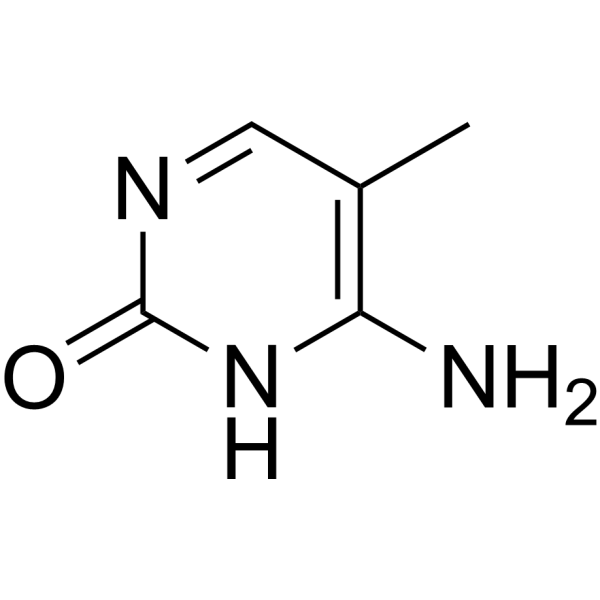
5-Methylcytosine is a well-characterized DNA modification in prokaryotes and eukaryotes. 5-Methylcytosine forms symmetrical methylation on CpG dinucleotides in DNA, stabilizes tRNA/rRNA structure in RNA, and affects mRNA translation. 5-Methylcytosine can be oxidized to generate 5hmC, 5fC, and 5caC. 5-Methylcytosine can be used in epigenetics, developmental biology, and the study of diseases such as colorectal cancer and hepatocellular carcinoma .
loading...
    loading...
2
2 Cited Publications
Cat. No.: HY-W008091R
CAS No.: 554-01-8
5-Methylcytosine (Standard) is the analytical standard of 5-Methylcytosine (HY-W008091). This product is intended for research and analytical applications. 5-Methylcytosine is a well-characterized DNA modification in prokaryotes and eukaryotes. 5-Methylcytosine forms symmetrical methylation on CpG dinucleotides in DNA, stabilizes tRNA/rRNA structure in RNA, and affects mRNA translation. 5-Methylcytosine can be oxidized to generate 5hmC, 5fC, and 5caC. 5-Methylcytosine can be used in epigenetics, developmental biology, and the study of diseases such as colorectal cancer and hepatocellular carcinoma .
loading...
    loading...
2
2 Cited Publications
Cat. No.: HY-W008091A
CAS No.: 58366-64-6
Research Areas:  

Cancer

5-Methylcytosine hydrochloride is a well-characterized DNA modification in prokaryotes and eukaryotes. 5-Methylcytosine hydrochloride forms symmetrical methylation on CpG dinucleotides in DNA, stabilizes tRNA/rRNA structure in RNA, and affects mRNA translation. 5-Methylcytosine hydrochloride can be oxidized to generate 5hmC, 5fC, and 5caC. 5-Methylcytosine hydrochloride can be used in epigenetics, developmental biology, and the study of diseases such as colorectal cancer and hepatocellular carcinoma .
loading...
    loading...
1
1 Cited Publications
Cat. No.: HY-P99107A
CAS No.: 914088-09-8
Research Areas:  

Cancer

Brentuximab vedotin (solution) (cAC10-vcMMAE) is an antibody-drug conjugate (ADC) comprising an anti-CD30 antibody and the cytotoxic agent Monomethyl auristatin E (MMAE). The antibody portion is Brentuximab (HY-P99151), and the drug-linker conjugate for ADC is VcMMAE (HY-15575). Brentuximab vedotin (solution) inhibits CD30-positive cells with an IC50 of 2.5 ng/mL. Brentuximab vedotin (solution) can be used for the research of relapsed and refractory Hodgkin lymphoma .
loading...
    loading...
1
1 Cited Publications
Cat. No.: HY-149830
CAS No.: 2894733-91-4
Purity:  98.66%
Target:  

PD-1/PD-L1

Research Areas:  

Cancer

PD-L1-IN-2 is a potential tumor immunological agent by inhibiting PD-L1. PD-L1-IN-2 is a Naamidine J derivative and exerts antitumor effects in vivo by reducing PD-L1 expression and enhancing tumor-infiltrating T-cell immunity. PD-L1-IN-2 is used for colorectal cancer research .
loading...
    loading...
Cat. No.: HY-14820A
CAS No.: 945212-59-9
Purity:  98.96%
Synonyms: EP-1572 acetate; AEZS-130 acetate
Target:  

GHSR

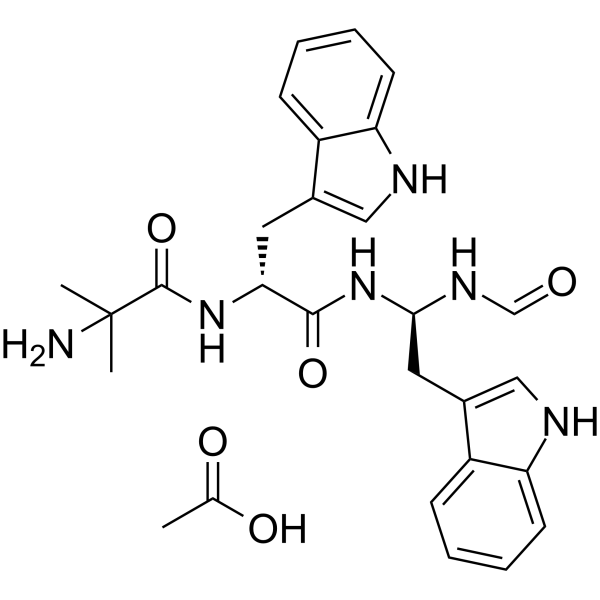
Macimorelin (EP-1572) acetate, a GH secretagogue, is an orally active GHSR agonist. Macimorelin acetate stimulates GH release. Macimorelin acetate can be used in the research of adult growth hormone deficiency (AGHD), and Cancer anorexia-cachexia syndrome (CACS) .
loading...
    loading...
Cat. No.: HY-W008091S
CAS No.: 1219795-15-9
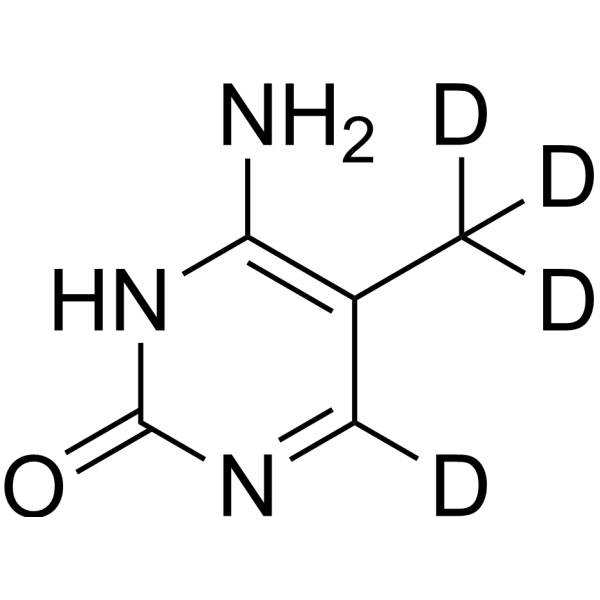
5-Methylcytosine-d4 is the deuterium labeled 5-Methylcytosine (HY-W008091). 5-Methylcytosine is a well-characterized DNA modification in prokaryotes and eukaryotes. 5-Methylcytosine forms symmetrical methylation on CpG dinucleotides in DNA, stabilizes tRNA/rRNA structure in RNA, and affects mRNA translation. 5-Methylcytosine can be oxidized to generate 5hmC, 5fC, and 5caC. 5-Methylcytosine can be used in epigenetics, developmental biology, and the study of diseases such as colorectal cancer and hepatocellular carcinoma .
loading...
    loading...
Cat. No.: HY-14820
CAS No.: 381231-18-1
Synonyms: EP-1572; AEZS-130
Target:  

GHSR

Research Areas:  

Endocrinology Cancer

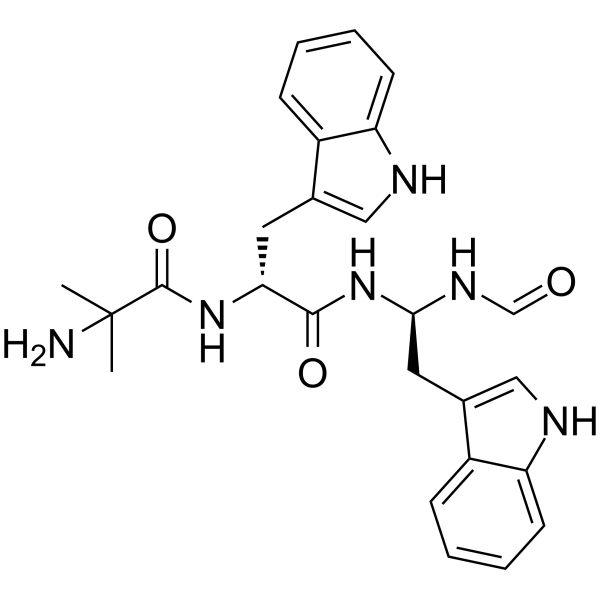
Macimorelin (EP-1572), a GH secretagogue, is an orally active GHSR agonist. Macimorelin stimulates GH release. Macimorelin can be used in the research of adult growth hormone deficiency (AGHD), and Cancer anorexia-cachexia syndrome (CACS) .
loading...
    loading...
Cat. No.: HY-112167B
CAS No.: 1196504-54-7
Synonyms: ARRY-575 hydrochloride; RG7741 hydrochloride
Research Areas:  

Inflammation/Immunology Cancer

GDC0575 (ARRY-575) hydrochloride is a highly-selective and orally active Chk1 (IC50=1.2 nM) inhibitor. GDC0575 (ARRY-575) hydrochloride can be used for colitis-associated cancer (CAC) and colitis research .
loading...
    loading...
Cat. No.: HY-178293
Research Areas:  

Cancer

N-Succinimidyl 3-maleimidopropionate (Compound MC1) is a Glucuronide-Gemcitabine conjugate. N-Succinimidyl 3-maleimidopropionate can be used to synthesize ADCs (such as cAc10ec-MC1). N-Succinimidyl 3-maleimidopropionate can be used in Hodgkin's lymphoma research .
loading...
    loading...
Cat. No.: HY-E70583
Target:  

TET Protein

Research Areas:  

Others

Recombinant Ten-Eleven Translocase is a recombinant Fe(II)- and α-ketoglutarate-dependent dioxygenase. Recombinant Ten-Eleven Translocase converts 5-methylcytosine (5mC) to 5-hydroxymethylcytosine (5hmC), and then to 5-formylcytosine (5fC) and 5-carboxycytosine (5caC) through a series of oxidation reactions. Then, 5caC is further converted into uracil (U) through the action of a conversion agent or enzyme, and uracil (U) is converted into thymine (T) through PCR, thereby achieving single-base resolution and high-accuracy identification of DNA methylation sites .
loading...
    loading...
Cat. No.: HY-178562
CAS No.: 1498305-51-3
Synonyms: 2'-Propargyl C(Ac) amidite
DMTr-2'-O-propargyl-rC(Ac)-3' -CE-Phosphoramidite (2'-Propargyl C(Ac) amidite) is a monomeric raw material that can be used for nucleic acid synthesis.
loading...
    loading...
Cat. No.: HY-182990
CAS No.: 2931457-60-0
Target:  

DNA/RNA Synthesis

Research Areas:  

Others

N3-Methylcytidine phosphoramidite [5′-O-DMT2′-O-TBDMS-m3 CAc] is a phosphoramidite monomer. Phosphoramidites can be used in the synthesis of oligonucleotides .
loading...
    loading...
Cat. No.: HY-L231
26 compounds

The TCA cycle (tricarboxylic acid cycle)—is also known as the Krebs cycle or the citric acid cycle (CAC). The TCA cycle is a series of chemical reactions that release stored energy through the oxidation of acetyl-CoA in carbohydrates, fats, and proteins.

For decades, the TCA cycle has been considered as the central pathway for cell oxidative phosphorylation to produce energy and biosynthesis. Research shows that TCA cycle is associated with many diseases, especially cancer. In colon carcinoma, liver cancer and other cancers, there are mutations that lead to the imbalance of TCA cycle metabolites, indicating that TCA cycle may be related to the occurrence of cancer. Understanding the role and molecular mechanism of TCA cycle in inhibiting or promoting cancer progression will promote the development of new metabolite-based cancer treatment methods in the future.

MCE supplies a unique collection of 26 key intermediates of the TCA cycle, which can be utilized for TCA-related research and metabolomics identification studies.

Cat. No.: HY-L148
73 compounds

The TCA cycle (tricarboxylic acid cycle)—is also known as the Krebs cycle or the citric acid cycle (CAC). The TCA cycle is a series of chemical reactions that release stored energy through the oxidation of acetyl-CoA in carbohydrates, fats, and proteins.

For decades, the TCA cycle has been considered as the central pathway for cell oxidative phosphorylation to produce energy and biosynthesis. Research shows that TCA cycle is associated with many diseases, especially cancer. In colon carcinoma, liver cancer and other cancers, there are mutations that lead to the imbalance of TCA cycle metabolites, indicating that TCA cycle may be related to the occurrence of cancer. Understanding the role and molecular mechanism of TCA cycle in inhibiting or promoting cancer progression will promote the development of new metabolite-based cancer treatment methods in the future.

MCE supplies a unique collection of 73 compounds related to the TCA cycle. MCE TCA Cycle Compound Library is a useful tool for the TCA cycle related research and anti-cancer drug development.

  • 1

