13 Results for "

MLL-rearranged acute leukemias

" in MedChemExpress (MCE) Product Catalog:
Products (13)

13 Results for "MLL-rearranged acute leukemias" in MCE Product Catalog:

17
17 Publications Verification
Cat. No.: HY-136175
CAS No.: 2169919-21-3
Purity:  99.76%
Synonyms: SNDX-5613
Research Areas:  

Cancer

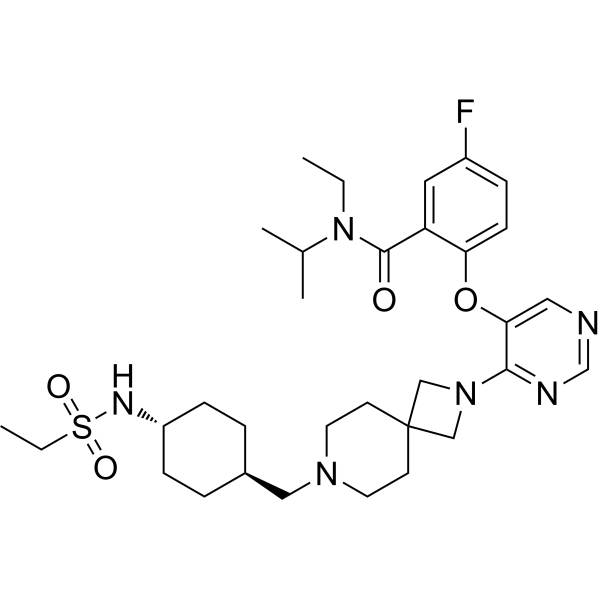
Revumenib (SNDX-5613) is a potent and specific Menin-MLL inhibitor with a binding Ki of 0.149 nM and a cell based IC50 of 10-20 nM. Revumenib can be used for the research of MLL-rearranged (MLL-r) acute leukemias, including acute lymphoblastic leukemia (ALL) and acute myeloid leukemia (AML) .
loading...
    loading...
4
4 Cited Publications
Cat. No.: HY-15222
CAS No.: 1271738-62-5
Purity:  99.81%
Research Areas:  

Cancer

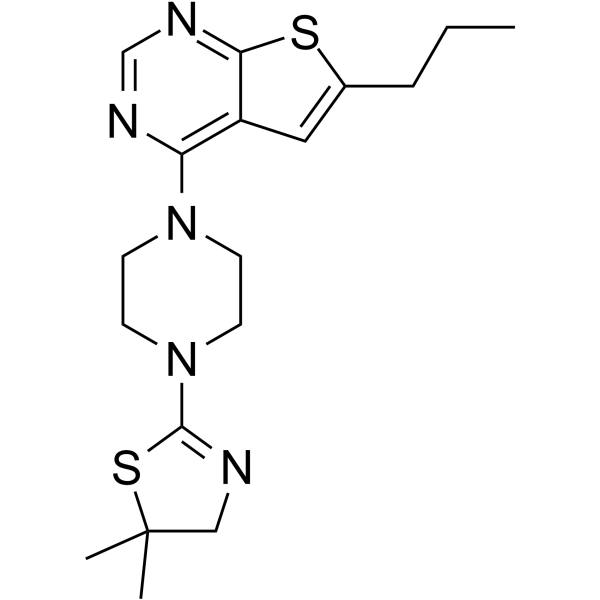
Menin-MLL inhibitor MI-2 is a competitive and selective Menin-MLL interaction inhibitor with an IC50 value of 446 nM and a Ki value of 158 nM. Menin-MLL inhibitor MI-2 downregulates the expression of target genes such as HOXA9 and MEIS1, inhibits proliferation of leukemia cells and induces apoptosis and differentiation. Menin-MLL inhibitor MI-2 is proming for rasearch of MLL-rearranged acute leukemias (e.g., AML, ALL) .
loading...
    loading...
Cat. No.: HY-156794
CAS No.: 2412555-70-3
Purity:  99.88%
Synonyms: DSP-5336
Research Areas:  

Cancer

Enzomenib (DSP-5336) is an orally active Menin inhibitor (IC50=1.4 nM, Kd=6.0 nM). Enzomenib disrupts the interaction between Menin and KMT2A/MLL fusion proteins, specifically inhibits the expression of leukemia driver genes such as HOX/MEIS1, and upregulates ITGAM. Enzomenib effectively induces cell differentiation, inhibits tumor cell proliferation, and suppresses primitive cell colony formation. Enzomenib reduces disease burden and prolongs survival, but causes adverse reactions including differentiation syndrome and QTc interval prolongation. Enzomenib is used for research on relapsed/refractory acute myeloid leukemia, acute lymphoblastic leukemia, and other hematologic malignancies with mixed lineage leukemia (MLL) rearrangements or NPM1 mutations .
loading...
    loading...
Cat. No.: HY-162250
CAS No.: 3050872-59-5
Research Areas:  

Cancer

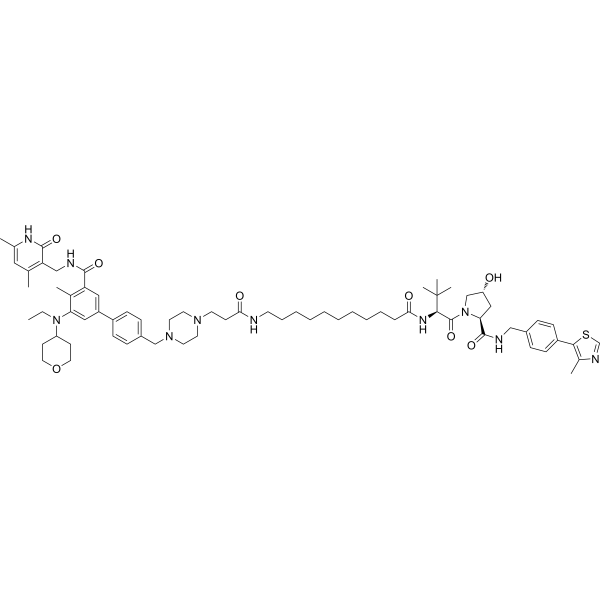
MS8847 is a PROTAC degrader and antiproliferative agent targeting EZH2 (DC50=34.4 nM in EOL-1 MLL-rAML cells). MS8847 recruits the E3 ligase von Hippel-Lindau (VHL) to mediate the degradation of EZH2 via the ubiquitin-proteasome system. MS8847 induces antiproliferative effects in MLL-rearranged acute myeloid leukemia cells and inhibits the growth of triple-negative breast cancer cell lines or 3D triple-negative breast cancer models. MS8847 is applicable to research related to MLL-rearranged acute myeloid leukemia and triple-negative breast cancer .
loading...
    loading...
Cat. No.: HY-136688
CAS No.: 2222635-92-7
Purity:  99.34%
MI-389 is a potent menin-MLL interaction inhibitor (IC50=25 nM) and a CRBN-recruiting, GSPT1-targeted PROTAC degrader. MI-389 upregulates myeloid differentiation-related genes that are lowly expressed in primitive hematopoietic progenitor cells, thereby inducing myeloid differentiation phenotypic changes in MLL-rearranged leukemia cells. MI-389 competitively blocks the MG-H1-RAGE interaction to interfere with the AGEs-RAGE pathway, thus alleviating AGEs-induced HUVEC injury . MI-389 can be used in studies related to MLL-rearranged acute leukemia .
loading...
    loading...
Cat. No.: HY-114162B
CAS No.: 2169919-27-9
Synonyms: SNDX-50469 mesylate
Research Areas:  

Cancer

VTP50469 mesylate is a potent, and selective Menin-MLL1 inhibitor that effectively targets MLL-rearranged and NPM1c+ leukemia. VTP50469 mesylate selectively kills cell lines with MLL rearrangements and NPM1c+ mutations. VTP50469 mesylate displaces Menin from protein complexes and inhibits MLL's chromatin occupancy at specific genes, leading to significant changes in gene expression, differentiation, and apoptosis. VTP50469 demonstrates dramatic reductions in leukemia burden in patient-derived xenograft models of MLL-r acute myeloid leukemia and MLL-r acute lymphoblastic leukemia, with some mice remaining disease-free for over a year post-treatment.
loading...
    loading...
Cat. No.: HY-15222A
Research Areas:  

Cancer

Menin-MLL inhibitor MI-2 dihydrochloride is a competitive and selective Menin-MLL interaction inhibitor with an IC50 value of 446 nM and a Ki value of 158 nM. Menin-MLL inhibitor MI-2 dihydrochloride downregulates the expression of target genes such as HOXA9 and MEIS1, inhibits proliferation of leukemia cells and induces apoptosis and differentiation. Menin-MLL inhibitor MI-2 dihydrochloride is proming for rasearch of MLL-rearranged acute leukemias (e.g., AML, ALL) .
loading...
    loading...
Cat. No.: HY-136175B
Synonyms: cis-SNDX-5613
Research Areas:  

Cancer

cis-Revumenib (cis-SNDX-5613) is an isomer of Revumenib (HY-136175). Revumenib (SNDX-5613) is a potent and specific Menin-MLL inhibitor with a binding Ki of 0.149 nM and a cell based IC50 of 10-20 nM. Revumenib can be used for the research of MLL-rearranged (MLL-r) acute leukemias, including acute lymphoblastic leukemia (ALL) and acute myeloid leukemia (AML) .
loading...
    loading...
Cat. No.: HY-136175R
CAS No.: 2169919-21-3
Synonyms: SNDX-5613 (Standard)
Research Areas:  

Cancer

Revumenib (Standard) is the analytical standard of Revumenib (HY-136175). This product is intended for research and analytical applications. Revumenib (SNDX-5613) is a potent and specific Menin-MLL inhibitor with a binding Ki of 0.149 nM and a cell based IC50 of 10-20 nM. Revumenib can be used for the research of MLL-rearranged (MLL-r) acute leukemias, including acute lymphoblastic leukemia (ALL) and acute myeloid leukemia (AML) .
loading...
    loading...
Cat. No.: HY-148829
CAS No.: 2407449-49-2
MS40 is a WDR5 PROTAC degrader with a DC50 of 42 nM in MV4;11 MLL-rearranged acute myeloid leukemia (AML) cells. MS40 induces WDR5 degradation dependent on WDR5, CRBN and the proteasome, dissociates the MLL/KMT2A complex from chromatin, reduces H3K4me2 levels, degrades IKZF1/IKZF3, the novel substrates of CRBN, inhibits the transcription of WDR5/MLL and IKZF target genes, and suppresses cancer cell growth. MS40 can be used in the research of MLL-rearranged acute myeloid leukemia, breast cancer, Burkholderia infection and cystic fibrosis-associated bacterial infections .
loading...
    loading...
Cat. No.: HY-181690
Research Areas:  

Cancer

Menin-MLL-IN-37 is an orally active Menin-MLL protein complex inhibitor with an IC50 of 820.50 nM. Menin-MLL-IN-37 disrupts the interaction between menin and MLL proteins. Menin-MLL-IN-37 induces differentiation of acute myeloid leukemia cells and selectively inhibits the proliferation of MLL-rearranged and DNMT3A/NPM1-mutant leukemia cells. Menin-MLL-IN-37 can be used for the research of acute myeloid leukemia (AML) .
loading...
    loading...
Cat. No.: HY-181834
CAS No.: 3111054-37-3
Research Areas:  

Cancer

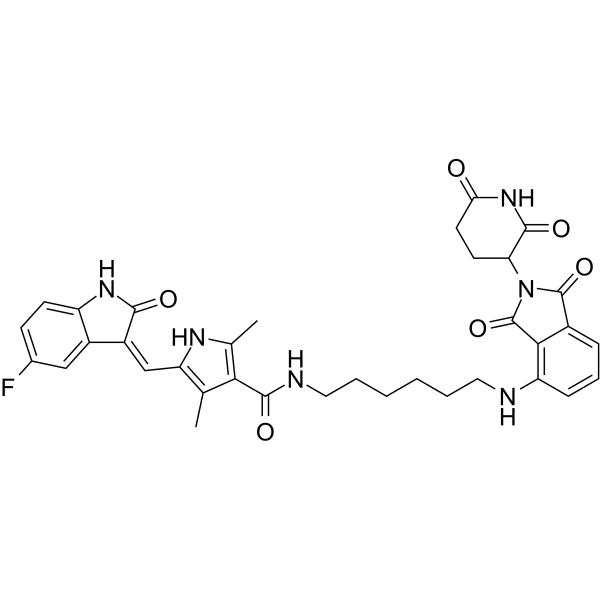
PROTAC MLLT1 Degrader-1 is a PROTAC degrader targeting MLLT1. PROTAC MLLT1 Degrader-1 inhibits AML cell proliferation and viability, suppresses tumor growth in human AML xenograft models, and can block the oncogene transcriptional program. PROTAC MLLT1 Degrader-1 can be used for the research of MLL-rearranged acute myeloid leukemia (AML) .
loading...
    loading...
Cat. No.: HY-156794A
Synonyms: DSP-5336 enantiomer
Enzomenib enantiomer (DSP-5336 enantiomer) is an enantiomer of Enzomenib (HY-156794). Enzomenib (DSP-5336) is an orally active Menin inhibitor (IC50=1.4 nM, Kd=6.0 nM). Enzomenib disrupts the interaction between Menin and KMT2A/MLL fusion proteins, specifically inhibits the expression of leukemia driver genes such as HOX/MEIS1, and upregulates ITGAM. Enzomenib effectively induces cell differentiation, inhibits tumor cell proliferation, and suppresses primitive cell colony formation. Enzomenib reduces disease burden and prolongs survival, but causes adverse reactions including differentiation syndrome and QTc interval prolongation. Enzomenib is used for research on relapsed/refractory acute myeloid leukemia, acute lymphoblastic leukemia, and other hematologic malignancies with mixed lineage leukemia (MLL) rearrangements or NPM1 mutations .
loading...
    loading...
  • 1

