8 Results for "

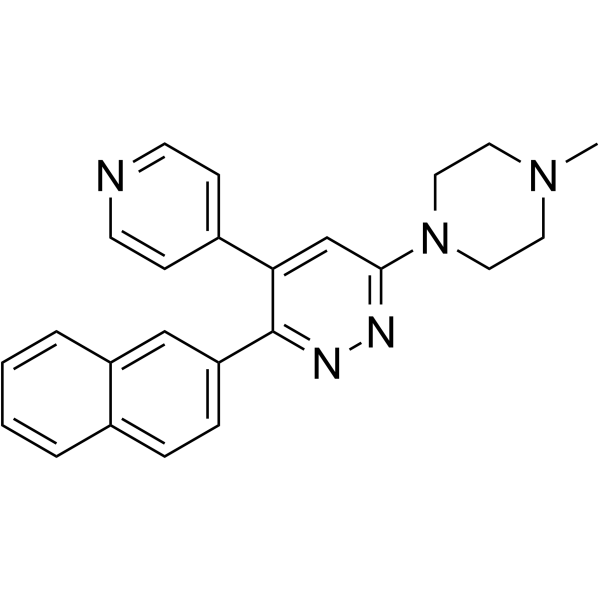
MW150

" in MedChemExpress (MCE) Product Catalog:
Products (8)

8 Results for "MW150" in MCE Product Catalog:

Referencia número: HY-120111
No. CAS: 1628502-91-9
Pureza:  99.89%
Synonyms: MW01-18-150SRM
Target:  

p38 MAPK Autophagy

Áreas de investigación:  

Neurological Disease Inflammation/Immunology

MW150 (MW01-18-150SRM) is a selective, CNS penetrant, and orally active inhibitor of p38α MAPK with a Ki of 101 nM. MW-150 inhibits the ability of the endogenous p38α MAPK to phosphorylate an endogenous substrate MK2 in activated glia .
loading...
    loading...
Referencia número: HY-112624M
No. CAS: 9004-54-0
Synonyms: Dextran 150; Dextran D150; Dextran T150(MW 130000-170000)
Dextran T150 (Dextran 150; Dextran D150) (MW 150,000) is a dehydrated glucose polymer with an average molecular weight of 150,000. Dextran T150 (MW 150,000) has excellent biodegradability and good biocompatibility, and can be used as a fluorescent labeling tracer and a high-molecular cross-linking agent .
loading...
    loading...
Referencia número: HY-158220A
Synonyms: HAMA (MW 150 kDa)
Hyaluronic acid Methacryloyl (HAMA) MW 150 kDa is methacrylated hyaluronic acid that is biocompatible. Hyaluronic acid Methacryloyl is also used as a 3D printing hydrogel ink, which has the characteristics of fast photosensitive response, fast gelation speed and stable hydrogel performance. Hyaluronic acid Methacryloyl can quickly induce gelation with lithium phenyl-2,4,6-trimethylbenzoylphosphinate (LAP) under UV irradiation. The combination of Hyaluronic acid Methacryloyl and tissue-specific extracellular matrix (ECM) materials (such as pancreatic extracellular matrix (pECM)) will become an important source material for organoid culture .
loading...
    loading...
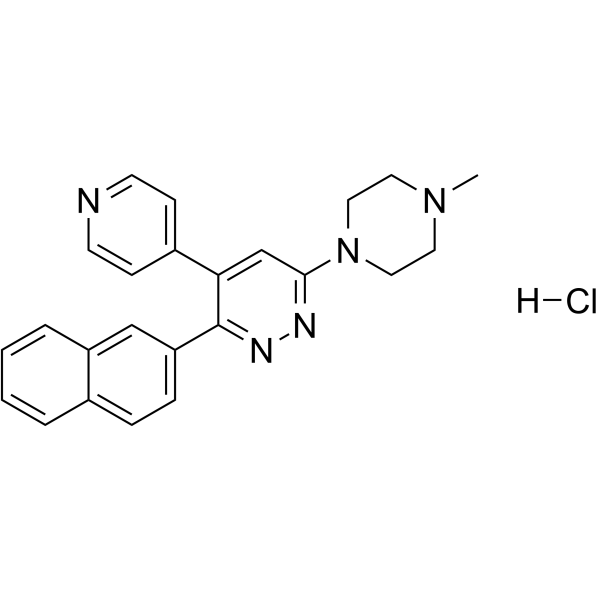
Referencia número: HY-120111A
No. CAS: 1923773-01-6
Synonyms: MW01-18-150SRM hydrochloride
Target:  

p38 MAPK Autophagy

Áreas de investigación:  

Neurological Disease Inflammation/Immunology

MW-150 hydrochloride (MW01-18-150SRM hydrochloride) is a selective, CNS penetrant, and orally active inhibitor of p38α MAPK with a Ki of 101 nM. MW-150 hydrochloride (MW01-18-150SRM hydrochloride) inhibits the ability of the endogenous p38α MAPK to phosphorylate an endogenous substrate MK2 in activated glia .
loading...
    loading...
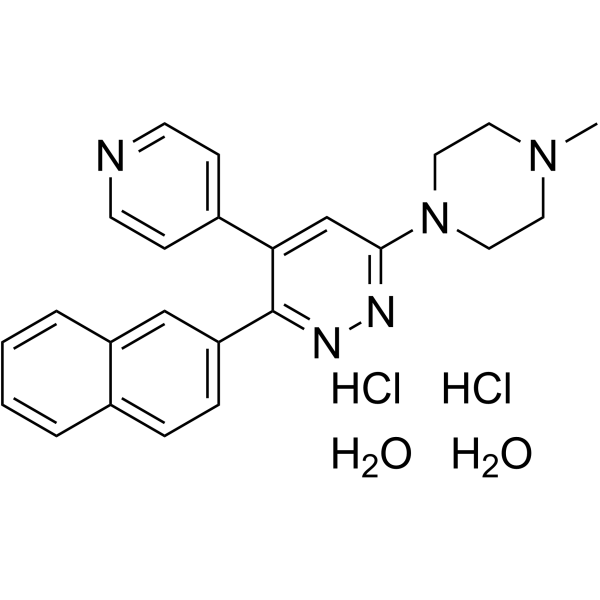
Referencia número: HY-120111B
No. CAS: 1661020-92-3
Synonyms: MW01-18-150SRM dihydrochloride dihydrate
Target:  

p38 MAPK Autophagy

Áreas de investigación:  

Neurological Disease Inflammation/Immunology

MW-150 dihydrochloride dihydrate (MW01-18-150SRM dihydrochloride dihydrate) is a selective, CNS penetrant, and orally active inhibitor of p38α MAPK with a Ki of 101 nM. MW-150 dihydrochloride dihydrate (MW01-18-150SRM dihydrochloride dihydrate) inhibits the ability of the endogenous p38α MAPK to phosphorylate an endogenous substrate MK2 in activated glia .
loading...
    loading...
Referencia número: HY-172165E
Lysine-dextran, 150kDa is a dextran with lysine coupling. Lysine-dextran exhibits higher Glu-plasminogen binding ability than dextran alone .
loading...
    loading...
loading...
    loading...
Referencia número: HY-L153
5,199 compounds

Covalent inhibitors are small molecules that can bind specifically to target proteins through covalent bonds and inhibit their biological functions. Although for a long time, covalent targeting has been playing a subordinate role in drug discovery, with an increasing number of reports on successful clinical applications of such drugs, the potential of these agents is now being acknowledged. Currently, cysteine is the most common covalent amino acid residue in a variety of covalent drugs, and various warheads have been developed that can react with cysteine, providing the key building blocks for covalent drugs to form covalent bonds.

To meet the development needs of covalent inhibitors targeting cysteine, MCE has designed a unique collection of 5,199 compounds with different covalent warheads that target cysteine. The MCE Cysteine Targeted Covalent Library is designed using the following covalent warheads: Acrylamides, Propiolic acid ester, Dimethylamine functionalized acrylamides, Chloroacetamides, Acrylonitrile, 2-Cyanoacrylamide, Aziridine, Haloacetamide, etc.

