17 Results for "

NODAL

" in MedChemExpress (MCE) Product Catalog:
Products (17)

17 Results for "NODAL" in MCE Product Catalog:

143
143 Cited Publications
Cat. No.: HY-10432
CAS No.: 909910-43-6
Purity:  99.33%
Research Areas:  

Cancer

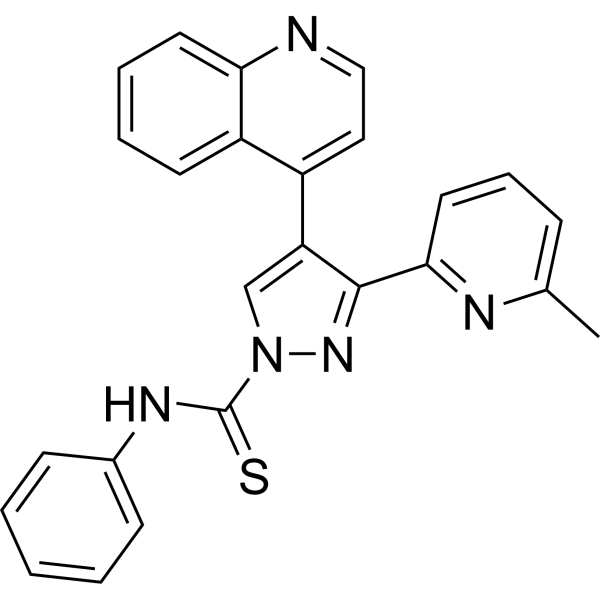
A 83-01 is a potent inhibitor of TGF-β type I receptor ALK5 kinase, type I nodal receptor ALK4 and type I nodal receptor ALK7, with IC50s of 12 nM, 45 nM and 7.5 nM against the transcription induced by ALK5, ALK4 and ALK7, respectively .
loading...
    loading...
2
2 Cited Publications
Cat. No.: HY-P700025AF
Purity:  ≥ 95%, as determined by reducing SDS-PAGE.
Synonyms: NODAL; NODAL, Mouse, Homolog; NODAL Growth Differentiation Factor; NODAL Homolog (Mouse); NODAL Homolog; HTX5
Species:  
Human
Source:  
E. coli
loading...
    loading...
Cat. No.: HY-100534
CAS No.: 1136466-93-7
Purity:  ≥99.0%
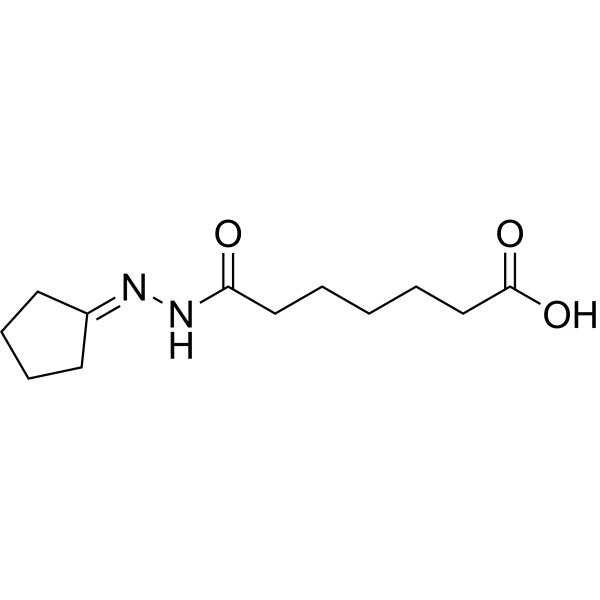
IDE 2 is a cell-permeable inducer of definitive endoderm differentiation that induces the differentiation of mouse and human embryonic stem cells into definitive endoderm. IDE2 activates the TGF‑β/Nodal signaling pathway, induces Smad2 phosphorylation, and increases Sox17 and FoxA2 expression. Endoderm induced by IDE 2 integrates into the developing gut tube, expresses gut tube markers, and differentiates into pancreatic progenitor cells. IDE 2 can be used for research related to directed endoderm differentiation of embryonic stem cells .
loading...
    loading...
Cat. No.: HY-10432R
CAS No.: 909910-43-6
Research Areas:  

Cancer

A 83-01 (Standard) is the analytical standard of A 83-01 (HY-10432). This product is intended for research and analytical applications. A 83-01 is a potent inhibitor of TGF-β type I receptor ALK5 kinase, type I nodal receptor ALK4 and type I nodal receptor ALK7, with IC50s of 12 nM, 45 nM and 7.5 nM against the transcription induced by ALK5, ALK4 and ALK7, respectively .
loading...
    loading...
Cat. No.: HY-RS09409
Research Areas:  

Others

NODAL Human Pre-designed siRNA Set A contains three designed siRNAs for NODAL gene (Human), as well as a negative control, a positive control, and a FAM-labeled negative control.

loading...
    loading...
Cat. No.: HY-RS19222
Research Areas:  

Others

Nodal Mouse Pre-designed siRNA Set A contains three designed siRNAs for Nodal gene (Mouse), as well as a negative control, a positive control, and a FAM-labeled negative control.

loading...
    loading...
Cat. No.: HY-P704126
Purity:  ≥ 90%, as determined by reducing SDS-PAGE.
Synonyms: NODAL; NODAL, Mouse, Homolog; NODAL Growth Differentiation Factor; NODAL Homolog (Mouse); NODAL Homolog; HTX5
Species:  
Human
Source:  
E. coli
loading...
    loading...
Cat. No.: HY-123196
CAS No.: 342419-09-4
Target:  

Adenosine Receptor

Research Areas:  

Cardiovascular Disease

CVT-2759 is a potent inhibitor of A1-ADOR, with the IC50 values of 0.18 μM and 9.5 μM to reduce the binding of [3H]CPX in the absence and presence of 1 mM GTP. CVT-2759 plays an important role in slowing AV nodal conduction and thereby ventricular rate without causing AV block, bradycardia, atrial arrhythmias, or vasodilation .
loading...
    loading...
Cat. No.: HY-RS25711
Research Areas:  

Others

Nodal Rat Pre-designed siRNA Set A contains three designed siRNAs for Nodal gene (Rat), as well as a negative control, a positive control, and a FAM-labeled negative control.

loading...
    loading...
Cat. No.: HY-P79080
Purity:  ≥ 95%, as determined by reducing SDS-PAGE.
Synonyms: NODAL; NODAL, Mouse, Homolog; NODAL Growth Differentiation Factor; NODAL Homolog (Mouse); NODAL Homolog; HTX5
Species:  
Mouse
Source:  
E. coli
loading...
    loading...
Cat. No.: HY-P810344
Synonyms: NODAL homolog, NODAL

Host:  

Mouse

Application:  

WB, ICC/IF, IF-Tissue, IHC-P, IP, ELISA

Reactivity:  

Human, Mouse, Rat

loading...
    loading...
Cat. No.: HY-P81665
Synonyms: HTX5

Host:  

Rabbit

Application:  

WB, FC

Reactivity:  

Human, Rat

loading...
    loading...
Cat. No.: HY-P11931
Target:  

Others

Research Areas:  

Cancer

NODA-FGLP21 is a tumor-targeting agent and a fibrinogen-like protein 1 (FGL1) binder. NODA-FGLP21 specifically binds to FGL1, and this binding is competitively inhibited by unlabeled FGLP21. NODA-FGLP21 can be used in the research of liver cancer .
loading...
    loading...
Cat. No.: HY-P81665A
Synonyms: HTX5

Host:  

Rabbit

Application:  

WB, FC

Reactivity:  

Human, Rat

loading...
    loading...
Cat. No.: HY-180334
CAS No.: 120004-07-1
Target:  

Calcium Channel

Research Areas:  

Cardiovascular Disease

S-312 is a calcium antagonist with a bicyclic dihydrothienopyridine structure. S-312 can relax the helical strips of various isolated rabbit arteries procontracted with high potassium depolarizaiton. S-312 competitively imhibits calcium-induced contractions in depolarized basilar and femoral arteries. S-312 increases AV nodal conduction time in Langenedorff-perfused isolated rabbit hearts. S-312 exhibits vasculoselectivity, particularly for cerebral vessel .
loading...
    loading...
Cat. No.: HY-118968
CAS No.: 112946-90-4
Research Areas:  

Cardiovascular Disease

(-)-SA2572 is an orally active Ca 2+ inward channel inhibitor. (-)-SA2572 inhibits the slow Ca 2+ inward channel and the fast Na + inward channel. (-)-SA2572 inhibits depolarization-induced contraction of gastrointestinal smooth muscle and vascular smooth muscle, prolongs atrioventricular nodal conduction time, and inhibits His bundle-ventricular conduction time. (-)-SA2572 reduces systolic blood pressure in spontaneously hypertensive rats. (-)-SA2572 can be used in the research of hypertension .
loading...
    loading...
Cat. No.: HY-10321G
CAS No.: 219580-11-7
PD173074 GMP is PD173074 (HY-10321) produced by using GMP guidelines. GMP small molecules works appropriately as an auxiliary reagent for cell therapy manufacture. PD173074 is an orally active FGFR inhibitor that targets the transphosphorylation of FGFR1 and FGFR2 and blocks the FGF signaling pathway. By reducing the phosphorylation level of SMAD2 and altering the expression of Nodal/Activin target genes, PD173074 eliminates endothelial differentiation potential, thereby inhibiting the formation of capillary-like structures. PD173074 blocks the proliferation and colony formation of tumor cells and increases intratumoral cell apoptosis. PD173074 successfully reverses FGF-2-induced chemoresistance to enhance the effect of cisplatin (HY-17394) in small cell lung cancer models. PD173074 can be applied to research related to critical limb ischemia and small cell lung cancer .
loading...
    loading...
  • 1

