25 Results for "

Neuro-2a

" in MedChemExpress (MCE) Product Catalog:
Products (25)

25 Results for "Neuro-2a" in MCE Product Catalog:

49
49 Publications Verification
Cat. No.: HY-B1081A
CAS No.: 636-00-0
Synonyms: 6-Hydroxydopamine hydrobromide; 6-OHDA hydrobromide
Oxidopamine (6-OHDA) hydrobromide is an antagonist of the neurotransmitter dopamine. Oxidopamine hydrobromide is a widely used neurotoxin and selectively destroys dopaminergic neurons. Oxidopamine hydrobromide promotes COX-2 activation, leading to PGE2 synthesis and pro-inflammatory cytokine IL-1β secretion. Oxidopamine hydrobromide can be used for the research of Parkinson’s disease (PD), attention-deficit hyperactivity disorder (ADHD), and Lesch-Nyhan syndrome [2] .
loading...
    loading...
49
49 Publications Verification
Cat. No.: HY-B1081
CAS No.: 28094-15-7
Synonyms: 6-Hydroxydopamine Hydrochloride
Oxidopamine (6-OHDA) hydrochloride is an antagonist of the neurotransmitter dopamine. Oxidopamine hydrochloride is a widely used neurotoxin and selectively destroys dopaminergic neurons. Oxidopamine hydrochloride promotes COX-2 activation, leading to PGE2 synthesis and pro-inflammatory cytokine IL-1β secretion. Oxidopamine hydrochloride can be used for the research of Parkinson’s disease (PD), attention-deficit hyperactivity disorder (ADHD), and Lesch-Nyhan syndrome [2] .
loading...
    loading...
4
4 Cited Publications
Cat. No.: HY-N6691
CAS No.: 71-62-5
Synonyms: 3-Veratroylveracevine
Veratridine (3-Veratroylveracevine) is a plant neurotoxin, a voltage-gated sodium channels (VGSCs) agonist. Veratridine inhibits the peak current of Nav1.7, with an IC50 of 18.39 µM. Veratridine regulates sodium ion channels mainly by activating sodium ion channels, preventing channel inactivation and increasing sodium ion flow [2].
loading...
    loading...
4
4 Cited Publications
Cat. No.: HY-151527
CAS No.: 2708177-73-3
Purity:  98.64%
Research Areas:  

Neurological Disease

PI3K/Akt/CREB activator 1 (compound AE-18) is a potent, orally active PI3K/Akt/CREB activator. PI3K/Akt/CREB activator 1 promotes neuronal proliferation, induced differentiation of Neuro-2a cells into a neuron-like morphology, and accelerated the establishment of axon-dendrite polarization of primary hippocampal neurons through upregulating brain-derived neurotrophic factor via the PI3K/Akt/CREB pathway. PI3K/Akt/CREB activator 1 can be used in research of vascular dementia (VaD) .
loading...
    loading...
2
2 Cited Publications
Cat. No.: HY-Y0669
CAS No.: 535-75-1
Pipecolic acid is an orally bioavailable, blood-brain barrier-permeable metabolite of lysine with antioxidant, inhibitor, and inducer activity. Pipecolic acid modulates the YAP-GPX4 signaling pathway, reduces retinal vascular tube formation, and mitigates ferroptosis. Pipecolic acid potentiates voltage-sensitive Ca 2+ channel currents and induces neuronal apoptosis. Pipecolic acid can be used for the research of diabetic retinopathy [2].
loading...
    loading...
Cat. No.: HY-120215
CAS No.: 1402612-64-9
Purity:  99.86%
Target:  

MAGL

Research Areas:  

Metabolic Disease

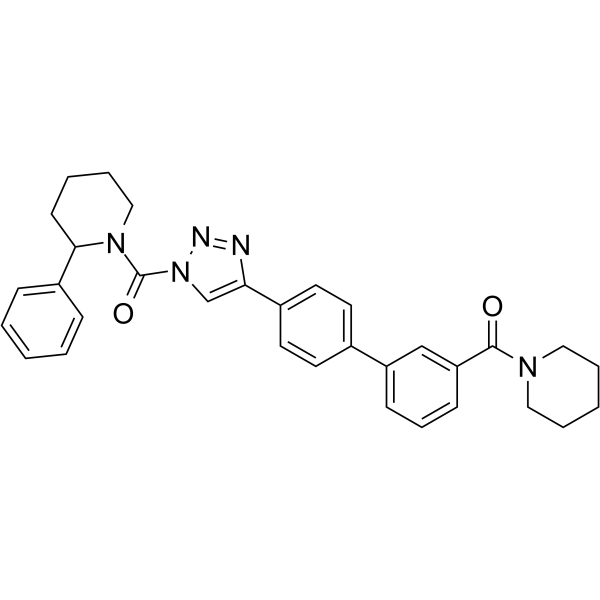
KT203 is a potent and selective inhibitor of α/β-hydrolase domain containing 6 (ABHD6), with an IC50 of 0.31 nM in Neuro2A cells .
loading...
    loading...
Cat. No.: HY-120177
CAS No.: 1402612-62-7
Purity:  99.93%
Target:  

MAGL

Research Areas:  

Others

KT182 is a potent and selective inhibitor of α/β-hydrolase domain containing 6 (ABHD6), with an IC50 of 0.24 nM in Neuro2A cells .
loading...
    loading...
Cat. No.: HY-115498
CAS No.: 1037837-27-6
Purity:  99.08%
ARN14494 is a potent and selective serine palmitoyltransferase (SPT) inhibitor, with an IC50 of 27.3 nM. ARN14494 affects the CNS in terms of anti-inflammation and neuroprotection. ARN14494 protects neurons from β-amyloid 1-42-induced neurotoxicity through a variety of mechanisms, including anti-oxidation, anti-apoptosis, and anti-inflammation. ARN14494 can be used for Alzheimer’s disease research .
loading...
    loading...
Cat. No.: HY-119910
CAS No.: 529507-84-4
Purity:  99.7%
Synonyms: XIB4035
Target:  

GDNF Receptor

Research Areas:  

Neurological Disease

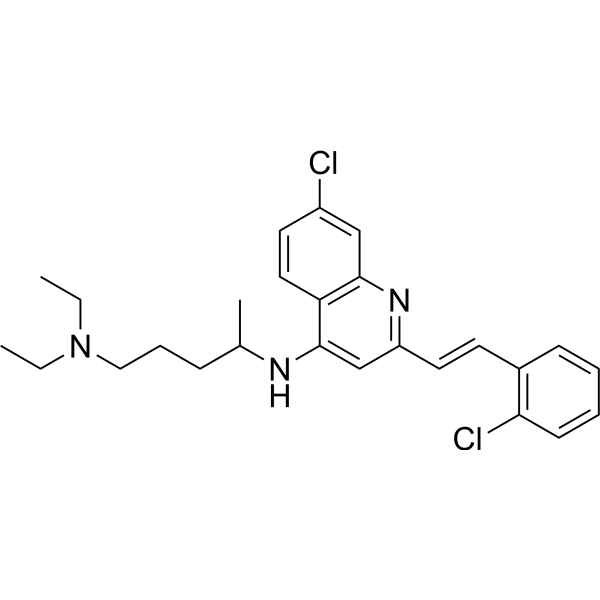
(E)-Aminoquinol (XIB4035) is a GFRα-1 agonist. (E)-Aminoquinol has mimic neurotrophic effects of GDNF, and induces Ret autophosphorylation in Neuro-2A cells. (E)-Aminoquinol can be used for research of Parkinson’s disease .
loading...
    loading...
Cat. No.: HY-P10397
CAS No.: 2243939-21-9
Synonyms: rALP-2, Rubisco anxiolytic-like peptide 2
Target:  

iGluR

YHIEPV (rALP-2, Rubisco anxiolytic-like peptide 2) is a potent and orally active peptide. YHIEPV shows anxiolytic effects. YHIEPV increases leptin sensitivity to exert its anti-obesity effects [2].
loading...
    loading...
Cat. No.: HY-139182
CAS No.: 2514-37-6
Target:  

Endogenous Metabolite

Research Areas:  

Metabolic Disease

CAY10762 is an inhibitor of monoacylglycerol lipase (MAGL; IC50=34.1 nM). It reduces hydrogen peroxide-induced lactate dehydrogenase (LDH) release from Neuro2a cells when used at a concentration of 1 μM. CAY10762 (10 mg/kg) increases levels of 2-arachidonoyl glycerol in mouse brain.
loading...
    loading...
Cat. No.: HY-114926
CAS No.: 1472640-86-0
Purity:  99.3%
Target:  

MAGL

Research Areas:  

Neurological Disease

KT185 is an orally-bioavailable, brain-penetrant and selective ABHD6 inhibitor, with an IC50 0.21 nM in Neuro2A cells .
loading...
    loading...
Cat. No.: HY-178110
CAS No.: 3028442-70-5
Research Areas:  

Cancer

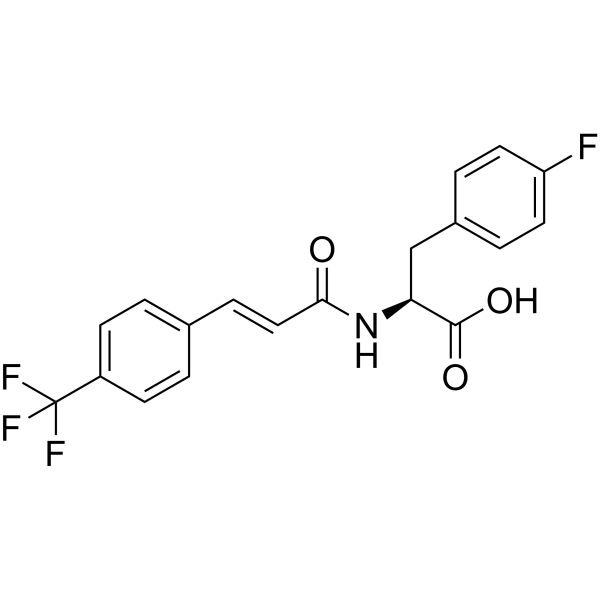
HDAC6-IN-65 is a selective HDAC6 inhibitor (IC50 = 0.9 nM) and also exhibits a certain suppressive effect on HDAC3 (IC50 = 39.4 nM). HDAC6-IN-65 can induce the accumulation of α-tubulin (ac-tubulin) and acetylated histone H3 (ac-histone H3, a class I HDAC inhibition marker) in Neuro-2a cells. HDAC6-IN-65 can be used for the study of melanoma .
loading...
    loading...
Cat. No.: HY-138967
CAS No.: 2095489-35-1
BRF110 is the selective, orally active rexinoid for Nurr1-RXRα, that selectively activates the Nurr1-RXRα heterodimer with an EC50 of 0.9 μM in SH-SY5Y. BRF110 upregulates the expression of BDNF, exhibits neuroprotective activity against MPP+ induced toxicity. BRF110 can cross blood-brain barrier .
loading...
    loading...
Cat. No.: HY-N6691R
CAS No.: 71-62-5
Synonyms: 3-Veratroylveracevine (Standard)
Veratridine (Standard) is the analytical standard of Veratridine. This product is intended for research and analytical applications. Veratridine (3-Veratroylveracevine) is a plant neurotoxin, a voltage-gated sodium channels (VGSCs) agonist. Veratridine inhibits the peak current of Nav1.7, with an IC50 of 18.39?μM. Veratridine regulates sodium ion channels mainly by activating sodium ion channels, preventing channel inactivation and increasing sodium ion flow [2].
loading...
    loading...
Cat. No.: HY-146678
CAS No.: 2413603-15-1
Research Areas:  

Neurological Disease

HDAC6-IN-5 (compound 11b) is a potent and BBB-penetrated HDAC6 inhibitor, with an IC50 of 0.025 μM. HDAC6-IN-5 exhibits strong inhibitory activity against 1-42 self-aggregation and AChE, with IC50 values of 3.0 and 0.72 μM. HDAC6-IN-5 can enhance neurite outgrowth without significant neurotoxicity .
loading...
    loading...
Cat. No.: HY-146679
CAS No.: 2413603-10-6
Research Areas:  

Neurological Disease

HDAC6-IN-6 (compound 6a) is a potent and BBB-penetrated HDAC6 inhibitor, with an IC50 of 0.025 μM. HDAC6-IN-6 exhibits strong inhibitory activity against 1-42 self-aggregation and AChE, with IC50 values of 3.0 and 0.72 μM. HDAC6-IN-6 can enhance neurite outgrowth without significant neurotoxicity .
loading...
    loading...
Cat. No.: HY-124503
CAS No.: 1438721-51-7
Longanlactone is a natural pyrrole-lactone alkaloid that can be used as a neurotrophic agent. Longanlactone increases BDNF gene expression in neuro2a cells .
loading...
    loading...
Cat. No.: HY-126981
CAS No.: 114066-50-1
Sarasinoside B1 is a glycoside compound. Sarasinoside B1 exhibits moderate cytotoxicity against Neuro-2a and HepG2 cell lines (IC50=~5-18 μM).
loading...
    loading...
Cat. No.: HY-119910A
CAS No.: 10023-54-8
Synonyms: (E/Z)-XIB4035
Target:  

GDNF Receptor

Research Areas:  

Neurological Disease

Aminoquinol is a GFRα-1 agonist. Aminoquinol exhibits neurotrophic effects similar to GDNF and induces Ret autophosphorylation in Neuro-2A cells. Aminoquinol can be used in research related to Parkinson's disease .
loading...
    loading...

