23 Results for "

Neuro2a cells

" in MedChemExpress (MCE) Product Catalog:
Products (23)

23 Results for "Neuro2a cells" in MCE Product Catalog:

4
4 Cited Publications
Cat. No.: HY-151527
CAS No.: 2708177-73-3
Purity:  98.64%
Research Areas:  

Neurological Disease

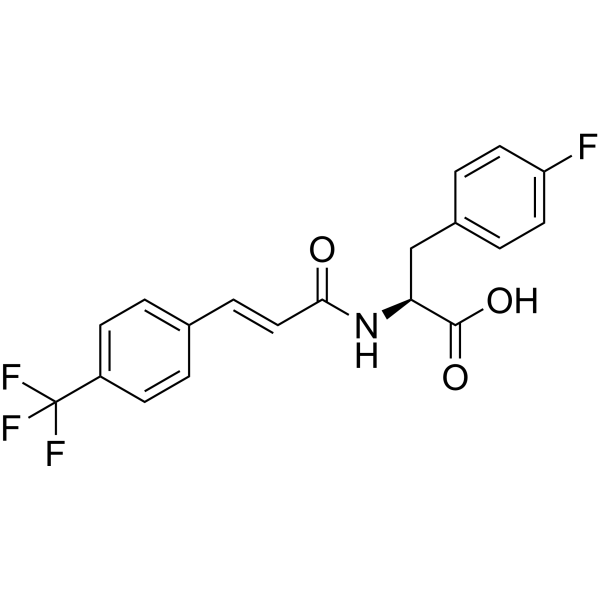
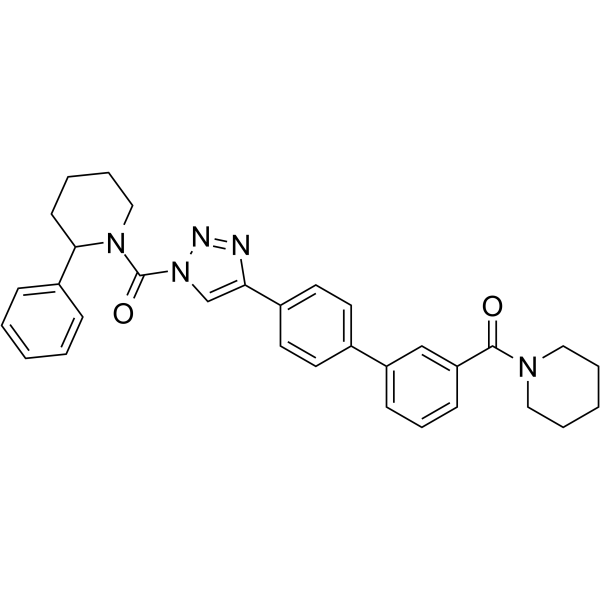
PI3K/Akt/CREB activator 1 (compound AE-18) is a potent, orally active PI3K/Akt/CREB activator. PI3K/Akt/CREB activator 1 promotes neuronal proliferation, induced differentiation of Neuro-2a cells into a neuron-like morphology, and accelerated the establishment of axon-dendrite polarization of primary hippocampal neurons through upregulating brain-derived neurotrophic factor via the PI3K/Akt/CREB pathway. PI3K/Akt/CREB activator 1 can be used in research of vascular dementia (VaD) .
loading...
    loading...
Cat. No.: HY-W614507
CAS No.: 19132-12-8
Research Areas:  

Metabolic Disease Cancer

Dihydronicotinamide riboside is a potent NAD + concentration enhancer. Dihydronicotinamide riboside modulates targets BAX, PUMA, NQO2, and IκB kinase. Dihydronicotinamide riboside mediates apoptosis, induces pro-oxidant activity, mitochondrial dysfunction, metabolic dysregulation, redox modulation, and pro-inflammatory M1 phenotype induction. Dihydronicotinamide riboside increases intracellular and mitochondrial NAD + levels, maintains cell survival against NAD +-depleting genotoxins. Dihydronicotinamide riboside can be used for the research of hepatocellular carcinoma .
loading...
    loading...
Cat. No.: HY-W749694
CAS No.: 76735-58-5
Synonyms: Canniflavone
Cannflavin B is a flavonoid compound that can be isolated from Cannabis sativa L. Cannflavin B is inhibitors of PGE2 release (IC50: 0.7 μM), mPGES-1 (IC50: 3.7 μM), and 5-lipoxygenase. Cannflavin B has multiple activities such as anti-inflammatory, antioxidant, anti-glycation, anti-ferroptosis, anti-tumor, and anti-Leishmania (IC50: 14 μM). Cannflavin B can also inhibit the TrkB-BDNF signaling pathway .
loading...
    loading...
Cat. No.: HY-120215
CAS No.: 1402612-64-9
Purity:  99.86%
Target:  

MAGL

Research Areas:  

Metabolic Disease

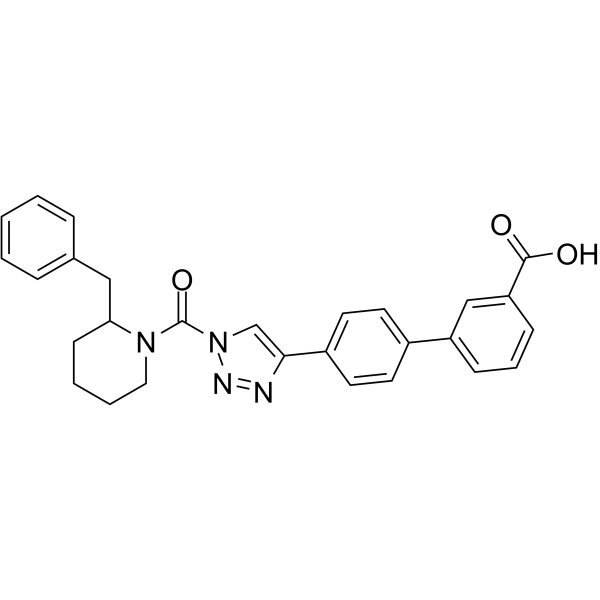
KT203 is a potent and selective inhibitor of α/β-hydrolase domain containing 6 (ABHD6), with an IC50 of 0.31 nM in Neuro2A cells .
loading...
    loading...
Cat. No.: HY-W250149
CAS No.: 1914-99-4
Chlorophosphonazo III is a cell membrane-permeable contrast agent and spectrophotometric reagent. Chlorophosphonazo III forms stable 1:1 complexes with intracellular calcium, magnesium, uranium, titanium, zirconium, thorium, scandium, equivalent actinides and protactinium. Chlorophosphonazo III generates photoacoustic signals correlated with Ca 2+ concentrations, which is applicable for imaging 3D tumor cell cultures and tumor spheroids. Chlorophosphonazo III exhibits no cytotoxicity, can be used for spectrophotometric detection of target ions, and the absorbance of its complexes remains stable for up to one week within the pH range of 2.2 to 7.0 .
loading...
    loading...
Cat. No.: HY-P10927A
Synonyms: BRINP2-related peptide TFA
Target:  

PKA AP-1

Research Areas:  

Metabolic Disease

BRP (BRINP2-related peptide) TFA is a 12-peptide derived from BRINP2 that can cross the blood-brain barrier. BRP TFA induces the central activation of FOS in neuronal cells via the cAMP-PKA-CREB signaling pathway. BRP TFA exerts anorectic and anti-obesity effects without triggering nausea or aversive responses. The action of BRP TFA is independent of the leptin, GLP-1 receptor and melanocortin 4 receptor pathways. BRP TFA is applicable to obesity-related research .
loading...
    loading...
Cat. No.: HY-120177
CAS No.: 1402612-62-7
Purity:  99.93%
Target:  

MAGL

Research Areas:  

Others

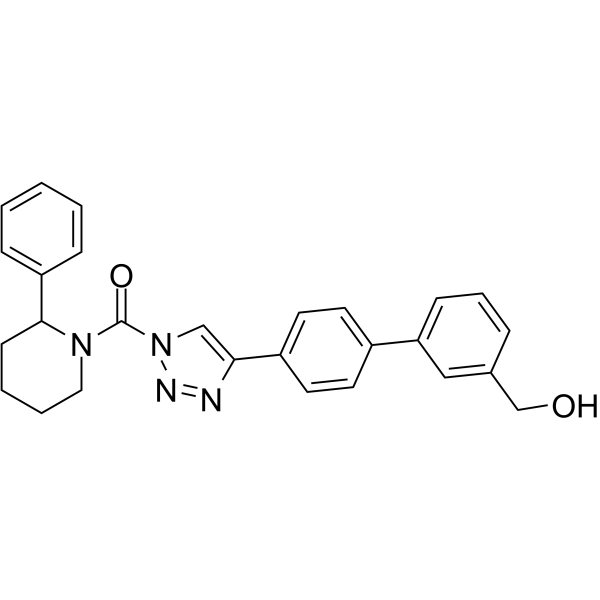
KT182 is a potent and selective inhibitor of α/β-hydrolase domain containing 6 (ABHD6), with an IC50 of 0.24 nM in Neuro2A cells .
loading...
    loading...
Cat. No.: HY-P10927
Synonyms: BRINP2-related peptide
Target:  

AP-1 PKA

Research Areas:  

Metabolic Disease

BRP is a 12-peptide derived from BRINP2 that can cross the blood-brain barrier. BRP induces the central activation of FOS in neuronal cells via the cAMP-PKA-CREB signaling pathway. BRP exerts anorectic and anti-obesity effects without triggering nausea or aversive responses. The action of BRP is independent of the leptin, GLP-1 receptor and melanocortin 4 receptor pathways. BRP is applicable to obesity-related research .
loading...
    loading...
Cat. No.: HY-119910
CAS No.: 529507-84-4
Purity:  99.7%
Synonyms: XIB4035
Target:  

GDNF Receptor

Research Areas:  

Neurological Disease

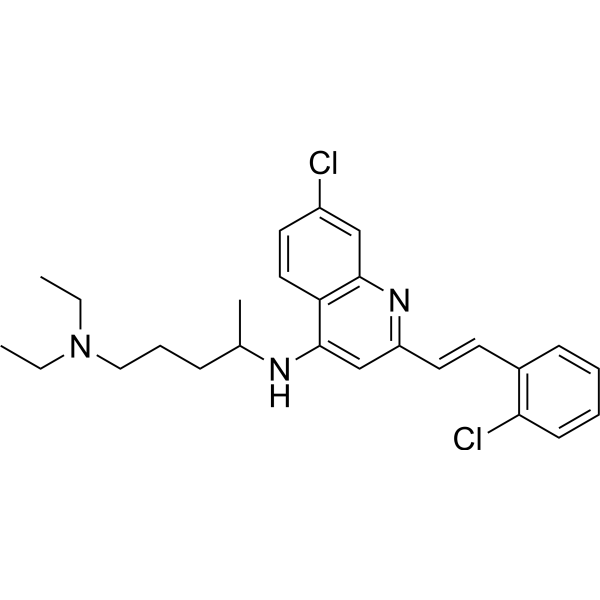
(E)-Aminoquinol (XIB4035) is a GFRα-1 agonist. (E)-Aminoquinol has mimic neurotrophic effects of GDNF, and induces Ret autophosphorylation in Neuro-2A cells. (E)-Aminoquinol can be used for research of Parkinson’s disease .
loading...
    loading...
Cat. No.: HY-139182
CAS No.: 2514-37-6
Target:  

Endogenous Metabolite

Research Areas:  

Metabolic Disease

CAY10762 is an inhibitor of monoacylglycerol lipase (MAGL; IC50=34.1 nM). It reduces hydrogen peroxide-induced lactate dehydrogenase (LDH) release from Neuro2a cells when used at a concentration of 1 μM. CAY10762 (10 mg/kg) increases levels of 2-arachidonoyl glycerol in mouse brain.
loading...
    loading...
Cat. No.: HY-114926
CAS No.: 1472640-86-0
Purity:  99.3%
Target:  

MAGL

Research Areas:  

Neurological Disease

KT185 is an orally-bioavailable, brain-penetrant and selective ABHD6 inhibitor, with an IC50 0.21 nM in Neuro2A cells .
loading...
    loading...
Cat. No.: HY-N15385
CAS No.: 137592-04-2
Target:  

Lipase

Hericenone D, an orally active pancreatic lipase inhibitor, can be found in Hericium erinaceus. Hericenone D reduces lipid absorption and stimulates nerve growth factor NGF gene expression. Hericenone D can be used for the research of menopausal obesity .
loading...
    loading...
Cat. No.: HY-178110
CAS No.: 3028442-70-5
Research Areas:  

Cancer

HDAC6-IN-65 is a selective HDAC6 inhibitor (IC50 = 0.9 nM) and also exhibits a certain suppressive effect on HDAC3 (IC50 = 39.4 nM). HDAC6-IN-65 can induce the accumulation of α-tubulin (ac-tubulin) and acetylated histone H3 (ac-histone H3, a class I HDAC inhibition marker) in Neuro-2a cells. HDAC6-IN-65 can be used for the study of melanoma .
loading...
    loading...
Cat. No.: HY-124503
CAS No.: 1438721-51-7
Longanlactone is a natural pyrrole-lactone alkaloid that can be used as a neurotrophic agent. Longanlactone increases BDNF gene expression in neuro2a cells .
loading...
    loading...
Cat. No.: HY-126981
CAS No.: 114066-50-1
Sarasinoside B1 is a glycoside compound. Sarasinoside B1 exhibits moderate cytotoxicity against Neuro-2a and HepG2 cell lines (IC50=~5-18 μM).
loading...
    loading...
Cat. No.: HY-119910A
CAS No.: 10023-54-8
Synonyms: (E/Z)-XIB4035
Target:  

GDNF Receptor

Research Areas:  

Neurological Disease

Aminoquinol is a GFRα-1 agonist. Aminoquinol exhibits neurotrophic effects similar to GDNF and induces Ret autophosphorylation in Neuro-2A cells. Aminoquinol can be used in research related to Parkinson's disease .
loading...
    loading...
Cat. No.: HY-125603
CAS No.: 1254277-89-8
Termitomycamide B (compound 2) is a neuroprotective agent that can be obtained from Termitomyces titanicus. Termitomycamide B effectively inhibits endoplasmic reticulum stress-dependent cell death. Termitomycamide B can be used in the study of neurodegenerative diseases .
loading...
    loading...
Cat. No.: HY-119910B
CAS No.: 7195-12-2
Synonyms: (E/Z)-XIB4035 phosphate
Target:  

GDNF Receptor

Research Areas:  

Neurological Disease

Aminoquinol ((E/Z)-XIB4035) phosphate is a GFRα-1 agonist. Aminoquinol phosphate exhibits neurotrophic effects similar to GDNF and induces Ret autophosphorylation in Neuro-2A cells. Aminoquinol phosphate can be used in research related to Parkinson's disease .
loading...
    loading...
Cat. No.: HY-119910C
CAS No.: 3653-53-0
Synonyms: (E/Z)-XIB4035 triphosphate
Target:  

GDNF Receptor

Research Areas:  

Neurological Disease

Aminoquinol ((E/Z)-XIB4035) phosphate is a GFRα-1 agonist. Aminoquinol phosphate exhibits neurotrophic effects similar to GDNF and induces Ret autophosphorylation in Neuro-2A cells. Aminoquinol phosphate can be used in research related to Parkinson's disease .
loading...
    loading...
Cat. No.: HY-169831
CAS No.: 3006795-68-9
Target:  

α-synuclein

Research Areas:  

Neurological Disease

HUP-55 is a prolyl endopeptidase inhibitor (IC50 = 5 nM). HUP-55 reduces the dimerization of α-synuclein in Neuro2a cells and induces autophagy (Autophagy) in HEK293 cells. It also decreases the increase in reactive oxygen species (ROS) production induced by hydrogen peroxide in SH-SY5Y cells at a concentration of 10 μM. In a mouse Parkinson’s disease model, HUP-55 (10 mg/kg) improves motor function (reduces the use frequency of the impaired paw) and decreases the levels of harmful oligomers of α-synuclein in the striatum caused by overexpression of α-synuclein .
loading...
    loading...

