1. Search Result
Search Result
Results for "

Neuroinflammatory model

" in MedChemExpress (MCE) Product Catalog:

14

Inhibitors & Agonists

1

Peptides

1

Inhibitory Antibodies

1

Natural
Products

2

Isotope-Labeled Compounds

Cat. No. Product Name Target Research Areas Chemical Structure
  • HY-145580

    UCB0599; (R)-NPT200-11

    α-synuclein Neurological Disease
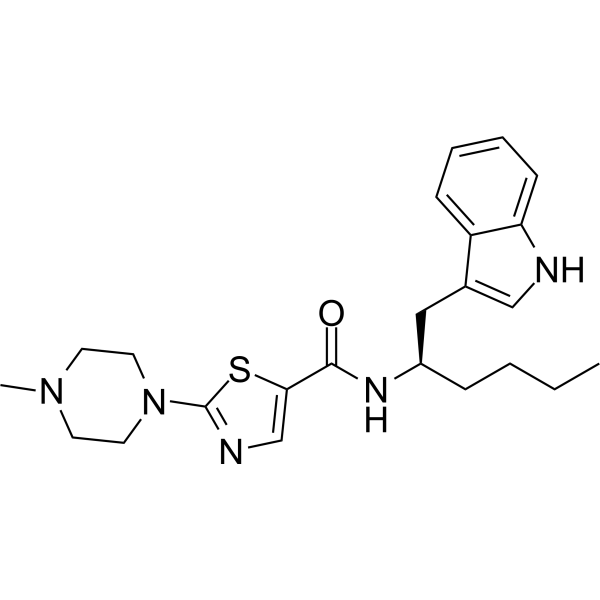
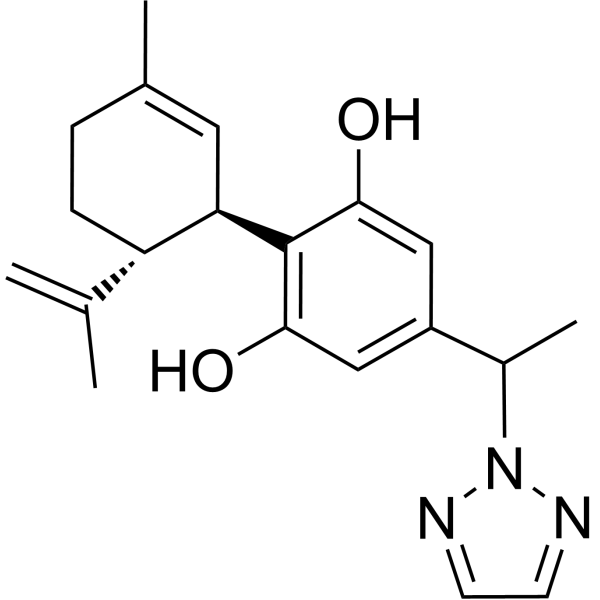
    Minzasolmin (UCB0599; (R)-NPT200-11) is an orally active, blood-brain-permeable α-synuclein (α-Syn) inhibitor that selectively binds to α-Syn misfolded intermediates (such as oligomers) and inhibits aggregation and fibril formation by regulating their conformational stability. Minzasolmin can reduce the generation of pathological oligomers and block neurotoxic signaling, thereby reducing the abnormal accumulation of α-Syn in the brain. Minzasolmin significantly improved motor deficits, reduced neuroinflammatory markers, and α-Syn-related pathological deposition in transgenic mouse models .
    Minzasolmin
  • HY-W009081

    Free Fatty Acid Receptor Neurological Disease
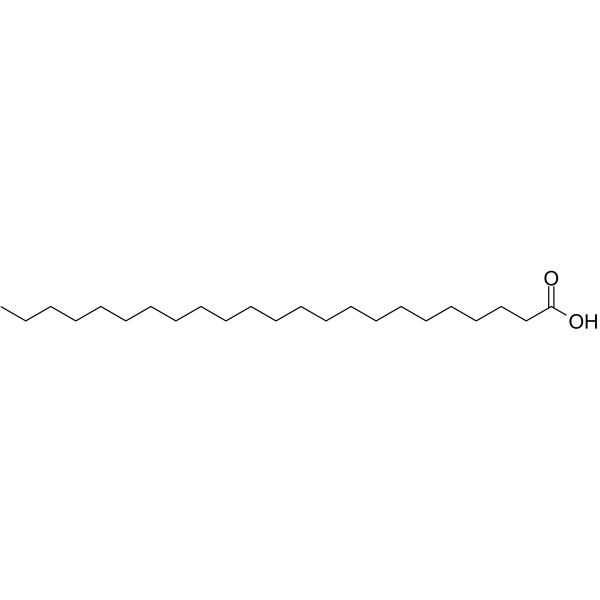
    Tricosanoic acid is an endogenous agonist of long-chain saturated fatty acids and free fatty acid receptor FFAR1, which can activate hair growth. Tricosanoic acid (C23:0) has the activity of improving cognitive function by regulating neuronal membrane fluidity, inhibiting neuroinflammatory response, participating in myelination and neuronal energy metabolism. Tricosanoic acid expression levels are low in the prefrontal cortex of Alzheimer's disease (AD) models; while better cognitive performance corresponds to higher serum concentration levels. Tricosanoic acid can be used as a biomarker for diseases related to cognitive decline .
    Tricosanoic acid
  • HY-132814

    ATH-1017

    c-Met/HGFR Neurological Disease
    Fosgonimeton (ATH-1017) is a hepatocyte growth factor receptor (c-Met/HGFR) agonist. Fosgonimeton has neuroprotective effects in both LPS (HY-D1056) -induced neuroinflammation and Aβ-induced AD models .
    Fosgonimeton
  • HY-162359

    IRAK Neurological Disease Inflammation/Immunology
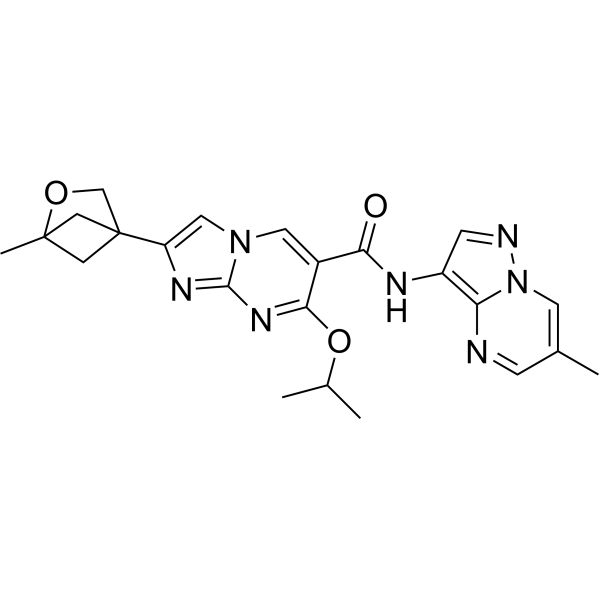
    BIO-7488 is an orally active, selective and blood-brain barrier permeable IRAK4 inhibitor, with an IC50 value of 0.5 nM. BIO-7488 inhibits the production of pro-inflammatory cytokines (IL-1β, TNFα, IL-6) and demonstrates anti-inflammatory effects in both LPS (HY-D1056) and distal hypoxic-middle cerebral artery occlusion (DH-MCAO) ischemic stroke model. BIO-7488 can be used for the study of neuroinflammatory-related diseases, particularly ischemic stroke .
    BIO-7488
  • HY-155850

    Pyruvate Kinase Neurological Disease
    CIAC001 is a Pyruvate Kinase PKM2 inhibitor with anti-neuroinflammatory activity. CIAC001 inhibits LPS-induced proinflammatory nitric oxide (NO) production and protects immunologically active BV-2 cells (IC50=2.5 μM). CIAC001 also has anti-neuroinflammation in mouse models and inhibits chronic morphine-induced addiction .
    CIAC001
  • HY-155126

    Reactive Oxygen Species (ROS) Neurological Disease
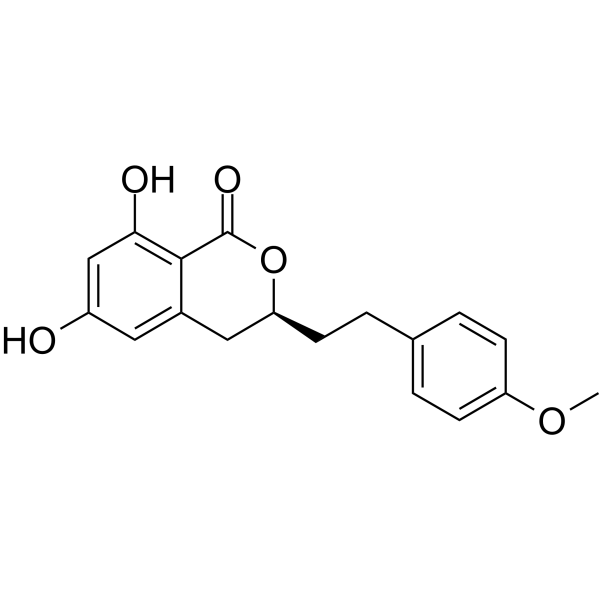
    LZWL02003 is an anti-neuroinflammatory agent. LZWL02003 has protective effect on MPP +-induced neuronal damage, and reduces the expression of ROS. LZWL02003 improves cognition, memory, learning, and athletic ability in a Rotenone (HY-B1756)-induced PD rat model. LZWL02003 can be used for research of neurodegenerative disease .
    LZWL02003
  • HY-W841438

    Amyloid-β Tau Protein Neurological Disease
    Lithium orotate is an orally active lithium supplement with reduced binding that can bypass amyloid sequestration in AD mice models. Lithium orotate can prevent Aβ plaque deposition and phospho-tau accumulation and reverse AD pathology, neuroinflammatory changes and memory loss in AD mice models and ageing wild-type mice. Lithium orotate can be used for the research of alcoholism and Alzheimer’s disease .
    Lithium orotate
  • HY-202233

    TBN

    Drug Derivative Neurological Disease Inflammation/Immunology
    Tetramethylpyrazine nitrone is a nitrone derivative of tetramethylpyrazine. Tetramethylpyrazine nitrone is an active ingredient from Ligusticum wallichii Franchat. Tetramethylpyrazine nitrone is a potent scavenger of free radicals with neuroprotective activitys in both rat and monkey models of ischemis stroke. Tetramethylpyrazine nitrone can suppress over-expression of neuroinflammatory marker vimentin .
    Tetramethylpyrazine nitrone
  • HY-179142

    COX TNF Receptor Interleukin Related Neurological Disease Inflammation/Immunology
    COX-2-IN-60 is a potent, orally active, and selective COX-2 inhibitor with an IC50 of 0.06 μM. COX-2-IN-60 exhibits ~100-fold selectivity over COX-1 (IC50 = 5.93 ). COX-2-IN-60 reduces oxidative stress and neuroinflammatory cytokines, and effectively counteracts epileptogenesis. COX-2-IN-60 exhibits significant anticonvulsant effects and protects against hippocampal injury by suppressing oxidative stress (reducing MDA and NO), pro-inflammatory signaling (reducing TNF-α and IL-6), and glial activationin in the Pilocarpine (HY-B0726A)-induced seizure mouse model. COX-2-IN-60 can be used for the research on neuroinflammatory and epilepsy .
    COX-2-IN-60
  • HY-178395S

    Isotope-Labeled Compounds Free Fatty Acid Receptor Neurological Disease
    Tricosanoic acid-d45 is the deuterium labeled Tricosanoic acid (HY-W009081). Tricosanoic acid is an endogenous agonist of long-chain saturated fatty acids and free fatty acid receptor FFAR1, which can activate hair growth. Tricosanoic acid (C23:0) has the activity of improving cognitive function by regulating neuronal membrane fluidity, inhibiting neuroinflammatory response, participating in myelination and neuronal energy metabolism. Tricosanoic acid expression levels are low in the prefrontal cortex of Alzheimer's disease (AD) models; while better cognitive performance corresponds to higher serum concentration levels. Tricosanoic acid can be used as a biomarker for diseases related to cognitive decline .
    Tricosanoic acid-d45
  • HY-W746542

    Isotope-Labeled Compounds Free Fatty Acid Receptor Neurological Disease
    Tricosanoic acid-d3 is the deuterium labeled Tricosanoic acid (HY-W009081). Tricosanoic acid is an endogenous agonist of long-chain saturated fatty acids and free fatty acid receptor FFAR1, which can activate hair growth. Tricosanoic acid (C23:0) has the activity of improving cognitive function by regulating neuronal membrane fluidity, inhibiting neuroinflammatory response, participating in myelination and neuronal energy metabolism. Tricosanoic acid expression levels are low in the prefrontal cortex of Alzheimer's disease (AD) models; while better cognitive performance corresponds to higher serum concentration levels. Tricosanoic acid can be used as a biomarker for diseases related to cognitive decline .
    Tricosanoic acid-d3
  • HY-P992382

    Interleukin Related Neurological Disease Inflammation/Immunology
    IC 100 is a humanized IgG4κ monoclonal antibody targeting apoptosis-associated speck-like protein (ASC) with blood-brain barrier permeability. IC 100 specifically inhibits ASC after being endocytosed via its Fc segment, blocks ASC polymerization and inflammasome activation, suppresses IL-1β release, forms complexes with ASC and TRIM21, and evades TRIM21-mediated proteasomal degradation. IC 100 alleviates symptoms associated with autoimmune encephalomyelitis, reduces immune cell infiltration and microglial activation in the mouse EAE model. IC 100 is suitable for research on neuroinflammatory and inflammasome-related diseases such as multiple sclerosis. Isotype comparison: HY-P99003 .
    IC 100
  • HY-186072

    NOD-like Receptor (NLR) Interleukin Related Cytochrome P450 Neurological Disease Metabolic Disease Inflammation/Immunology
    NT-0527 is a selective, orally active, and brain-permeable NLRP3 inflammasome inhibitor. NT-0527 can specifically block the formation of the NLRP3 inflammasome, resulting in the reduction in the maturation and release of IL-1β, exhibit inhibition on CYP2C19. NT-0527 displays anti-inflammatory activity in the mouse LPS (HY-D1056) /ATP (HY-B2176)-induced peritonitis model. NT-0527 can be used for the research of neuroinflammatory disorders (Parkinson's disease, Alzheimer's disease, amyotrophic lateral sclerosis) and peripheral inflammatory disorders (type II diabetes, atherosclerosis, gout, etc.) associated with NLRP3 inflammasome .
    NT-0527
  • HY-180824

    p38 MAPK Neurological Disease
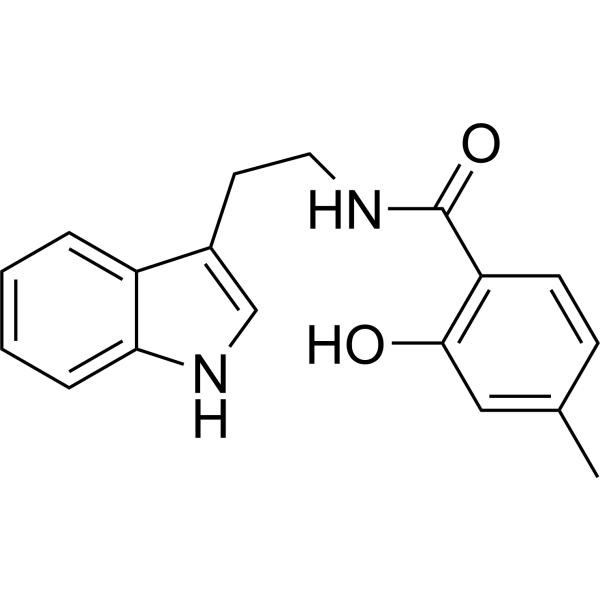
    P38-α MAPK-IN-11 (Compound 4C) is a selective inhibitor of P38α MAPK that can cross the blood-brain barrier with an IC50 value of 43 nM. P38-α MAPK-IN-11 has extremely low inhibitory activity against other MAPK subtypes, namely p38β, p38γ, and p38δ, with IC50 values of > 100 nM, > 100 nM, and 48.6 mM respectively. P38-α MAPK-IN-11 exhibits outstanding neuroprotective effects and anti-neuroinflammatory effects in Alzheimer's disease-like rat models. P38-α MAPK-IN-11 can be used for the study of Alzheimer's disease .
    p38-α MAPK-IN-11

Inquiry Online

Your information is safe with us. * Required Fields.

Salutation


Country or Region *

Applicant Name *


Organization Name *

Department *


Email Address *


Product Name *

Cat. No.


Requested quantity *

Phone Number *


Remarks

Inquiry Online

Inquiry Information

Product Name:
Cat. No.:
Quantity:
MCE Japan Authorized Agent:

