1. Search Result
Search Result
Results for "

Synechococcus sp. PCC 7002 BIS strains

" in MedChemExpress (MCE) Product Catalog:

4686

Inhibitors & Agonists

5

Screening Libraries

139

Fluorescent Dyes

265

Biochemical Assay Reagents

147

Peptides

4

MCE Kits

36

Inhibitory Antibodies

667

Natural
Products

55

Recombinant Proteins

160

Isotope-Labeled Compounds

50

Antibodies

1175

Click Chemistry

246

Oligonucleotides

4

GMP Molecules

Cat. No. Product Name Target Research Areas Chemical Structure
  • HY-12041
    SP600125
    Maximum Cited Publications
    584 Publications Verification

    JNK Autophagy Apoptosis Ferroptosis Cancer
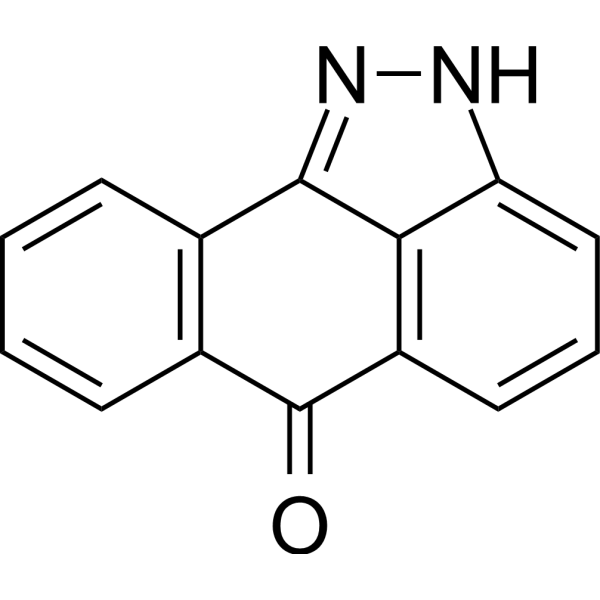
    SP600125 is an orally active, reversible, and ATP-competitive JNK inhibitor with IC50s of 40, 40 and 90 nM for JNK1, JNK2 and JNK3, respectively. SP600125 is a potent ferroptosis inhibitor. SP600125 induces the transformation of bladder cancer cells from autophagy to apoptosis .
    SP600125
  • HY-110182
    SP-141
    4 Publications Verification

    MDM-2/p53 Cancer
    SP-141 is a specific inhibitor of MDM2. SP-141 promotes MDM2 auto-ubiquitination and degradation. SP-141 might be used for the research of pancreatic cancer and breast cancer cells .
    SP-141
  • HY-110177
    SP-100030
    1 Publications Verification

    NF-κB Inflammation/Immunology
    SP-100030 is a potent NF-κB and activator protein-1 (AP-1) double inhibitor (IC50s=50 and 50 nM, respectively). SP-100030 inhibits IL-2, IL-8, and TNF-alpha production in Jurkat and other T cell lines. SP-100030 decreases murine collagen-induced arthritis (CIA) .
    SP-100030
  • HY-131339
    SP-96
    2 Publications Verification

    Aurora Kinase Cancer
    SP-96 is a highly potent, selective and non-ATP-competitive Aurora B (IC50=0.316 nM) inhibitor and shows >2000 fold selectivity against FLT3 and KIT. SP-96 shows selective growth inhibition in NCI60 screening, incluing MDA-MD-468 (GI50=107 nM). SP-96 can be used for the research of triple negative breast cancer (TNBC) .
    SP-96
  • HY-172942

    Mitochondrial Metabolism Reactive Oxygen Species (ROS) Dynamin Cardiovascular Disease Infection Neurological Disease Cancer
    SP11 is a mitochondrial fission protein 1 (Fis1) inhibitor with an IC50 of 9.4 μM. SP11 binds only to activated Fis1 by engaging Cys41. SP11 preserves mitochondrial integrity and function during oxidative stress, inhibits hydrogen peroxide-induced mitochondrial ROS production, mitochondrial fragmentation, and Drp1 mitochondrial translocation. SP11 can be used for the research of parkinson’s disease .
    SP11
  • HY-121262
    Bisabolene (mixture of isomers)
    1 Publications Verification

    BISabolene; γ-BISabolene

    Drug Intermediate Infection
    Bisabolene (mixture of isomers) (Bisabolene) is a sesquiterpenoid plant natural product and also a hydrocarbon precursor for various industry-relevant chemicals. Bisabolene (mixture of isomers) serves as an important precursor for the production of industry-relevant chemicals such as biofuels, bioplastics, pharmaceuticals and cosmetics .
    Bisabolene (mixture of isomers)
  • HY-P2742

    ASO, Cucurbit sp.

    Endogenous Metabolite Metabolic Disease
    Ascorbate oxidase, Cucurbit sp., also known as vitamin C oxidase, is a REDOX enzyme involved in the regulation of extracellular matrix. Ascorbate oxidase catalyzes the reaction of ascorbic acid and oxygen to produce dehydroascorbic acid .
    Ascorbate oxidase, Cucurbit sp.
  • HY-P2936

    Phospholipase Cardiovascular Disease Infection
    Sphingomyelin phosphodiesterase, Streptomyces sp. is a sphingomyelin phosphodiesterase derived from the genus Streptomyces, which cleaves the phosphodiester bond of sphingomyelin. Sphingomyelin phosphodiesterase, Streptomyces sp. catalyzes the hydrolysis of sphingomyelin in micelles, synthetic substrates, erythrocyte ghost membranes and liposomes, as well as the hydrolysis of the substrate HNP. In the presence of Mg 2+ or Mn 2+ , Sphingomyelin phosphodiesterase, Streptomyces sp. induces hemolysis of bovine erythrocytes through the hydrolysis of membrane sphingomyelin .
    Sphingomyelin phosphodiesterase, Streptomyces sp.
  • HY-P2857A

    Amyloglucosidase, Rhizopus sp.

    Endogenous Metabolite Metabolic Disease
    Glucoamylase, Rhizopus sp. (Amyloglucosidase, Rhizopus sp.) is a starch-hydrolyzing enzyme with high catalytic efficiency towards soluble starch and raw starch. Glucoamylase, Rhizopus sp. hydrolyzes α-1,4 and α-1,6 glycosidic linkages in starch and similar substrates, and primarily releases β-glucose molecules from the non-reducing ends. Glucoamylase, Rhizopus sp. participates in glycogen metabolism and is associated with type II glycogen storage disease. Glucoamylase, Rhizopus sp. converts starch into glucose, and is applicable to the industrial production of high-fructose syrup, ethanol and other fermented products .
    Glucoamylase, Rhizopus sp.
  • HY-P2889

    Biochemical Assay Reagents Others
    Pyranose oxidase, Coriolus sp. is an oxidoreductase targeting monosaccharides (e.g., D-glucose, D-galactose). Pyranose oxidase, Coriolus sp. is promising for research of biosensors (glucose, 1,5-anhydroglucitol detection) and biofuel cells .
    Pyranose oxidase, Coriolus sp.
  • HY-125863C

    G6PD, Bacillus sp.

    Endogenous Metabolite Others
    Glucose-6-phosphate dehydrogenase, Bacillus sp. catalyzes the conversion of glucose-6-phosphate into 6-phosphogluconolactone, and produces reduced nicotinamide adenine dinucleotide phosphate (NADPH) and ribose-5-phosphate in this process. Glucose-6-phosphate dehydrogenase, Bacillus sp. can be used in research about diabetic complications .
    Glucose-6-phosphate dehydrogenase, Bacillus sp.
  • HY-100530C

    PKA Phosphodiesterase (PDE) Neurological Disease Metabolic Disease
    Sp-cAMPS sodium salt, a cAMP analog, is potent activator of cAMP-dependent PKA I and PKA II. Sp-cAMPS sodium salt is also a potent, competitive phosphodiesterase (PDE3A) inhibitor with a Ki of 47.6 µM. Sp-cAMPS sodium salt binds the PDE10 GAF domain with an EC50 of 40 μM .
    Sp-cAMPS sodium salt
  • HY-149324

    PROTACs Polo-like Kinase (PLK) Cancer
    SP27 is a PROTAC that can selective degrades PLK4, with a DC50 of 19.5 nM. SP27 can be used for the research of breast cancer .
    SP27
  • HY-144645

    Flavivirus Dengue Virus Virus Protease DNA/RNA Synthesis Infection
    SP-471P is a potent dengue virus (DENV) protease inhibitor with EC50s of 5.9 μM, 1.4 μM, 5.1 μM and 1.7 μM for DENV1, DENV2, DENV3 and DENV4, respectively and CC50 value over 100 μM. SP-471P can reduce DENV viral RNA synthesis .
    SP-471P
  • HY-161794A

    FKBP Cancer
    SP3N hydrochloride is a specific degrader of the prolyl isomerase (FKBP12). The alkylamine of SP3N hydrochloride is metabolized to a reactive aldehyde (SP3CHO), which recruits the SCF FBXO22 ligase for FKBP12 degradation. SP3N hydrochloride may be used in research for cancer .
    SP3N hydrochloride
  • HY-137640A

    PKA Inflammation/Immunology
    Sp-8-Br-cAMPS sodium is a cAMP analog, which performs a protein kinase A (PKA) activating activity with EC50 of 360 nM. Sp-8-Br-cAMPS sodium inhibits proliferation of T cells and the haemocyte non-self response in Lepidoptera larve .
    Sp-8-Br-cAMPS sodium
  • HY-16912

    SP-420

    Ferroptosis Metabolic Disease
    Petadeferitrin (SP-420) is a tridentate iron chelator belonging to the class of iron chelators, with orally activity. Petadeferitrin can be used in research related to β-thalassemia .
    Petadeferitrin
  • HY-P11050A

    Apoptosis Cancer
    SP94 is a peptide ligand with high specificity for hepatocellular carcinoma cells. SP94 selectively binds to multiple hepatocellular carcinoma cell lines in vitro. SP94 inhibits tumor growth in a mouse model of hepatocellular carcinoma by promoting apoptosis and reducing angiogenesis. SP94 can be used as a specific probe for hepatocellular carcinoma imaging. SP94 is useful for hepatocellular carcinoma research .
    SP94
  • HY-120994B

    PKA Neurological Disease Inflammation/Immunology
    Sp-8-CPT-cAMPS, a cAMP analog, is a potent and selective activator of the cAMP-dependent protein kinas A (PKA I and PKA II). Sp-8-CPT-cAMPS selects site A of RI compares to site A of RII by 153-fold and site B of RII compares to site B of RI by 59-fold .
    Sp-8-CPT-cAMPS
  • HY-P2917A

    GyK, Cellulomonas sp.

    Endogenous Metabolite Others
    Glycerol kinase, Cellulomonas sp. (EC 2.7.1.30) is a bacterial sugar kinase, is often used in biochemical studies. Glycerol kinase, Cellulomonas sp. catalyzes the first step of glycerol metabolism by transforming the triol into glycerol-3-P (G3P). Glycerol kinase, Cellulomonas sp. is crucial for regulating channel/facilitator-independent uptake of glycerol into the cell .
    Glycerol kinase, Cellulomonas sp.
  • HY-P2776B

    Endogenous Metabolite Others
    Hexokinase, Bacillus sp. catalyzes the phosphorylation of glucose, and is involved in glycolysis. Hexokinase, Bacillus sp. participates is also related to energy production, protection of mitochondrial integrity, and cell survival .
    Hexokinase, Bacillus sp.
  • HY-P2979A

    β-D-Fructofuranosidase, candida sp.

    Biochemical Assay Reagents Others
    Invertase from Candida sp. is responsible for catalyzing the hydrolysis of sucrose into glucose and fructose and is widely used in the field of carbohydrate processing. Invertase from Candida sp. can be used for enzymatic determination of sucrose concentration as well as for structural analysis of carbohydrates containing β-D-fructofuranosyl residues .
    Invertase, candida sp.
  • HY-P2733A

    GPO, Pedio coccus sp.

    Endogenous Metabolite Metabolic Disease
    Glycerol-3-phosphate oxidase, Pedio coccus sp. (GPO, Pedio coccus sp.) is a key intermediate in glycerol metabolism. Glycerol-3-phosphate oxidase is the skeleton of phospholipids in membrane lipids, and also a substrate in the respiratory chain. Glycerol-3-phosphate oxidase produces electrons through oxidation .
    Glycerol 3-phosphate Oxidase, Pedio coccus sp.
  • HY-161795

    Drug Metabolite Cancer
    SP3CHO is an active metabolite generated by the metabolism of SP3N in cell culture by the action of amine oxidase. SP3CHO can induce polyubiquitination of specific proteins by recruiting the SCFFBXO22 E3 ligase complex. SP3CHO can be used in cancer therapy research .
    SP3CHO
  • HY-100530B

    PKA Phosphodiesterase (PDE) Neurological Disease Metabolic Disease
    Sp-cAMPS, a cAMP analog, is potent activator of cAMP-dependent PKA I and PKA II. Sp-cAMPS is also a potent, competitive phosphodiesterase (PDE3A) inhibitor with a Ki of 47.6 µM. Sp-cAMPS binds the PDE10 GAF domain with an EC50 of 40 μM .
    Sp-cAMPS
  • HY-110005

    PKA Phosphodiesterase (PDE) Neurological Disease Metabolic Disease
    Sp-cAMPS triethylamine, a cAMP analog, is potent activator of cAMP-dependent PKA I and PKA II. Sp-cAMPS triethylamine is also a potent, competitive phosphodiesterase (PDE3A) inhibitor with a Ki of 47.6 µM. Sp-cAMPS triethylamine binds the PDE10 GAF domain with an EC50 of 40 μM .
    Sp-cAMPS triethylamine
  • HY-P2800A

    Endogenous Metabolite Metabolic Disease
    Diaphorase, Clostridium sp. is a diaphorase derived from Clostridium sp. As a flavin-containing NAD (P) H dehydrogenase, Diaphorase, Clostridium sp. uses NADH as an electron donor to reduce artificial dyes such as DCPIP and NBT, and participates in energy metabolism .
    Diaphorase, clostridium sp.
  • HY-P2724A

    PNP, Bacillus sp.

    Endogenous Metabolite Metabolic Disease
    Purine nucleoside phosphorylase, Bacillus sp. is a key enzyme in purine metabolism, involved in the purine salvage pathway. A deficiency in Purine nucleoside phosphorylase, Bacillus sp. can lead to impaired T-cell function. In the presence of inorganic phosphate as a second substrate, Purine nucleoside phosphorylase, Bacillus sp. catalyzes the cleavage of the glycosidic bond of ribonucleosides and deoxyribonucleosides, producing purine bases and ribose (or deoxyribose)-1-phosphate. Purine nucleoside phosphorylase, Bacillus sp. can be used for the determination of inorganic phosphate .
    Purine nucleoside phosphorylase, Bacillus sp.
  • HY-12430

    MDM-2/p53 Cancer
    SP-141 (hydrochloride) is a specific inhibitor of MDM2. SP-141 (hydrochloride) promotes MDM2 auto-ubiquitination and degradation. SP-141 (hydrochloride) might be used for the research of pancreatic cancer and breast cancer cells .
    SP-141 hydrochloride
  • HY-144646

    Flavivirus Dengue Virus Virus Protease Infection
    SP-471 is a potent dengue virus (DENV) protease inhibitor with IC50 value of 18 μM. SP-471 inhibits both intermolecular and intramolecular protease processes of DENV .
    SP-471
  • HY-138019

    Integrin Cardiovascular Disease
    SP-8008 is a selective shear stress-induced platelet aggregation (SIPA) inhibitor with an IC50 of 1.44 μM. SP-8008 effectively interferes von Willebrand factor (vWF) and platelet glycoprotein (GP) Ib interaction. SP-8008 exerts its antithrombotic effect by selectively inhibiting shear stress-induced platelet aggregation .
    SP-8008
  • HY-P3258

    Cholinesterase (ChE) Infection
    SP-10 is a small peptide derived from S protein with an IC50 value of 1.88 nM for blocks the interaction between S protein and ACE2. SP-10 can be used for SARS-CoV research .
    SP-10
  • HY-P11027

    Bacterial Antibiotic Infection
    Thiazoplanomicin (Compound 1) is a thiazolyl peptide antibiotic. Thiazoplanomicin can be isolated from the leaf-litter actinomycete Actinoplanes sp. MM794L-181F6. Thiazoplanomicin has potent antimicrobial activities against gonococcal strains (especially drug-resistant strains) and Gram-positive bacterium with MICs of 31.2-125 and 0.5-15.6 ng/mL, respectively. Thiazoplanomicin has no antibacterial activity against E.coli. Thiazoplanomicin can be used for bacterial infections research .
    Thiazoplanomicin
  • HY-161794

    FKBP Cancer
    SP3N is a specific degrader of the prolyl isomerase (FKBP12). The alkylamine of SP3N is metabolized to a reactive aldehyde (SP3CHO), which recruits the SCF FBXO22 ligase for FKBP12 degradation. SP3N may be used in research for cancer .
    SP3N
  • HY-137613

    HIV Infection Inflammation/Immunology
    Sp-TTPαS is a competitivesterile alpha motif and HD domain containing protein 1 (SAMHD1) hydrolysis inhibitor. Sp-TTPαS competitively inhibits SAMHD1 triphosphohydrolase activity with a Ki value of 46 µM .
    Sp-TTPαS
  • HY-P5569

    Fungal Infection
    SP-B peptide is an antimicrobial peptide. SP-B peptide has antifungal activity against strains of Cryptococcus neoformans, Candida albicans and Aspergillus fumigatus
    SP-B peptide
  • HY-N9714

    Others Others
    4-Hydroxyalternariol-9-methyl ether can be isolated from an endolichenic fungal strain Nigrospora sphaerica (No.83-1-1-2), endolichenic fungal strains Alternaria alternata (No.58-8-4-1) and Phialophora sp. (No.96-1-8-1) .
    4-Hydroxyalternariol-9-methyl ether
  • HY-N14111

    Bacterial Fungal Infection
    Cuevaene A can be isolated from the strain of gdmAI-disrupted Streptomyces sp. LZ35 and. Cuevaene A displays moderate activity against Gram-positive bacteria (e.g., Bacillus subtilis strain ATCC 11060) and modest activity against fungi (e.g., Fusarium verticillioides strain S68 and Rhizoctonia solani strain GXE4) .
    Cuevaene A
  • HY-N14112

    Bacterial Fungal Infection
    Cuevaene B can be isolated from the strain of gdmAI-disrupted Streptomyces sp. LZ35 and. Cuevaene B displays moderate activity against Gram-positive bacteria (e.g., Bacillus subtilis strain ATCC 11060) and modest activity against fungi (e.g., Fusarium verticillioides strain S68 and Rhizoctonia solani strain GXE4) .
    Cuevaene B
  • HY-155176

    HDAC Cancer
    SP-2-225 is a selective HDAC6 inhibitor. SP-2-225 enhance the production of cancer-associated antigens and macrophage antigen cross-presentation to T cells. SP-2-225 reduces the tumor volume in a syngeneic SM1 melanoma model .
    SP-2-225
  • HY-178143

    KLF Cancer
    Sp1-IN-1 is a selective specificity protein 1 (Sp1) inhibitor. Sp1-IN-1 inhibits the proliferation of Hela cells and MCF-7 cells. Sp1-IN-1 can be used to the studies of cervical cancer and breast cancer .
    Sp1-IN-1
  • HY-106987

    NO Synthase Cardiovascular Disease Inflammation/Immunology
    SP/W-5186 is a nitric oxide (NO) donor agent containing a cysteine structure. SP/W-5186 can improve cardiac function, reduce myocardial damage, protect vascular endothelial function and inhibit inflammation and oxidative stress. SP/W-5186 has the ability to inhibit oxidative damage induced by peroxynitrite (ONOO⁻). SP/W-5186 can be used in the research of myocardial ischemia-reperfusion injury .
    SP/W 5186
  • HY-165272

    Bacterial Antibiotic Infection
    Antibiotic SF-2132 is a peptide antibiotic identified in Nocardiopsis sp., which exhibits inhibitory activity against β-lactam antibiotic-resistant strains, such as Pseudomonas and Escherichia .
    Antibiotic SF-2132
  • HY-N14548

    Antibiotic Bacterial Infection
    Cryptosporiopsin can be isolated from the strain of Cryptosporiopsis sp. and Sporormia affinis. Cryptosporiopsin has antibacterial activity to many kinds of basidiomycetes, algal fungi, ascomycetes and hemiplegia fungi that cause wood rot, and can inhibit spore germination of Phytophthora potatoes. Cryptosporiopsin also has certain activity against gram-positive bacteria and negative bacteria .
    Cryptosporiopsin
  • HY-137638A

    Sp-5,6-DCI-cBIMPS

    PKA Metabolic Disease
    Sp-5,6-DCl-cBIMPS sodium is a potent and specific cAMP-dependent protein kinases (cAMP-PK) activator. Sp-5,6-DCl-cBIMPS sodium stimulates insulin release. Sp-5,6-DCl-cBIMPS sodium inhibits U-46619 (HY-108566)-induced activation of Rho, Gq and G12/G13 in platelets .
    Sp-5,6-DCl-cBIMPS sodium
  • HY-137632

    PKA Cancer
    Sp-8-Cl-cAMPS is an analog of cAMP (HY-B1511) and a derivative of Sp-8-Cl-cAMP. Sp-8-Cl-cAMPS inhibits the growth of human leukemia cell HL-60 and colon cancer cell LS-174T, with IC50 of 8-100 μM. Sp-8-Cl-cAMPS activates the protein kinases cAKI and cAKII, with Ka of 0.25 and 3.2 μM .
    Sp-8-Cl-cAMPS
  • HY-137639

    HCN Channel Neurological Disease
    Sp-8-Br-cGMPS is an analog of cGMP. Sp-8-Br-cGMPS is an agonist for cGMP-gated cation channels (CNG channels), with an EC50 of 106.5 μM. Sp-8-Br-cGMPS induces the currents, without the ability to stabilize the channel open state as a full agonist .
    Sp-8-Br-cGMPS
  • HY-137626

    P2Y Receptor Others
    Sp-ATPαS is a regulator of ATP-binding proteins. Sp-ATPαS is a competitive antagonist of the human P2Y1 receptor, which can inhibit the calcium signal induced by ADP. Sp-ATPαS is metabolically more stable than ATP . Sp-ATPαS can be used to study the binding patterns of metals and nucleotides in enzymatic reactions.
    Sp-ATPαS
  • HY-137620

    Biochemical Assay Reagents Others
    Sp-dADPαS is a regulator of ADP-binding proteins. Sp-dADPαS is metabolically more stable than ATP .
    Sp-dATPαS
  • HY-137627

    Biochemical Assay Reagents Others
    Sp-ADPαS is a regulator of ADP-binding proteins. Sp-ADPαS is metabolically more stable than ADP .
    Sp-ADPαS

Inquiry Online

Your information is safe with us. * Required Fields.

Salutation


Country or Region *

Applicant Name *


Organization Name *

Department *


Email Address *


Product Name *

Cat. No.


Requested quantity *

Phone Number *


Remarks

Inquiry Online

Inquiry Information

Product Name:
Cat. No.:
Quantity:
MCE Japan Authorized Agent:

