Search Result
Results for "
Tartaric acid
" in MedChemExpress (MCE) Product Catalog:
21
Biochemical Assay Reagents
1
Isotope-Labeled Compounds
| Cat. No. |
Product Name |
Target |
Research Areas |
Chemical Structure |
-
- HY-Y1134
-
|
D-(-)-Tartaric acid
|
Biochemical Assay Reagents
Bacterial
|
Infection
|
|
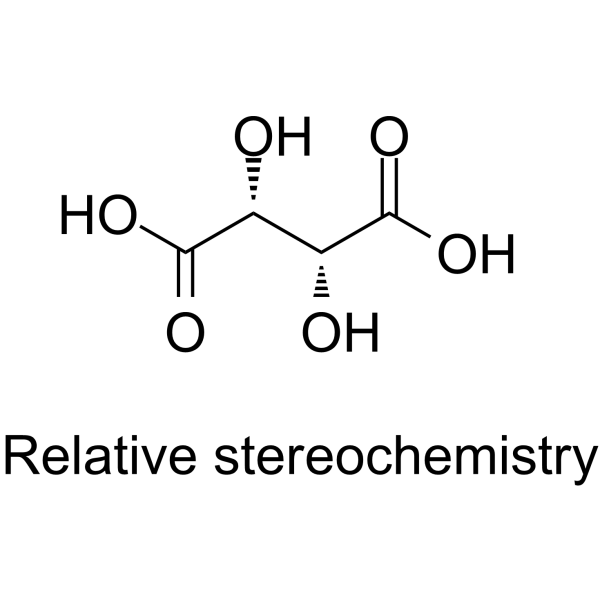
D-Tartaric acid (D-(-)-Tartaric acid) serves as an additive in beverages and other food products. When combined with pyrrole, D-Tartaric acid is used to construct a D-TA/polypyrrole-based bacterial imprinted polymer sensor for the detection of Vibrio parahaemolyticus. D-Tartaric acid enhances the sensitivity of polypyrrole-based bacterial imprinted polymer sensors for detecting Vibrio parahaemolyticus. D-Tartaric acid is applicable to research on Vibrio parahaemolyticus infection .
|
-
-
- HY-D0850
-
|
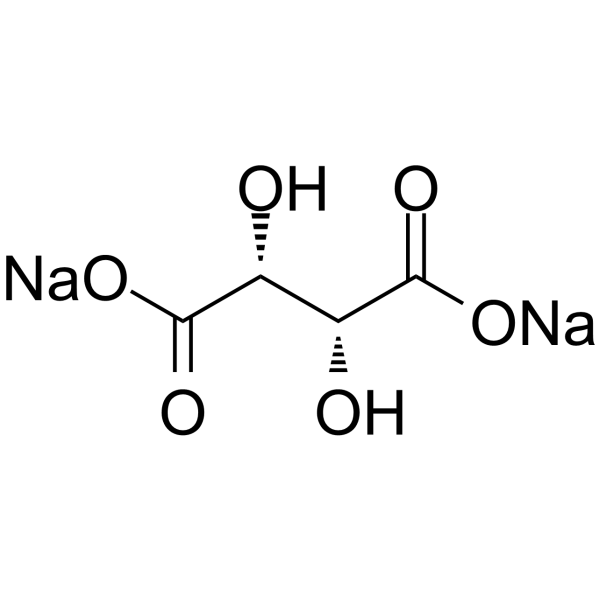
Sodium tartrate dibasic dihydrate; Sodium tartrate dihydrate
|
Phosphatase
Endogenous Metabolite
|
Cardiovascular Disease
|
|
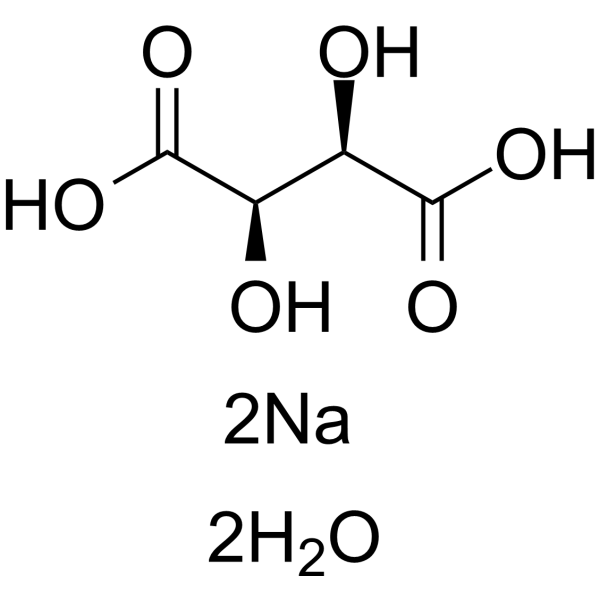
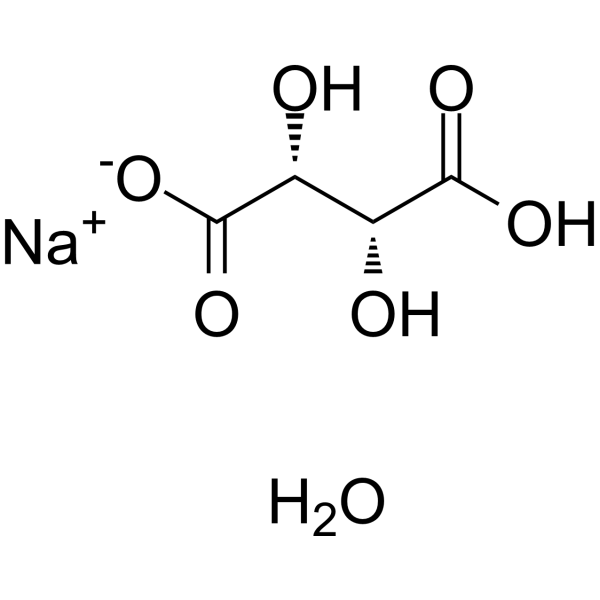
Tartaric acid disodium dehydrate (L-(+) -tartaric acid) is an orally active weak organic acid that can be isolated from grapes. Tartaric acid disodium dehydrate has vasodilatory and antihypertensive effects. Tartaric acid disodium dehydrate can be used as flavorings and antioxidants in a range of foods and beverages. Tartaric acid disodium dehydrate can be used in laser frequency doubling and optical limiting applications .
|
-
-
- HY-Y1332
-
|
L-Tartaric acid potassium sodium salt tetrahydrate; Potassium sodium tartrate tetrahydrate; Sodium potassium tartrate tetrahydrate
|
Biochemical Assay Reagents
|
Others
|
|
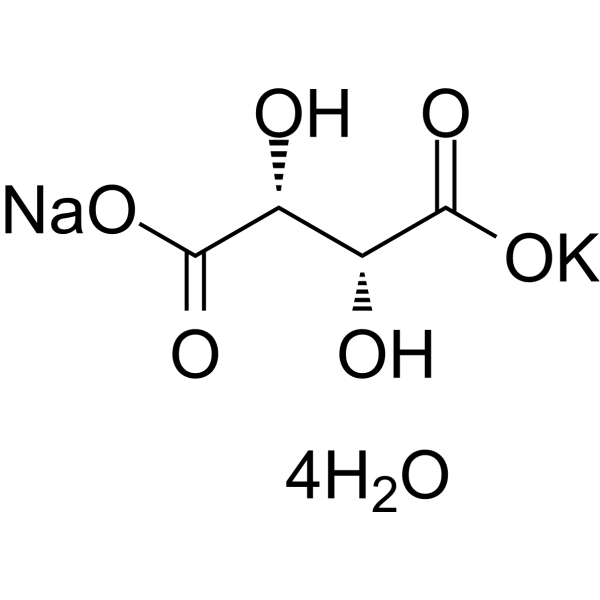
Rochelle salt is an organic-inorganic compound commonly used as a catalyst and complexing reagent. It can be used to catalyze or promote certain chemical reactions, and is widely used in batteries, pharmaceuticals and food industries. In addition, this compound is also used as a substrate or intermediate in some biochemical reactions.
|
-
-
- HY-N2436
-
|
Tartaric acid
|
Biochemical Assay Reagents
|
Others
|
|
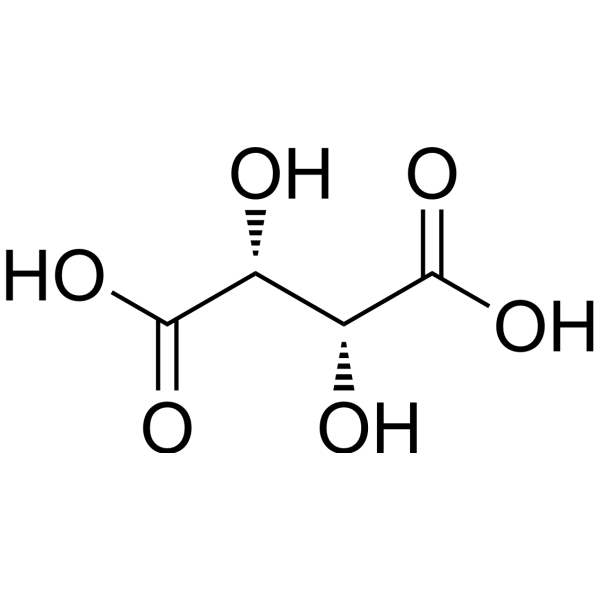
2,3-Dihydroxysuccinic acid (Tartaric acid) is an organic acid containing two hydroxyl groups and two carboxyl groups. 2,3-Dihydroxysuccinic acid exists in various stereoisomers and is widely used in food, pharmaceutical, chemical, and other fields .
|
-
-
- HY-Y1315
-
|
|
Biochemical Assay Reagents
|
Endocrinology
|
|
DL-Tartaric acid is an orally active and non-racemic mixture of L- and D-tartaric acid with antioxidant activity. 14C-labeled DL-Tartaric acid is nephrotoxic .
|
-
-
- HY-128476
-
|
|
Environmental Pollutants
Biochemical Assay Reagents
|
Others
|
|
Sodium Tartrate (E335ii) is an approved food additive that functions as both a pH regulator and an emulsifier. Sodium Tartrate effectively inhibits hydrolysis, thermal oxidation, polymerization and coloration of vegetable oil during high-temperature heating, exhibiting significant antioxidant activity. The DL-tartaric acid component of Sodium Tartrate has an absorption rate of up to 90% in brown rats, while the absorption rate of related tartaric acid in humans is only 20% .
|
-
-
- HY-Y1315S
-
-
-
- HY-159051
-
|
|
Biochemical Assay Reagents
|
Others
|
|
Dragendorff reagent is used for detecting alkaloids and other nitrogen-containing compounds. Dragendorff reagent is a solution of potassium bismuth iodide composing of Basic bismuth nitrate (Bi(NO3)3), Tartaric acid (HY-N2436), and Potassium iodide (KI). When contact with alkaloids, Dragendorff reagent produces an orange or orange red precipitate .
|
-
-
- HY-20551
-
|
|
Biochemical Assay Reagents
|
Others
|
|
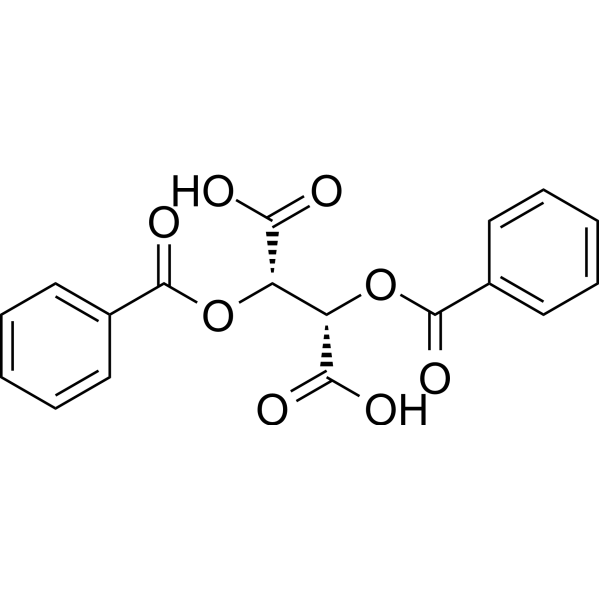
(+)-Dibenzoyl-D-tartaric acid is a biochemical reagent that can be used as a biological material or organic compound for life science related research.
|
-
-
- HY-Y1361
-
|
D-(-)-Tartaric acid diethyl ester
|
Biochemical Assay Reagents
Drug Intermediate
|
Others
|
|
Diethyl D-(-)-tartrate (D-(-)-Tartaric acid diethyl ester) is a biochemical reagent that can be used as a biological material or organic compound for life science related research. Diethyl D(-)-tartrate can also react with fatty carbonyl compounds to form bis(sodium carboxylate) types of surfactants, which have good water solubility, strong ability to lower surface tension, and can be easily decomposed under acidic conditions .
|
-
-
- HY-W133962
-
|
Potassium L-(+)-Tartaric acid
|
Biochemical Assay Reagents
|
Others
|
|
Potassium L-tartaric acid (Potassium L-(+)-tartaric acid) is a kind of biological materials or organic compounds that are widely used in life science research .
|
-
-
- HY-W109973
-
|
L-(+)-Tartaric acid diammonium
|
Endogenous Metabolite
|
Cardiovascular Disease
|
|
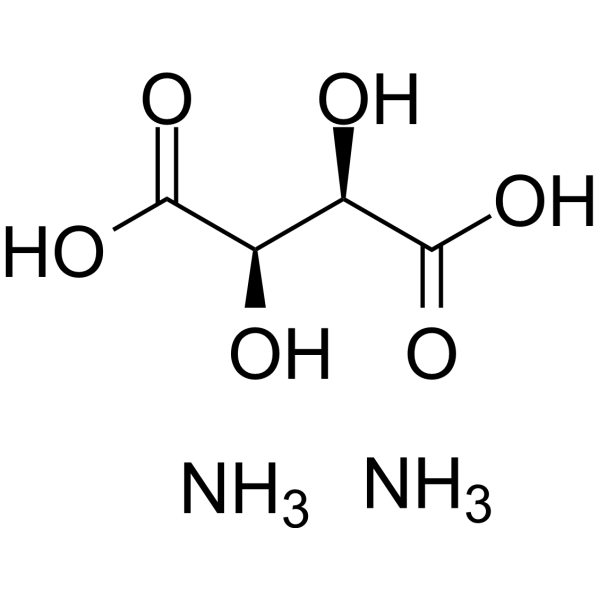
L-Tartaric acid diammonium (L-(+) -tartaric acid) is an orally active weak organic acid that can be isolated from grapes. L-Tartaric acid diammonium has vasodilatory and antihypertensive effects. L-Tartaric acid diammonium can be used as flavorings and antioxidants in a range of foods and beverages. L-Tartaric acid diammonium can be used in laser frequency doubling and optical limiting applications .
|
-
-
- HY-N2436R
-
|
Tartaric acid (Standard)
|
Biochemical Assay Reagents
Reference Standards
|
Others
|
|
2,3-Dihydroxysuccinic acid (Standard) (Tartaric acid (Standard)) is the analytical standard of 2,3-Dihydroxysuccinic acid (HY-N2436). This product is intended for research and analytical applications. 2,3-Dihydroxysuccinic acid (Tartaric acid) is an organic acid containing two hydroxyl groups and two carboxyl groups. 2,3-Dihydroxysuccinic acid exists in various stereoisomers and is widely used in food, pharmaceutical, chemical, and other fields.
|
-
-
- HY-Y0117
-
|
|
Biochemical Assay Reagents
|
Others
|
|
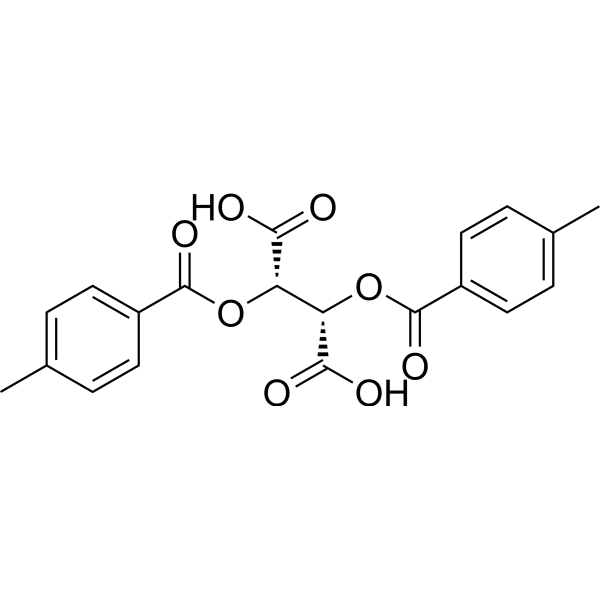
(S,S)-O,O'-Di-p-toluoyltartaric acid is a biochemical reagent that can be used as a biological material or organic compound for life science related research.
|
-
-
- HY-Y1134R
-
|
D-(-)-Tartaric acid (Standard)
|
Biochemical Assay Reagents
Reference Standards
Bacterial
|
Infection
|
|
D-Tartaric acid (Standard) is the analytical standard of D-Tartaric acid (HY-Y1134). This product is intended for research and analytical applications. D-Tartaric acid (D-(-)-Tartaric acid) serves as an additive in beverages and other food products. When combined with pyrrole, D-Tartaric acid is used to construct a D-TA/polypyrrole-based bacterial imprinted polymer sensor for the detection of Vibrio parahaemolyticus. D-Tartaric acid enhances the sensitivity of polypyrrole-based bacterial imprinted polymer sensors for detecting Vibrio parahaemolyticus. D-Tartaric acid is applicable to research on Vibrio parahaemolyticus infection .
|
-
-
- HY-17038B
-
|
S-20098 L(+)-Tartaric acid
|
Melatonin Receptor
5-HT Receptor
Endogenous Metabolite
|
Neurological Disease
|
|
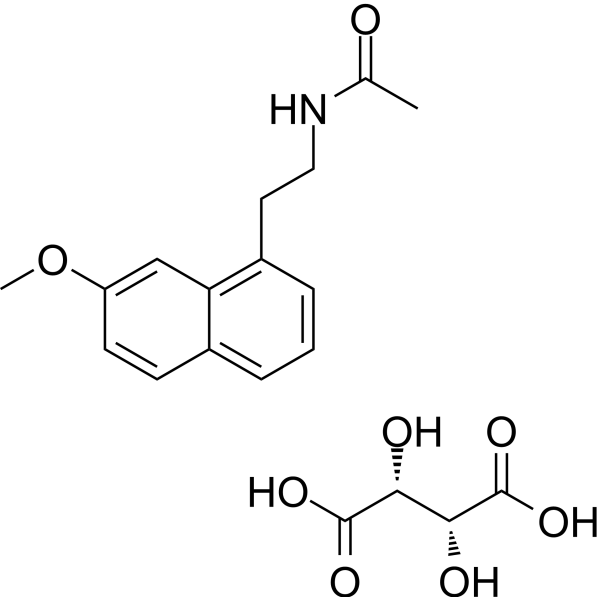
Agomelatine L(+)-Tartaric acid (S-20098 L(+)-Tartaric acid) is a specific agonist of MT1 and MT2 receptors with Kis of 0.1, 0.06, 0.12, and 0.27 nM for CHO-hMT1, HEK-hMT1, CHO-hMT2, and HEK-hMT2, respectively . Agomelatine L(+)-Tartaric acid is a selective 5-HT2C receptor antagonist with pKis of 6.4 and 6.2 at native (porcine) and cloned, human 5-HT2C receptors, respectively .
|
-
-
- HY-W037483
-
|
|
Biochemical Assay Reagents
|
Others
|
|
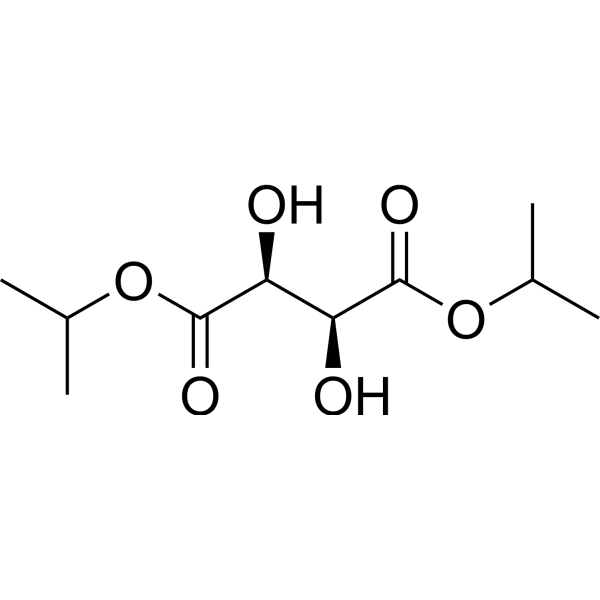
D-(-)-Tartaric acid diisopropyl ester is a biochemical reagent that can be used as a biological material or organic compound for life science related research.
|
-
-
- HY-W127787
-
|
L-(+)-Tartaric acid sodium hydrate
|
Endogenous Metabolite
|
Others
|
|
L-Tartaric acid (L-(+)-Tartaric acid) sodium hydrate is the enantiomer of D-tartaric acid. L-Tartaric acid (HY-Y0293) is a white crystalline dicarboxylic acid found in many plants, such as grapes, and is one of the main organic acids in wine. L-Tartaric acid sodium hydrate which acts as a flour bulking agent and as a food additive can interact with sodium bicarbonate to produce carbon dioxide .
|
-
-
- HY-Y0293R
-
|
L-(+)-Tartaric acid (Standard)
|
Reference Standards
Endogenous Metabolite
|
Cardiovascular Disease
|
|
L-Tartaric acid (Standard) is the analytical standard of L-Tartaric acid. This product is intended for research and analytical applications. L-tartaric acid (L-(+) -tartaric acid) is an orally active weak organic acid that can be isolated from grapes. L-Tartaric acid has vasodilatory and antihypertensive effects. L-Tartaric acid can be used as flavorings and antioxidants in a range of foods and beverages. L-Tartaric acid can be used in laser frequency doubling and optical limiting applications .
|
-
-
- HY-Y1315R
-
|
|
Biochemical Assay Reagents
Reference Standards
|
Others
|
|
DL-Tartaric acid (Standard) is the analytical standard of DL-Tartaric acid. This product is intended for research and analytical applications. DL-Tartaric acid is a non-racemic mixture of L- and D-tartaric acid with antioxidant activity. 14C-labeled DL-Tartaric acid is nephrotoxic .
|
-
-
- HY-W134004
-
|
L-(+)-Tartaric acid ammonium
|
Biochemical Assay Reagents
|
Others
|
|
L-Tartaric acid (ammonium) (L-(+)-Tartaric acid (ammonium)) is a kind of biological materials or organic compounds that are widely used in life science research .
|
-
-
- HY-D0850R
-
|
Sodium tartrate dibasic dihydrate (Standard); Sodium tartrate dihydrate (Standard)
|
Reference Standards
Phosphatase
Endogenous Metabolite
|
Cardiovascular Disease
|
|
Tartaric acid (disodium dihydrate) (Standard) is the analytical standard of Tartaric acid (disodium dihydrate). This product is intended for research and analytical applications. Tartaric acid disodium dehydrate (L-(+) -tartaric acid) is an orally active weak organic acid that can be isolated from grapes. Tartaric acid disodium dehydrate has vasodilatory and antihypertensive effects. Tartaric acid disodium dehydrate can be used as flavorings and antioxidants in a range of foods and beverages. Tartaric acid disodium dehydrate can be used in laser frequency doubling and optical limiting applications [4].
|
-
-
- HY-Y0117R
-
|
|
Biochemical Assay Reagents
Reference Standards
|
Others
|
|
(+)-Di-p-toluoyl-D-tartaric Acid (Standard) is the analytical standard of (+)-Di-p-toluoyl-D-tartaric Acid. This product is intended for research and analytical applications. (S,S)-O,O'-Di-p-toluoyltartaric acid is a biochemical reagent that can be used as a biological material or organic compound for life science related research.
|
-
-
- HY-W008948
-
|
|
Biochemical Assay Reagents
|
Others
|
|
Bis(L-tartaric acid) 18-crown-6 is a biochemical reagent that can be used as a biological material or organic compound for life science related research.
|
-
-
- HY-170454
-
|
|
Biochemical Assay Reagents
|
Others
|
|
5-Keto-D-gluconic acid potassium is a product formed by Gluconobacter oxydans. 5-Keto-D-gluconic acid potassium can be converted effectively into L-(+)-tartaric acid .
|
-
-
- HY-W127787R
-
|
L-(+)-Tartaric acid sodium hydrate (Standard)
|
Endogenous Metabolite
Reference Standards
|
Others
|
|
Tartaric acid (sodium hydrate) (Standard) is the analytical standard of Tartaric acid (sodium hydrate) (HY-W127787). This product is intended for research and analytical applications. L-Tartaric acid (L-(+)-Tartaric acid) sodium hydrate is the enantiomer of D-tartaric acid. L-Tartaric acid (HY-Y0293) is a white crystalline dicarboxylic acid found in many plants, such as grapes, and is one of the main organic acids in wine. L-Tartaric acid sodium hydrate which acts as a flour bulking agent and as a food additive can interact with sodium bicarbonate to produce carbon dioxide .
|
-
-
- HY-Y1332R
-
|
L-Tartaric acid potassium sodium salt tetrahydrate (Standard); Potassium sodium tartrate tetrahydrate (Standard); Sodium potassium tartrate tetrahydrate (Standard)
|
Biochemical Assay Reagents
Reference Standards
|
Others
|
|
Rochelle salt (Standard) is the analytical standard of Rochelle salt. This product is intended for research and analytical applications. Rochelle salt is an organic-inorganic compound commonly used as a catalyst and complexing reagent. It can be used to catalyze or promote certain chemical reactions, and is widely used in batteries, pharmaceuticals and food industries. In addition, this compound is also used as a substrate or intermediate in some biochemical reactions.
|
-
-
- HY-77377
-
|
|
Drug Intermediate
|
Others
|
|
Methyl (3S,6R)-6-methyl-3-piperidinecarboxylate L-tartaric acid salt is a drug intermediate for synthesis of various active compounds.
|
-
| Cat. No. |
Product Name |
Type |
-
- HY-Y1134
-
|
D-(-)-Tartaric acid
|
Biochemical Assay Reagents
|
|
D-Tartaric acid (D-(-)-Tartaric acid) serves as an additive in beverages and other food products. When combined with pyrrole, D-Tartaric acid is used to construct a D-TA/polypyrrole-based bacterial imprinted polymer sensor for the detection of Vibrio parahaemolyticus. D-Tartaric acid enhances the sensitivity of polypyrrole-based bacterial imprinted polymer sensors for detecting Vibrio parahaemolyticus. D-Tartaric acid is applicable to research on Vibrio parahaemolyticus infection .
|
-
- HY-D0850
-
|
Sodium tartrate dibasic dihydrate; Sodium tartrate dihydrate
|
Biochemical Assay Reagents
|
|
Tartaric acid disodium dehydrate (L-(+) -tartaric acid) is an orally active weak organic acid that can be isolated from grapes. Tartaric acid disodium dehydrate has vasodilatory and antihypertensive effects. Tartaric acid disodium dehydrate can be used as flavorings and antioxidants in a range of foods and beverages. Tartaric acid disodium dehydrate can be used in laser frequency doubling and optical limiting applications .
|
-
- HY-Y1332
-
|
L-Tartaric acid potassium sodium salt tetrahydrate; Potassium sodium tartrate tetrahydrate; Sodium potassium tartrate tetrahydrate
|
Biochemical Assay Reagents
|
|
Rochelle salt is an organic-inorganic compound commonly used as a catalyst and complexing reagent. It can be used to catalyze or promote certain chemical reactions, and is widely used in batteries, pharmaceuticals and food industries. In addition, this compound is also used as a substrate or intermediate in some biochemical reactions.
|
-
- HY-N2436
-
|
Tartaric acid
|
Biochemical Assay Reagents
|
|
2,3-Dihydroxysuccinic acid (Tartaric acid) is an organic acid containing two hydroxyl groups and two carboxyl groups. 2,3-Dihydroxysuccinic acid exists in various stereoisomers and is widely used in food, pharmaceutical, chemical, and other fields .
|
-
- HY-159051
-
|
|
Biochemical Assay Reagents
|
|
Dragendorff reagent is used for detecting alkaloids and other nitrogen-containing compounds. Dragendorff reagent is a solution of potassium bismuth iodide composing of Basic bismuth nitrate (Bi(NO3)3), Tartaric acid (HY-N2436), and Potassium iodide (KI). When contact with alkaloids, Dragendorff reagent produces an orange or orange red precipitate .
|
-
- HY-20551
-
|
|
Biochemical Assay Reagents
|
|
(+)-Dibenzoyl-D-tartaric acid is a biochemical reagent that can be used as a biological material or organic compound for life science related research.
|
-
- HY-Y1361
-
|
D-(-)-Tartaric acid diethyl ester
|
Biochemical Assay Reagents
|
|
Diethyl D-(-)-tartrate (D-(-)-Tartaric acid diethyl ester) is a biochemical reagent that can be used as a biological material or organic compound for life science related research. Diethyl D(-)-tartrate can also react with fatty carbonyl compounds to form bis(sodium carboxylate) types of surfactants, which have good water solubility, strong ability to lower surface tension, and can be easily decomposed under acidic conditions .
|
-
- HY-W133962
-
|
Potassium L-(+)-Tartaric acid
|
Biochemical Assay Reagents
|
|
Potassium L-tartaric acid (Potassium L-(+)-tartaric acid) is a kind of biological materials or organic compounds that are widely used in life science research .
|
-
- HY-W109973
-
|
L-(+)-Tartaric acid diammonium
|
Biochemical Assay Reagents
|
|
L-Tartaric acid diammonium (L-(+) -tartaric acid) is an orally active weak organic acid that can be isolated from grapes. L-Tartaric acid diammonium has vasodilatory and antihypertensive effects. L-Tartaric acid diammonium can be used as flavorings and antioxidants in a range of foods and beverages. L-Tartaric acid diammonium can be used in laser frequency doubling and optical limiting applications .
|
-
- HY-N2436R
-
|
Tartaric acid (Standard)
|
Biochemical Assay Reagents
|
|
2,3-Dihydroxysuccinic acid (Standard) (Tartaric acid (Standard)) is the analytical standard of 2,3-Dihydroxysuccinic acid (HY-N2436). This product is intended for research and analytical applications. 2,3-Dihydroxysuccinic acid (Tartaric acid) is an organic acid containing two hydroxyl groups and two carboxyl groups. 2,3-Dihydroxysuccinic acid exists in various stereoisomers and is widely used in food, pharmaceutical, chemical, and other fields.
|
-
- HY-Y0117
-
|
|
Biochemical Assay Reagents
|
|
(S,S)-O,O'-Di-p-toluoyltartaric acid is a biochemical reagent that can be used as a biological material or organic compound for life science related research.
|
-
- HY-Y1134R
-
|
D-(-)-Tartaric acid (Standard)
|
Biochemical Assay Reagents
|
|
D-Tartaric acid (Standard) is the analytical standard of D-Tartaric acid (HY-Y1134). This product is intended for research and analytical applications. D-Tartaric acid (D-(-)-Tartaric acid) serves as an additive in beverages and other food products. When combined with pyrrole, D-Tartaric acid is used to construct a D-TA/polypyrrole-based bacterial imprinted polymer sensor for the detection of Vibrio parahaemolyticus. D-Tartaric acid enhances the sensitivity of polypyrrole-based bacterial imprinted polymer sensors for detecting Vibrio parahaemolyticus. D-Tartaric acid is applicable to research on Vibrio parahaemolyticus infection .
|
-
- HY-W037483
-
|
|
Biochemical Assay Reagents
|
|
D-(-)-Tartaric acid diisopropyl ester is a biochemical reagent that can be used as a biological material or organic compound for life science related research.
|
-
- HY-W127787
-
|
L-(+)-Tartaric acid sodium hydrate
|
Biochemical Assay Reagents
|
|
L-Tartaric acid (L-(+)-Tartaric acid) sodium hydrate is the enantiomer of D-tartaric acid. L-Tartaric acid (HY-Y0293) is a white crystalline dicarboxylic acid found in many plants, such as grapes, and is one of the main organic acids in wine. L-Tartaric acid sodium hydrate which acts as a flour bulking agent and as a food additive can interact with sodium bicarbonate to produce carbon dioxide .
|
-
- HY-W134004
-
|
L-(+)-Tartaric acid ammonium
|
Biochemical Assay Reagents
|
|
L-Tartaric acid (ammonium) (L-(+)-Tartaric acid (ammonium)) is a kind of biological materials or organic compounds that are widely used in life science research .
|
-
- HY-D0850R
-
|
Sodium tartrate dibasic dihydrate (Standard); Sodium tartrate dihydrate (Standard)
|
Biochemical Assay Reagents
|
|
Tartaric acid (disodium dihydrate) (Standard) is the analytical standard of Tartaric acid (disodium dihydrate). This product is intended for research and analytical applications. Tartaric acid disodium dehydrate (L-(+) -tartaric acid) is an orally active weak organic acid that can be isolated from grapes. Tartaric acid disodium dehydrate has vasodilatory and antihypertensive effects. Tartaric acid disodium dehydrate can be used as flavorings and antioxidants in a range of foods and beverages. Tartaric acid disodium dehydrate can be used in laser frequency doubling and optical limiting applications [4].
|
-
- HY-Y0117R
-
|
|
Biochemical Assay Reagents
|
|
(+)-Di-p-toluoyl-D-tartaric Acid (Standard) is the analytical standard of (+)-Di-p-toluoyl-D-tartaric Acid. This product is intended for research and analytical applications. (S,S)-O,O'-Di-p-toluoyltartaric acid is a biochemical reagent that can be used as a biological material or organic compound for life science related research.
|
-
- HY-W008948
-
|
|
Biochemical Assay Reagents
|
|
Bis(L-tartaric acid) 18-crown-6 is a biochemical reagent that can be used as a biological material or organic compound for life science related research.
|
-
- HY-170454
-
|
|
Biochemical Assay Reagents
|
|
5-Keto-D-gluconic acid potassium is a product formed by Gluconobacter oxydans. 5-Keto-D-gluconic acid potassium can be converted effectively into L-(+)-tartaric acid .
|
-
- HY-W127787R
-
|
L-(+)-Tartaric acid sodium hydrate (Standard)
|
Biochemical Assay Reagents
|
|
Tartaric acid (sodium hydrate) (Standard) is the analytical standard of Tartaric acid (sodium hydrate) (HY-W127787). This product is intended for research and analytical applications. L-Tartaric acid (L-(+)-Tartaric acid) sodium hydrate is the enantiomer of D-tartaric acid. L-Tartaric acid (HY-Y0293) is a white crystalline dicarboxylic acid found in many plants, such as grapes, and is one of the main organic acids in wine. L-Tartaric acid sodium hydrate which acts as a flour bulking agent and as a food additive can interact with sodium bicarbonate to produce carbon dioxide .
|
-
- HY-Y1332R
-
|
L-Tartaric acid potassium sodium salt tetrahydrate (Standard); Potassium sodium tartrate tetrahydrate (Standard); Sodium potassium tartrate tetrahydrate (Standard)
|
Biochemical Assay Reagents
|
|
Rochelle salt (Standard) is the analytical standard of Rochelle salt. This product is intended for research and analytical applications. Rochelle salt is an organic-inorganic compound commonly used as a catalyst and complexing reagent. It can be used to catalyze or promote certain chemical reactions, and is widely used in batteries, pharmaceuticals and food industries. In addition, this compound is also used as a substrate or intermediate in some biochemical reactions.
|
| Cat. No. |
Product Name |
Category |
Target |
Chemical Structure |
| Cat. No. |
Product Name |
Chemical Structure |
-
- HY-Y1315S
-
|
|
|
DL-Tartaric acid-d2 is the deuterium labeled DL-Tartaric acid (HY-Y1315) .
|
-
| Cat. No. |
Product Name |
|
Classification |
-
- HY-D0850
-
|
Sodium tartrate dibasic dihydrate; Sodium tartrate dihydrate
|
|
Chelating Agents
|
|
Tartaric acid disodium dehydrate (L-(+) -tartaric acid) is an orally active weak organic acid that can be isolated from grapes. Tartaric acid disodium dehydrate has vasodilatory and antihypertensive effects. Tartaric acid disodium dehydrate can be used as flavorings and antioxidants in a range of foods and beverages. Tartaric acid disodium dehydrate can be used in laser frequency doubling and optical limiting applications .
|
Your information is safe with us. * Required Fields.
Inquiry Information
- Product Name:
- Cat. No.:
- Quantity:
- MCE Japan Authorized Agent:

