21 Results for "

XPO1

" in MedChemExpress (MCE) Product Catalog:
Products (21)

21 Results for "XPO1" in MCE Product Catalog:

  • Categories Recommended:
    More
4
4 Cited Publications
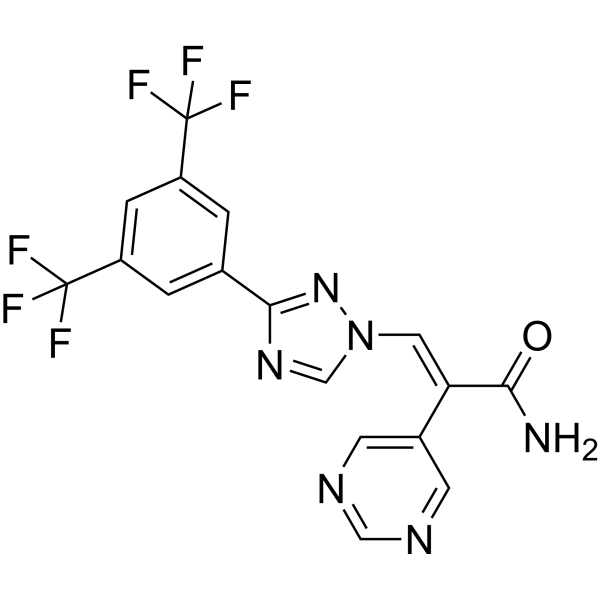
Cat. No.: HY-100423
CAS No.: 1642300-52-4
Purity:  99.79%
Synonyms: KPT-8602
Target:  

CRM1

Research Areas:  

Cancer

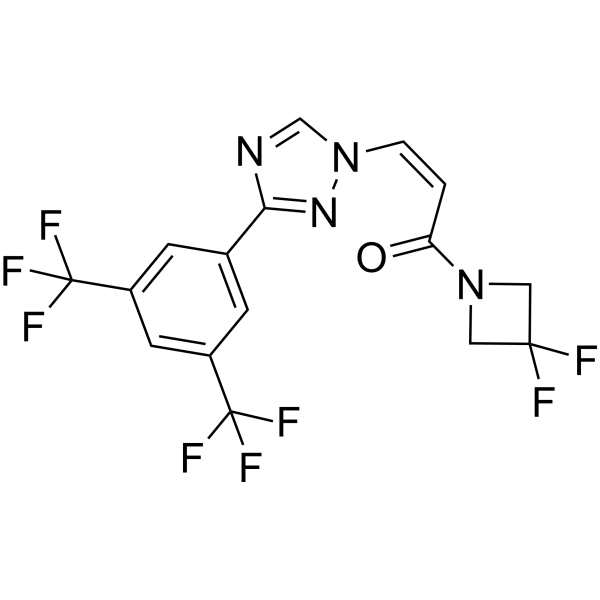
Eltanexor (KPT-8602) is a second-generation, highly specific and orally active exportin-1 (XPO1) inhibitor with potent anti-leukemic activity. Eltanexor (KPT-8602) inhibits XPO1-dependent nuclear export (EC50=60.9 nM) by directly targeting XPO1. Eltanexor (KPT-8602) induces Caspase-dependent apoptosis in a panel of leukemic cell lines [1].
loading...
    loading...
2
2 Cited Publications
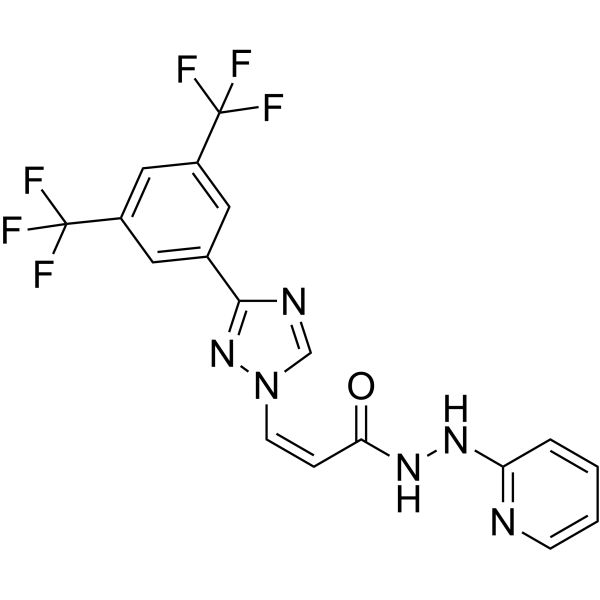
Cat. No.: HY-15970
CAS No.: 1392136-43-4
Synonyms: KPT-335
Target:  

CRM1 Apoptosis RSV

Verdinexor (KPT-335) is an orally active inhibitor for selective inhibitor of nuclear export (SINE). Verdinexor inhibits the respiratory syncytial virus A2 (RSV A2) replication with an IC50 of 0.96 µM. Verdinexor inhibits the function of nuclear export protein Exportin 1 (XPO1/CRM1), inhibiting pro-inflammatory responses. Verdinexor exhibits antitumor effciency [1] .
loading...
    loading...
1
1 Cited Publications
Cat. No.: HY-164710
Synonyms: b-LMB
Target:  

CRM1

Research Areas:  

Others

Biotinylated leptomycin B is a compound used to quantify nuclear export protein 1 (XPO1) occupancy and is used to study the interaction of SINE compounds with XPO1 and the response of cancer cells to related compounds.
loading...
    loading...
Cat. No.: HY-111485
CAS No.: 1820889-23-3
Purity:  98.29%
Synonyms: INCB-057643
Research Areas:  

Cancer

Ertabresib (INCB-057643) is an orally active BET protein inhibitor. Ertabresib blocks gene transcription by targeting the BET protein family, induces cell cycle arrest and apoptosis by downregulating proto-oncogenes such as c-MYC, and additionally reduces the expression of FOXP3 and PD-L1 to improve the immune microenvironment. It also exerts synergistic effects and overcomes drug resistance when combined with chemotherapy and XPO1 inhibitors. Ertabresib can be used in research related to high-grade B-cell lymphoma with MYC and BCL2 rearrangements, pancreatic cancer, pancreatitis, and metastatic castration-resistant prostate cancer [1] .
loading...
    loading...
Cat. No.: HY-170669
CAS No.: 3105680-00-7
Research Areas:  

Cancer

PROTAC XPO1 degrader-1 is a CRBN-recruiting PROTAC degrader of exportin 1 (XPO1), with a DC50 of 23.67 nM. It exerts anti-proliferative effects against acute myeloid leukemia cells by inducing XPO1 protein degradation, inhibiting NF-κB activity, inducing apoptosis, and causing G1 cell cycle arrest. PROTAC XPO1 degrader-1 can be used for research on acute myeloid leukemia [1].
loading...
    loading...
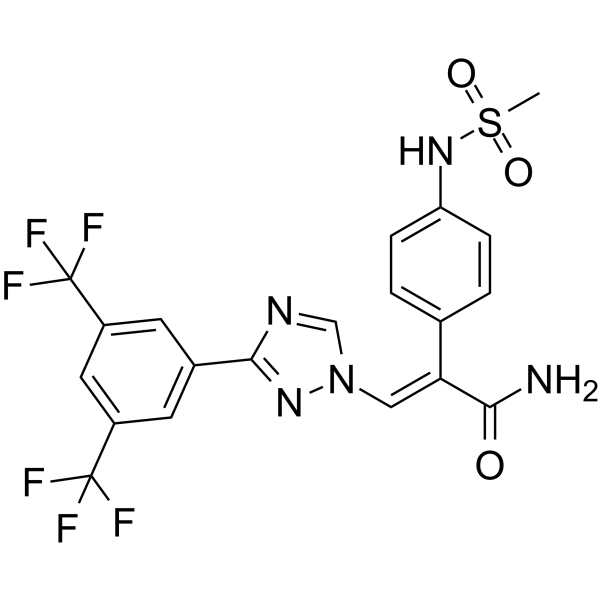
Cat. No.: HY-144763
CAS No.: 3033267-42-1
Target:  

Apoptosis

Research Areas:  

Cancer

XPO1-IN-1 (compound D4) is an orally active and potent XPO1 inhibitor, with an IC50 of 24 nM in MM.1S cell. XPO1-IN-1 can efficiently induce cell apoptosis and cell cycle arrest. XPO1-IN-1 displays favorable metabolic stability and pharmacokinetic properties. XPO1-IN-1 can be used for multiple myeloma (MM) research [1].
loading...
    loading...
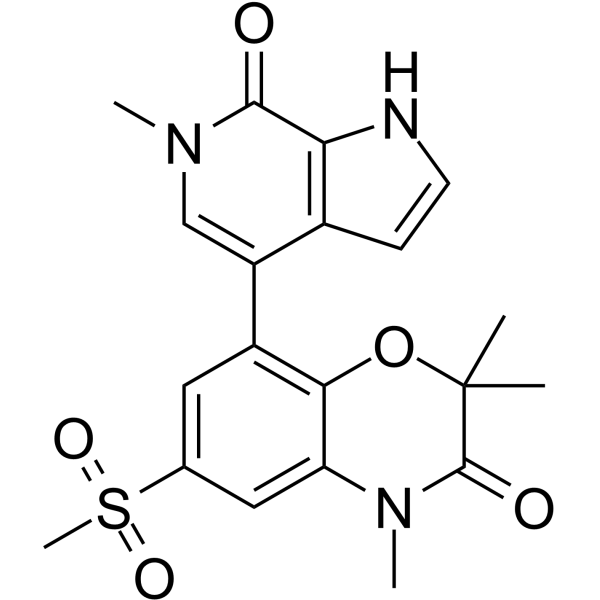
Cat. No.: HY-17539
CAS No.: 1421919-75-6
KPT-276 is an orally active and blood-brain barrier-penetrant selective XPO1/CRM1 inhibitor. KPT-276 blocks XPO1-mediated nuclear export function and promotes nuclear retention of various tumor suppressor proteins. KPT-276 induces apoptosis and G1 cell cycle arrest in tumor cells, and downregulates c-MYC, CDC25A, and BRD4. KPT-276 reduces immune cell proliferation through nuclear accumulation of cell cycle inhibitors, rescues TDP-43 cytoplasmic mislocalization, and restores axon growth and growth rate in mutant PFN1 motor neurons. KPT-276 maintains axonal cytoskeletal integrity and mitochondrial function, and inhibits tumor growth. KPT-276 can be used for research on glioblastoma, non-Hodgkin lymphoma, amyotrophic lateral sclerosis, multiple myeloma, and non-small cell lung cancer [1] .
loading...
    loading...
Cat. No.: HY-170672
CAS No.: 1076236-11-7
Research Areas:  

Cancer

XPO1-ligand-1 is a target protein ligand for XPO1 and can be used to synthesize PROTAC PROTAC XPO1 degrader-1 (HY-170669) [1].
loading...
    loading...
Cat. No.: HY-RS15889
Research Areas:  

Others

XPO1 Human Pre-designed siRNA Set A contains three designed siRNAs for XPO1 gene (Human), as well as a negative control, a positive control, and a FAM-labeled negative control.

loading...
    loading...
Cat. No.: HY-RS23134
Research Areas:  

Others

Xpo1 Rat Pre-designed siRNA Set A contains three designed siRNAs for Xpo1 gene (Rat), as well as a negative control, a positive control, and a FAM-labeled negative control.

loading...
    loading...
Cat. No.: HY-174132
Target:  

CRM1

Research Areas:  

Inflammation/Immunology

CW8001 is a covalent XPO1 (Exportin-1) inhibitor with an EC50 value of 1 nM for inhibiting T cell activation. CW8001 prevents nuclear localization of NFAT transcription factors, suppressing expression of inflammatory cytokines like IL-2. CW8001 is promising for research of T cell-driven immune diseases such as graft-versus-host disease (GVHD) [1].
loading...
    loading...
Cat. No.: HY-RS16700
Research Areas:  

Others

Xpo1 Mouse Pre-designed siRNA Set A contains three designed siRNAs for Xpo1 gene (Mouse), as well as a negative control, a positive control, and a FAM-labeled negative control.

loading...
    loading...
Cat. No.: HY-113902
CAS No.: 109628-38-8
Target:  

CRM1

Research Areas:  

Cancer

(2-(β-Piperidinoethyl)-9-hydroxyellipticinium chloride (compound 1AA) is a SETBP1 inhibitor that disrupts the interaction between SETBP1 and XPO1. (2-(β-Piperidinoethyl)-9-hydroxyellipticinium chloride inhibits colony formation, induces differentiation/cytotoxicity, and downregulates the transcription of Setbpl target genes. (2-(β-Piperidinoethyl)-9-hydroxyellipticinium chloride improves survival and reduces the spleen size of leukemic mice. (2-(β-Piperidinoethyl)-9-hydroxyellipticinium chloride can be used for myeloid neoplasms and solid tumors research [1].
loading...
    loading...
Cat. No.: HY-161391
CAS No.: 1076235-18-1
Target:  

CRM1

Research Areas:  

Cancer

CW0134 (Compound 12) is a modulator for exportin1 (XPO1) ,which disrupts the chromatin binding, inhibits NFAT transcription factors and activation of T cells [1].
loading...
    loading...
Cat. No.: HY-163902
CAS No.: 154934-68-6
Target:  

CRM1

Research Areas:  

Cancer

SP100030 analogue 1 (compound 11), a SP100030 (HY-110177) analogue, is a selective inhibitor of transcriptional activation (SITA) with an EC50 of 137 nM for suppressing the XPO1-dependent upregulation of IL2 by Jurkat-based IL2-Luc reporter assay [1].
loading...
    loading...
Cat. No.: HY-161392
Target:  

CRM1

Research Areas:  

Cancer

CW2158 (Compound 13) is a modulator for exportin1 (XPO1) ,which disrupts the chromatin binding, inhibits NFAT transcription factors and activation of T cells [1].
loading...
    loading...
Cat. No.: HY-170673
CAS No.: 3105679-97-5
Research Areas:  

Cancer

E3 Ligase Ligand-linker Conjugate 156 is a CRBN E3 ligase ligand-linker conjugate. E3 Ligase Ligand-linker Conjugate 156 can be used to synthesize PROTAC XPO1 degrader-1 (HY-170669) [1].
loading...
    loading...
Cat. No.: HY-187684
CAS No.: 3054389-11-3
Target:  

CRM1 Apoptosis

Research Areas:  

Neurological Disease Cancer

FR-027 is an orally active, blood-brain barrier permeable XPO1 inhibitor with an EC50 value of 54-69 nM in human cells. FR-027 covalently modifies Cys528 of XPO1 via nucleophilic aromatic substitution, maintaining the nuclear export signal binding groove of XPO1 in a closed conformation to block the nuclear export process, and inhibits XPO1 function without inducing its protein degradation. FR-027 promotes cancer cell apoptosis and inhibits the growth of hematological and solid tumor cells. FR-027 can be used in research related to acute lymphoblastic leukemia, ovarian cancer, glioblastoma, and primary central nervous system lymphoma [1] .
loading...
    loading...
Cat. No.: HY-P81809
Synonyms: XPO1; CRM1; EXPOrtin-1; Exp1; Chromosome region maintenance 1 protein homolog

Host:  

Rabbit

Application:  

WB, IHC-P, ICC/IF, FC

Reactivity:  

Human, Mouse, Rat

loading...
    loading...
Cat. No.: HY-170671
CAS No.: 1911013-66-5
Target:  

Ligands for E3 Ligase

Research Areas:  

Cancer

E3 ligase Ligand 49 serves as the E3 ubiquitin ligase ligand for PROTAC XPO1 degrader-1 (HY-170669). E3 ligase Ligand 49 can be utilized for the synthesis of PROTACs [1].
loading...
    loading...

