10 Results for "

aliphatic glucosinolate

" in MedChemExpress (MCE) Product Catalog:
Products (10)

10 Results for "aliphatic glucosinolate" in MCE Product Catalog:

Cat. No.: HY-N10346A
CAS No.: 19041-09-9
Synonyms: 3-Butenyl glucosinolate
Gluconapin (3-Butenyl glucosinolate) is an orally active aliphatic glucosinolate and also a flavor modifier. Gluconapin inhibits the elevation of plasma triglyceride levels in mice. Gluconapin also exhibits certain antibacterial activity .
loading...
    loading...
Cat. No.: HY-N10347
CAS No.: 186037-18-3
Synonyms: Homoglucocamelinin; GS11
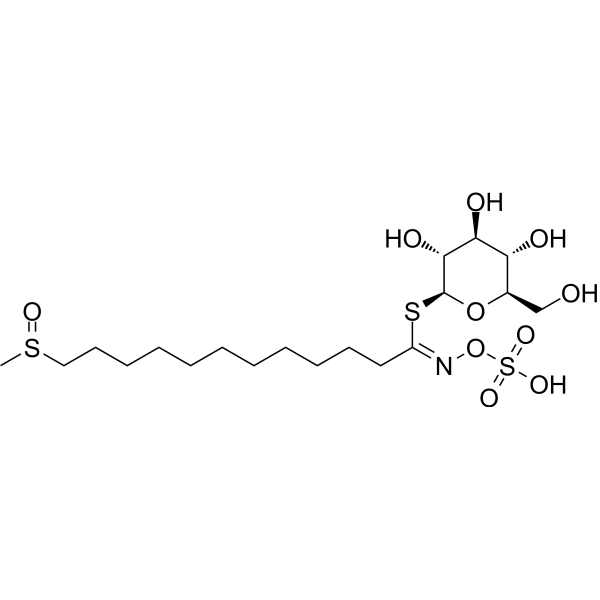
11-(Methylsulfinyl)undecyl-glucosinolate is an aliphatic glucosinolate .
loading...
    loading...
Cat. No.: HY-N10345
CAS No.: 245550-58-7
Synonyms: 4-Pentenylglucosinolate potassium
Target:  

Others

Research Areas:  

Others

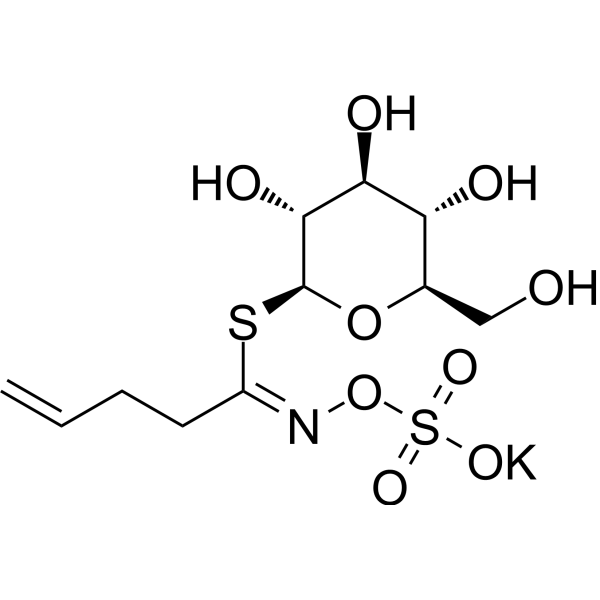
Glucobrassicanapin (4-Pentenylglucosinolate) potassium is an aliphatic glucosinolate in vegetable crops of Brassica rapa .
loading...
    loading...
Cat. No.: HY-N10346
CAS No.: 245550-57-6
Synonyms: 3-Butenyl glucosinolate potassium
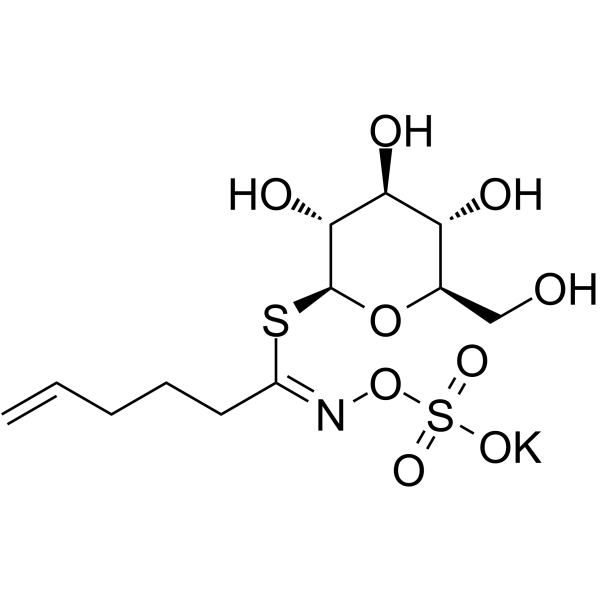
Gluconapin (3-Butenyl glucosinolate) potassium is an orally active aliphatic glucosinolate and also a flavor modifier. Gluconapin potassium inhibits the elevation of plasma triglyceride levels in mice. Gluconapin potassium also exhibits certain antibacterial activity .
loading...
    loading...
Cat. No.: HY-N13299
CAS No.: 29611-01-6
Glucoberteroin is an aliphatic glucosinolate. Glucoberteroin can be isolated from Degenia velebitica, inhibits protein glycosylation and carbonylation, reduces the production of carbonylated proteins, and helps prevent skin aging .
loading...
    loading...
Cat. No.: HY-N21950
CAS No.: 21973-60-4
Synonyms: 8-Methylsulfinyloctyl glucosinolate
Glucohirsutin is an 8-carbon aliphatic glucosinolate that can be isolated from *Arabidopsis thaliana* seeds. The abundance of Glucohirsutin is increased in a specific *Arabidopsis thaliana* mutant line (3614) with seed-specific glucosinolate alterations .
loading...
    loading...
Cat. No.: HY-N21951
CAS No.: 75331-11-2
Synonyms: 3-Benzoyloxypropyl glucosinolate
Glucomalcomin (3-Benzoyloxypropyl glucosinolate) is an aliphatic, side-chain benzoylated hydroxyalkyl derivative of 3-hydroxypropyl glucosinolate. Glucomalcomin is one of the most abundant glucosinolates induced to accumulate by high temperature during seed development of Arabidopsis thaliana, and its content is closely correlated with the expression of the AOP3 gene .
loading...
    loading...
Cat. No.: HY-W702980
CAS No.: 287966-62-5
Desulfoglucoraphanin is an aliphatic glucosinolate present in Brassica rapa L. ssp. pekinensis. Desulfoglucoraphanin is the desulfated derivative of Glucoraphanin (HY-N4068) .
loading...
    loading...
Cat. No.: HY-N13299A
CAS No.: 245550-65-6
Glucoberteroin potassium is an aliphatic glucosinolate. Glucoberteroin potassium can be isolated from Degenia velebitica, inhibits protein glycosylation and carbonylation, reduces the production of carbonylated proteins, and helps prevent skin aging .
loading...
    loading...
Cat. No.: HY-N2423B
CAS No.: 534-69-0
Synonyms: (E/Z)-Allyl-glucosinolate free base; (E/Z)-2-Propenyl-glucosinolate free base
(E/Z)-Sinigrin ((E/Z)-Allyl-glucosinolate; (E/Z)-2-Propenyl-glucosinolate) free base is an orally active aliphatic thioglucoside anti-leukemia compound. Allyl isothiocyanate, produced by the hydrolysis of (E/Z)-sinigrin free base by myrosinase, has an IC50 of 2.71 μM against HL60 leukemia cells. The hydrolysis products of (E/Z)-sinigrin free base can further activate apoptosis pathways, inhibit NF-κB and MAPK signaling pathways, and induce phase II metabolic enzyme activity, thus exhibiting anti-cancer, anti-inflammatory, antibacterial, antioxidant, and wound healing activities. (E/Z)-Sinigrin free base can be used in research on cancer, inflammation-related diseases (such as atherosclerosis), and infectious diseases. (E/Z)-Sinigrin free base can be naturally extracted from the seeds of Brassica nigra, Brassica juncea, and other Brassicaceae plants such as broccoli and Brussels sprouts. Methyl pechueloate is a guaiane-type sesquiterpene ester compound and a potential precursor of xerantholide. It is useful in the structural elucidation and biosynthetic pathway studies of sesquiterpenoids. Methyl pechueloate can be naturally extracted from the aerial parts of Pechuel-Loeschea leibnitziae (Kuntze) O. Hoffm .
loading...
    loading...

