
1. Search Result
Search Result
Results for "

baboon

" in MedChemExpress (MCE) Product Catalog:

9

Inhibitors & Agonists

4

Peptides

1

Recombinant Proteins

2

Antibodies

Cat. No. Product Name Target Research Areas Chemical Structure
  • HY-P1036
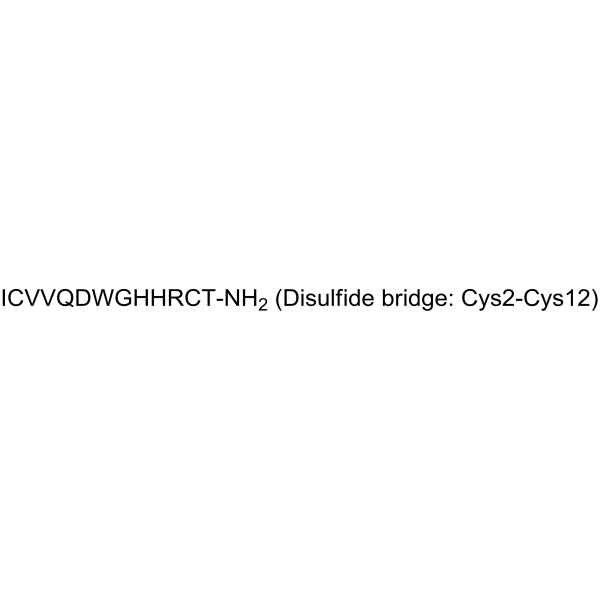
    Compstatin
    4 Publications Verification

    Complement System Others
    Compstatin, a 13-residue cyclic peptide, is a potent inhibitor of the complement system C3 with species specificity. Compstatin binds to baboon C3 and is resistant to proteolytic cleavage in baboon blood (similar to humans). Compstatin inhibits only the activation of primates’ complement system. Compstatin exhibits IC50 values of 63 μM and 12 μM for classical and alterative complement pathway, respectively .
    Compstatin
  • HY-153248

    Biochemical Assay Reagents Neurological Disease Inflammation/Immunology
    PBR28 is a translocator protein (TSPO) binding positron emission tomography (PET) radiotracer with blood-brain barrier permeability . PBR28 binds to TSPO, a marker of microglial activation and neuroinflammation, and is used for neuroinflammation imaging in brain diseases and HIV-infected individuals .
    PBR28
  • HY-135714

    EKZ-001

    HDAC Microtubule/Tubulin Neurological Disease Cancer
    Bavarostat (EKZ-001) is a blood-brain barrier-permeable, potent HDAC6 inhibitor and PET radiotracer, with an IC50 as low as 17 nM against human HDAC6. Bavarostat can be labeled with 18F and used as a probe to map HDAC6 distribution and measure target occupancy in the brains of non-human primates. Bavarostat also selectively modulates tubulin acetylation, but not histone acetylation. Bavarostat is applicable for research on Alzheimer's disease, other neurodegenerative disorders, and cancers .
    Bavarostat
  • HY-P1036A
    Compstatin TFA
    4 Publications Verification

    Complement System Others
    Compstatin TFA, a 13-residue cyclic peptide, is a potent inhibitor of the complement system C3 with species specificity. Compstatin TFA binds to baboon C3 and is resistant to proteolytic cleavage in baboon blood (similar to humans). Compstatin TFA inhibits only the activation of primates’ complement system. Compstatin TFA exhibits IC50 values of 63 μM and 12 μM for classical and alterative complement pathway, respectively .
    Compstatin TFA
  • HY-172316

    Factor Xa Cardiovascular Disease
    BAY 3389934 is a selective dual inhibitor of factor IIa and factor Xa, with an IC50 of 4.9 nM for factor IIa and an IC50 of 0.66 nM for factor Xa. BAY 3389934 directly inhibits the activities of factor IIa and factor Xa and regulates the common coagulation pathway. BAY 3389934 exhibits anticoagulant and organ-protective effects. BAY 3389934 can be used in the research of sepsis and coagulopathy .
    BAY 3389934
  • HY-113896

    Cholecystokinin Receptor Others
    U-67827E is a cholecystokinin (CCK) agonist that decreases food intake over a prolonged period of time in baboons. U-67827E may affect the latency to food by inhibiting the movement of food in the stomach and magnifying a gastric distention signal .
    U-67827E
  • HY-101301A

    Imidazoline Receptor Neurological Disease
    RS 45041-190 hydrochloride is a high-affinity ligand for I2 imidazoline receptors, with the pKis of 8.66, 9.37, 9.32, and 8.85 in rat, rabbit, dog and baboon kidney, respectively. RS 45041-190 hydrochloride shows moderate potency for the inhibition of monoamine oxidase A in vitro (pIC50= 6.12), but had much lower potency for monoamine oxidase B (pIC50 = 4.47) .
    RS 45041-190 hydrochloride
  • HY-178082

    Others Cardiovascular Disease
    MK-251 is an orally active anti-arrhythmic agent. MK-251 prevents or modifies ventricular arrhythmias induced in dogs and baboons by tetrafluorethylbutylamine. MK-251 antagonizes the arrhythmias caused by Digoxin (HY-B1049) in cats. MK-251 at effective doses has little effect on basic cardiovascular parameters such as blood pressure, cardiac output, myocardial contractility and ventricular conduction, thus demonstrating its unique advantages .
    MK-251
  • HY-106394

    P-glycoprotein Cardiovascular Disease
    TP-9201 is a platelet glycoprotein (GP) IIb/IIIa receptor antagonist. TP-9201 inhibits the interaction between GPIIb/IIIa and fibrinogen, thereby suppressing platelet aggregation. TP-9201 exhibits similar inhibitory activity on adenosine diphosphate (ADP) (HY-W010918)-induced platelet aggregation in humans, baboons, and dogs (IC50 = 1-3 μM), while showing lower activity in rabbits (IC50 = 45 μM) and rats (IC50 = 20 μM). TP-9201can be used in studies related to the prevention of rethrombosis after arterial thrombolysis .
    TP-9201

Inquiry Online

Your information is safe with us. * Required Fields.

Salutation


Country or Region *

Applicant Name *


Organization Name *

Department *


Email Address *


Product Name *

Cat. No.


Requested quantity *

Phone Number *


Remarks

Inquiry Online

Inquiry Information

Product Name:
Cat. No.:
Quantity:
MCE Japan Authorized Agent:

