14 Results for "

brain/plasma ratio

" in MedChemExpress (MCE) Product Catalog:
Products (14)

14 Results for "brain/plasma ratio" in MCE Product Catalog:

2
2 Cited Publications
Cat. No.: HY-110192
CAS No.: 1443246-62-5
Purity:  99.14%
Synonyms: VU 0456810; CID 56642816
Target:  

Potassium Channel

Research Areas:  

Neurological Disease

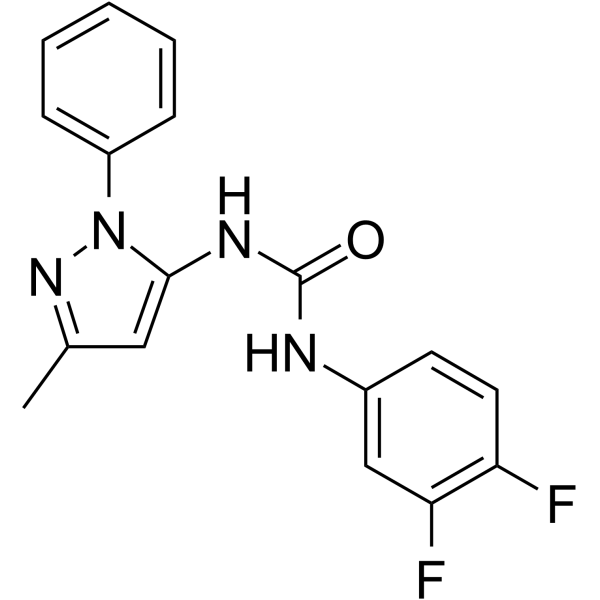
ML 297 (VU 0456810) is a potent and selective GIRK1/2 activator, with an EC50 of 0.16 μM. ML 297 can cross the blood-brain barrier with brain-to-plasma ratio of 0.2 in mice model (i.p.). ML 297 is potential for the treatment of epilepsy .
loading...
    loading...
1
1 Cited Publications
Cat. No.: HY-N8157
CAS No.: 1464-33-1
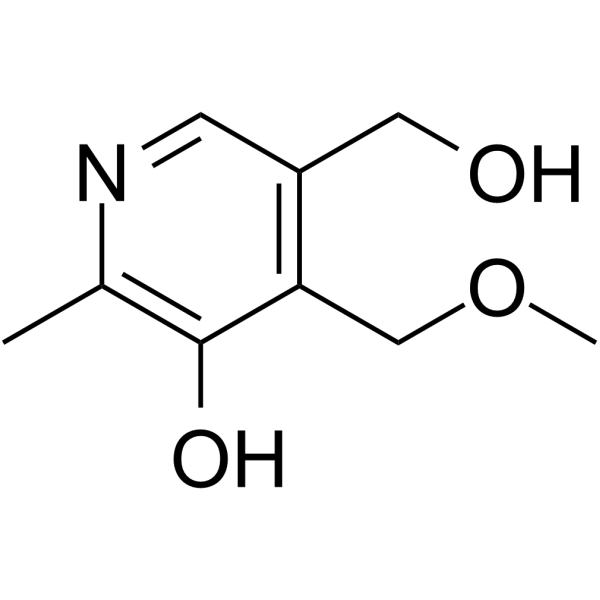
4'-O-Methylpyridoxine is an orally active antivitamin B6 compound found in Ginkgo biloba seeds and leaves. 4'-O-Methylpyridoxine inhibits pyridoxal kinase. 4'-O-Methylpyridoxine reduces brain pyridoxal-5'-phosphate (PLP) levels, decreases gamma-aminobutyric acid/glutamate (GABA/Glu) ratio. 4'-O-Methylpyridoxine increases plasma levels of pyridoxal-5'-phosphate and pyridoxal. 4'-O-Methylpyridoxine induces hyperactivity, convulsions, pathological tissue changes, organ damage in rodent brain and heart .
loading...
    loading...
Cat. No.: HY-172550
CAS No.: 3095336-10-7
Target:  

HCN Channel

Research Areas:  

Neurological Disease

MS7710 is a hyperpolarization-activated cyclic nucleotide-gated (HCN) channel inhibitor with blood-brain barrier permeability and an excellent brain/plasma concentration ratio. MS7710 inhibits HCN channel-mediated Ih current, and reduces the firing frequency and burst activity of dopaminergic neurons in the ventral tegmental area. MS7710 ameliorates chronic social defeat stress-induced deficits in social interaction and impairments in reward-related cognitive flexibility in mice. MS7710 exerts only limited effects on ventral tegmental area dopaminergic neuron activity, social interaction, exploratory behavior, locomotor activity or sucrose preference in control mice. MS7710 is applicable to the research of major depressive disorder .
loading...
    loading...
Cat. No.: HY-131943
CAS No.: 2361327-08-2
Purity:  99.36%
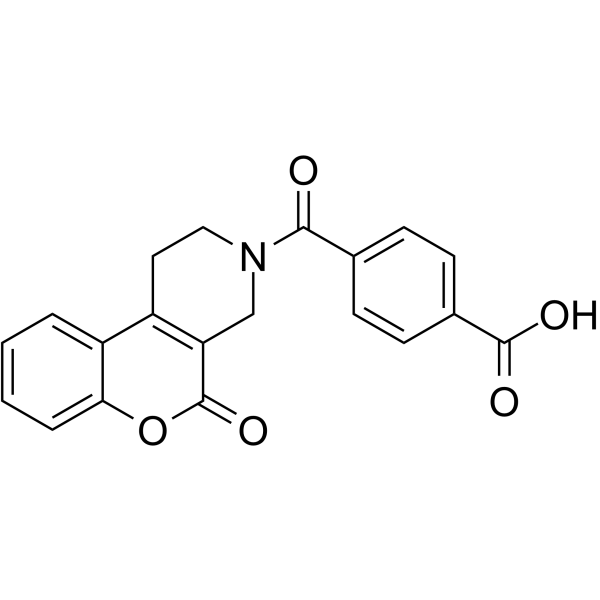
DS44960156 is a selective MTHFD2 inhibitor with moderate to low blood-brain barrier penetration (IC50=1.6 μM, Ki=1.23 μM). DS44960156 specifically binds to the active site of MTHFD2, disrupts redox homeostasis and blocks serine-mediated one-carbon metabolism, thereby increasing the NAD +/NADH ratio and ROS levels. DS44960156 not only effectively inhibits the proliferation of glioma cells, but also enhances the sensitivity of cells to glutamine starvation-induced death. DS44960156 binds to plasma proteins, shows no mutagenicity, carcinogenicity or acute oral toxicity, and serves as a research agent for glioblastoma multiforme and other cancers .
loading...
    loading...
Cat. No.: HY-155111
CAS No.: 2968322-24-7
Purity:  98.24%
Target:  

Phospholipase

Research Areas:  

Neurological Disease

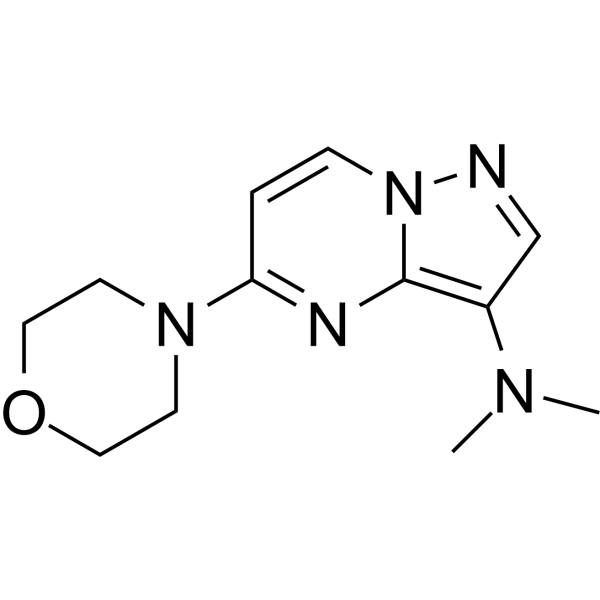
nSMase2-IN-1 is an orally active Neutral sphingomyelinase 2 (nSMase2) inhibitor with an IC50 value of 0.13 ± 0.06 μM. nSMase2-IN-1 is metabolically stable in liver microsomes and orally available with a favorable brain-to-plasma ratio. nSMase2-IN-1 can be used for nervous system disease research .
loading...
    loading...
Cat. No.: HY-161377
CAS No.: 3034840-25-7
Target:  

TGF-β Receptor

Research Areas:  

Cancer

M4K2306 is a selective inhibitor for activin receptor-like kinase-2 (ALK2) with an IC50 of 7 nM. M4K2306 is blood brain permeable with a brain to plasma ratio of 75.6 .
loading...
    loading...
Cat. No.: HY-161376
CAS No.: 3034840-19-9
Target:  

TGF-β Receptor

Research Areas:  

Cancer

M4K2281 is a selecitve inhibitor for activin receptor-like kinase-2 (ALK2) with an IC50 of 2 nM. M4K2281 exhibits a moderate blood brain permeability with a brain to plasma ratio of 3.7 at 4h .
loading...
    loading...
Cat. No.: HY-174381
BChE-IN-41 is a highly selective Butyrylcholinesterase (BChE) inhibitor (IC50 =12 nM, Ki = 6.6 nM). BChE-IN-41 has high brain penetration with a brain-to-plasma ratio of 9.0. BChE-IN-41 has pro-cognitive effects on mice with AD-like symptoms induced by Scopolamine (HY-N0296) and Aβ1-42 .
loading...
    loading...
Cat. No.: HY-146151
CAS No.: 2204249-82-9
Target:  

γ-secretase Amyloid-β

Research Areas:  

Neurological Disease

γ-Secretase modulator 12 (Compound 1a) is a γ-secretase modulator that can selectively decrease amyloid-β42 (Aβ42) levels (IC50 of 0.39 µM). γ-Secretase modulator 12 can be used for Alzheimer’s disease research. γ-Secretase modulator 12 has a good brain/plasma ratio (Kp, brain = 0.72) in mice .
loading...
    loading...
Cat. No.: HY-160761
CAS No.: 1816990-29-0
Target:  

Opioid Receptor

Research Areas:  

Inflammation/Immunology

K-Opioid receptor agonist-1 (Compound 5a) is an agonist for κ-Opioid receptor with Ki of 0.25 nM and EC50 of 2 nM. K-Opioid receptor agonist-1 is blood brain barrier (BBB) penetrate (brain/plasma ratios of 0.50 to 0.65). K-Opioid receptor agonist-1 exhibits anti-inflammatory activity in dermatitis models induced by Arachidonic acid (HY-109590) or oxazolidinone .
loading...
    loading...
Cat. No.: HY-170377
CAS No.: 3035311-43-1
Research Areas:  

Cancer

ER degrader 10 (Compound 51) is a selective, orally active degrader and antagonist for estrogen receptor (ER) with a DC50 of 0.43 nM and an IC50 of 0.56 nM. ER degrader 10 inhibits the proliferation of ER-positive cells with IC50s of 0-15 nM. ER degrader 10 exhibits a weak inhibitory activity against hERG channel with an IC50 >40 μM. ER degrader 10 is blood-brain barrier penetrable with a brain/plasma ratio (Kp) of 3.05. ER degrader 10 exhibits antitumor efficacy in mice model .
loading...
    loading...
Cat. No.: HY-110192R
CAS No.: 1443246-62-5
Synonyms: VU 0456810 (Standard); CID 56642816 (Standard)
ML 297 (Standard) is the analytical standard of ML 297 (HY-110192). This product is intended for research and analytical applications. ML 297 (VU 0456810) is a potent and selective GIRK1/2 activator, with an EC50 of 0.16 μM. ML 297 can cross the blood-brain barrier with brain-to-plasma ratio of 0.2 in mice model (i.p.). ML 297 is potential for the treatment of epilepsy .
loading...
    loading...
Cat. No.: HY-180406
CAS No.: 1262495-12-4
Research Areas:  

Neurological Disease

NPY Y2 antagonist 2 is a modulator targeting the neuropeptide Y (NPY) receptor Y2, with pKi values of 6.8 nM and 7.2 nM in human and rat brains, respectively, and demonstrating blood-brain barrier penetration. NPY Y2 antagonist 2 shows selectivity for the Y1 and Y5 receptors. NPY Y2 antagonist 2 blocks the negative feedback regulation mediated by the NPY Y2 receptor, thereby increasing endogenous NPY release and enhancing Y1 receptor activation, resulting in the modulation of central neurotransmitter release. NPY Y2 antagonist 2 exhibits moderate in vivo clearance, high free fraction in rat brain, and a favorable brain/plasma ratio and brain exposure. NPY Y2 antagonist 2 is applicable for research in conditions such as mood disorders, anxiety induced by alcohol withdrawal, and social anxiety associated with nicotine withdrawal .
loading...
    loading...
Cat. No.: HY-184290
CAS No.: 3062852-59-6
Research Areas:  

Neurological Disease Cancer

PRMT5-IN-56 is a PRMT5⋅MTA complex inhibitor with an IC50 of 0.2 nM, oral activity, and blood-brain barrier penetration. PRMT5-IN-56 inhibits PRMT5 methyltransferase activity in an MTA-cooperative manner, suppresses symmetrical dimethylarginine levels in MTAP-deficient cells. PRMT5-IN-56 suppresses proliferation of MTAP-deleted cancer cells with high selectivity over MTAP-wild type cells. PRMT5-IN-56 induces dose-dependent tumor growth inhibition in subcutaneous xenograft models, inhibits intracranial tumor progression, and prolongs survival in orthotopic brain xenograft models. PRMT5-IN-56 exhibits high intrinsic permeability, good oral bioavailability, and a high brain-to-plasma ratio. PRMT5-IN-56 can be used for the research of MTAP-deleted cancers and glioblastoma .
loading...
    loading...
  • 1

