12 Results for "

chloroquine-sensitive strains

" in MedChemExpress (MCE) Product Catalog:
Products (12)

12 Results for "chloroquine-sensitive strains" in MCE Product Catalog:

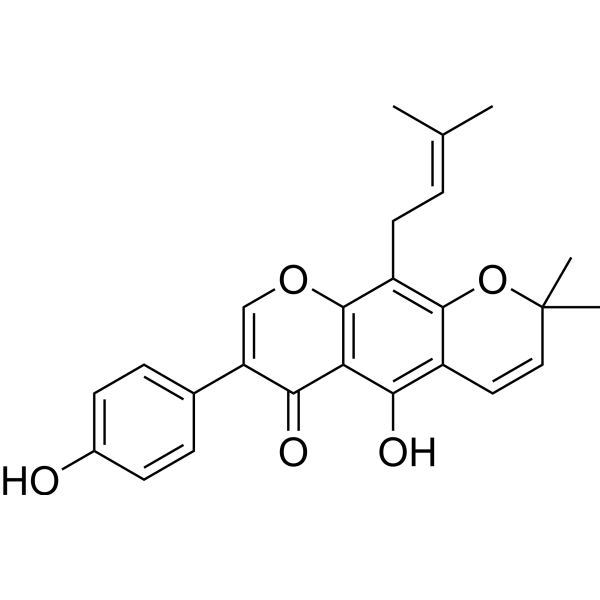
Cat. No.: HY-N1074
CAS No.: 4449-55-2
Synonyms: Scandenolone
Warangalone is an anti-malarial compound which can inhibit the growth of both strains of parasite 3D7 (chloroquine sensitive) and K1 (chloroquine resistant) with IC50s of 4.8 μg/mL and 3.7 μg/mL, respectively. Warangalone can also inhibit cyclic AMP-dependent protein kinase catalytic subunit (cAK) with an IC50 of 3.5 μM.
loading...
    loading...
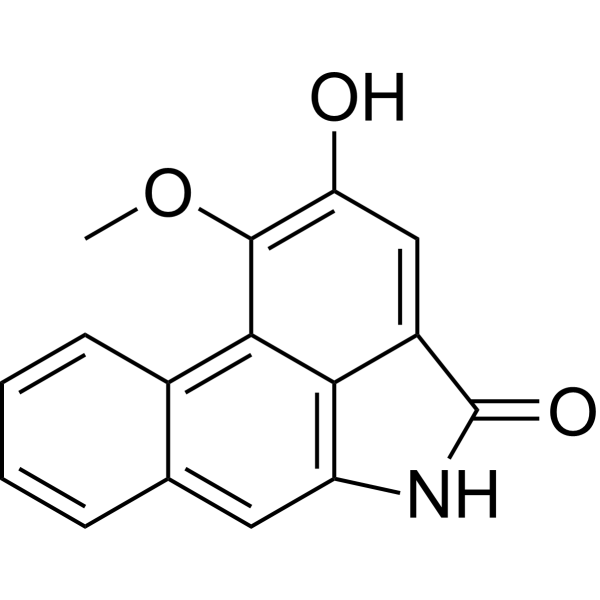
Cat. No.: HY-N2891
CAS No.: 53948-07-5
Synonyms: Aristololactam A II
Aristolactam A II (Aristololactam A II) is a weak COX inhibitor with cytotoxic and anti-plasmodial activities. Aristolactam A II exhibits inhibitory activity against Chloroquine (HY-17589A)-sensitive strains, and exerts its inhibitory effect on Plasmodium falciparum growth by inducing cell membrane damage marked by LDH release. Aristolactam A II can be applied to the research of malaria-related mechanisms .
loading...
    loading...
Cat. No.: HY-W437569
CAS No.: 568-01-4
Melicopine is an alkaloid found in Z. simulans with antimalarial and anticancer activities. It exhibits inhibitory activity against chloroquine-sensitive 3D7 and chloroquine-resistant Dd2 strains of P. falciparum, with IC50 values of 29.7 and 33.7 µg/mL, respectively. Melicopine is cytotoxic to prostate cancer cells PC-3M and LNCaP (IC50 values of 47.9 and 37.8 µg/mL), but has no effect on non-cancerous HEK293 cells (IC50 greater than 100 µg/mL). Melicopine holds promise for research in anticancer and anti-infection fields .
loading...
    loading...
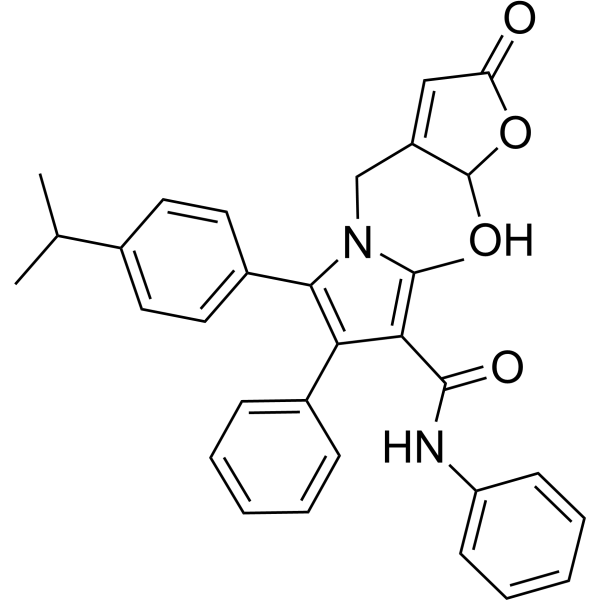
Cat. No.: HY-116552
CAS No.: 1809050-49-4
Target:  

Parasite

Research Areas:  

Infection

KAR425 is a potent and orally active antimalarial agent. KAR425 shows antimalarial activity against the Chloroquine-sensitive (CQS) D6, the Chloroquine-resistant (CQR) Dd2, and 7G8 strains of Plasmodium falciparum, with IC50 values of 62 nM, 55 nM, and 60 nM, respectively .
loading...
    loading...
Cat. No.: HY-N8374
CAS No.: 1263-79-2
Pheanthine (Compound 2) is an antiplasmodial agent, that inhibits chloroquine-resistant Plasmodium falciparum K-1 (IC50 is 0.8 μM) and chloroquine-sensitive P. falciparum strain NF54 A19A (IC50 of 0.03 μM). Pheanthine exhibits low cytotoxicity in human lung fibrosblast (MRC-5, IC50 is 11.2 μM) and macrophages (PMM, IC50 is 8 μM) .
loading...
    loading...
Cat. No.: HY-175215
CAS No.: 2417648-94-1
Target:  

Parasite

Research Areas:  

Infection

PfPK6-IN-1 is a potent and selective PfPK6 inhibitor with an IC50 of 0.3 μM. PfPK6-IN-1 inhibits hemozoin formation, a Plasmodium-specific pathway with IC50 of 13 μM against β-hematin (βH). PfPK6-IN-1 exhibits rapid and broad-spectrum anti-malarial properties, being effective against both chloroquine-sensitive and resistant strains.PfPK6-IN-1 can be used for the study of antimalarial .
loading...
    loading...
Cat. No.: HY-149960
CAS No.: 3043821-43-5
Target:  

Parasite

Research Areas:  

Infection

Antiparasitic agent-17 (compound 5u) is an orally active antiparasitic agent. Antiparasitic agent-17 inhibits Chloroquine sensitive (Pf3D7) and Chloroquine resistant (PfK1) strain with IC50s of 0.96 μM and 1.67 μM, respectively .
loading...
    loading...
Cat. No.: HY-N18179
CAS No.: 15575-49-2
8-Acetonylidihydrochelerythrine is a benzophenanthridine alkaloid found in the stem bark of Zanthoxylum gilletii. 8-Acetonylidihydrochelerythrine inhibits growth of Chloroquine (HY-17589A)-resistant and Chloroquine-sensitive Plasmodium falciparum strains. 8-Acetonylidihydrochelerythrine can be used for the research of malaria .
loading...
    loading...
Cat. No.: HY-180373
CAS No.: 19160-62-4
Target:  

Parasite

Research Areas:  

Infection

WR 30090 (Compound 37) is a broad-spectrum antimalarial agent that does not rely on the classical antifolate pathway. WR 30090 exhibits strong activity against a variety of chloroquine-sensitive and resistant Plasmodium falciparum strains, especially the highly resistant Vietnamese strain. WR 30090 shows high activity in mouse malaria tests, with a minimum effective dose of 5 mg/kg and a minimum cure dose of 20 mg/kg. WR 30090 can be used for research on acute malaria .
loading...
    loading...
Cat. No.: HY-N19238
CAS No.: 84224-28-2
4-Hydroxy-2-methoxybenzamide is a phenolic amide natural product that can be isolated from the mangrove plant Aegiceras corniculatum. 4-Hydroxy-2-methoxybenzamide exhibits moderate antimalarial activity. It also serves as a chemical intermediate. 4-Hydroxy-2-methoxybenzamide can be used in malaria-related research .
loading...
    loading...
Cat. No.: HY-184181
CAS No.: 1596337-67-5
Target:  

Parasite

Research Areas:  

Infection

Antimalarial agent 63 is an inhibitor of Plasmodium falciparum. Antimalarial agent 63 exhibits inhibitory activity against field isolates of Plasmodium falciparum and Plasmodium vivax. Antimalarial agent 63 shows an antagonistic interaction when used in combination with Proguanil (HY-B0806) against Plasmodium falciparum. Antimalarial agent 63 has low cytotoxicity to hepatocytes and a high selectivity index. Antimalarial agent 63 can be used in the research of malaria .
loading...
    loading...
Cat. No.: HY-182348
Target:  

Parasite

Research Areas:  

Infection

LSPN959 is a slow-acting indole peptidomimetic antiplasmodial agent with submicromolar activity against the Plasmodium falciparum 3D7 strain. LSPN959 does not inhibit plastid-dependent isoprenoid biosynthesis. The combination of LSPN959 with Artesunate (HY-N0193) exhibits an additive effect against Plasmodium falciparum. LSPN959 can be used in malaria research .
loading...
    loading...
  • 1

