11 Results for "

excited-state proton transfer

" in MedChemExpress (MCE) Product Catalog:
Products (11)

11 Results for "excited-state proton transfer" in MCE Product Catalog:

Cat. No.: HY-Y1309
CAS No.: 90-15-3
Synonyms: Furro ER; NSC 9586; Nako TRB
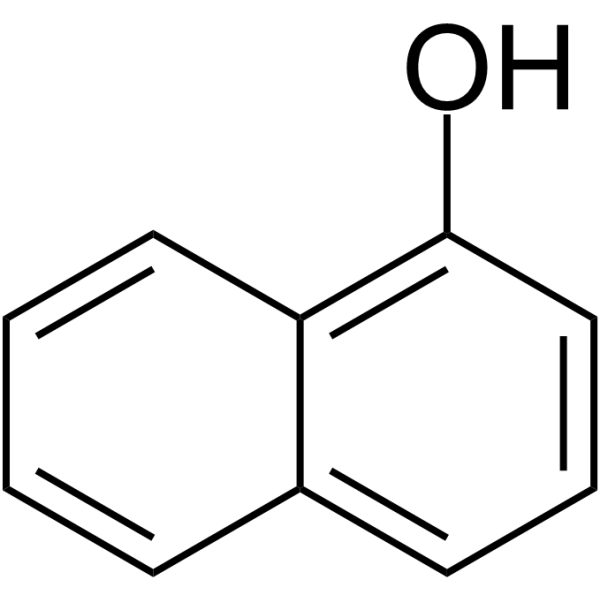
1-naphthol (Furro ER) is an excited state proton transfer (ESPT) fluorescent molecular probe. 1-naphthol can sense the hydrophobic domains in micellar aggregation and accurately sense the sol-gel transition. 1-naphthol can be used to study the thermally induced microenvironmental changes and hydration levels of Pluronic F127 (PF127) in different microenvironments in aqueous media .
loading...
    loading...
Cat. No.: HY-D0077
CAS No.: 195136-58-4
Synonyms: Oregon green 488
Target:  

Fluorescent Dye

Research Areas:  

Others

2',7'-Difluorofluorescein (Oregon green 488) is a fluorescein derivative and a pH-sensitive fluorescent probe (pKa ~4.7). Upon excitation at 488 nm, 2',7'-Difluorofluorescein exhibits pH-sensitive fluorescence intensity through the formation of dianions, while its pH sensitivity decreases under excitation at 450 nm, allowing its use in ratiometric pH analysis. 2',7'-Difluorofluorescein can be used for the quantitative analysis of pH values in the range of 2-7 in submicron aerosol particles. 2',7'-Difluorofluorescein undergoes buffer-mediated and buffer-free excited-state proton transfer between different protonated forms, and its cationic form undergoes rapid excited-state deprotonation. 2',7'-Difluorofluorescein is resistant to photodegradation, maintains stable absorption and fluorescence properties within the physiological pH range, and serves as a fluorescent protein label, a component of Ca 2+ indicators, a fluorescent imaging agent, and an anisotropy probe .
loading...
    loading...
Cat. No.: HY-W140203
CAS No.: 2963-66-8
Target:  

Fluorescent Dye

Research Areas:  

Others

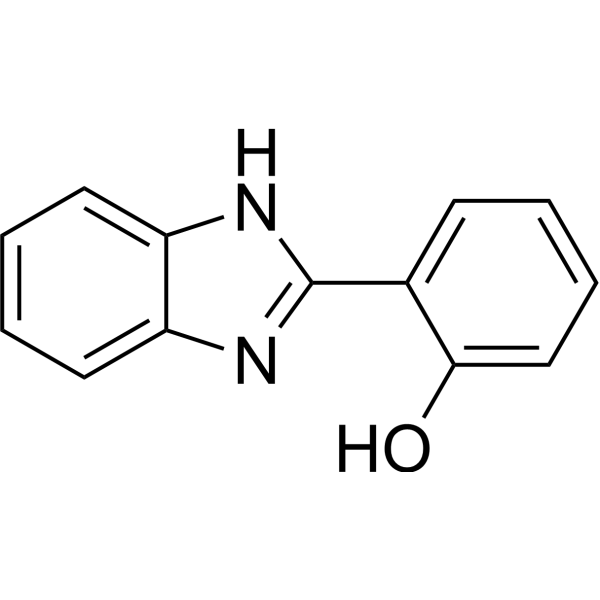
2-(2′-Hydroxyphenyl) benzimidazole is the most extensively studied excited-state intramolecular proton transfer (ESIPT) molecule, exhibiting normal and tautomer emissions. 2-(2′-Hydroxyphenyl) benzimidazole has been applied as a fluorescent probe in various systems .
loading...
    loading...
Cat. No.: HY-I0259
CAS No.: 118-46-7
8-Amino-2-naphthol is a photoactive charge transfer compounds, which can be used as fluorescent probe. 8-Amino-2-naphthol undergoes excited-state proton transfer (ESPT) to form a zwitterion under acidic conditions, where the photoacidity of its hydroxyl group is regulated by the protonation state of the amino group, enabling pH to act as an on/off switch for photoacidity. 8-Amino-2-naphthol is also utilized as chiral organocatalyst .
loading...
    loading...
Cat. No.: HY-N16571
CAS No.: 65602-55-3
Marionol is a type of flavonol compound and belongs to the secondary metabolites of plants. Marionol exhibits significant specificity towards Cu²⁺ and possesses the characteristic of intramolecular proton transfer in excited state (ESIPT), enabling it to generate strong fluorescence upon excitation by ultraviolet light. The maximum excitation/emission wavelengths are 350 nm and 510 nm (depending on the solvent), respectively. Marionol can be used as a fluorescence probe for Cu²⁺ .
loading...
    loading...
Cat. No.: HY-D2286
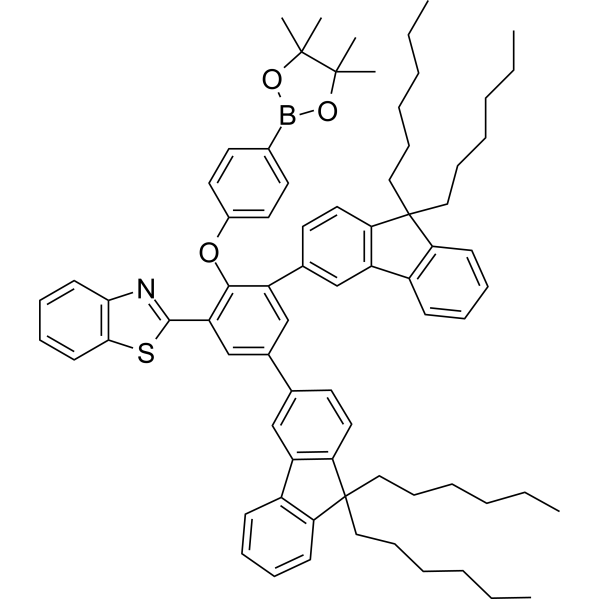
HBT-Fl-BnB is a fluorescent probe for the ratiometric detection of ONOO - in vitro and in vivo. HBT-Fl-BnB consists of an HBT core with Fl groups at the ortho and para positions responding to the zwitterionic excited-state intramolecular proton-transfer (zwitterionic ESIPT) process and a boronic acid pinacol ester with dual roles that block the zwitterionic ESIPT and recognize ONOO - .
loading...
    loading...
Cat. No.: HY-Y1309R
CAS No.: 90-15-3
Synonyms: Furro ER (Standard); NSC 9586 (Standard); Nako TRB (Standard)
1-Naphthol (Standard) is the analytical standard of 1-Naphthol. This product is intended for research and analytical applications. 1-naphthol is an excited state proton transfer (ESPT) fluorescent molecular probe.
loading...
    loading...
Cat. No.: HY-Y1309S1
CAS No.: 124251-84-9
Synonyms: Furro ER-d7; NSC 9586-d7; Nako TRB-d7
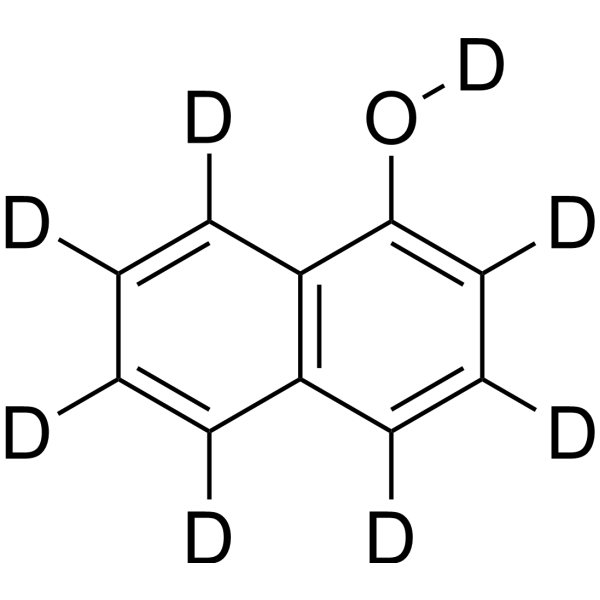
1-Naphthol-d7 (Furro ER-d7) is the deuterium labeled Naphthol (HY-Y1309). 1-Naphthol (Furro ER) is an excited state proton transfer (ESPT) fluorescent molecular probe. 1-naphthol can sense the hydrophobic domains in micellar aggregation and accurately sense the sol-gel transition. 1-naphthol can be used to study the thermally induced microenvironmental changes and hydration levels of Pluronic F127 (PF127) in different microenvironments in aqueous media .
loading...
    loading...
Cat. No.: HY-Y1309S
CAS No.: 207569-03-7
Synonyms: Furro ER-d8; NSC 9586-d8; Nako TRB-d8
1-Naphthol-d8 is the deuterium labeled 1-Naphthol . 1-naphthol is an excited state proton transfer (ESPT) fluorescent molecular probe .
loading...
    loading...
Cat. No.: HY-D3150
CAS No.: 905306-19-6
Target:  

Fluorescent Dye

Research Areas:  

Others

di-SFA is a fluorescent probe used to measure transmembrane potential (Vm) across the plasma membrane. di-SFA contains a 3-hydroxychromone fluorophore that undergoes excited-state intramolecular proton transfer (ESIPT), producing dual emission from the normal (N*) and tautomeric (T*) states. di-SFA inserts deeply into the hydrophobic region of lipid bilayers. The sulfonate groups give di-SFA a double negative charge in aqueous media. Ratiometric measurements are performed in lipid vesicles using Ex/Em = 450/527 nm and Ex/Em = 450/605 nm.
loading...
    loading...
Cat. No.: HY-D3067
Target:  

Fluorescent Dye

Research Areas:  

Metabolic Disease Cancer

ASSI-Leu is a novel AIE fluorescent probe based on an asymmetric tetraaryl imidazole skeleton, which can be used for ratiometric imaging detection of endogenous leucine aminopeptidase. ASSI-Leu contains an L-leucine-based recognition group that blocks the excited-state intramolecular proton transfer (ESIPT) in its 2-(2'-hydroxyphenyl) benzothiazole (HBT) skeleton, thereby generating an enol-form emission signal at Ex/Em = 365/417 nm. ASSI-Leu undergoes cleavage of the L-leucine group mediated by LAP to form ASSI-OH, which further activates aggregation-induced emission (AIE) and ESIPT, generating a keto-form emission signal at Ex/Em = 365/554 nm and producing a ratiometric fluorescent signal. ASSI-Leu enables real-time tracking of LAP in cancer cells and zebrafish models .\n
loading...
    loading...
  • 1

