





82 Results for "

hepatocyte growth factor receptor

" in MedChemExpress (MCE) Product Catalog:
Products (82)

82 Results for "hepatocyte growth factor receptor" in MCE Product Catalog:

6
6 Cited Publications
Cat. No.: HY-16969
CAS No.: 1401708-83-5
Synonyms: PNB-0408; N-hexanoic-Try-Ile-(6)-amino hexanoic amide; Hexanoyl-Tyr-Ile-Ahx-NH2
Target:  

c-Met/HGFR

Research Areas:  

Neurological Disease

Dihexa, an oligopeptide drug, is an orally active and blood-brain barrier-permeable angiotensin IV analog. Dihexa binds to hepatocyte growth factor (HGF) with high affinity (Kd=65 pM) and potentiates its activity at its receptor, c-Met. Dihexa exhibits excellent antidementia activity and improves cognitive function in animal models. Dihexa may have therapeutic potential as a treatment Alzheimer’s disease .
loading...
    loading...
1
1 Cited Publications
Cat. No.: HY-P1415A
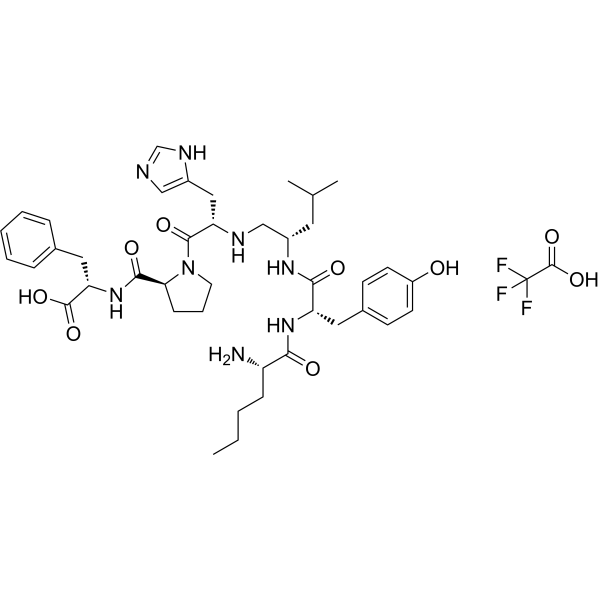
Norleual TFA, an angiotensin (Ang) IV analog, is a hepatocyte growth factor (HGF)/c-Met inhibitor with an IC50 of 3 pM. Norleual TFA is an AT4 receptor antagonist and exhibits potent antiangiogenic activities .
loading...
    loading...
1
1 Cited Publications
Cat. No.: HY-P72267
Purity:  ≥ 90%, as determined by reducing SDS-PAGE.
Synonyms: MET; Soluble MET Variant 13; MET Proto-Oncogene, receptor Tyrosine Kinase; Soluble MET Variant 14; hepatocyte growth factor receptor; Soluble MET Variant 15; DFNB97; Soluble MET Variant 1; RCCP2; Soluble MET Variant 2; HGFR; Soluble MET Variant 3; Tyrosin
Species:  
Human
Source:  
HEK293
loading...
    loading...
Cat. No.: HY-12423
CAS No.: 1190836-34-0
Purity:  98.28%
Synonyms: TAS-115
Target:  

VEGFR c-Met/HGFR

Research Areas:  

Cancer

Pamufetinib (TAS-115) is a potent VEGFR and hepatocyte growth factor receptor (c-Met/HGFR)-targeted kinase inhibitor with IC50s of 30 and 32 nM for rVEGFR2 and rMET, respectively.
loading...
    loading...
Cat. No.: HY-137455
CAS No.: 1070881-42-3
Purity:  99.89%
Synonyms: ANG-3777
Target:  

c-Met/HGFR

Research Areas:  

Inflammation/Immunology

Terevalefim (ANG-3777), an hepatocyte growth factor (HGF) mimetic, selectively activates the c-Met receptor .
loading...
    loading...
Cat. No.: HY-P99196
CAS No.: 1174900-84-5

Target:  

c-Met/HGFR

Research Areas:  

Cancer

Ficlatuzumab is a monoclonal antibody (McAb) targeting human hepatocyte growth factor (HGF). Ficlatuzumab blocks the activation of the HGF/c-Met signaling pathway, and inhibits c-Met receptor-mediated cancer cell proliferation, migration, and invasion .
loading...
    loading...
Cat. No.: HY-132814
CAS No.: 2093305-05-4
Purity:  98.24%
Synonyms: ATH-1017
Target:  

c-Met/HGFR

Research Areas:  

Neurological Disease

Fosgonimeton (ATH-1017) is a hepatocyte growth factor receptor (c-Met/HGFR) agonist. Fosgonimeton has neuroprotective effects in both LPS (HY-D1056) -induced neuroinflammation and Aβ-induced AD models .
loading...
    loading...
Cat. No.: HY-12423A
CAS No.: 1688673-09-7
Purity:  99.17%
Synonyms: TAS-115 mesylate
Target:  

VEGFR c-Met/HGFR

Research Areas:  

Cancer

Pamufetinib (TAS-115) mesylate is a potent VEGFRand hepatocyte growth factor receptor (c-Met/HGFR)-targeted kinase inhibitor, with IC50s of 30 and 32 nM for rVEGFR2 and rMET, respectively.
loading...
    loading...
Cat. No.: HY-156897
Purity:  98.01%
Research Areas:  

Cancer

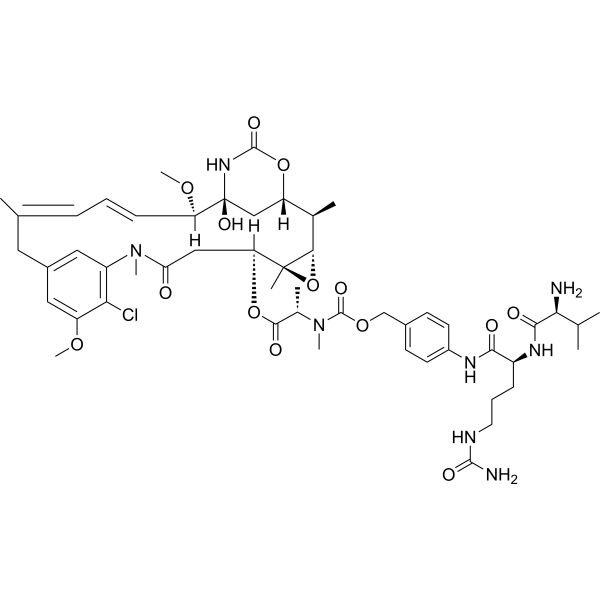
Val-Cit-amide-Ph-Maytansine is an antibody and bispecific antigen-binding mol. that bind hepatocyte growth factor receptor c-Met (MET) or antibody-drug conjugates (ADCs) .
loading...
    loading...
Cat. No.: HY-177134
CAS No.: 2243235-80-3
Target:  

VEGFR c-Met/HGFR

Research Areas:  

Cancer

Taligantinib (Compound Example 70) is an orally active and selective dual inhibitor targeting vascular endothelial growth factor receptor 2 (VEGFR-2) and hepatocyte growth factor receptor (c-Met). Taligantinib suppresses tumor angiogenesis and cell proliferation. Taligantinib is promising for research of solid tumors such as non-small cell lung cancer and hepatocellular carcinoma .
loading...
    loading...
Cat. No.: HY-P1415
CAS No.: 334994-34-2
Norleual, an angiotensin (Ang) IV analog, is a hepatocyte growth factor (HGF)/c-Met inhibitor with an IC50 of 3 pM. Norleual is an AT4 receptor antagonist and exhibits potent antiangiogenic activities .
loading...
    loading...
Cat. No.: HY-10338A
CAS No.: 1226999-07-0
Target:  

c-Met/HGFR VEGFR

Research Areas:  

Cancer

Foretinib phosphate is an orally bioavailable small molecule with potential anti-tumor activity. Foretinib phosphate can selectively inhibit hepatocyte growth factor (HGF) receptor c-MET and vascular endothelial growth factor receptor 2 (VEGFR2), thereby potentially inhibiting tumor angiogenesis, tumor cell proliferation and metastasis. Foretinib phosphate shows different anti-cancer activity from cabozantinib in lung cancer cells and has stronger inhibitory effects on targets such as MEK1/2, FER and AURKB .
loading...
    loading...
Cat. No.: HY-E70751
Target:  

c-Met/HGFR

Research Areas:  

Cancer

Mesenchymal-to-epithelial transition (MET) is a receptor tyrosine kinase for hepatocyte growth factor (HGF). MET overactivation is strongly associated with angiogenesis, cellular motility, growth, and invasion. Aberrant MET signaling can drive tumorigenesis in several cancer types through various molecular mechanisms, including MET amplification, MET exon 14 skipping mutation, MET overexpression, and MET fusions. MET G1163R is a mutant of MET. MET G1163R Recombinant Human Active Protein Kinase is a recombinant MET G1163R protein that can be used to study MET G1163R-related functions .
loading...
    loading...
Cat. No.: HY-E70758
Target:  

c-Met/HGFR

Research Areas:  

Cancer

Mesenchymal-to-epithelial transition (MET) is a receptor tyrosine kinase for hepatocyte growth factor (HGF). MET overactivation is strongly associated with angiogenesis, cellular motility, growth, and invasion. Aberrant MET signaling can drive tumorigenesis in several cancer types through various molecular mechanisms, including MET amplification, MET exon 14 skipping mutation, MET overexpression, and MET fusions. MET Y1235D is a mutant of MET. MET Y1235D Recombinant Human Active Protein Kinase is a recombinant MET Y1235D protein that can be used to study MET Y1235D-related functions .
loading...
    loading...
Cat. No.: HY-174670
Target:  

mRNA

Research Areas:  

Cancer

Human HGF mRNA encodes the human hepatocyte growth factor (HGF) protein, a protein that binds to the hepatocyte growth factor receptor to regulate cell growth, cell motility and morphogenesis in numerous cell and tissue types. It also plays a role in angiogenesis, tumorogenesis, and tissue regeneration.
loading...
    loading...
Cat. No.: HY-156896
CAS No.: 1628543-59-8
Purity:  97.92%
Research Areas:  

Cancer

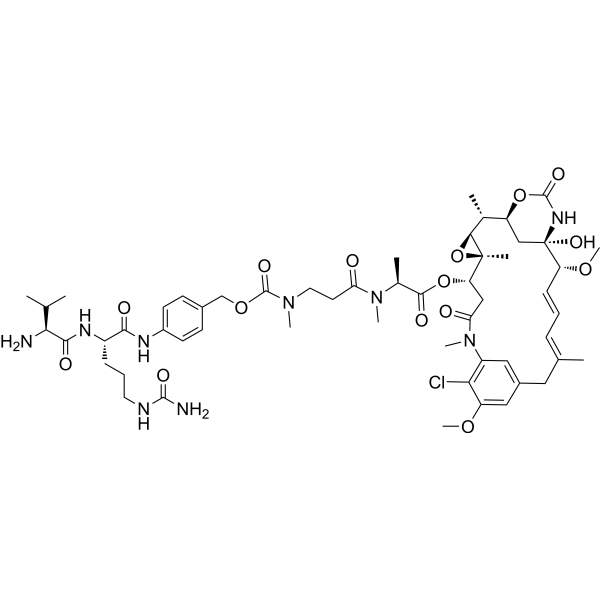
Val-Cit-amide-Cbz-N(Me)-Maytansine is an antibody and bispecific antigen-binding mol. that bind hepatocyte growth factor receptor c-Met (MET) or antibody-drug conjugates (ADCs) .
loading...
    loading...
Cat. No.: HY-14510
CAS No.: 959584-91-9
Target:  

c-Met/HGFR

Research Areas:  

Cardiovascular Disease Cancer

PF 04254644 is an orally active c-Met inhibitor. PF 04254644 inhibits mesenchymal transfer factor/hepatocyte growth factor receptor. PF 04254644 induces myocardial degeneration in rats. PF 04254644 may be used in research on cardiovascular disease and cancer .
loading...
    loading...
Cat. No.: HY-E70754
Target:  

c-Met/HGFR

Research Areas:  

Cancer

Mesenchymal-to-epithelial transition (MET) is a receptor tyrosine kinase for hepatocyte growth factor (HGF). MET overactivation is strongly associated with angiogenesis, cellular motility, growth, and invasion. Aberrant MET signaling can drive tumorigenesis in several cancer types through various molecular mechanisms, including MET amplification, MET exon 14 skipping mutation, MET overexpression, and MET fusions. MET Y1230A is a mutant of MET. MET Y1230A Recombinant Human Active Protein Kinase is a recombinant MET Y1230A protein that can be used to study MET Y1230A-related functions .
loading...
    loading...
Cat. No.: HY-E70748
Target:  

c-Met/HGFR

Research Areas:  

Cancer

Mesenchymal-to-epithelial transition (MET) is a receptor tyrosine kinase for hepatocyte growth factor (HGF). MET overactivation is strongly associated with angiogenesis, cellular motility, growth, and invasion. Aberrant MET signaling can drive tumorigenesis in several cancer types through various molecular mechanisms, including MET amplification, MET exon 14 skipping mutation, MET overexpression, and MET fusions. MET D1228H is a mutant of MET. MET D1228H Recombinant Human Active Protein Kinase is a recombinant MET D1228H protein that can be used to study MET D1228H-related functions .
loading...
    loading...
Cat. No.: HY-E70749
Target:  

c-Met/HGFR

Research Areas:  

Cancer

Mesenchymal-to-epithelial transition (MET) is a receptor tyrosine kinase for hepatocyte growth factor (HGF). MET overactivation is strongly associated with angiogenesis, cellular motility, growth, and invasion. Aberrant MET signaling can drive tumorigenesis in several cancer types through various molecular mechanisms, including MET amplification, MET exon 14 skipping mutation, MET overexpression, and MET fusions. MET D1228N is a mutant of MET. MET D1228N Recombinant Human Active Protein Kinase is a recombinant MET D1228N protein that can be used to study MET D1228N-related functions .
loading...
    loading...

