11 Results for "

membrane potential imaging

" in MedChemExpress (MCE) Product Catalog:
Products (11)

11 Results for "membrane potential imaging" in MCE Product Catalog:

7
7 Cited Publications
Art. -Nr.: HY-D1063
CAS. Nr.: 207399-07-3
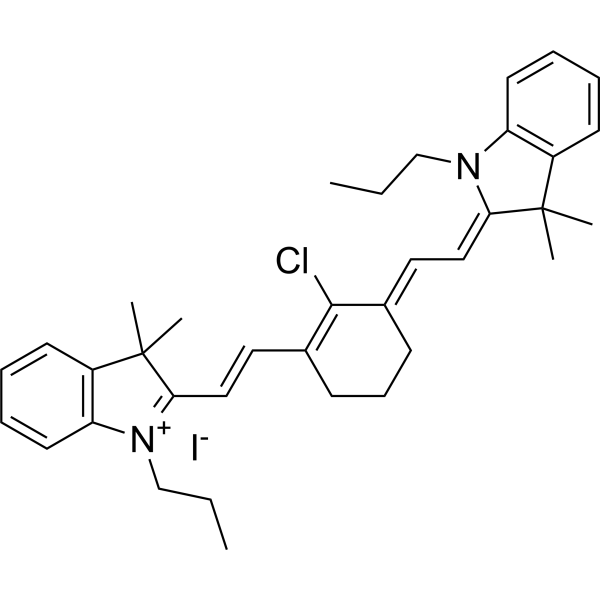
IR-780 is a near-infrared fluorescent probe for in vivo imaging of tumor cells. IR-780 is transported into tumor cells via OATPs and ABCB10, with uptake dependent on glycolytic activity and plasma membrane potential. IR-780 preferentially accumulates in tumor cell mitochondria, including those of drug-resistant cancer cells, without chemical conjugation. IR-780 generates reactive oxygen species (ROS), induces hyperthermia and apoptosis, inhibits tumor growth and recurrence, and modulates HSP70 expression upon ultrasound or 808 nm laser exposure. IR-780 acts as a sonosensitizer, photodynamic and photothermal agent, and drug delivery carrier, with low acute imaging-dose toxicity and rapid vital organ clearance. IR-780 can be used for the research of cancer, such as breast cancer, lung cancer, and non-small cell lung cancer (NSCLC) .
loading...
    loading...
4
4 Cited Publications
Art. -Nr.: HY-139109
CAS. Nr.: 115970-66-6
Reinheit:  99.87%
Synonyms: ADS 780WS
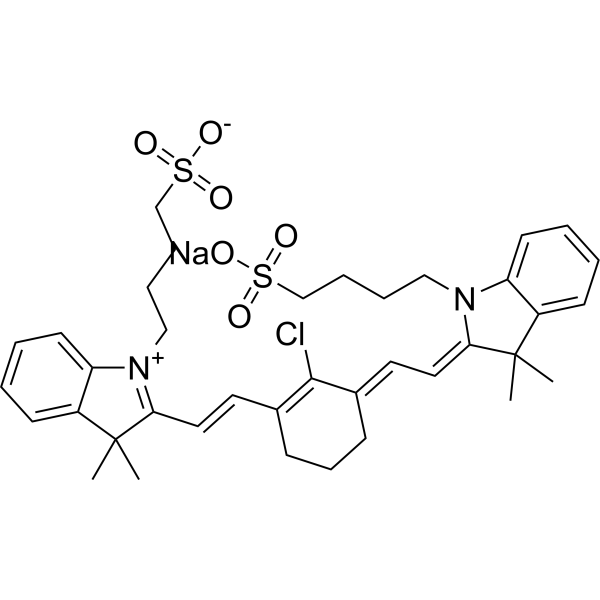
IR-783 (ADS 780WS) is a heptamethine cyanine dye. IR-783 induces Mitochondrial membrane potential loss, ATP depletion, mitochondrial permeability transition pore opening, Cytochrome c release and Apoptosis in breast cancer cells. IR-783 promotes the translocation of Drp1 from the cytosol to mitochondria. IR-783 increases the expression of mitochondrial fission proteins such as MFF and Fission-1. IR-783 possesses imaging, cancer-targeting and anticancer properties. IR-783 exerts anticancer effects against breast cancer. IR-783 can be used in breast cancer-related research .
loading...
    loading...
Art. -Nr.: HY-76573
CAS. Nr.: 1216897-16-3
Target:  

Apoptosis

Forschungsgebiete:  

Cardiovascular Disease Cancer

ML-10 is a small molecule apoptosis probe. Due to the presence of fluorine atoms, ML-10 can be radiolabeled with 18F isotopes and can be used for apoptosis positron emission tomography imaging studies. ML-10 is selectively taken up and accumulated in apoptotic cells, while being excluded from live or necrotic cells. In addition, the uptake of ML-10 is associated with apoptotic features such as caspase activation, Annexin-V binding, and disruption of mitochondrial membrane potential .
loading...
    loading...
Art. -Nr.: HY-P10743
Forschungsgebiete:  

Cancer

BQ7876 is a probe targeting prostate-specific membrane antigen (PSMA) that contains a DOTA chelator. BQ7876, after being radiolabeled with radionuclide (177Lu), functions in both radionuclide imaging and tumor cell destruction by specifically binding to PSMA. BQ7876 shows potential for research in the field of metastatic castration-resistant prostate cancer (mCRPC) . BQ7876 can be used for the synthesis/research of Radionuclide-Drug Conjugates (RDCs).
loading...
    loading...
Art. -Nr.: HY-W777429
CAS. Nr.: 634151-16-9
Ceratamine B is a fluorescent substrate with significant biological activity and can be used for cell imaging and biolabeling. Ceratamine B can effectively penetrate cell membranes, facilitating the study of cellular processes. Ceratamine B also shows broad application potential in compound screening and biosensor development.
loading...
    loading...
Art. -Nr.: HY-D1439
CAS. Nr.: 172807-13-5
Target:  

Fluorescent Dye

Forschungsgebiete:  

Neurological Disease

RH 795 is a lipophilic potentiometric styryl fluorescent dye (Ex/Em = 530 nm/712 nm). RH 795 stains the cell membranes of sensory cells and nerve fibers in living cells that maintain membrane potential, while it shows weak staining effect on supporting cells. RH 795 supports in vivo and in vitro confocal microscopy imaging of intact living inner ear cells and neuronal components. RH 795 can be used in studies related to hearing loss .
loading...
    loading...
Art. -Nr.: HY-D3147
CAS. Nr.: 1965316-23-7
Target:  

Fluorescent Dye

Forschungsgebiete:  

Others

RhoVR 1 is a voltage-sensitive probe targeted to the inner mitochondrial membrane. The detection mechanism of RhoVR 1 relies on membrane potential via the photoinduced electron transfer (PeT) mechanism. RhoVR 1 can be used for cell imaging .
loading...
    loading...
Art. -Nr.: HY-184962
CAS. Nr.: 2415493-70-6
Target:  

GLUT

Forschungsgebiete:  

Cancer

Fluorodeoxyglucopyranose is a GLUT1 transporter substrate with facilitated bidirectional plasma membrane transport dependent on substrate gradients and independent of membrane potential. Fluorodeoxyglucopyranose undergoes conjugation to neuropharmaceutical agents and cancer imaging components. Fluorodeoxyglucopyranose can be used for the research of cancer .
loading...
    loading...
Art. -Nr.: HY-D3148
CAS. Nr.: 1804107-88-7
Target:  

Fluorescent Dye

Forschungsgebiete:  

Others

TPE-Ph-In is a mitochondria-targeted voltage-sensitive probe that can be used for mitochondrial membrane potential detection, mitochondrial imaging of animal and plant cells and tissues, mouse sperm activity indication, and detection of mitochondrial membrane potential changes associated with early apoptosis. TPE-Ph-In is non-fluorescent in solution, but emits strong fluorescence when aggregated via restriction of intramolecular rotation/movement, and its fluorescence intensity is directly correlated with local probe concentration or mitochondrial membrane potential level. TPE-Ph-In can penetrate cell membranes, target mitochondria through charge-dependent accumulation, has low cytotoxicity and high photostability, and enables super-resolution imaging of plant mitochondrial fission, fusion and cristae structures. The excitation wavelengths of TPE-Ph-In include 450 nm, 488 nm, and 489 nm, while its emission wavelengths include 551-661 nm, 660 nm, and 694 nm. TPE-Ph-In can be used for studies on mitochondrial dysfunction associated with early apoptosis .
loading...
    loading...
Art. -Nr.: HY-D3132
CAS. Nr.: 1616505-01-1
Target:  

Fluorescent Dye

Forschungsgebiete:  

Others

Spring Red is a fluorescent probe for mitochondrial pH detection (Ex/Em = 530/680 nm) that can be taken up by live cells and mitochondria. The detection mechanism of Spring Red depends on pH changes and mitochondrial membrane potential. Fluorescence intensity increases with elevated pH, and a significant pH-dependent fluorescent response is observed in the pH range of 5.0‑8.0. Spring Red is suitable for long-term live-cell imaging and in vivo imaging, and can be used to monitor dynamic mitochondrial pH changes .
loading...
    loading...
Art. -Nr.: HY-D3146
CAS. Nr.: 1418017-91-0
Target:  

Fluorescent Dye

Forschungsgebiete:  

Others

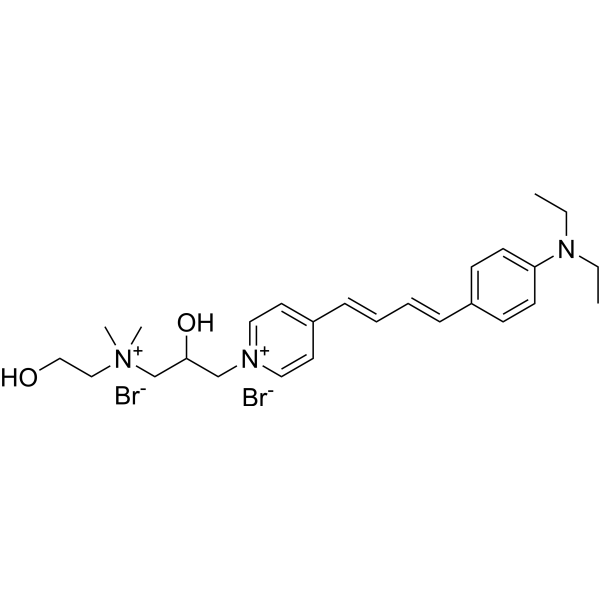
Di-4-AN (F) EPPTEA is a voltage-sensitive dye used for membrane potential imaging and optical recording of electrical activity in excitable cells and tissues. Its detection mechanism is based on electrochromism (also known as the molecular Stark effect). The single-photon excitation/emission wavelengths measured in ethanol solution are Ex/Em = 444/610 nm, and it can be excited via 1064 nm two-photon excitation in optical recording applications. Di-4-AN (F) EPPTEA can be used to record backpropagating action potentials in individual dendritic spines of brain cortical slices, map subcellular action potential characteristics of single cardiomyocytes, and perform real-time recording of multicellular action potentials in cerebellar slices .
loading...
    loading...
  • 1

