9 Results for "

optical reagent

" in MedChemExpress (MCE) Product Catalog:
Products (9)

9 Results for "optical reagent" in MCE Product Catalog:

2
2 Cited Publications
Cat. No.: HY-D0023
CAS No.: 6358-69-6
Synonyms: HPTS; Solvent Green 7
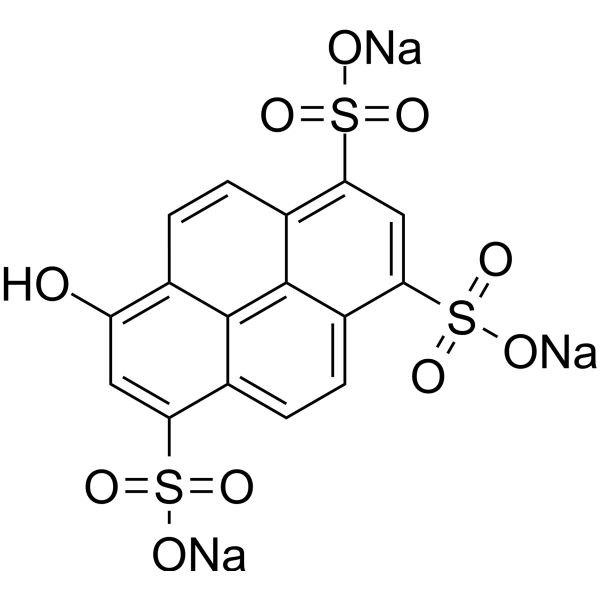
Pyranine (HPTS; Solvent Green 7) is a cell-impermeant pH-sensitive fluorescent indicator. Pyranine acts as a class of fluorescent chemosensor for the Cu + ion. Pyranine is used as a coloring agent, biological stain, optical detecting reagent, and pH indicator (Ex/Em = 450/510 nm) .
loading...
    loading...
1
1 Cited Publications
Cat. No.: HY-41982
CAS No.: 32449-92-6
Synonyms: D-Glucurono-6,3-lactone; D-Glucurono-γ-lactone; D-Glucuronolactone; Dicurone; Glucoxy; Glucurolactone; Glucurone
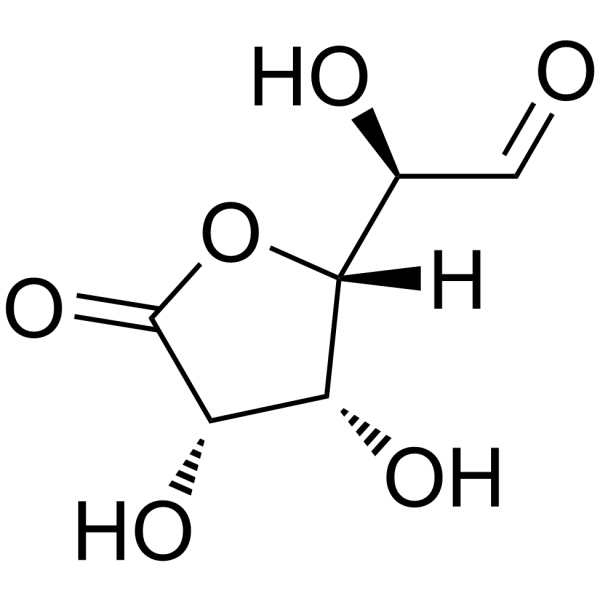
D-Glucuronic acid lactone (D-Glucurono-6,3-lactone; D-Glucurono-γ-lactone; D-Glucuronolactone; Dicurone; Glucoxy; Glucurolactone; Glucurone) is an endogenous metabolite and a glucuronic acid derivative. D-Glucuronic acid lactone serves as a starting reagent for the synthesis of 2,3,4-tris (tert-butyldimethylsilyl) glucuronic acid trichloroethyl ester, which is used to prepare 1-O-acyl glucuronic acids for the anti-inflammatory agent mL-3000 (HY-B1452), synthesize optically active glucuronic acids, and produce long-chain alkyl glucuronides. D-Glucuronic acid lactone shows potential for use in studies of reversible cerebral vasoconstriction syndrome (RCVS) .
loading...
    loading...
Cat. No.: HY-W105135
CAS No.: 101-38-2
Research Areas:  

Others

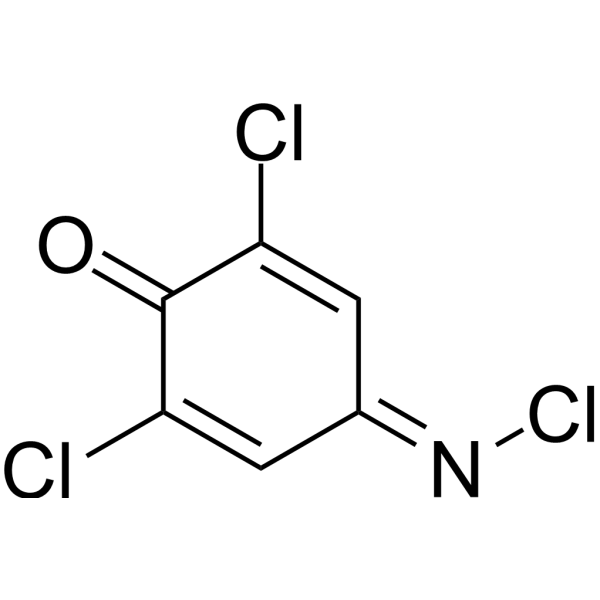
2,6-Dichloroquinone-4-chloroimide is a spray reagent for organic compounds. 2,6-Dichloroquinone-4-chloroimide can be used in thin-layer chromatograms and detecting phenol and its derivatives. 2,6-Dichloroquinone-4-chloroimide can be used as an optical sensor for rapid detection of permethrin in treated wood .
loading...
    loading...
Cat. No.: HY-W588722
CAS No.: 3024705-52-7
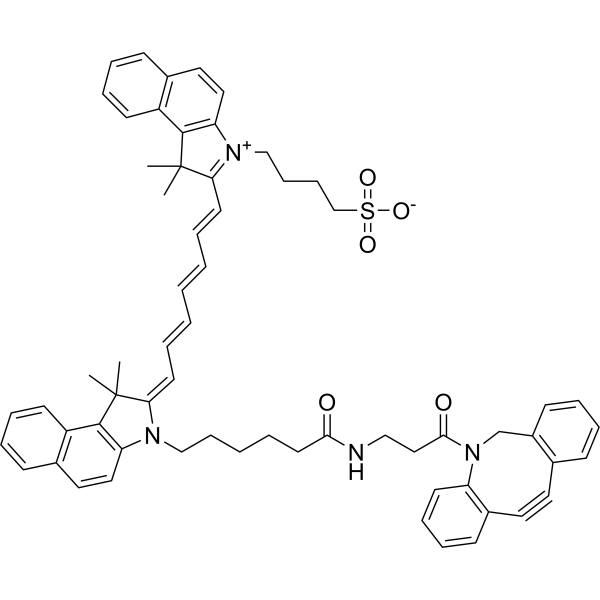
ICG-DBCO is a near-infrared fluorescent click chemistry reagent (Ex/Em = 789/813 nm), composed of Indocyanine green (ICG) (HY-D0711) and dibenzocyclooctyne (DBCO). ICG-DBCO enables copper-free, strain-promoted azide-alkyne cycloaddition (SPAAC) for labeling biomolecules such as antibodies, proteins and peptides, thereby facilitating deep tissue optical imaging .
loading...
    loading...
Cat. No.: HY-W087187G
CAS No.: 1375475-53-8
DOTAGA-anhydride (GMP) is DOTAGA-anhydride (HY-W087187) produced by using GMP guidelines. GMP small molecules works appropriately as an auxiliary reagent for cell therapy manufacture. DOTAGA-anhydride is a DOTA-based metal chelator that can bind to radionuclides and is used to prepare radionuclide drug conjugates (RDCs). DOTAGA-anhydride has been successfully used for labeling antibodies (e.g., Trastuzumab (HY-P9907)). DOTAGA-anhydride can be used for the synthesis of a bimodal tag for Single-photon emission computed tomography (SPECT) or PET/optical imaging .
loading...
    loading...
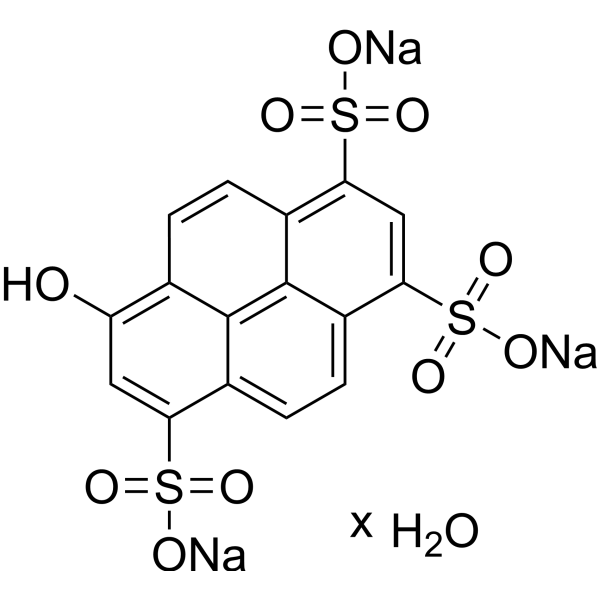
Cat. No.: HY-D0023A
Synonyms: HPTS hydrate; Solvent Green 7 hydrate
Pyranine (HPTS; Solvent Green 7) hydrate is a cell-impermeant pH-sensitive fluorescent indicator. Pyranine hydrate acts as a class of fluorescent chemosensor for the Cu + ion. Pyranine hydrate is used as a coloring agent, biological stain, optical detecting reagent, and pH indicator (Ex/Em = 450/510 nm) .
loading...
    loading...
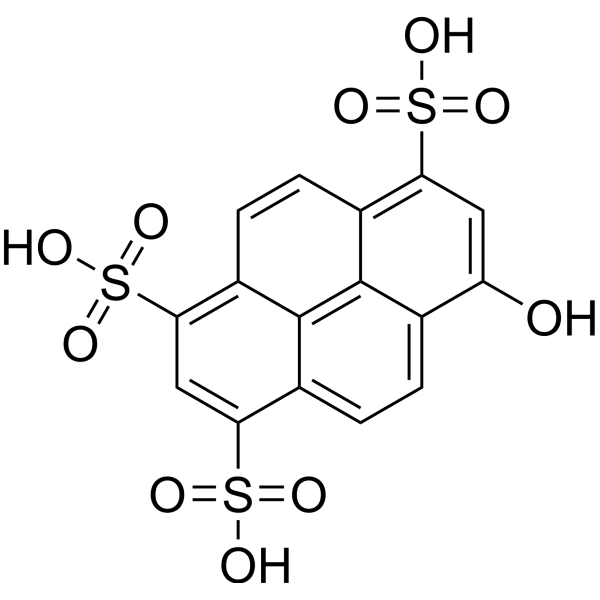
Cat. No.: HY-D0116
CAS No.: 27928-00-3
Synonyms: HPTS free acid; Solvent Green 7 free acid
Pyranine (HPTS; Solvent Green 7) free acid is a pH-sensitive fluorescent indicator. Pyranine free acid acts as a class of fluorescent chemosensor for the Cu + ion. Pyranine free acid is used as a coloring agent, biological stain, optical detecting reagent, and pH indicator (Ex/Em = 450/510 nm) .
loading...
    loading...
Cat. No.: HY-34849
CAS No.: 53531-34-3
Research Areas:  

Others

(R)-(-)-1-(9-Anthryl)-2,2,2-trifluoroethanol is utilized as a chiral shift reagent for determining enantiomeric ratios. Additionally, (R)-(-)-1-(9-Anthryl)-2,2,2-trifluoroethanol can be employed for nuclear magnetic resonance (NMR) optical purity determination .
loading...
    loading...
Cat. No.: HY-D1737
RADA is a fluorescent D-amino acid (FDAA) with high photostability and thermostability, which emits yellow-to-orange fluorescence. RADA shows low outer membrane permeability in wild-type Gram-negative Escherichia coli, but it targets penicillin-binding proteins and L,D-transpeptidases, mimics the interaction between acyl acceptors and enzyme intermediates, and integrates into peptidoglycan during biosynthesis. As a peptidoglycan labeling reagent, RADA metabolically integrates into the nascent peptidoglycan of live bacterial cells, labels the peptidoglycan at the poles and lateral walls of mycobacteria, and enables visualization of peptidoglycan synthesis and remodeling processes. RADA serves as a non-specific stain for fixed cells, is non-toxic to bacterial cells, and its red-shifted excitation/emission spectra reduce phototoxicity. RADA also supports virtual pulse-chase labeling experiments and stochastic optical reconstruction microscopy for sub-diffraction-limited imaging of bacterial cell walls .
loading...
    loading...

