11 Results for "

pH sensor

" in MedChemExpress (MCE) Product Catalog:
Products (11)

11 Results for "pH sensor" in MCE Product Catalog:

1
1 Cited Publications
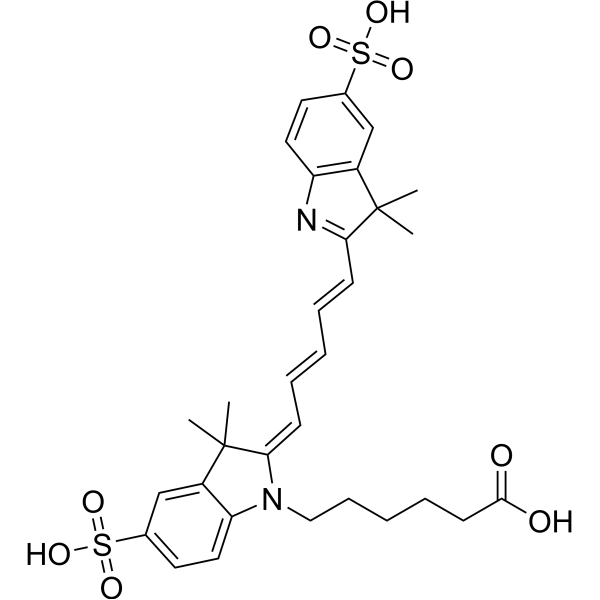
Cat. No.: HY-D1563
CAS No.: 312961-83-4
pH Receptor Probe is a pH-sensitive cyanine derivative and a environmental sensitive fluorophore. pH Receptor Probe has a pH-sensitive maximal absorption at 644 nm and emission at 664 nm. pH Receptor Probe has been used as a pH sensor of lysosomal compartments .
loading...
    loading...
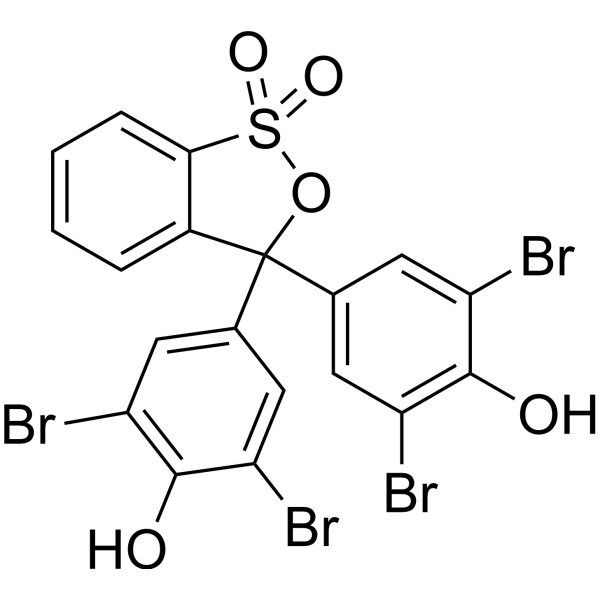
Cat. No.: HY-B1571
CAS No.: 115-39-9
Bromophenol blue is an acid phthalein dye, and it is used as a tracking dye for electrophoresis. Bromophenol blue is also used as a pH indicator, with a transition range of pH 3 to 4.6. Bromophenol blue is used as a sensor for the determination of several compounds including ammonia, drugs, proteins and amino acids. The binding of Bromophenol blue to proteins is accompanied by the appearance of a strong absorbance at 610 nm .
loading...
    loading...
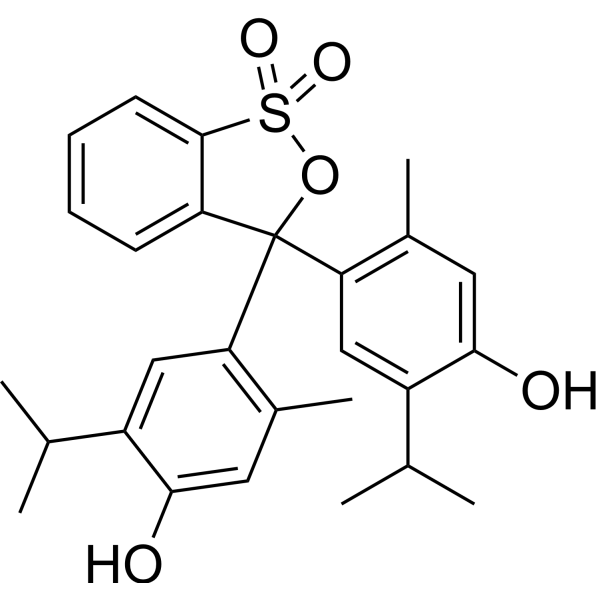
Cat. No.: HY-D0219
CAS No.: 76-61-9
Synonyms: ThymolsulpHonepHthalein
Thymol blue is a reversible pH indicator that responds to the pH of the solution through structural changes of protonation and deprotonation. Thymol blue is red (HI - form) under acidic conditions and blue (I 2- form) under alkaline conditions. Quantitative detection is achieved through the absorption peak shift (435 nm/596 nm) of the UV-visible spectrum. Thymol blue selectively responds to pH changes, changing from red to yellow at pH 1.2-2.8 and from yellow to blue at pH 8.0-9.6. Thymol blue can be fixed in a silica gel matrix through sol-gel technology to form a solid-state sensor for in-situ pH measurement in the marine environment and acid-base monitoring in the biomedical field[1][2].
loading...
    loading...
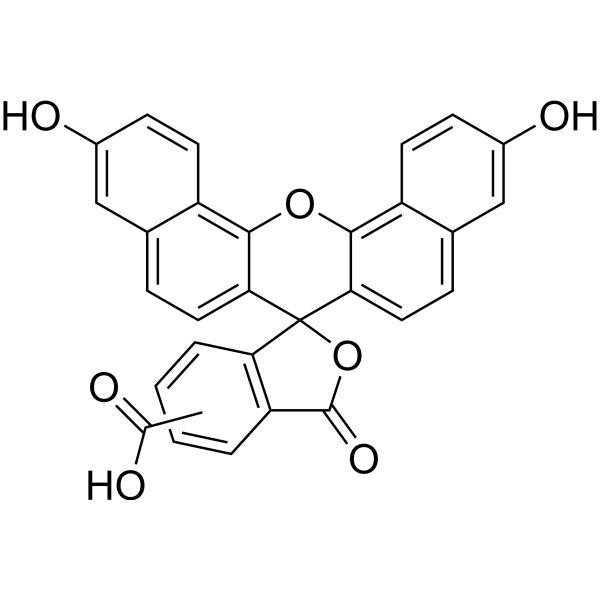
Cat. No.: HY-D1677
CAS No.: 128724-35-6
Target:  

Fluorescent Dye

Research Areas:  

Others

5(6)-Carboxynaphthofluorescein is a pH-dependent fluorophore. 5(6)-Carboxynaphthofluorescein shows good sensitivity in an alkaline pH range and it can be exploited in the construction of fiber-optic pH sensors. 5(6)-Carboxynaphthofluorescein can be used as a fluorescent pH indicator (Ex/Em=593/668 nm) .
loading...
    loading...
Cat. No.: HY-DY1071
CAS No.: 312961-83-4
pH Receptor Probe (solution) is a pH-sensitive cyanine derivative and a environmental sensitive fluorophore. pH Receptor Probe has a pH-sensitive maximal absorption at 644 nm and emission at 664 nm. pH Receptor Probe has been used as a pH sensor of lysosomal compartments .
Solvent and concentration: DMSO: 10 mM
loading...
    loading...
Cat. No.: HY-131007
CAS No.: 2341841-05-0
Purity:  ≥99.0%
Target:  

Adrenergic Receptor

Research Areas:  

Metabolic Disease

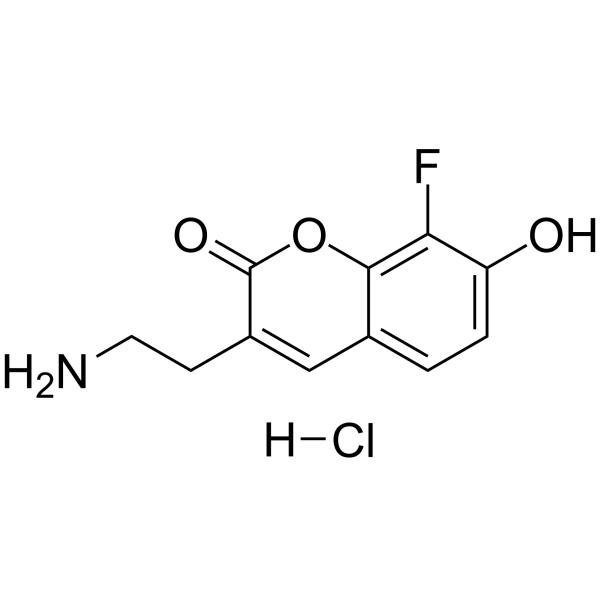
FFN270 hydrochloride, a fluorescent tracer of norepinephrine, is a fluorescent substrate of the norepinephrine and vesicular monoamine transporters. FFN270 hydrochloride exhibits two resolved absorption/excitation maxima depending on solvent pH (FFN270 ex: 320 nm or 365 nm, em: 475 nm) and can function as ratiometric fluorescent pH-sensors .
loading...
    loading...
Cat. No.: HY-D0219A
CAS No.: 62625-21-2
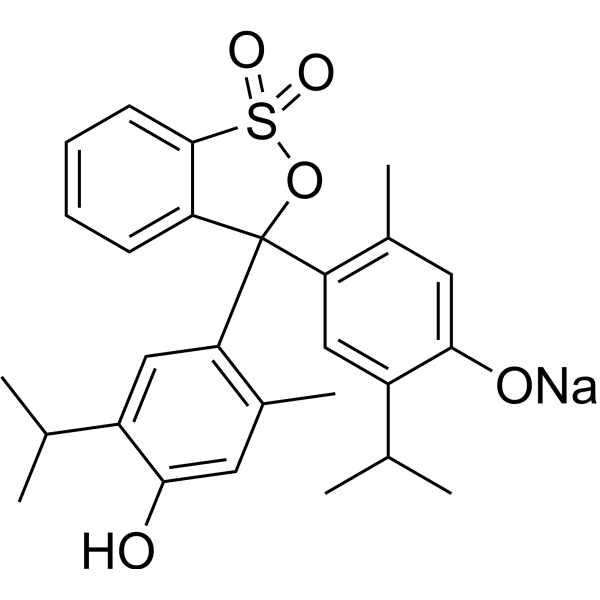
Thymol Blue sodium is an acid-base indicator used to indicate changes in pH. Thymol Blue sodium fades from red to yellow at pH 1.2 to 2.8 and from yellow to blue at pH 8.0 to 9.6. Quantitative detection is achieved through the absorption peak shift (435 nm/596 nm) of the UV-visible spectrum. Thymol blue sodium can be fixed in a silica gel matrix through sol-gel technology to form a solid-state sensor for in-situ pH measurement in the marine environment and acid-base monitoring in the biomedical field .
loading...
    loading...
Cat. No.: HY-D0140
CAS No.: 125829-24-5
Synonyms: ETH 5294
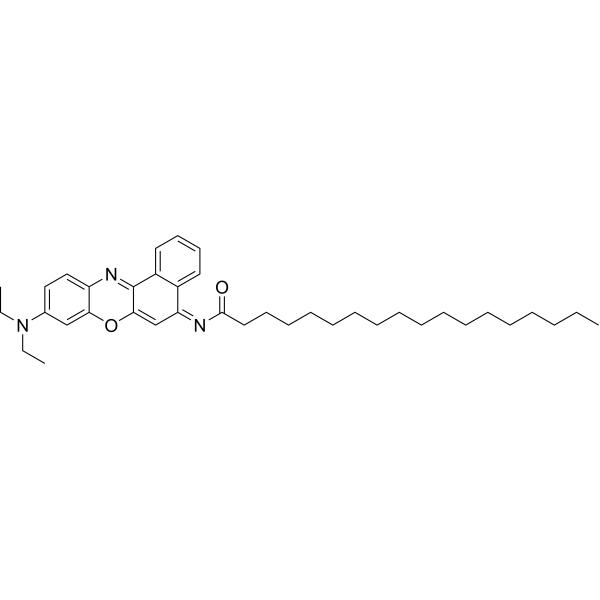
Chromoionophore I (ETH 5294) is a hydrophobic pH indicator. Chromoionophore I is used as a transmissive or fluorescent probe molecule in many types of hydrophobic sensor membranes. Chromoionophore I is oil-soluble .
loading...
    loading...
Cat. No.: HY-N11882
CAS No.: 4299-57-4
Synonyms: PQ-9
Plastoquinone (PQ-9) is a photosynthetic electron carrier as well as a redox sensor capable of regulating state transitions and gene expression. Plastoquinone transfers electrons to the cytochrome b6/f complex via the Q cycle, and participates in the establishment of the thylakoid transmembrane pH gradient. Plastoquinone can react with ROS. Plastoquinone is used in plant photosynthesis research .
loading...
    loading...
Cat. No.: HY-113621B
CAS No.: 2757574-06-2
Target:  

Fluorescent Dye MMP

Research Areas:  

Cancer

Ageladine A dihydrochloride is an inhibitor of matrix metalloproteinase (MMP) isolated from the marine sponge Agelas nakamurai, possessing anti-angiogenic activity. Ageladine A dihydrochloride not only inhibits MMP-2 but also MMP-1, MMP-8, MMP-9, MMP-12, and MMP-13, with IC50 values of 4.65 μM, 2.79 μM, 907.12 nM, 1.83 μM, 767.57 nM, and 1.09 μM, respectively. Additionally, Ageladine A dihydrochloride is a pH-sensitive membrane-permeable dye that emits fluorescence in the blue-green range upon UV excitation, featuring a maximum absorption peak at 370 nm. Furthermore, Ageladine A dihydrochloride serves as a reliable and stable fluorescent pH sensor for detecting changes in intracellular pH values .
loading...
    loading...
Cat. No.: HY-W585368
CAS No.: 945921-51-7
Research Areas:  

Others

BODIPY dyes are a class of small-molecule fluorophores with strong ultraviolet absorption and sharp fluorescence emission peaks. BODIPY dyes can non-specifically label erythrocyte membranes, fail to inhibit the proliferation of Plasmodium falciparum, exhibit weak cytotoxicity against Chinese hamster ovary cells, and have extremely low hemolytic activity. BODIPY dyes serve as a universal scaffold for fluorescent compounds such as laser dyes and fluorescent probes, and can also be used to construct photoelectric and biophotonic molecular assembly units. BODIPY dyes are applicable to research related to live-cell imaging, fluorescent labeling of proteins and DNA, and various biological imaging assays .
loading...
    loading...
  • 1

