8 Results for "

peripheral anionic site

" in MedChemExpress (MCE) Product Catalog:
Products (8)

8 Results for "peripheral anionic site" in MCE Product Catalog:

  • Categories Recommended:
    More
製品番号: HY-149484
Target:  

Cholinesterase (ChE)

研究分野:  

Neurological Disease

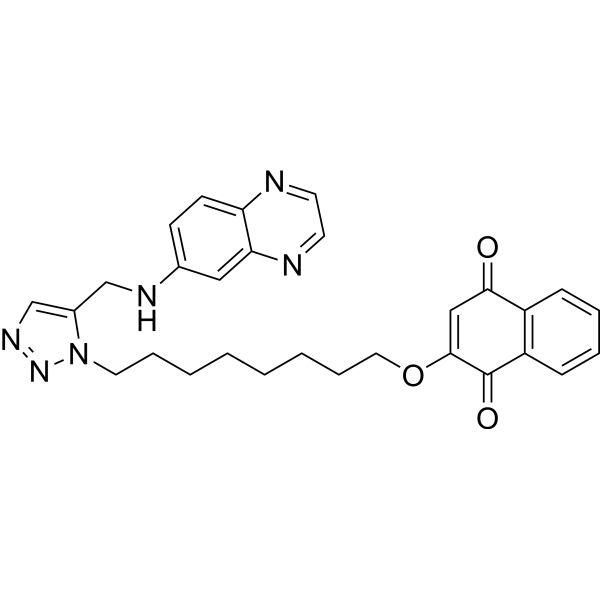
AChE/BChE-IN-15 (Compound 6d) is an AChE/BChE inhibitor, with IC50s of 20 nM and 220 nM respectively. AChE/BChE-IN-15 binds to both catalytic anionic site (CAS) and peripheral anionic site (PAS) in the active sites of AChE and BChE. AChE/BChE-IN-15 can be used for research of Alzheimer’s disease .
loading...
    loading...
製品番号: HY-151885
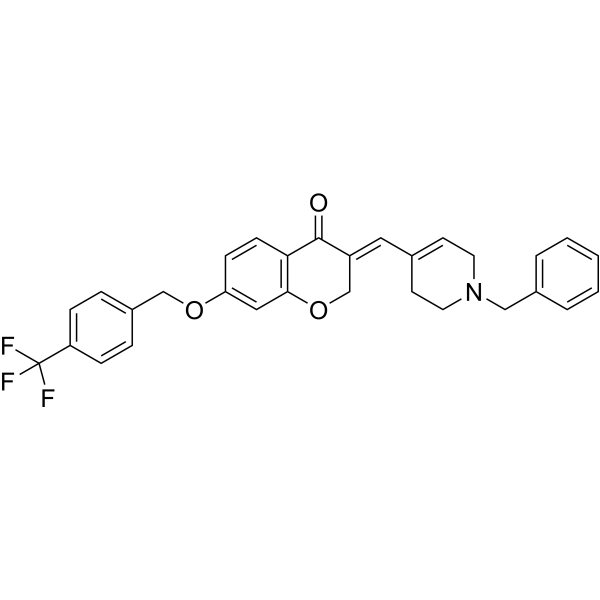
Dual AChE-MAO B-IN-3 (compound C10) is a potent dual AChE/MAO-B inhibitior, with IC50 values of 0.58 and 0.41 μM, respectively. Dual AChE-MAO B-IN-3 is a dual-binding inhibitor bound to both the catalytic anionic site and peripheral anionic site of AChE. Dual AChE-MAO B-IN-3 can be used for Alzheimer’s disease (AD) research .
loading...
    loading...
製品番号: HY-150728
CAS 番号: 3032264-62-0
Target:  

Cholinesterase (ChE)

研究分野:  

Neurological Disease

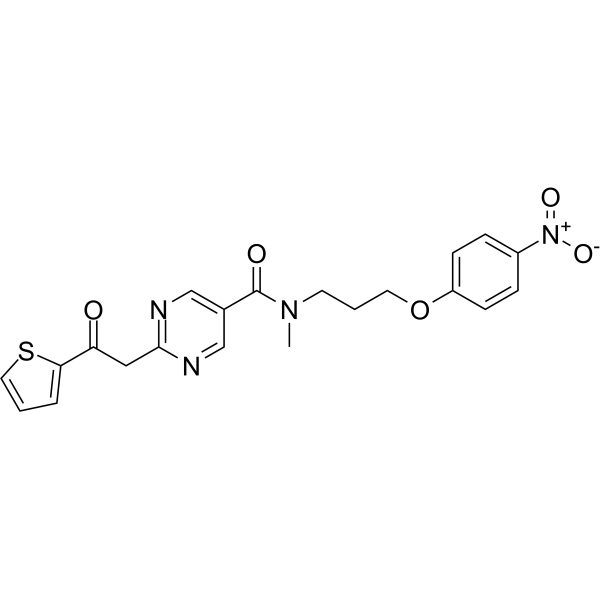
AChE-IN-22 (compound 10q) is a selective acetylcholinesterase (AChE) inhibitor against AChE and BuChE with the IC50 values of 0.88 μM and 10 μM, respectively. AChE-IN-22 can bind to both the CAS (catalytic active site) and PAS (peripheral anionic site) of AChE and has the potential for the research of Alzheimer's disease .
loading...
    loading...
製品番号: HY-163746
Target:  

Cholinesterase (ChE)

研究分野:  

Neurological Disease

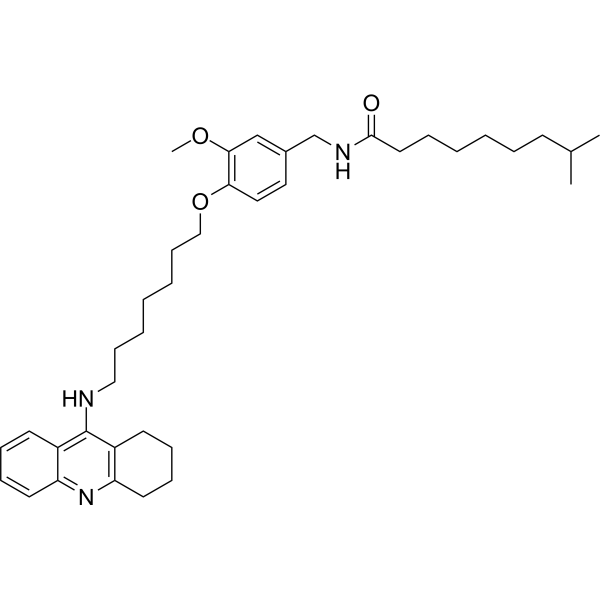
BuChE-IN-11 (Compound 3b-1) is an selective BuChE inhibitor with an IC50 of 0.44 μM for hBuChE. BuChE-IN-11 has high blood-brain barrier permeability and exhibits strong antioxidant activity due to its free radical scavenging properties. BuChE-IN-11 interacts with the choline binding site, acetyl binding site, and peripheral anionic site, exhibiting submicromolar BuChE inhibitory activity and preventing β-amyloid (Aβ) self-aggregation. BuChE-IN-11 holds promise for research in the field of Alzheimer's disease .
loading...
    loading...
製品番号: HY-157527
CAS 番号: 2978613-03-3
hAChE-IN-7 (compound 5s) is a mixed inhibitor affecting both the catalytic active site (CAS) and peripheral anionic site (PAS) of hAChE. hAChE-IN-7 displays the balanced inhibitory effect on hAChE (IC50=69.8 nM) and hBuChE (IC50=68.0 nM), and exhibits inhibitory activity against β-secretase-1 (BACE-1) (IC50=3.6 μM). hAChE-IN-7 has the potential for Alzheimer's disease (AD) research .
loading...
    loading...
製品番号: HY-184796
AChE-IN-119 is a selective acetylcholinesterase (AChE) inhibitor with an IC50 of 0.0641 μM and a Ki of 0.01648 μM. AChE-IN-119 exerts antioxidant effects by scavenging DPPH free radicals. AChE-IN-119 exhibits mixed-type inhibition and interacts with both the catalytic active site and the peripheral anionic site of acetylcholinesterase. AChE-IN-119 can be used for the research of Alzheimer's disease .
loading...
    loading...
製品番号: HY-181851
Target:  

Cholinesterase (ChE)

研究分野:  

Neurological Disease

AChE-IN-109 is a potent mixed-type cholinesterase inhibitor with significantly stronger inhibitory activity against AChE than BChE. AChE-IN-109 has IC50 values of 0.55 μM and 12.45 μM against AChE and BChE, respectively. AChE-IN-109 inhibits cholinesterases through a mixed-type mechanism, binds to both the catalytic active site (CAS) and peripheral anionic site (PAS) of AChE. AChE-IN-109 can be used for the study of Alzheimer’s disease (AD) .
loading...
    loading...
製品番号: HY-DY2020
Target:  

Fluorescent Dye

研究分野:  

Others

Neutral Red Staining Solution (for Live Cells) is a vital stain used for vital staining of peripheral blood cells, and it can also be used for staining other living cells or tissues. Neutral Red Staining Solution (for Live Cells) accumulates in cytoplasmic vacuoles, lysosomes of living cells, as well as plant/fungal vacuoles. It binds to anionic sites, suberin, lignin, cell walls, DNA and phenolic substances, and can intercalate into DNA. Neutral Red Staining Solution (for Live Cells) stains the cytoplasm of specific phytoplankton and estuarine zooplankton, while dead cells are not stained, enabling viability determination of such organisms .
loading...
    loading...

