
14 Results for "

thermosensitive

" in MedChemExpress (MCE) Product Catalog:
Products (14)

14 Results for "thermosensitive" in MCE Product Catalog:

1
1 Cited Publications
Cat. No.: HY-125924
CAS No.: 474922-26-4
Purity:  99.96%
Synonyms: DSPE-PEG-NH2, MW 2000 ammonium; DSPE-PEG(2000) Amine ammonium
Target:  

Drug Derivative

Research Areas:  

Cancer

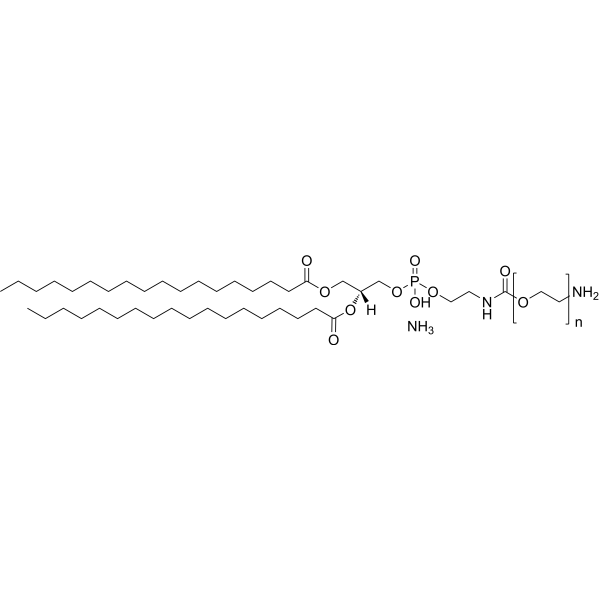
DSPE-PEG-Amine, MW 2000 (ammonium), an amine derivative of phospholipid poly ethylene glycol, is used in the synthesis of solid lipid and thermosensitive liposomal nanoparticles for the delivery of anticancer agents .
loading...
    loading...
Cat. No.: HY-101532
CAS No.: 98169-85-8
Purity:  ≥98.0%
Synonyms: β-CDN3; 6A-deoxy-6A-azido-β-cyclodextrin
Research Areas:  

Others

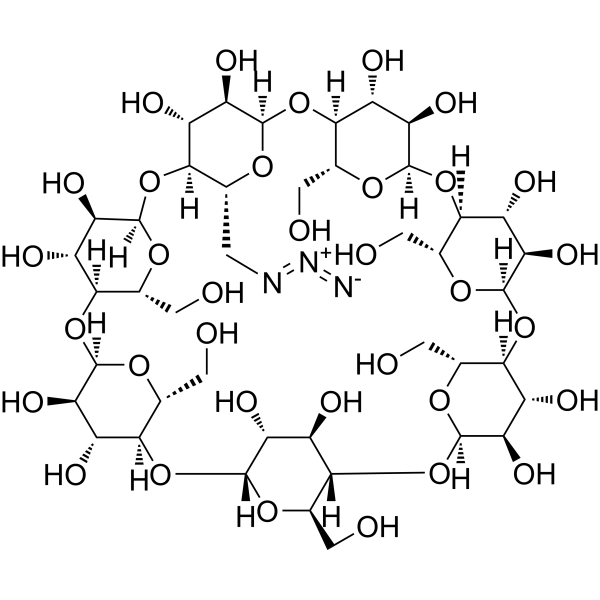
6A-Azido-6A-deoxy-β-cyclodextrin (β-CDN3) is a site-specifically modified β-cyclodextrin with a single azido group replacing the hydroxyl group at the C6 position. 6A-Azido-6A-deoxy-β-cyclodextrin forms a host-guest inclusion complex with Dexamethasone (HY-14648), localizing the drug within its hydrophobic cavity, which restricts the rotational mobility of the drug and places Dexamethasone in a less polar environment. 6A-Azido-6A-deoxy-β-cyclodextrin acts as a coupling agent to graft β-cyclodextrin onto thermosensitive nanogels via strain-promoted alkyne-azide cycloaddition (SPAAC). 6A-Azido-6A-deoxy-β-cyclodextrin also serves as a click chemistry reagent. It contains an azide group and undergoes copper-catalyzed azide-alkyne cycloaddition (CuAAc) with molecules bearing an alkyne group. It also undergoes strain-driven alkyne-azide cycloaddition (SPAAC) with molecules containing DBCO or BCN groups .
loading...
    loading...
Cat. No.: HY-156829B
PLGA-PEG-PLGA (hydrogel) (LA:GA 7:1) is a biodegradable thermosensitive hydrogel product that can undergo phase transition at a specific temperature. PLGA-PEG-PLGA (hydrogel) (LA:GA 7:1) can be widely used in drug delivery systems, tissue engineering, wound dressings, and biosensors. The gelation temperature varies with concentration. The gelation temperature varies with the concentration; the higher the concentration, the lower the gelation temperature .
loading...
    loading...
Cat. No.: HY-156829I
PLGA-PEG-PLGA (hydrogel) (LA:GA 3:1) (15% solution) is a biodegradable thermosensitive hydrogel product that can undergo phase transition at a specific temperature. PLGA-PEG-PLGA (hydrogel) (LA:GA 3:1) (15% solution) can be widely used in drug delivery systems, tissue engineering, wound dressings, and biosensors . The gelation temperature varies with the concentration; the higher the concentration, the lower the gelation temperature.
loading...
    loading...
Cat. No.: HY-A0104F
CAS No.: 9004-65-3
Synonyms: Hypromellose (Type II,Viscosity:400mPa.s); (Hydroxypropyl)methyl cellulose (Type II,Viscosity:400mPa.s); Celacol HPM 5000 (Type II,Viscosity:400mPa.s)
Research Areas:  

Others

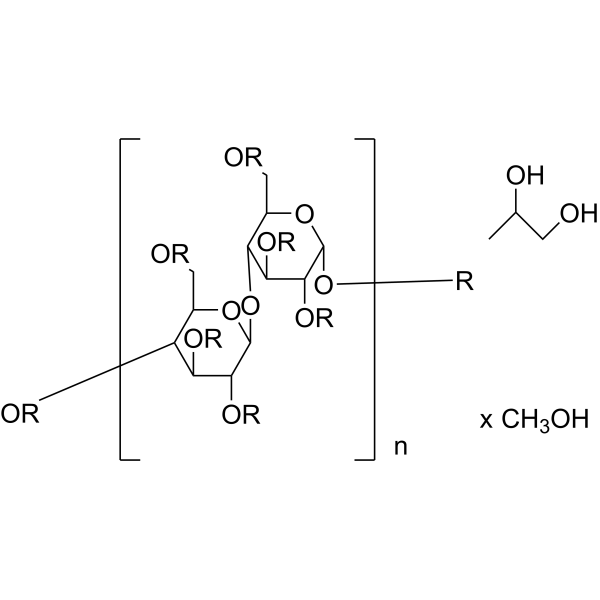
HPMC (Type II, Viscosity: 400 mPa·s) is a thermosensitive hydroxypropyl methylcellulose polymer. HPMC (Type II, Viscosity: 400 mPa·s) can be used to prepare Fe3O4@HPMC magnetic fluids with temperature-responsive properties, and its temperature-responsive process involves the weakening of HPMC-water hydrogen bonds and the enhanced association of hydrophobic groups. HPMC (Type II, Viscosity: 400 mPa·s) can be used in research on thermosensitive magnetic fluid materials .
loading...
    loading...
Cat. No.: HY-156829J
PLGA-PEG-PLGA (hydrogel) (LA:GA 3:1) (20% solution) is a biodegradable thermosensitive hydrogel product that can undergo phase transition at a specific temperature. PLGA-PEG-PLGA (hydrogel) (LA:GA 3:1) (20% solution) can be widely used in drug delivery systems, tissue engineering, wound dressings, and biosensors. The gelation temperature varies with the concentration; the higher the concentration, the lower the gelation temperature .
loading...
    loading...
Cat. No.: HY-W440823B
CAS No.: 1292302-96-5
Target:  

Liposome

Research Areas:  

Cancer

DSPE-PEG2000-amine sodium is a pegylated derivative of 1,2-Distearoyl-sn-glycero-3-phosphorylethanolamine (HY-112530), which can be used to synthesize solid lipid and thermosensitive liposomal nanoparticles for the delivery of anticancer agents .
loading...
    loading...
Cat. No.: HY-125924A
CAS No.: 474922-26-4
Target:  

Drug Derivative

Research Areas:  

Cancer

DSPE-PEG20000-Amine ammonium is an amine derivative of phospholipid-polyethylene glycol, which is used to synthesize solid lipid and thermosensitive liposome nanoparticles for the delivery of anticancer agents. DSPE-PEG20000-Amine ammonium is applicable for cancer research .
loading...
    loading...
Cat. No.: HY-D1005A7
CAS No.: 9003-11-6
Synonyms: PEG-PPG-PEG, 2400 (Average)
Poloxamer 125 (L45) (PEG-PPG-PEG, 2400 (Average)) is a block polymer of polyoxyethylene and polyoxypropylene, belonging to water-soluble non-ionic biosurfactants with properties such as emulsification and wetting. Poloxamer 125 (L45) has thermosensitive characteristics and can form thermoreversible hydrogels in aqueous solutions, presenting a fluid state at room temperature and transforming into a viscous gel under body temperature conditions; when its concentration is higher than the critical micelle concentration, it can also self-assemble into micelles in aqueous systems. Poloxamer 125 (L45) enables controlled drug release, prolongs the local retention time of drugs, and is often used as a drug delivery carrier. Poloxamer 125 (L45) can be applied in the fields of cosmetics, biomedicine and tissue engineering .
loading...
    loading...
Cat. No.: HY-156829H
PLGA-PEG-PLGA (hydrogel) (LA:GA 7:1) (20% solution) is a biodegradable thermosensitive hydrogel product that can undergo phase transition at a specific temperature. PLGA-PEG-PLGA (hydrogel) (LA:GA 7:1) (20% solution) can be widely used in drug delivery systems, tissue engineering, wound dressings, and biosensors. The gelation temperature varies with concentration. The gelation temperature varies with the concentration; the higher the concentration, the lower the gelation temperature .
loading...
    loading...
Cat. No.: HY-N3230
CAS No.: 88478-44-8
Synonyms: Murraxocin
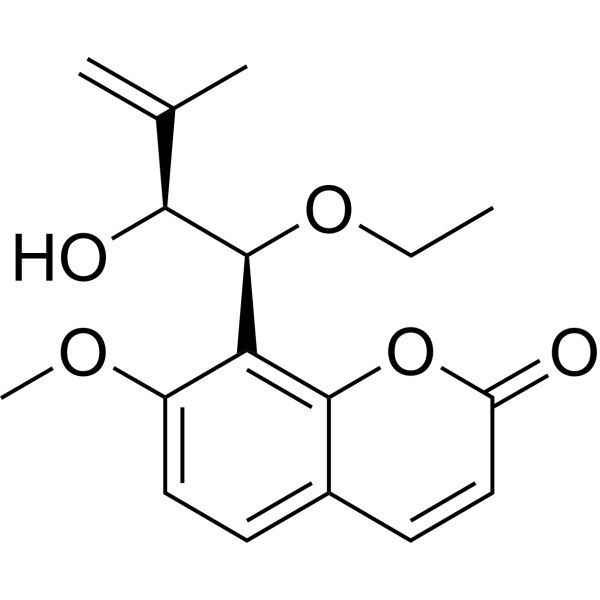
Murpanicin (murraxocin) is a coumarin that is a thermosensitive transient receptor potential vanilloid 2 (TRPV2) channel inhibitor. Murpanicin has significant anti-inflammatory and insecticidal effects.
loading...
    loading...
Cat. No.: HY-156829E
PLGA-PEG-PLGA (hydrogel) (LA:GA 7:1) (15% solution) is a biodegradable thermosensitive hydrogel product that can undergo phase transition at a specific temperature. PLGA-PEG-PLGA (hydrogel) (LA:GA 7:1) (15% solution) can be widely used in drug delivery systems, tissue engineering, wound dressings, and biosensors. The gelation temperature varies with concentration. The gelation temperature varies with the concentration; the higher the concentration, the lower the gelation temperature .
loading...
    loading...
Cat. No.: HY-179432
CAS No.: 2699950-81-5
Synonyms: CBDD
Cannabitwinol is a selective thermosensitive TRP modulator and NF-κB inhibitor. Cannabitwinol inhibits TNFα-induced NF-κB-driven transcription and TNFα-induced IL-8 release, and exhibits anti-inflammatory and antioxidant activities. Cannabitwinol shows selectivity for cold-activated TRP channels, activating TRPA1 (EC50 = 3.0 μM) and antagonizing TRPM8 (IC50 = 3.9 μM), but has no significant affinity for heat-activated TRP channels such as TRPV1 and TRPV2. Cannabitwinol can be used in research related to inflammatory skin diseases, cold allodynia, and hyperalgesia .
loading...
    loading...
Cat. No.: HY-D3144
CAS No.: 2713577-11-6
Target:  

Fluorescent Dye

Research Areas:  

Others

RhBIV is a thermosensitive rhodamine B (RhB)-derived fluorescent probe that fluorescently labels cellular mitochondria and detects mitochondrial temperature in vitro and in vivo. RhBIV contains a quaternized rhodamine B core, which confers a positive charge for binding to the negatively charged mitochondrial membrane, and an ortho-substituted electron-donating piperidine group; at lower temperatures, RhBIV forms an unstable ion pair form under kinetic control and exhibits strong fluorescence, whereas elevated temperature disrupts or partially interrupts the ion pair form, favoring formation of the conjugated RhBV form and leading to loss of fluorescence. RhBIV exhibits decreased fluorescence responsiveness with increasing temperature over the range of 20-42°C. RhBIV enables biological imaging of cells and mice, mitochondrial thermogenesis imaging, dynamic observation in mitochondrial thermogenesis imaging experiments, and non-invasive imaging of mitochondrial function in living animals (Ex/Em = 520/592 nm) .
loading...
    loading...
  • 1

