
1. Search Result
Search Result
Results for "

tissue section

" in MedChemExpress (MCE) Product Catalog:

21

Inhibitors & Agonists

11

Fluorescent Dyes

5

Biochemical Assay Reagents

7

MCE Kits

Cat. No. Product Name Target Research Areas Chemical Structure
  • HY-D0218
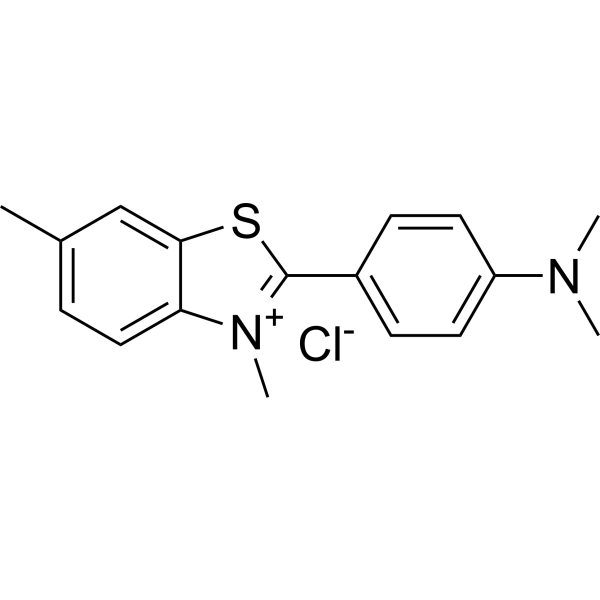
    Thioflavin T
    25+ Cited Publications

    Basic Yellow 1

    Amyloid-β Others
    Thioflavin T is a cationic Benzothiazole dye that shows enhanced fluorescence upon binding to amyloid in tissue sections. Excitation max.: ~385 nm (free); ~450 nm (bound); Emission max.: ~445 nm (free); ~485 nm (bound) .
    Thioflavin T
  • HY-D0236
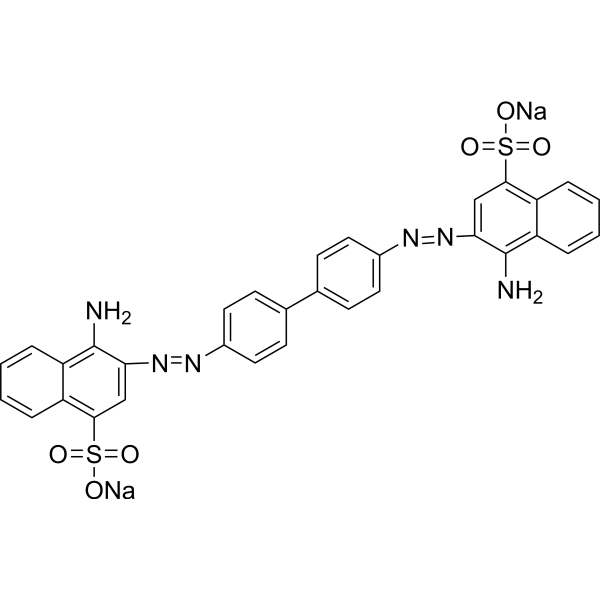
    Congo Red
    4 Publications Verification

    Fluorescent Dye Others
    Congo Red is an azo dye. Congo Red (CR) binding been used as a diagnostic test for the presence of amyloid in tissue sections.
    Congo Red
  • HY-118907

    Fluorescent Dye Others
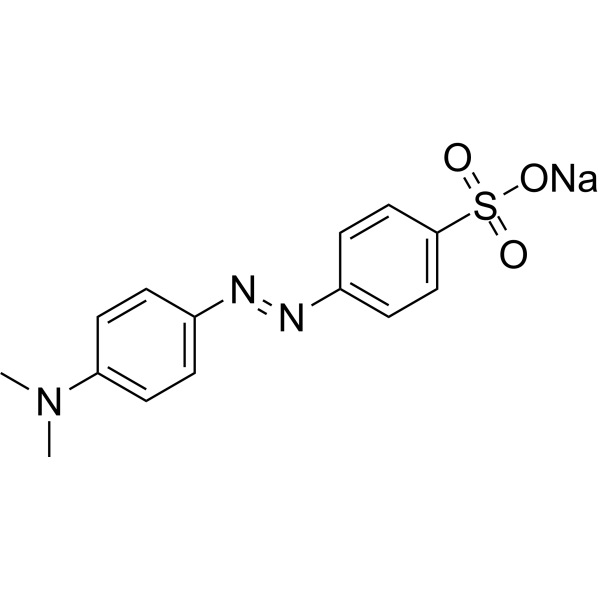
    Methyl Orange is a soluble azo dye commonly used as an acid-base indicator and for staining cells and tissue sections, as well as for dyeing textiles. Methyl Orange appears red at a pH of 3.1 and changes to bright yellow as the pH increases to 4.4. Methyl Orange (500 mg/L) exhibits cytotoxicity and can cause DNA damage .
    Methyl Orange
  • HY-W010341

    Biochemical Assay Reagents Others
    2-Pyridinecarbohydrazide is a versatile heterocyclic building block widely used in medicinal chemistry and coordination chemistry, and it finds extensive applications in various synthetic fields. 2-Pyridinecarbohydrazide reacts with the reducing end of carbohydrates to enhance mass spectrometry ionization efficiency, enabling isomer-specific identification of monosaccharides, disaccharides, ketoses/aldoses, and quantitative mass spectrometry imaging of biological tissues .
    2-Pyridinecarbohydrazide
  • HY-DY1049

    Amyloid-β Others
    Thioflavin T (solution) is a cationic Benzothiazole dye that shows enhanced fluorescence upon binding to amyloid in tissue sections. Excitation max.: ~385 nm (free) ; ~450 nm (bound) ; Emission max.: ~445 nm (free) ; ~485 nm (bound) .
    Solvent and Concentration: Sterile water: 10 mM
    The 1 mL volume is defined as the base specification. All larger sizes correspond to incremental volumes of this base.
    Thioflavin T (solution)
  • HY-DY3004

    Biochemical Assay Reagents Others
    Frozen Section Embedding Medium is a water-soluble mixture of polyethylene glycol and polyvinyl alcohol, widely used in immunohistochemistry experiments. Frozen Section Embedding Medium supports tissue during frozen sectioning, increasing tissue continuity and reducing wrinkling and fragmentation.
    Frozen Section Embedding Medium
  • HY-78035

    Methylmaleic anhydride

    Biochemical Assay Reagents Others
    Citraconic anhydride (Methylmaleic anhydride) is a derivative of maleic anhydride (HY-Z0060) and novel antigen retrieval solution. Citraconic anhydride reversibly blocks protein amino groups, stabilizing specific enzymes and improving their catalytic performance. Citraconic anhydride reacts with free amino groups on proteins (especially lysine residues), converting positively charged NH3 + into carboxyl groups, thereby disrupting methylene bridge crosslinks caused by Formaldehyde during antigen retrieval. Citraconic anhydride functionalizes Isotactic polypropylene. Citraconic anhydride precisely responds to pH changes to achieve reversible modification. Citraconic anhydride is irritating to skin and eyes .
    Citraconic anhydride
  • HY-W106322

    Biochemical Assay Reagents Others
    Methyl nadic anhydride is an epoxy resin embedding agent used for embedding biological tissue sections.
    Methyl nadic anhydride
  • HY-D1542

    Fluorescent Dye Cancer
    Mucicarmine is used in the histological visualization of acid mucopolysaccharides in tissue sections. Mucicarmine can identify mucin (deep rose), which is useful in determining the mucin positive cancer (such as liver carcinoma) .
    Mucicarmine
  • HY-D2344

    3-Benzothiazole-daphnetin

    Fluorescent Dye Others
    3-BTD (3-Benzothiazole-daphnetin) is a Catechol-O-methyltransferase (COMT) two-photon fluorescence probe. 3-BTD can also be used for biological imaging of endogenous COMT in living cells and tissue sections .
    3-BTD
  • HY-W250143

    Biochemical Assay Reagents Others
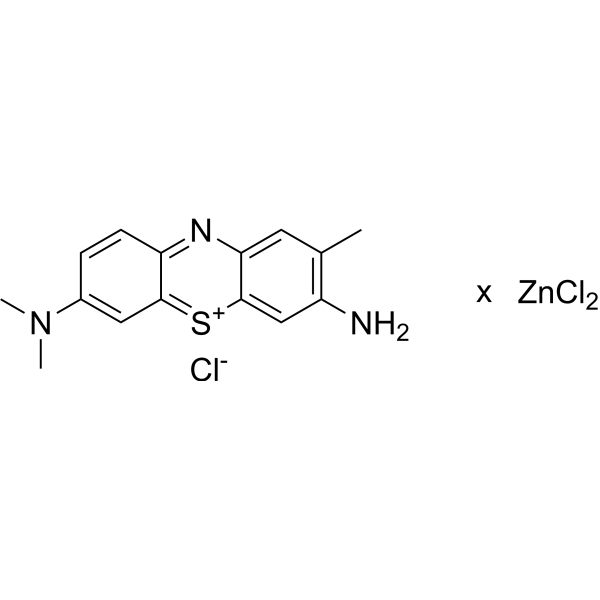
    Toluidine blue (ZnCl2) is a basic thiazine dye commonly used as a biological stain for microscopy. It has a deep bluish-purple color and is commonly used to stain nucleic acids such as DNA and RNA, as well as to stain mast cells, cartilage, and other connective tissues. Toluidine blue (ZnCl2) stains the acidic components of these tissues, such as sulfated or carboxylated mucopolysaccharides. It is frequently used in histology, cytology, and pathology applications to aid in the diagnosis of various diseases and conditions. The dye is usually applied to tissue sections prior to microscopic examination and can be differentiated using an acidic alcohol solution. Toluidine blue (ZnCl2) is a relatively simple and inexpensive stain with good reproducibility, making it a popular choice for many laboratories.
    Toluidine blue (ZnCl2)
  • HY-D0236R

    Fluorescent Dye Reference Standards Others
    Congo Red (Standard) is the analytical standard of Congo Red. This product is intended for research and analytical applications. Congo Red is an azo dye. Congo Red (CR) binding been used as a diagnostic test for the presence of amyloid in tissue sections.
    Congo Red (Standard)
  • HY-136675

    Fluorescent Dye Others
    ASMI is a ratiometric, two-photon excited fluorescent probe, composed of a highly two-photon active and biocompatible merocyanine fluorophore and an acrylate moiety as a thiol reactive site. ASMI is able to selectively detect and monitor mitochondrial Cys with rapid responsiveness, imaging living cells and intact tissues with high contrast and brightness at a depth of 150 μm. The two-photon action cross section (Φσmax) of ASMI is 65.2 GM, corresponding to an excitation wavelength (λex) of 740 nm.
    ASMI
  • HY-118907R

    Fluorescent Dye Reference Standards Others
    Methyl Orange (Standard) is the analytical standard of Methyl Orange. This product is intended for research and analytical applications. Methyl Orange is a soluble azo dye commonly used as an acid-base indicator and for staining cells and tissue sections, as well as for dyeing textiles. Methyl Orange appears red at a pH of 3.1 and changes to bright yellow as the pH increases to 4.4. Methyl Orange (500 mg/L) exhibits cytotoxicity and can cause DNA damage .
    Methyl Orange (Standard)
  • HY-D0992

    Peridinin-chlorophyll-protein complex

    Fluorescent Dye Cancer
    PerCP is a peridinin-chlorophyll protein complex derived from the dinoflagellate *Glenodinium*, suitable for immunofluorescence staining of formalin-fixed, paraffin-embedded human tumor sections. As a red fluorescent dye, PerCP enables clear differentiation between antibody-bound tumor regions and yellow-green autofluorescence of tissues. PerCP allows simultaneous observation of tissue morphology without counterstaining. PerCP can be used in cancer research (Ex/Em = 482/677 nm) .
    PerCP
  • HY-182593

    Biochemical Assay Reagents Others
    Arabic Gum Solution, 10%, is a thickener composed of gum arabic, deionized water, preservatives, etc., commonly used for mounting tissue sections.
    Arabic Gum Solution, 10%
  • HY-182593A

    Biochemical Assay Reagents Others
    Arabic Gum Solution, 25%, is a thickener composed of gum arabic, deionized water, preservatives, etc., commonly used for mounting tissue sections.
    Arabic Gum Solution, 25%
  • HY-182593B

    Biochemical Assay Reagents Others
    Arabic Gum Solution, 35%, is a thickener composed of gum arabic, deionized water, preservatives, etc., commonly used for mounting tissue sections.
    Arabic Gum Solution, 35%
  • HY-W713888

    Fluorescent Dye Others
    Aniline blue diammonium is a component of commonly used polychrome stains. Aniline blue diammonium is used to stain collagen fibers in tissue sections using Masson′s trichrome protocol for staining multiple components. Collagen is stained blue by this method. The dye is suitable for selective staining of callose in plant specimens and staining histones for assessing nuclear maturity. Aniline blue diammonium is used in Gomori′s one-step trichrome stain and Mallory′s connective tissue stain for tissue including kidney and intestine.
    Aniline blue diammonium
  • HY-D3430

    Fluorescent Dye Amyloid-β Neurological Disease
    PTPA-QM is a low-cytotoxicity protein probe that can be used for live-cell imaging and tissue section staining (Lys. Ex/Em = 385/615 nm). PTPA-QM can intercalate into the β-sheet layered structure of β-amyloid fibrils, form intermolecular interactions with amino acid residues, restrict intramolecular rotation and trigger fluorescence activation for imaging purposes. PTPA-QM is applicable to Alzheimer's disease-related research. Maximum excitation/emission wavelength: 448/605 nm .
    PTPA-QM
  • HY-W700204

    Dopamine Receptor Neurological Disease
    N-(p-Aminophenethyl) spiperone is a selective D2-like dopamine receptor antagonist. N-(p-Aminophenethyl) spiperone binds to the ligand recognition sites of functional D2 and D3 dopamine receptors. N-(p-Aminophenethyl) spiperone serves as a research tool compound for labeling, localizing and identifying D2 and D3 dopamine receptors .
    N-(p-Aminophenethyl)spiperone

Inquiry Online

Your information is safe with us. * Required Fields.

Salutation


Country or Region *

Applicant Name *


Organization Name *

Department *


Email Address *


Product Name *

Cat. No.


Requested quantity *

Phone Number *


Remarks

Inquiry Online

Inquiry Information

Product Name:
Cat. No.:
Quantity:
MCE Japan Authorized Agent:

