
9 Results for "

toxic metal ions

" in MedChemExpress (MCE) Product Catalog:
Products (9)

9 Results for "toxic metal ions" in MCE Product Catalog:

1
1 Cited Publications
Cat. No.: HY-W129633
CAS No.: 1266615-56-8
Synonyms: DCIP sodium hydrate; DPIP sodium hydrate
2,6-Dichlorophenolindophenol (DCIP; DPIP) sodium hydrate is a redox chromogenic indicator with a redox potential of +217 mV relative to SHE, and it acts as a substrate for reduction reactions. During the metabolic process of nutrient consumption by Saccharomyces cerevisiae, 2,6-Dichlorophenolindophenol sodium hydrate is reduced from dark blue to colorless, resulting in a decrease in absorbance. 2,6-Dichlorophenolindophenol sodium hydrate is widely used in spectrophotometric biochemical oxygen demand determination and preclinical colorimetric toxicity analysis for heavy metal ion detection based on Saccharomyces cerevisiae .
loading...
    loading...
Cat. No.: HY-W012683
CAS No.: 142-73-4
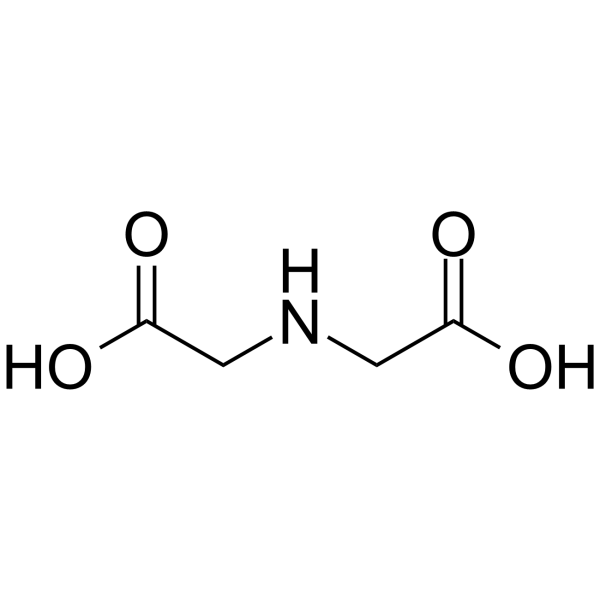
Iminodiacetic acid is a metal ion chelator targeting Cr 6+, Cd 2+, Ni 2+, and Pb 2+. Iminodiacetic acid selectively and irreversibly binds metal ions through the coordination of carboxyl and imino groups, reduces the toxicity of metal ions and promotes their adsorption and separation. Iminodiacetic acid has the functions of heavy metal ion removal and coordination complex stabilization. Iminodiacetic acid is often used in environmental pollution control (such as heavy metal adsorption in water) and coordination chemistry (such as metal ion detection and separation) research .
loading...
    loading...
Cat. No.: HY-W110793
CAS No.: 60-10-6
Synonyms: Diphenylthiocarbazone
Research Areas:  

Metabolic Disease

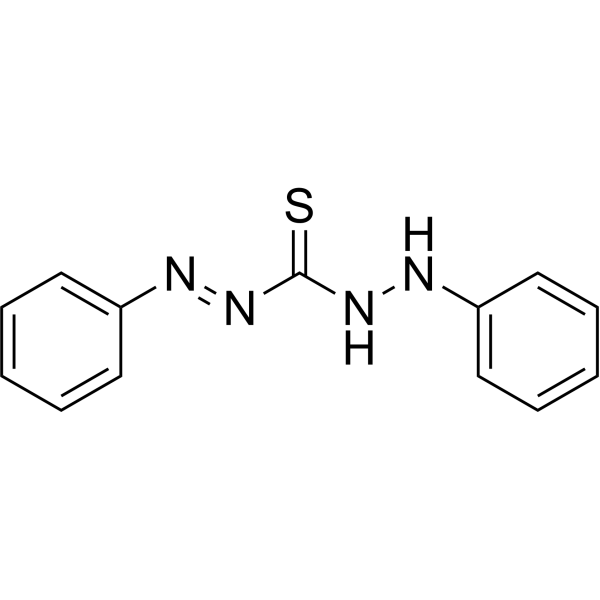
Dithizone can be toxic to pancreatic islet cells and cause experimental diabetes. Dithizone can be used for in vitro in vivo staining of transplanted islets and cytoplasmic granules of bone marrow cells. Dithizone can be used as a chelating agent and colorimetric indicator for the detection and extraction of various heavy metals, including lead and mercury, in analytical and biochemical applications. Dithizone forms stable colored complexes with metal ions and can be quantitatively analyzed by methods such as spectrophotometry .
loading...
    loading...
Cat. No.: HY-W133963
CAS No.: 9063-38-1
Carboxyl methylstarch sodium is an anionic polymer prepared by carboxymethylation of starch, with properties of stability, thickening ability and film-forming capacity . Carboxyl methylstarch sodium exhibits metal adsorption activity and can remove copper ions and cadmium ions from aqueous solutions. Carboxyl methylstarch sodium can serve as a hydrophilic shell component for AIE-active luminescent polymer nanoprobes to achieve high water dispersibility. Carboxyl methylstarch sodium can bind to vancomycin without altering the in vitro antibacterial activity of vancomycin. Carboxyl methylstarch sodium possesses biodegradable, non-toxic and environmentally friendly characteristics. Carboxyl methylstarch sodium can be applied to relevant researches in various fields such as food, medicine and industry .
loading...
    loading...
Cat. No.: HY-W008992
CAS No.: 207386-91-2
Synonyms: 8-Hydroxyquinoline sulfate hydrate
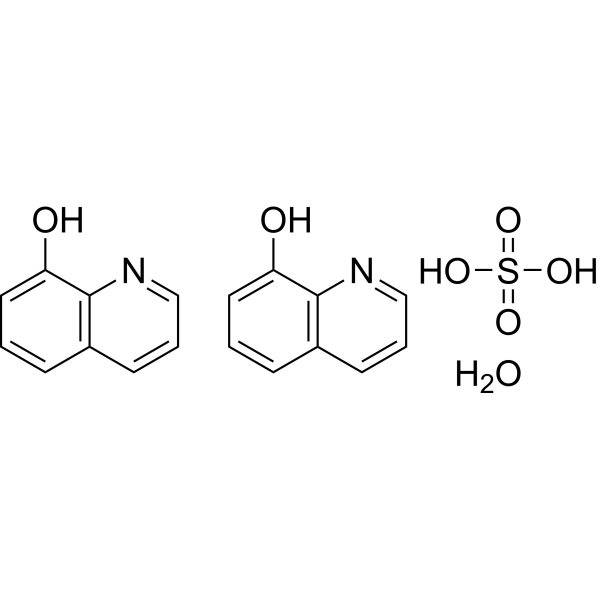
Quinolin-8-ol sulfate hydrate is an organic compound commonly used in dyes and as a raw material for chemical analysis. It can cooperate with metal ions to form dyes, and is widely used in the fields of dyes, printing and textile manufacturing. In addition, the compound also has good toxicity and biocompatibility, and is also used in some medical fields.
loading...
    loading...
Cat. No.: HY-W012683R
CAS No.: 142-73-4
Iminodiacetic acid is a metal ion chelator targeting Cr6+, Cd2+, Ni2+, and Pb2+. Iminodiacetic acid selectively and irreversibly binds metal ions through the coordination of carboxyl and imino groups, reduces the toxicity of metal ions and promotes their adsorption and separation. Iminodiacetic acid has the functions of heavy metal ion removal and coordination complex stabilization. Iminodiacetic acid is often used in environmental pollution control (such as heavy metal adsorption in water) and coordination chemistry (such as metal ion detection and separation) research .
loading...
    loading...
Cat. No.: HY-156939
CAS No.: 65229-17-6
Research Areas:  

Cancer

ZnDTPA is an orally effective chelating agent, which belongs to the class of amino carboxylic acid chelating agents and is mainly used to form stable complexes with metal ions. DTPA (diethylenetriaminepentaacetic acid) itself is a polydentate ligand that can form stable cyclic or chain-like complexes with a variety of metal ions. ZnDTPA can be used to reduce the long-term toxicity of 239Pu to rats and reduce the incidence of osteosarcoma, breast cancer, etc. in rats .
loading...
    loading...
Cat. No.: HY-W722245
CAS No.: 79236-62-7
Pyochelin is a salicylate-based nonribosomal peptide siderophore produced by Pseudomonas aeruginosa. Pyochelin chelates Fe 3+ and transports it back into bacterial cells, providing the iron essential for bacterial survival. Pyochelin can also chelate other metals such as Zn 2+, Co 2+, and Ni 2+, which helps bacteria maintain intracellular metal ion homeostasis by chelating and excreting excess metals in response to toxic metal stress. Pyochelin can be used in studies related to Pseudomonas aeruginosa infection .
loading...
    loading...
Cat. No.: HY-W783351
CAS No.: 1416808-87-1
Synonyms: Coppersensor 790 acetoxymethyl ester
Target:  

Fluorescent Dye

Research Areas:  

Metabolic Disease

CS790AM (Coppersensor 790 acetoxymethyl ester) is a cell-permeable, Cu +-targeted near-infrared fluorescent probe (λabs=760 nm, λem=790 nm) applicable to live cells. CS790AM can cross lipophilic cell membranes, and is converted into negatively charged CS790 under the action of intracellular esterases to be retained, thus enabling highly sensitive, reversible "turn-on" detection of labile Cu + pools in live cells and mice. CS790AM possesses excellent biocompatibility and selectivity, avoids interference from other metal ions, shows no obvious toxicity, and can be rapidly cleared. CS790AM allows long-term longitudinal monitoring of individual mice, visualizes copper levels in internal organs and isolated livers, and effectively evaluates abnormal copper accumulation in Wilson's disease models (Atp7b -/-) as well as dynamic changes after chelator treatment. CS790AM can be used for research on Wilson's disease and related copper metabolic disorders .
loading...
    loading...

