18 Results for "

trypanosome inhibitor

" in MedChemExpress (MCE) Product Catalog:
Products (18)

18 Results for "trypanosome inhibitor" in MCE Product Catalog:

6
6 Cited Publications
Cat. No.: HY-B0670A
CAS No.: 6190-39-2
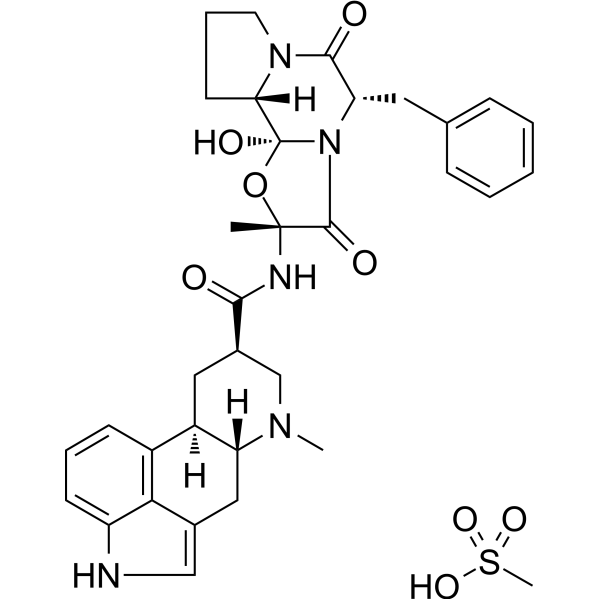
Dihydroergotamine mesylate is a blood-brain barrier-permeable semi-synthetic ergot alkaloid, acting as a full agonist of 5-HT1B/1D receptors (Ki values of 0.3 nM and 2.5 nM, respectively; functional IC50 values of 2 nM and 2.2 nM, respectively). Dihydroergotamine mesylate inhibits Forskolin (HY-15371)-stimulated cAMP accumulation, possesses α-adrenergic receptor antagonistic activity and weak dopaminergic agonistic activity. It mediates intracranial cerebrovascular contraction, inhibits the release of neuropeptides such as CGRP/substance P, and suppresses neurogenic inflammation by activating 5-HT1B/1D receptors in the trigeminovascular system. Dihydroergotamine mesylate binds to the catalytic site of Trypanosoma cruzi trypanothione reductase and exhibits trypanocidal activity in vitro. Dihydroergotamine mesylate can be used in studies related to migraine and trypanosome infections .
loading...
    loading...
Cat. No.: HY-N125722
CAS No.: 33538-71-5
Synonyms: Aabomycin A1
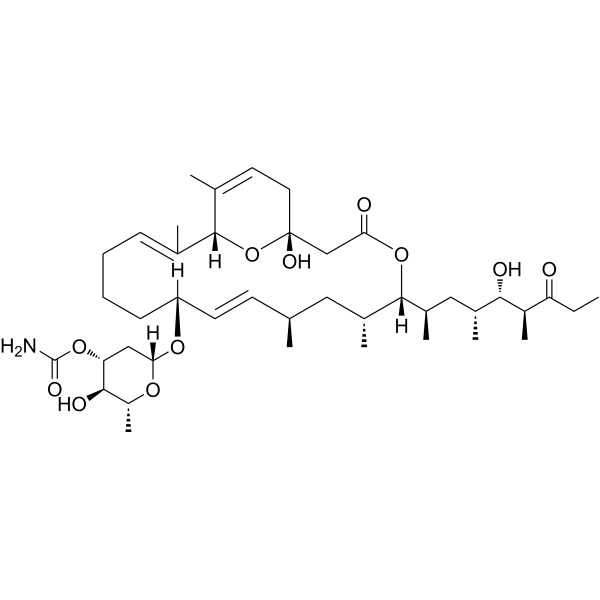
Venturicidin A (Aabomycin A1) is a natural product derived from Streptomyces, possessing antifungal, anti-Trypanosoma brucei, anti-Leishmania donovani, and ATP synthase inhibitory activities. Venturicidin A acts as an antibiotic adjuvant, promoting the uptake of aminoglycoside antibiotics and enhancing bactericidal efficacy. Venturicidin A inhibits ATP synthesis by blocking proton translocation through the FO subunit. In bloodstream-form Trypanosoma brucei, Venturicidin A causes collapse of the mitochondrial membrane potential; in fungi, it disrupts cell membrane integrity, induces leakage of cytoplasmic contents, elevates ROS levels, and downregulates the expression of fungal pathogenicity-related genes. Venturicidin A exhibits antifungal activity against Botrytis cinerea. Venturicidin A is used in research on bacterial infections, trypanosome/leishmania infections, and gray mold disease .
loading...
    loading...
Cat. No.: HY-169932
CAS No.: 2956781-84-1
Target:  

Apolipoprotein

Research Areas:  

Infection

APOL1-IN-2 (Compound 467) is the inhibitor for Apolipoprotein 1 (APOL1). APOL1-IN-2 reduces the APOL1 G2/G1 induced cell death in HEK293 with EC50 of 4.74 nM and 14.3 nM. APOL1-IN-2 reduces the APOL1 G2/G1/G0 induced death of trypanosomes with EC50 of 2.24, 6.03 and 3.72 nM, respectively .
loading...
    loading...
Cat. No.: HY-155531
CAS No.: 3052256-03-5
Research Areas:  

Infection

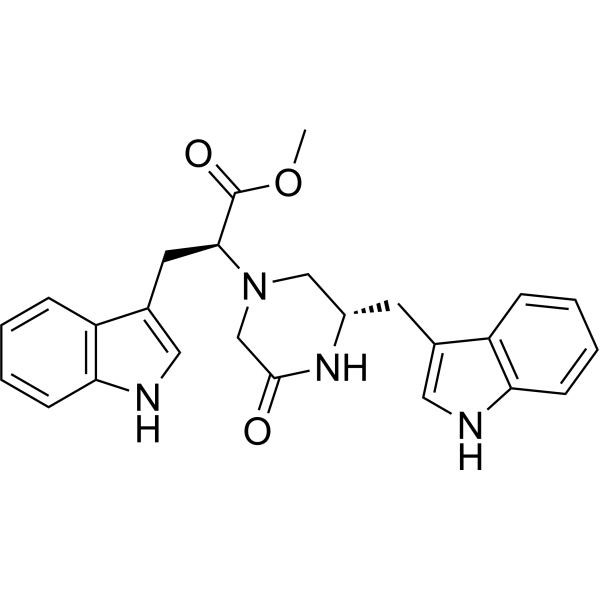
PEX5-PEX14 PPI-IN-2 (compound 12) is a PEX14-PEX5 protein-protein interaction (PPI) inhibitor. PEX5-PEX14 PPI-IN-2 inhibits PEX14-PEX5 PPI with EC50 values of 5 and 17 µM in T. b. brucei and HepG2 cells, respectively. PEX5-PEX14 PPI-IN-2 can be used in the research of diseases related to trypanosome infection .
loading...
    loading...
Cat. No.: HY-W342283
CAS No.: 536-71-0
Diminazene is an antiparasitic agent widely used to treat parasitic diseases caused by hemoparasites (such as trypanosomes and babesia). Diminazene acts as an ACE2 activator and exerts cardiovascular protective effects by activating the ACE2/Ang-(1-7)/Mas receptor axis. By regulating gut microbiota-tryptophan metabolism, Diminazene inhibits the activation of core inflammatory signaling pathways including MAPK, STAT and NF-κB, increases central 5-HT levels, and suppresses splenic TNF-α production, thereby alleviating systemic inflammation .
loading...
    loading...
Cat. No.: HY-112905
CAS No.: 2152662-85-4
Target:  

Parasite mRNA

Research Areas:  

Infection

AN11736 is a CPSF3 inhibitor. AN11736 exerts a potent anti-trypsin effect by specifically inhibiting the activity of the trypanosome CPSF3 endonuclease, disrupting the mRNA maturation process. AN11736 exhibits IC50s against T. congolense and T. vivax of 0.14 and 1.3 nM, respectively. AN11736 exhibits strong anti-trypsin activity in mouse and cattle models .
loading...
    loading...
Cat. No.: HY-B0670
CAS No.: 511-12-6
Synonyms: DFN-19
Dihydroergotamine (DFN-19) is a blood-brain barrier-permeable semi-synthetic ergot alkaloid, acting as a full agonist of 5-HT1B/1D receptors (Ki values of 0.3 nM and 2.5 nM, respectively; functional IC50 values of 2 nM and 2.2 nM, respectively). Dihydroergotamine inhibits Forskolin (HY-15371)-stimulated cAMP accumulation, possesses α-adrenergic receptor antagonistic activity and weak dopaminergic agonistic activity. It mediates intracranial cerebrovascular contraction, inhibits the release of neuropeptides such as CGRP/substance P, and suppresses neurogenic inflammation by activating 5-HT1B/1D receptors in the trigeminovascular system. Dihydroergotamine binds to the catalytic site of Trypanosoma cruzi trypanothione reductase and exhibits trypanocidal activity in vitro. Dihydroergotamine can be used in studies related to migraine and trypanosome infections .
loading...
    loading...
Cat. No.: HY-176253
CAS No.: 2601665-22-7
Target:  

Parasite

Research Areas:  

Infection

Antitrypanosomal agent 26 (Compound 1) is an allosteric trypanosome alternative oxidase (TAO) inhibitor. Antitrypanosomal agent 26 exhibits potent activity against African animal trypanosomes (e.g., Trypanosoma brucei, etc.) with an IC50 value of 1.3 nM for recombinant TAO. Antitrypanosomal agent 26 blocks the mitochondrial electron transport chain of trypanosomes and inhibits glucose-dependent respiration. Antitrypanosomal agent 26 is promising for research of African animal trypanosomiasis, such as bovine trypanosomiasis .
loading...
    loading...
Cat. No.: HY-178064
Research Areas:  

Infection

Antiparasitic agent-29 (Compound 5) is a Trypanosome alternative oxidase (TAO) inhibitor with an IC50 of 1.3 nM in Trypanosoma brucei. Antiparasitic agent-29 has a broad-spectrum antiparasitic activity against Trypanosoma and Leishmania spp. Antiparasitic agent-29 accumulates in parasite mitochondria, selectively disrupting its energy metabolism and has potent membrane-perturbing activity with no cross-resistance. Antiparasitic agent-29 shows low ecotoxicity in zebrafish and Daphnia magna models. Antiparasitic agent-29 can be used for parasitic diseases like surra and dourine research .
loading...
    loading...
Cat. No.: HY-184074
CAS No.: 2152662-88-7
Target:  

Parasite

Research Areas:  

Infection

Enfiborole is an oxaborolane ester inhibitor with trypanocidal activity against parasites. Enfiborole displays IC50 values ≤ 20 nM against Trypanosoma brucei and Trypanosoma cruzi, and its IC50 against replicating trypanosomes ranges from 21 to 999 nM. Enfiborole inhibits the growth of Trypanosoma brucei, suppresses hypoxanthine incorporation in replicating trypanosomes, and inhibits the growth of Trypanosoma cruzi amastigotes. Enfiborole can be used in studies related to trypanosome infections .
loading...
    loading...
Cat. No.: HY-114734
CAS No.: 2095-21-8
Target:  

Parasite

Research Areas:  

Infection

Didesmethylpromazine (Compound 18) is a trypanothione reductase inhibitor with an I50of 1412  μM against T. cruzi trypanothione reductase. Didesmethylpromazine can be used in the research of trypanosome and leishmania infections .
loading...
    loading...
Cat. No.: HY-178326
Target:  

Parasite

Research Areas:  

Infection

NEU-5123 is a human kinase inhibitor with potent inhibitory activity to several kinases. NEU-5123 is a Trypanosome proliferation inhibitor. NEU-5123 can be used for the research of infection .
loading...
    loading...
Cat. No.: HY-180418
CAS No.: 602-52-8
Target:  

Parasite

Research Areas:  

Infection

Homidium chloride is a potent antiparasitic agent exhibiting activity against Trypanosoma rhodesiense and Trypanosoma congolense. Homidium chloride can reduce parasitaemia in murine models of infection. Homidium chloride can be used for trypanosomiasis research .
loading...
    loading...
Cat. No.: HY-125188
CAS No.: 2306305-57-5
Research Areas:  

Infection

NEU-4438 is an antimalarial agent. NEU-4438 inhibits DNA synthesis, reduces AMPK-γ, and increases Clathrin heavy chain. NEU-4438 exhibits antiparasitic activity against Trypanosoma brucei. NEU-4438 reduces trypanosome tissue burden in a chronic HAT mouse model .
loading...
    loading...
Cat. No.: HY-180158
CAS No.: 2413738-47-1
Research Areas:  

Infection Cancer

Antitrypanosomal agent 28 (Compound 2a) is a trypanocidal agent. Antitrypanosomal agent 28 effectively inhibits Trypanosoma cruzi by inducing the generation of ROS and mitochondrial damage, with an IC₅₀ of 49.4 μM. Antitrypanosomal agent 28 exhibits broad-spectrum anti-tumor activity against various tumor cell lines, especially being sensitive to leukemia, colon cancer, and breast cancer. Antitrypanosomal agent 28 can be used for research on anti-cancer and anti-trypanosome activities .
loading...
    loading...
Cat. No.: HY-187603
CAS No.: 211816-91-0
Target:  

Parasite

Research Areas:  

Infection

CGP 40215 is an S-adenosylmethionine decarboxylase inhibitor with an IC50 of 20.3 μM against Trypanosoma brucei brucei AdoMet decarboxylase. CGP 40215 blocks spermidine production and leads to putrescine accumulation. CGP 40215 inhibits polyamine biosynthesis in intact trypanosomes, acts synergistically with the ornithine decarboxylase inhibitor DFMO (HY-B0744) against CNS model infections, and ameliorates laboratory infections caused by multiple Trypanosoma brucei subspecies and Trypanosoma congolense isolates, including strains tolerant to standard trypanocides. CGP 40215 can be used for research on African trypanosomiasis and Chagas disease .
loading...
    loading...
Cat. No.: HY-183242
CAS No.: 120154-96-3
Target:  

Bacterial Parasite

Research Areas:  

Infection Neurological Disease Cancer

Eilatin is a seven-ring pyridoacridine marine alkaloid with anticancer, antibacterial, and antiparasitic activities. Eilatin acts as a DNA intercalator with selectivity for electron-deficient polycyclic purines; it can chelate Ni 2+ ions and cleave DNA via hydroxyl radical generation. Eilatin induces the SOS response in bacteria, inhibits cancer cell proliferation, and induces cancer cell differentiation and reversion of transformation. The IC50 of Eilatin against Trypanosoma brucei brucei is 1.33 μM. Eilatin can be used in research related to colon tumors, neuroblastoma, chronic myeloid leukemia, acute myeloid leukemia, and trypanosome infections .
loading...
    loading...
Cat. No.: HY-B0670S
Dihydroergotamine-d3 is the d3-labeled Dihydroergotamine (HY-B0670). Dihydroergotamine (DFN-19) is a blood-brain barrier-permeable semi-synthetic ergot alkaloid, acting as a full agonist of 5-HT1B/1D receptors (Ki values of 0.3 nM and 2.5 nM, respectively; functional IC50 values of 2 nM and 2.2 nM, respectively). Dihydroergotamine inhibits Forskolin (HY-15371)-stimulated cAMP accumulation, possesses α-adrenergic receptor antagonistic activity and weak dopaminergic agonistic activity. It mediates intracranial cerebrovascular contraction, inhibits the release of neuropeptides such as CGRP/substance P, and suppresses neurogenic inflammation by activating 5-HT1B/1D receptors in the trigeminovascular system. Dihydroergotamine binds to the catalytic site of Trypanosoma cruzi trypanothione reductase and exhibits trypanocidal activity in vitro. Dihydroergotamine can be used in studies related to migraine and trypanosome infections .
loading...
    loading...
  • 1

