



Sissotrin

Based on 1 Customer Validation
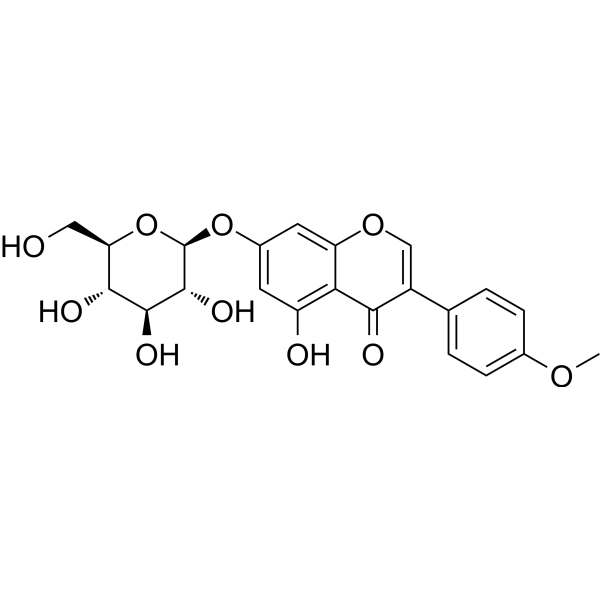
Sissotrin (Biochanin A 7-glucoside; Sissonin) is an orally active isoflavone glycoside natural product found in Leguminosae plants, with weak antibacterial activity. Sissotrin exacerbates the increase in blood glucose after glucose loading. Sissotrin is used in studies related to glucose metabolism.
Nur für Forschungszwecke. Wir verkaufen nicht an Patienten.
- Reinheit : 98.46%
- CAS. Nr.: 5928-26-7
- Formel: C22H22O10
- Molecular Weight:446.40
-
Speicherung:
4°C, protect from light
* In solvent : -80°C, 6 months; -20°C, 1 month (protect from light)

To place orders, for customer services and technical support, please contact: MedChemExpress USA
Tel: 609-228-6898 E-mail: [email protected] [email protected]


-
 Biologische Aktivität
-
Chemical Information
- Protokoll
- Reinheit & Dokumentation
- Verweise
-
 Help & FAQs


Alle Endogenous Metabolite Isoform-spezifische Produkte anzeigen
More

Biologische Aktivität
Beschreibung
In Vitro
Sissotrin (compound 1) (1-1000 μM; 10 min) fails to protect HUVEC against H2O2-induced oxidative damage [1].
Sissotrin (compound 1) (500-3.906 μg/mL; 24 h) exhibits weak antibacterial activity against Shigella flexneri CPC (MIC = 250 μg/mL) and Shigella flexneri NR 518 (MIC = 500 μg/mL), but shows no activity against Staphylococcus aureus ATCC 43300, Methicillin-resistant (HY-121544) Staphylococcus aureus 33591, Escherichia coli ATCC 25922, and Staphylococcus aureus CPC[3].
Sissotrin is an isoflavone glucoside obtained via microbial glycosylation of Biochanin A (HY-14595)[4].
MedChemExpress (MCE) has not independently confirmed the accuracy of these methods. They are for reference only. Further protocols information, click here.
-
Cell Line:HUVEC
-
Concentration:1, 3, 10, 30, 100, 300, 1000 μM
-
Incubation Time:10 min (pre-incubation)
4 h (H2O2 challenge) -
Result:Did not prevent cellular damage induced by H2O2.
Did not show toxicity to the cells at concentrations up to 1 mM.
In Vivo
MedChemExpress (MCE) has not independently confirmed the accuracy of these methods. They are for reference only.
-
Animal Model:Wistar (Male, 140-170 g)[2]
-
Dosage:50, 100 mg/kg
-
Administration:p.o.; single administration 10 min prior to glucose load
-
Result:Caused a significant rise in blood glucose levels at 15, 30 and 60 min after the glucose load.
At 30 min after the glucose load, blood glucose was 172 mg/dL for 100 mg/kg versus 144 mg/dL for control.
Produced 133 mg/dL at 50 mg/kg.
The hyperglycaemic effect observed at 100 mg/kg was abolished at the lower dose of 50 mg/kg.


Chemical Information
-
CAS. Nr. 5928-26-7
-
Appearance Solid
-
Molecular Weight 446.40
-
Formel C22H22O10
-
Color White to off-white
-
SMILES
O=C1C(C2=CC=C(OC)C=C2)=COC3=CC(O[C@H]4[C@@H]([C@H]([C@@H]([C@@H](CO)O4)O)O)O)=CC(O)=C13
-
Synonyms
Biochanin A 7-glucoside; Sissonin
-
Structure Classification
-
Initial Source
-
Versand
Room temperature in continental US; may vary elsewhere.
-
Speicherung
4°C, protect from light
* In solvent : -80°C, 6 months; -20°C, 1 month (protect from light)

Protokoll
-
Research Protocol for Infectious Diseases
Infectious-disease experiments test how pathogens interact with host barriers, innate immune receptors, inflammatory signaling, pathogen replication, and tissue injury; pattern-recognition receptors such as TLRs, RIG-I-like receptors, NOD-like receptors, and inflammasomes detect microbial molecules and activate NF-κB, interferon, and cytokine responses. The central hypothesis is that infection severity reflects the balance between pathogen burden and host response: protective inflammation restricts pathogen growth, whereas excessive or mislocalized inflammation contributes to tissue damage and disease phenotype. Unresolved questions include which host pathways are protective versus pathogenic, why some infection models fail to translate to human disease, and which combined readouts best predict clinically relevant infection outcomes.
-
Bacterial live/dead nucleic-acid viability staining
The LIVE/DEAD bacterial viability staining method is based on differential permeability of nucleic-acid-binding fluorescent dyes, most commonly SYTO 9 and propidium iodide (PI), which enables discrimination of bacterial populations with intact versus compromised cytoplasmic membranes. SYTO 9 penetrates both intact and damaged bacterial membranes and binds nucleic acids to produce green fluorescence, whereas propidium iodide penetrates only cells with compromised membranes and fluoresces red while also reducing SYTO 9 signal through competitive binding and fluorescence interactions. The resulting fluorescence pattern is interpreted as a proxy for membrane integrity, which is widely used as an indicator of bacterial viability in microscopy, flow cytometry, and spectroscopic platforms. However, mechanistic studies show that SYTO 9 and PI interactions involve displacement and fluorescence resonance energy transfer effects, which can influence signal interpretation depending on dye ratios a


Reinheit & Dokumentation
-
Data Sheet (281 KB)
-
SDS (394 KB)
- English - EN (394 KB)
- Français - FR (394 KB)
- Deutsch - DE (394 KB)
- Norwegian - NO (394 KB)
- Español - ES (394 KB)
- Swedish - SV (394 KB)
- Italian - IT (394 KB)
- Korean - KR (394 KB)
- Portuguese - PT (394 KB)
-
Handling Instructions (2659 KB)
Verweise

Calculators
Konzentration (Stammlösung) × Volumen (Stammlösung) = Konzentration (Ziellösung) × Volumen (Ziellösung)


Sissotrin Related Classifications
HY-N1240 Related Classifications
 Powered by Bioz
Keywords
- Sissotrin
- 5928-26-7
- Biochanin A 7-glucoside
- Sissonin
- Bacterial
- Endogenous Metabolite
- Drug Derivative
- endothelial cells
- Escherichia coli
- HUVEC
- Shighella flexineri
- Absidia glauca
- Pterospartum tridentatum
- Trifolium baccarinii
- Staphylococcus aureus
- Methicillin-resistant Staphylococcus aureus
- red clover
- Inhibitor
- inhibitor
- inhibit