



Sodium aescinate
Based on 3 publication(s) in Google Scholar
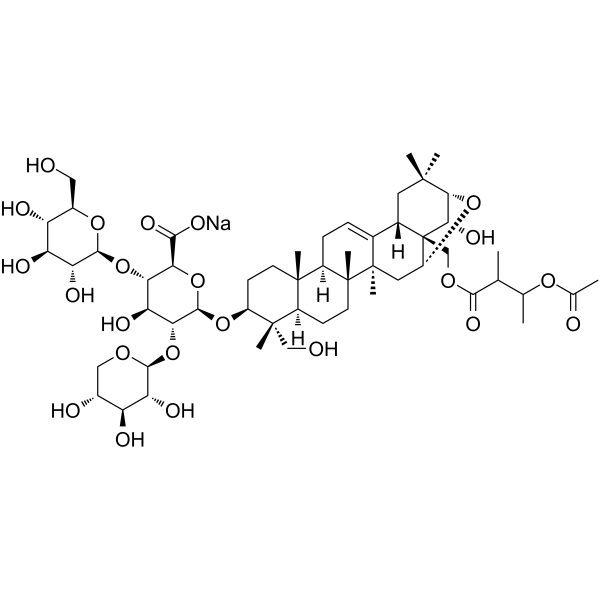
Sodium aescinate is a triterpene saponin derived from Aesculus hippocastanum seeds, with anti-inflammatory and antioxidant activities. Sodium aescinate inhibits hepatocellular carcinoma growth by targeting CARMA3/NF-κB pathway.
商品は「研究用試薬」です。人や動物の医療用・臨床診断用・食品用の製品ではありません。
研究用途以外に使用した場合、当社は一切の責任を負いかねます。
- 純度 : 99.26%
- CAS 番号: 20977-05-3
- 分子式: C54H83NaO23
- 分子量:1123.21
-
保管条件:
4°C, sealed storage, away from moisture and light
* In solvent : -80°C, 6 months; -20°C, 1 month (sealed storage, away from moisture and light)

To place orders, for customer services and technical support, please contact: MedChemExpress USA
Tel: 609-228-6898 E-mail: [email protected] [email protected]


-
 生物活性
生物活性
-
化学情報
-
溶剤 & 溶解度
- プロトコル
- 純度とドキュメンテーション
- 参考文献
-
 Help & FAQs


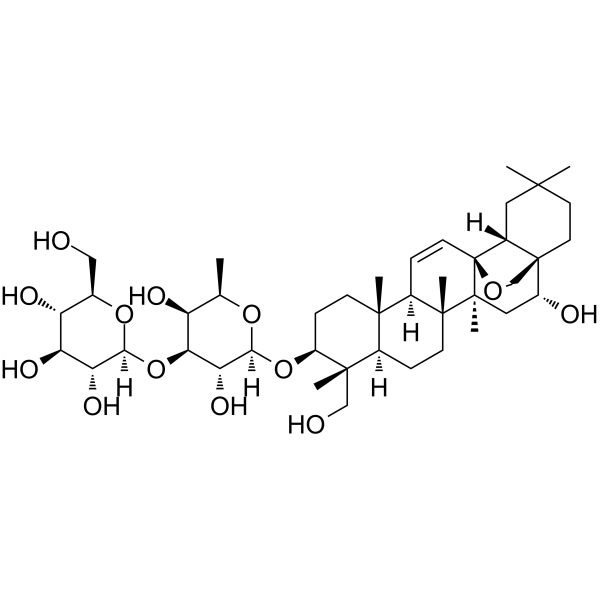
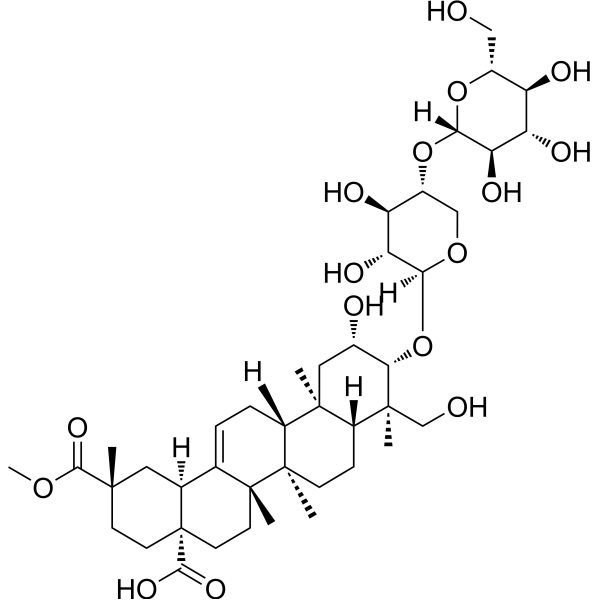
MedChemExpress(MCE)の使用を引用している文献 Sodium aescinate
More Customer Validation & Images

-
Cell Proliferation/Viability Assay
-
IF
-
WB
-
Flow Cytometry


生物活性
製品説明
体外実験
Sodium aescinate can block signals transiting to downstream molecules AKT, ERK, inhibit the proliferation of breast cancer cell MCF-7 cell apoptosis and induced cell apoptosis by suppressing the activation of SRC[3].
MedChemExpress (MCE) has not independently confirmed the accuracy of these methods. They are for reference only.
体内実験
? Sodium aescinate treatment can alleviate the symptom of polycystic ovary syndrome (PCOS) in rat model through regulating the PI3K/Akt/GSK3-β pathway[4].
MedChemExpress (MCE) has not independently confirmed the accuracy of these methods. They are for reference only.
臨床実験
| NCT Number | Sponsor | Condition | Start Date |
Phase

|
|---|---|---|---|---|
| NCT01329991 | 2011-05 | PHASE1 |


化学情報
-
CAS 番号 20977-05-3
-
性状 Solid
-
分子量 1123.21
-
分子式 C54H83NaO23
-
Color White to off-white
-
SMILES
CC(C(OC[C@@]12[C@H]3C[C@]4(C)C([C@]1([H])CC(C)(C)[C@H](O3)[C@@H]2O)=CC[C@@]5([H])[C@@]4(C)CC[C@]6([H])[C@]5(C)CC[C@H](O[C@@H]7O[C@H](C(O[Na])=O)[C@@H](O[C@@H]8O[C@H](CO)[C@@H](O)[C@H](O)[C@H]8O)[C@H](O)[C@H]7O[C@@H]9OC[C@@H](O)[C@H](O)[C@H]9O)[C@]6(CO)C)=O)C(OC(C)=O)C
-
Structure Classification
-
Initial Source
-
輸送条件
Room temperature in continental US; may vary elsewhere.
-
保管条件
4°C, sealed storage, away from moisture and light
* In solvent : -80°C, 6 months; -20°C, 1 month (sealed storage, away from moisture and light)


Publications (3)
-
Journal Impact Factor
-
Most Recent
-
Cell Biochem Funct
Synergistic Induction of Apoptosis by Apocytochrome C and Sodium Aescinate Is Mediated by Excessive Autophagy via the AKT-mTOR-TFEB Signaling Axis. [Abstract]2026 Apr;44(4):e70214. PMID: 42046264
Sodium aescinate purchased from MedChemExpress. Usage Cited in: Cell Biochem Funct. 2026 Apr;44(4):e70214. [Abstract]
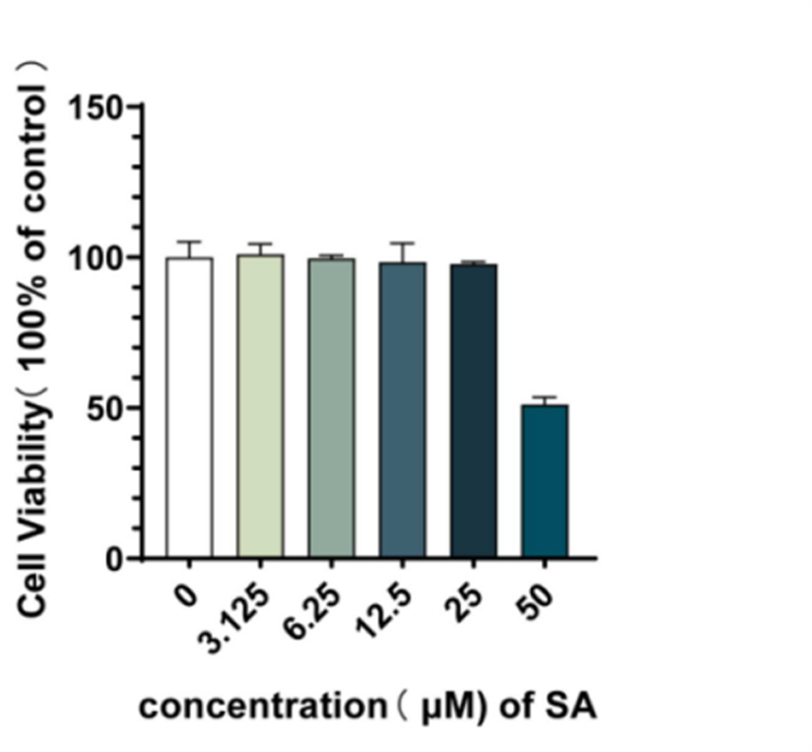
The cytotoxicity of different concentrations (0–50 μM) of Sodium aescinate (SA) on HeLa cells was detected by MTT assay.
Sodium aescinate purchased from MedChemExpress. Usage Cited in: Cell Biochem Funct. 2026 Apr;44(4):e70214. [Abstract]
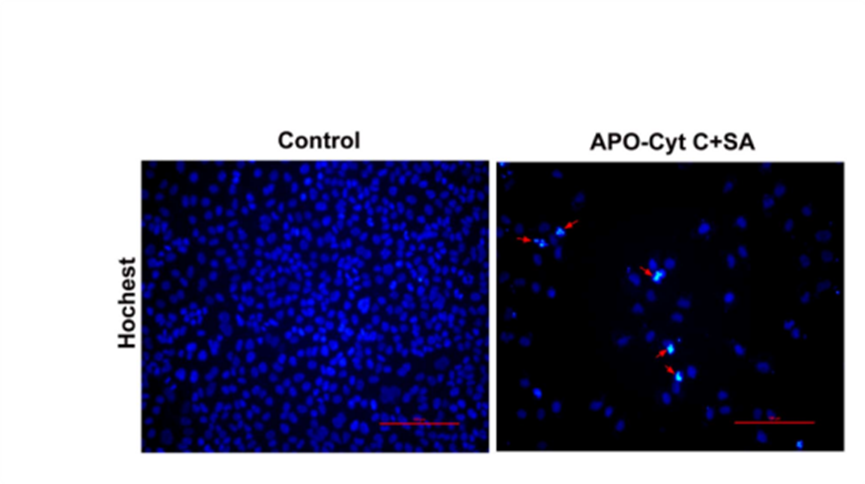
HeLa cells were incubated with APO‐Cyt C (1 μM) and Sodium aescinate (SA) (25 μM) for 24 h, and the cell nuclei were stained with Hoechst 33342 to observe the morphological changes.
Sodium aescinate purchased from MedChemExpress. Usage Cited in: Cell Biochem Funct. 2026 Apr;44(4):e70214. [Abstract]
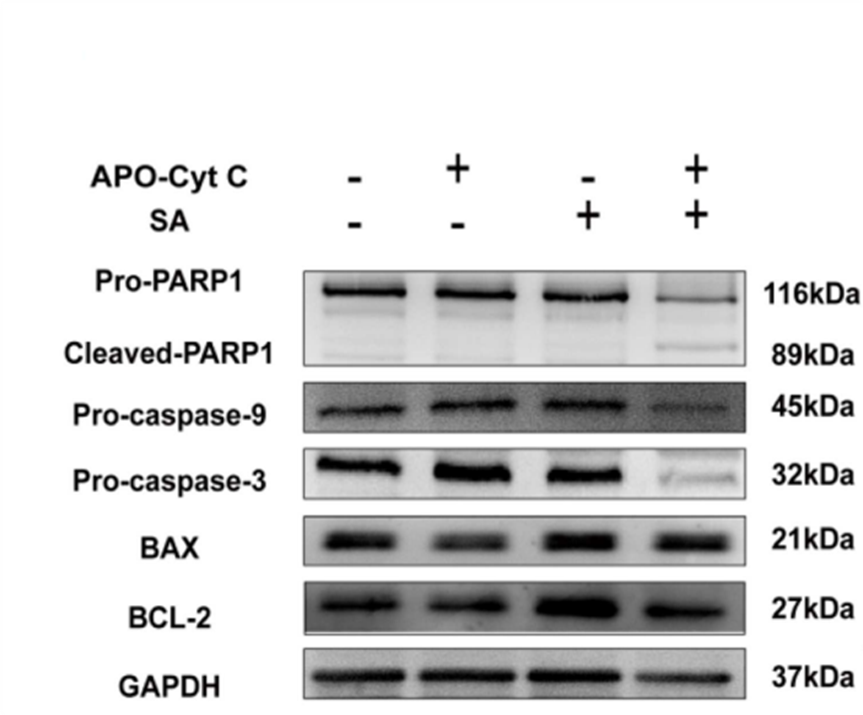
Effects of incubation with APO‐Cyt C and Sodium aescinate (SA) alone or in combination on the levels of apoptosis‐related proteins. After incubation with specific concentrations of APO‐Cyt C and SA alone or in combination for 24 h, the treated cells were collected for Western Blotting analysis of key proteins related to the apoptosis pathway.
Sodium aescinate purchased from MedChemExpress. Usage Cited in: Cell Biochem Funct. 2026 Apr;44(4):e70214. [Abstract]
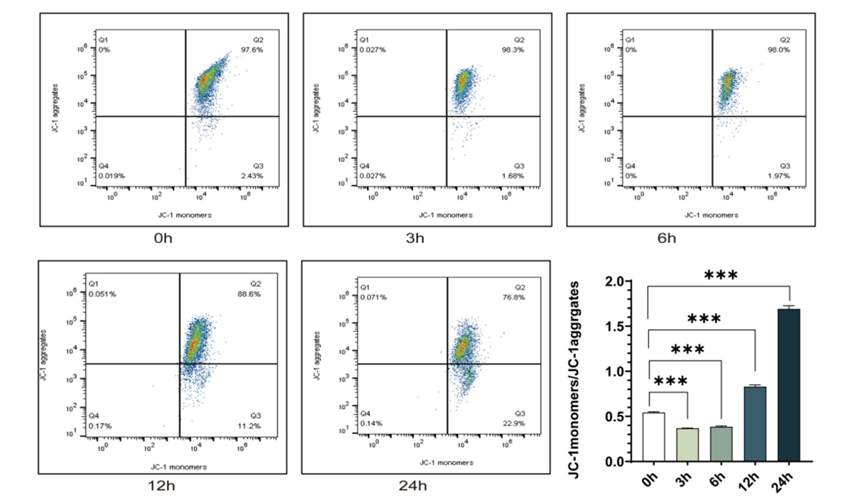
Membrane integrity was observed by mitochondrial membrane potential detection: HeLa cells were incubated with APO‐Cyt C (1 μM) and Sodium aescinate (SA) (25 μM) for different time periods (0, 3, 6, 12, and 24 h), and flow cytometry was used to detect changes in mitochondrial membrane potential.
-
Biochem Biophys Res Commun
Engineered MAP30ER: A plant toxin-derived platform for EGFR-Targeted delivery of protein and chemotherapeutic payloads. [Abstract]2025 Aug 30:776:152184. PMID: 40517671 -


溶剤 & 溶解度
体外:
DMSO : 100 mg/mL (89.03 mM; Need ultrasonic; Hygroscopic DMSO has a significant impact on the solubility of product, please use newly opened DMSO)
H2O : 100 mg/mL (89.03 mM; Need ultrasonic)
Please refer to the solubility information to select the appropriate solvent. Once prepared, please aliquot and store the solution to prevent product inactivation from repeated freeze-thaw cycles.
Storage method and period of stock solution: -80°C, 6 months; -20°C, 1 month (sealed storage, away from moisture and light). When stored at -80°C, please use it within 6 months. When stored at -20°C, please use it within 1 month.
* Note: If you choose water as the stock solution, please dilute it to the working solution, then filter and sterilize it with a 0.22 μm filter before use.
Please refer to the solubility information to select the appropriate solvent. Once prepared, please aliquot and store the solution to prevent product inactivation from repeated freeze-thaw cycles.
Storage method and period of stock solution: -80°C, 6 months; -20°C, 1 month (sealed storage, away from moisture and light). When stored at -80°C, please use it within 6 months. When stored at -20°C, please use it within 1 month.
* Note: If you choose water as the stock solution, please dilute it to the working solution, then filter and sterilize it with a 0.22 μm filter before use.
濃度 (開始) × 体積 (開始) = 濃度 (終了) × 体積 (終了)
体内:
For the following dissolution methods, please prepare the working solution directly:
It is recommended to prepare fresh solutions and use them promptly within a short period of time.
The percentages shown for the solvents indicate their volumetric ratio in the final prepared solution. If precipitation or phase separation occurs during preparation, heat and/or sonication can be used to aid dissolution.
Add each solvent one by one: PBS
Solubility: 25 mg/mL (22.26 mM); Clear solution; Need ultrasonic


純度とドキュメンテーション
-
データシート (278 KB)
-
SDS (252 KB)
- English - EN (252 KB)
- Français - FR (252 KB)
- Deutsch - DE (252 KB)
- Norwegian - NO (252 KB)
- Español - ES (252 KB)
- Swedish - SV (252 KB)
- Italian - IT (252 KB)
- Korean - KR (252 KB)
- Portuguese - PT (252 KB)
-
取扱説明書 (2659 KB)
参考文献
[1]. Zhang Z, et al. The Efficacy of Sodium Aescinate on Cutaneous Wound Healing in Diabetic Rats. Inflammation. 2015 Oct;38(5):1942-8. [Content Brief]
[2]. Hou H, et al. CARMA3/NF-κB signaling contributes to tumorigenesis of hepatocellular carcinoma and is inhibited by sodium aescinate. World J Gastroenterol. 2019 Sep 28;25(36):5483-5493. [Content Brief]
[3]. Qi SM, et al. Effect of sodium aescinate in inducing human breast cancer MCF-7 cells apoptosis by inhibiting AKT, ERK and upstream signal SRC activity. Zhongguo Zhong Yao Za Zhi. 2015 Aug;40(16):3267-72. [Content Brief]
[4]. Chen L, et al. Effect of sodium aescinate treatment on PCOS rat model with insulin resistance. Bratisl Lek Listy. 2017;118(4):223-227. [Content Brief]


Complete Stock Solution Preparation Table
Please refer to the solubility information to select the appropriate solvent. Once prepared, please aliquot and store the solution to prevent product inactivation from repeated freeze-thaw cycles.
Storage method and period of stock solution: -80°C, 6 months; -20°C, 1 month (sealed storage, away from moisture and light). When stored at -80°C, please use it within 6 months. When stored at -20°C, please use it within 1 month.
| Optional Solvent | Concentration Solvent Mass | 1 mg | 5 mg | 10 mg | 25 mg |
|---|---|---|---|---|---|
| DMSO / H2O | 1 mM | 0.8903 mL | 4.4515 mL | 8.9031 mL | 22.2576 mL |
| 5 mM | 0.1781 mL | 0.8903 mL | 1.7806 mL | 4.4515 mL | |
| 10 mM | 0.0890 mL | 0.4452 mL | 0.8903 mL | 2.2258 mL | |
| 15 mM | 0.0594 mL | 0.2968 mL | 0.5935 mL | 1.4838 mL | |
| 20 mM | 0.0445 mL | 0.2226 mL | 0.4452 mL | 1.1129 mL | |
| 25 mM | 0.0356 mL | 0.1781 mL | 0.3561 mL | 0.8903 mL | |
| 30 mM | 0.0297 mL | 0.1484 mL | 0.2968 mL | 0.7419 mL | |
| 40 mM | 0.0223 mL | 0.1113 mL | 0.2226 mL | 0.5564 mL | |
| 50 mM | 0.0178 mL | 0.0890 mL | 0.1781 mL | 0.4452 mL | |
| 60 mM | 0.0148 mL | 0.0742 mL | 0.1484 mL | 0.3710 mL | |
| 80 mM | 0.0111 mL | 0.0556 mL | 0.1113 mL | 0.2782 mL |
* Note: If you choose water as the stock solution, please dilute it to the working solution, then filter and sterilize it with a 0.22 μm filter before use.


Sodium aescinate 関連分類
HY-N1404 関連分類
 Powered by Bioz