



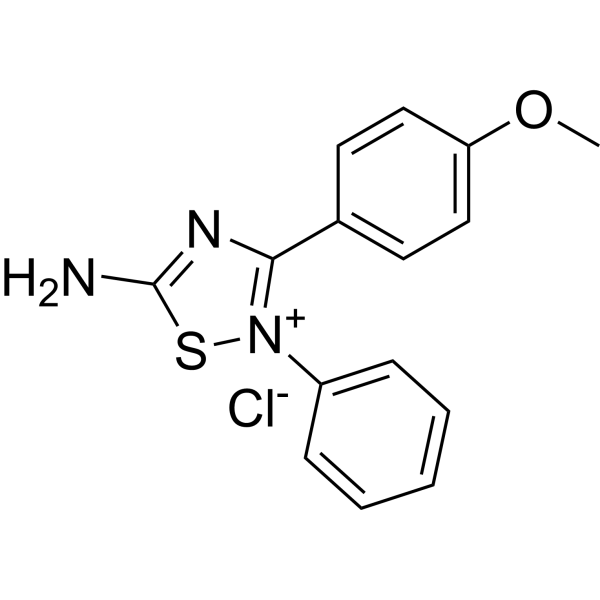
SR31527 chloride

Based on 1 Customer Validation
SR31527 chloride is a potent KIFC1 inhibitor with an IC50 value of 6.6 µM. SR31527 chloride decreases cell viability and colony formation.
For research use only. We do not sell to patients.
- Purity : 97.35%
- CAS No.: 311814-78-5
- Formula: C15H14ClN3OS
- Molecular Weight:319.81
-
Storage:
4°C, sealed storage, away from moisture
* In solvent : -80°C, 6 months; -20°C, 1 month (sealed storage, away from moisture)

To place orders, for customer services and technical support, please contact: MedChemExpress USA
Tel: 609-228-6898 E-mail: [email protected] [email protected]


-
 Biological Activity
-
Chemical Information
-
Solvent & Solubility
- Protocols
- Purity & Documentation
- References
-
 Help & FAQs


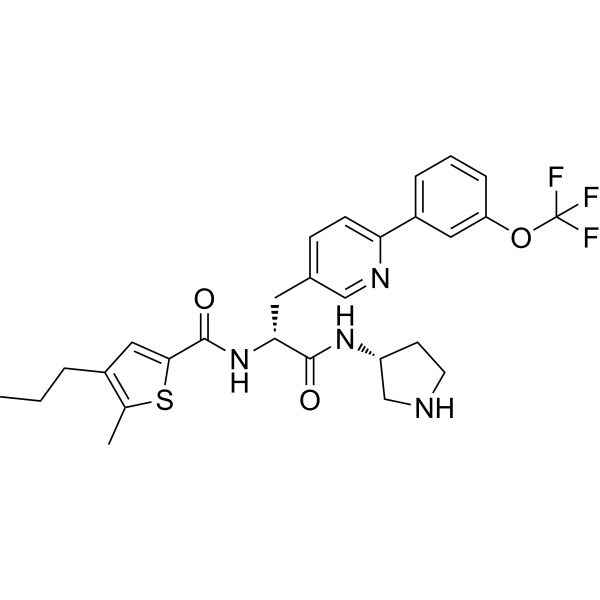
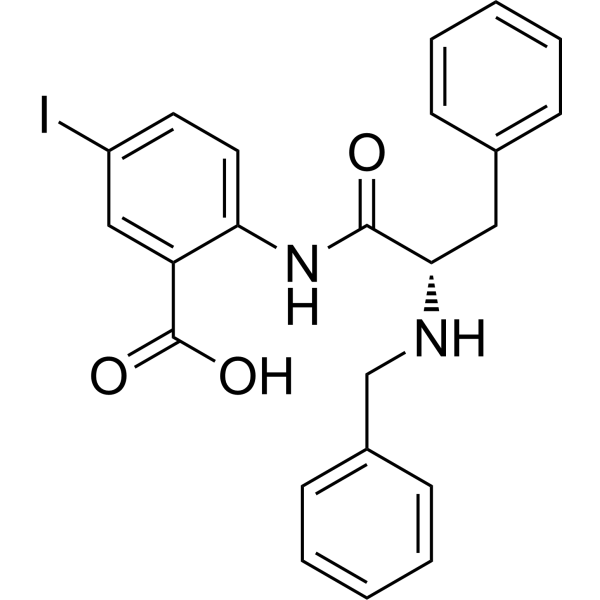
All Kinesin Isoforms
More

Biological Activity
Description
IC50 & Target
IC50: 6.6 µM (KIFC1)[1]
In Vitro
SR31527 chloride binds to KIFC1 with a Kd value of 25.4 nM[1].
SR31527 chloride (50 µM; 24 h) induces multiple spindle formation in MDA-MB-231, BT549 and MDA-MB-435s cells[1].
SR31527 chloride (0-100 µM; 96 h, 10-12 days) decreases the cell viability and colony formation of breast cancer cells and is less cytotoxic to LL47 cells[1].
MedChemExpress (MCE) has not independently confirmed the accuracy of these methods. They are for reference only.
-
Cell Line:MDA-MB-231, BT549, MDA-MB-435s cells
-
Concentration:0-100 µM
-
Incubation Time:96 h
-
Result:Decreased cell viability with IC50s of 29, 33, 20 µM for MDA-MB-231, BT549, MDA-MB-435s cells, respectively.


Chemical Information
-
CAS No. 311814-78-5
-
Appearance Solid
-
Molecular Weight 319.81
-
Formula C15H14ClN3OS
-
Color White to off-white
-
SMILES
COC1=CC=C(C=C1)C2=[N+](SC(N)=N2)C3=CC=CC=C3.[Cl-]
-
Shipping
Room temperature in continental US; may vary elsewhere.
-
Storage
4°C, sealed storage, away from moisture
* In solvent : -80°C, 6 months; -20°C, 1 month (sealed storage, away from moisture)


Solvent & Solubility
In Vitro:
DMSO : ≥ 100 mg/mL (312.69 mM; Hygroscopic DMSO has a significant impact on the solubility of product, please use newly opened DMSO)
* "≥" means soluble, but saturation unknown.
Please refer to the solubility information to select the appropriate solvent. Once prepared, please aliquot and store the solution to prevent product inactivation from repeated freeze-thaw cycles.
Storage method and period of stock solution: -80°C, 6 months; -20°C, 1 month (sealed storage, away from moisture). When stored at -80°C, please use it within 6 months. When stored at -20°C, please use it within 1 month.
Please refer to the solubility information to select the appropriate solvent. Once prepared, please aliquot and store the solution to prevent product inactivation from repeated freeze-thaw cycles.
Storage method and period of stock solution: -80°C, 6 months; -20°C, 1 month (sealed storage, away from moisture). When stored at -80°C, please use it within 6 months. When stored at -20°C, please use it within 1 month.
Concentration (start) × Volume (start) = Concentration (final) × Volume (final)


Purity & Documentation
-
Data Sheet (276 KB)
-
SDS (393 KB)
- English - EN (393 KB)
- Français - FR (393 KB)
- Deutsch - DE (393 KB)
- Norwegian - NO (393 KB)
- Español - ES (393 KB)
- Swedish - SV (393 KB)
- Italian - IT (393 KB)
- Korean - KR (393 KB)
- Portuguese - PT (393 KB)
-
Handling Instructions (2659 KB)
References


Complete Stock Solution Preparation Table
Please refer to the solubility information to select the appropriate solvent. Once prepared, please aliquot and store the solution to prevent product inactivation from repeated freeze-thaw cycles.
Storage method and period of stock solution: -80°C, 6 months; -20°C, 1 month (sealed storage, away from moisture). When stored at -80°C, please use it within 6 months. When stored at -20°C, please use it within 1 month.
| Optional Solvent | Concentration Solvent Mass | 1 mg | 5 mg | 10 mg | 25 mg |
|---|---|---|---|---|---|
| DMSO | 1 mM | 3.1269 mL | 15.6343 mL | 31.2686 mL | 78.1714 mL |
| 5 mM | 0.6254 mL | 3.1269 mL | 6.2537 mL | 15.6343 mL | |
| 10 mM | 0.3127 mL | 1.5634 mL | 3.1269 mL | 7.8171 mL | |
| 15 mM | 0.2085 mL | 1.0423 mL | 2.0846 mL | 5.2114 mL | |
| 20 mM | 0.1563 mL | 0.7817 mL | 1.5634 mL | 3.9086 mL | |
| 25 mM | 0.1251 mL | 0.6254 mL | 1.2507 mL | 3.1269 mL | |
| 30 mM | 0.1042 mL | 0.5211 mL | 1.0423 mL | 2.6057 mL | |
| 40 mM | 0.0782 mL | 0.3909 mL | 0.7817 mL | 1.9543 mL | |
| 50 mM | 0.0625 mL | 0.3127 mL | 0.6254 mL | 1.5634 mL | |
| 60 mM | 0.0521 mL | 0.2606 mL | 0.5211 mL | 1.3029 mL | |
| 80 mM | 0.0391 mL | 0.1954 mL | 0.3909 mL | 0.9771 mL | |
| 100 mM | 0.0313 mL | 0.1563 mL | 0.3127 mL | 0.7817 mL |


SR31527 chloride Related Classifications
HY-118961 Related Classifications
 Powered by Bioz