



Tat-NR2B9c TFA
Based on 8 publication(s) in Google Scholar
Tat-NR2B9c TFA (Tat-NR2Bct TFA) is a postsynaptic density-95 (PSD-95) inhibitor, with EC50 values of 6.7 nM and 670 nM for PSD-95d2 (PSD-95 PDZ domain 2) and PSD-95d1, respectively. Tat-NR2B9c TFA disrupts the PSD-95/NMDAR interaction, inhibiting NR2A and NR2B binding to PSD-95 with IC50 values of 0.5 μM and 8 μM, respectively. Tat-NR2B9c TFA also inhibits neuronal nitric oxide synthase (nNOS)/PSD-95 interaction, and possesses neuroprotective efficacy.
For research use only. We do not sell to patients.
- Purity : 99.66%
- CAS No.: 1834571-04-8
- Formula: C105H188N42O30.C2HF3O2
- Molecular Weight:2632.90
-
Storage:
Sealed storage, away from moisture.
Powder -80°C, 2 years , -20°C, 1 year* In solvent : -80°C, 6 months; -20°C, 1 month (sealed storage, away from moisture)


To place orders, for customer services and technical support, please contact: MedChemExpress USA
Tel: 609-228-6898 E-mail: [email protected] [email protected]


-
 Biological Activity
-
Chemical Information
-
Solvent & Solubility
- Protocols
- Purity & Documentation
- References
-
 Help & FAQs



Publications Citing Use of MedChemExpress (MCE) Tat-NR2B9c TFA
More- Sci Rep. 2018 May 18;8(1):7848. [Abstract]
- Neuropharmacology. 2024 Jun 15:251:109905. [Abstract]
- J Cereb Blood Flow Metab. 2019 Aug;39(8):1588-1601. [Abstract]
- J Neuropathol Exp Neurol. 2020 Jul 1;79(7):800-808. [Abstract]
- Behav Brain Res. 2022 Jan 7:416:113537. [Abstract]
- PLoS One. 2020 Mar 3;15(3):e0229499. [Abstract]
- Biochem Biophys Res Commun. 2024 Aug 6:720:150076. [Abstract]
- Neuroreport. 2021 Sep 8;32(13):1122-1127. [Abstract]
 Customer Validation & Images

-
WB
All iGluR Isoforms
More

Biological Activity
Description
IC50 & Target
|
NMDA Receptor |
nNOS |
In Vitro
Tat-NR2B9c is a PSD-95 inhibitor, with an EC50 of 6.7 nM for PSD-95d2, representing a >100-fold higher affinity for this domain than for PSD-95d1 (EC50, 0.67 μM). Tat-NR2B9c inhibits NMDAR2A, NMDAR2B, and NMDAR2C binding to PSD-95, with IC50s of 0.5 μM, ~8 μM, and 0.75 μM, respectively.Tat-NR2B9c also blocks the interaction between PSD-95 and nNOS with an IC50 of ~0.2 μM[1].Tat-NR2B9c reduces association of PSD-95 with GluN2B by ~50% in the YAC128 striatum, decreases NMDA-induced p38 activation in YAC128 striatal tissue, but shows no effect on the NMDA-induced JNK activation[2].
MedChemExpress (MCE) has not independently confirmed the accuracy of these methods. They are for reference only. Further protocols information, click here.
In Vivo
MedChemExpress (MCE) has not independently confirmed the accuracy of these methods. They are for reference only.


Chemical Information
-
CAS No. 1834571-04-8
-
Appearance Solid
-
Molecular Weight 2632.90
-
Formula C105H188N42O30.C2HF3O2
-
Color White to off-white
-
Synonyms
Tat-NR2Bct TFA; NA-1 TFA
-
Sequence Shortening
YGRKKRRQRRRKLSSIESDV
-
Shipping
Room temperature in continental US; may vary elsewhere.
-
Storage
Sealed storage, away from moisture
Powder -80°C 2 years -20°C 1 year * In solvent : -80°C, 6 months; -20°C, 1 month (sealed storage, away from moisture)


Publications (8)
-
Journal Impact Factor
-
Most Recent
-
Sci Rep
N-methyl D-aspartate receptor subtype 2B antagonist, Ro 25-6981, attenuates neuropathic pain by inhibiting postsynaptic density 95 expression. [Abstract]2018 May 18;8(1):7848. PMID: 29777135 -
Neuropharmacology
Tat-NR2B9c attenuates oxidative stress via inhibition of PSD95-NR2B-nNOS complex after subarachnoid hemorrhage in rats. [Abstract]2024 Jun 15:251:109905. PMID: 38521229 -
J Cereb Blood Flow Metab
Treatment of secondary brain injury by perturbing postsynaptic density protein-95-NMDA receptor interaction after intracerebral hemorrhage in rats. [Abstract]2019 Aug;39(8):1588-1601. PMID: 29513122
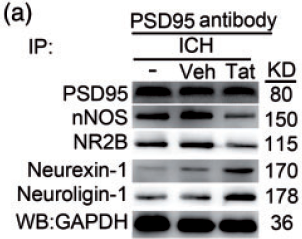
Tat-NR2B9c TFA purchased from MedChemExpress. Usage Cited in: J Cereb Blood Flow Metab. 2019 Aug;39(8):1588-1601. [Abstract]
Tat-NR2B9c affects PSD95-NR2B-nNOS complex and PSD95-neurexin-neuroligin complex formation after ICH. Western blots of IP with PSD95 antibody show the interactions between nNOS, NR2B, neurexin-1 or neuroligin-1, and PSD95.
-
J Neuropathol Exp Neurol
Activation of CaMKII and GluR1 by the PSD-95-GluN2B Coupling-Dependent Phosphorylation of GluN2B in the Spinal Cord in a Rat Model of Type-2 Diabetic Neuropathic Pain. [Abstract]2020 Jul 1;79(7):800-808. PMID: 32386416 -
Behav Brain Res
Intravenous administration of Tat-NR2B9c peptide, a PSD95 inhibitor, attenuates reinstatement of cocaine-seeking behavior in rats. [Abstract]2022 Jan 7:416:113537. PMID: 34416299 -
PLoS One
Hypothermia but not NMDA receptor antagonism protects against stroke induced by distal middle cerebral arterial occlusion in mice. [Abstract]2020 Mar 3;15(3):e0229499. PMID: 32126102 -
Biochem Biophys Res Commun
Formation of chronic morphine withdrawal memories requires C1QL3-mediated regulation of PSD95 in the mouse basolateral amygdala. [Abstract]2024 Aug 6:720:150076. PMID: 38772224 -
Neuroreport
Stroke injury induced by distal middle cerebral artery occlusion is resistant to N-methyl-d-aspartate receptor antagonism in FVB/NJ mice. [Abstract]2021 Sep 8;32(13):1122-1127. PMID: 34284452


Solvent & Solubility
In Vitro:
H2O : ≥ 50 mg/mL (18.99 mM)
* "≥" means soluble, but saturation unknown.
Please refer to the solubility information to select the appropriate solvent. Once prepared, please aliquot and store the solution to prevent product inactivation from repeated freeze-thaw cycles.
Storage method and period of stock solution: -80°C, 6 months; -20°C, 1 month (sealed storage, away from moisture). When stored at -80°C, please use it within 6 months. When stored at -20°C, please use it within 1 month.
* Note: If you choose water as the stock solution, please dilute it to the working solution, then filter and sterilize it with a 0.22 μm filter before use.
Please refer to the solubility information to select the appropriate solvent. Once prepared, please aliquot and store the solution to prevent product inactivation from repeated freeze-thaw cycles.
Storage method and period of stock solution: -80°C, 6 months; -20°C, 1 month (sealed storage, away from moisture). When stored at -80°C, please use it within 6 months. When stored at -20°C, please use it within 1 month.
* Note: If you choose water as the stock solution, please dilute it to the working solution, then filter and sterilize it with a 0.22 μm filter before use.
Concentration (start) × Volume (start) = Concentration (final) × Volume (final)
In Vivo:
For the following dissolution methods, please prepare the working solution directly:
It is recommended to prepare fresh solutions and use them promptly within a short period of time.
The percentages shown for the solvents indicate their volumetric ratio in the final prepared solution. If precipitation or phase separation occurs during preparation, heat and/or sonication can be used to aid dissolution.
Add each solvent one by one: PBS
Solubility: 100 mg/mL (37.98 mM); Clear solution; Need ultrasonic

Protocols
-
Cell Cytotoxicity Assay
Cytotoxicity assays are usually based on the assessment of cell membrane damage, which can also be indirectly detected by measuring cell viability. Detection methods include MTT assay, CKK-8 assay, LDH assay and ATP assay, etc.


Purity & Documentation
-
Data Sheet (272 KB)
-
SDS (252 KB)
- English - EN (252 KB)
- Français - FR (252 KB)
- Deutsch - DE (252 KB)
- Norwegian - NO (252 KB)
- Español - ES (252 KB)
- Swedish - SV (252 KB)
- Italian - IT (252 KB)
- Korean - KR (252 KB)
- Portuguese - PT (252 KB)
-
Handling Instructions (2659 KB)
References
[1]. Cui H, et al. PDZ protein interactions underlying NMDA receptor-mediated excitotoxicity and neuroprotection by PSD-95 inhibitors. J Neurosci. 2007 Sep 12;27(37):9901-15. [Content Brief]
[2]. Fan J, et al. P38 MAPK is involved in enhanced NMDA receptor-dependent excitotoxicity in YAC transgenic mouse model of Huntington disease. Neurobiol Dis. 2012 Mar;45(3):999-1009. [Content Brief]


Complete Stock Solution Preparation Table
Please refer to the solubility information to select the appropriate solvent. Once prepared, please aliquot and store the solution to prevent product inactivation from repeated freeze-thaw cycles.
Storage method and period of stock solution: -80°C, 6 months; -20°C, 1 month (sealed storage, away from moisture). When stored at -80°C, please use it within 6 months. When stored at -20°C, please use it within 1 month.
| Optional Solvent | Concentration Solvent Mass | 1 mg | 5 mg | 10 mg | 25 mg |
|---|---|---|---|---|---|
| H2O | 1 mM | 0.3798 mL | 1.8990 mL | 3.7981 mL | 9.4952 mL |
| 5 mM | 0.0760 mL | 0.3798 mL | 0.7596 mL | 1.8990 mL | |
| 10 mM | 0.0380 mL | 0.1899 mL | 0.3798 mL | 0.9495 mL | |
| 15 mM | 0.0253 mL | 0.1266 mL | 0.2532 mL | 0.6330 mL |
* Note: If you choose water as the stock solution, please dilute it to the working solution, then filter and sterilize it with a 0.22 μm filter before use.


Tat-NR2B9c TFA Related Classifications
HY-P0117A Related Classifications
 Powered by Bioz