



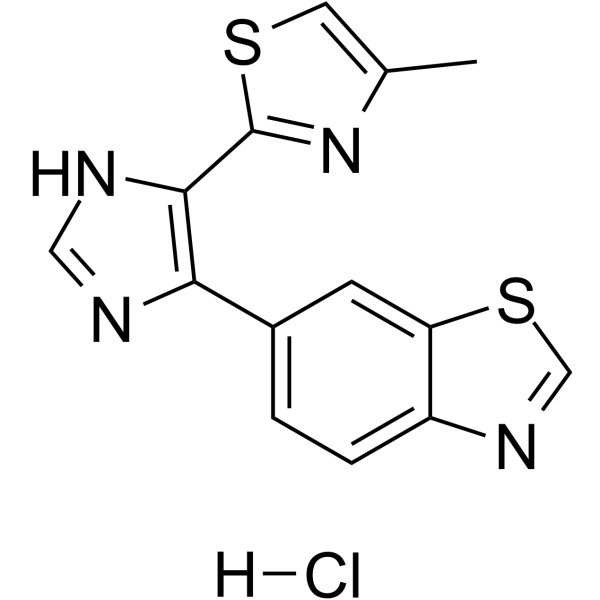
TP0427736 hydrochloride
Based on 2 publication(s) in Google Scholar
TP0427736 hydrochloride is a potent inhibitor of ALK5 kinase activity with an IC50 of 2.72 nM and this effect is 300-fold higher than the inhibitory effect on ALK3 (IC50=836 nM). TP0427736 hydrochloride also inhibits Smad2/3 phosphorylation in A549 cells induced by TGF-β1 with an IC50 value of 8.68 nM. TP0427736 hydrochloride can be used for the research of androgenic alopecia (AGA).
Nos produits utilisent uniquement pour la recherche. Nous ne vendons pas aux patients.
- Pureté : 99.91%
- CAS No.: 2459963-17-6
- Formule: C14H11ClN4S2
- Masse moléculaire:334.85
-
Stockage:Powder -20°C, 3 years , 4°C, 2 years ; In solvent -80°C, 6 months , -20°C, 1 month

To place orders, for customer services and technical support, please contact: MedChemExpress USA
Tel: 609-228-6898 E-mail: [email protected] [email protected]


-
 Activité biologique
-
Chemical Information
-
Solvant et solubilité
- Protocole
- Pureté et documentation
- Références
-
 Help & FAQs


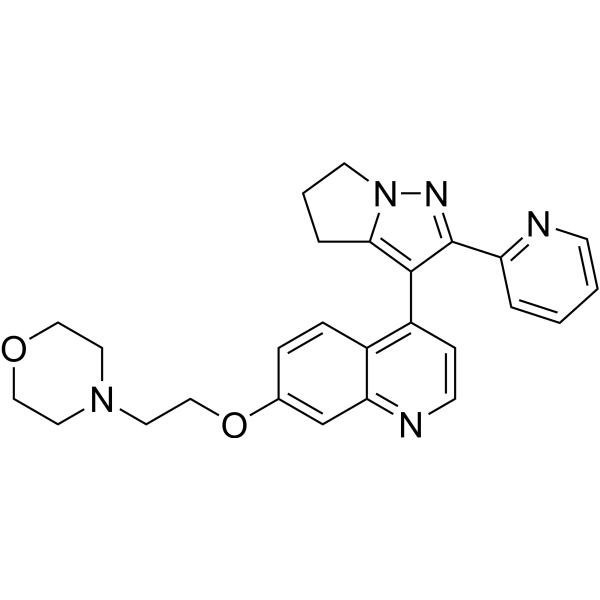
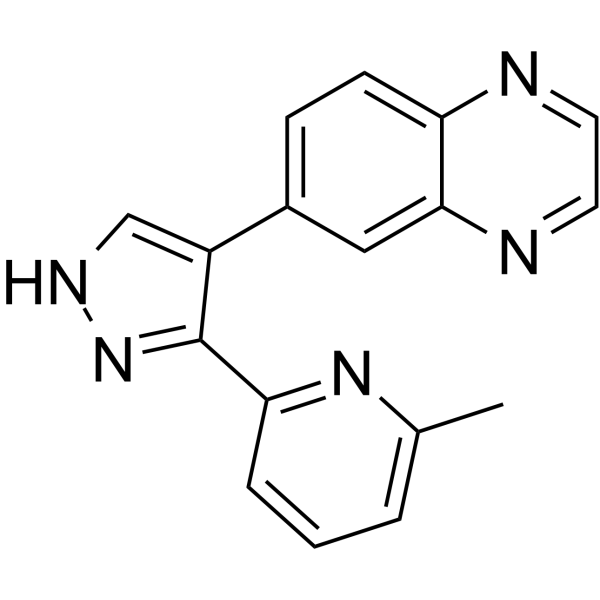
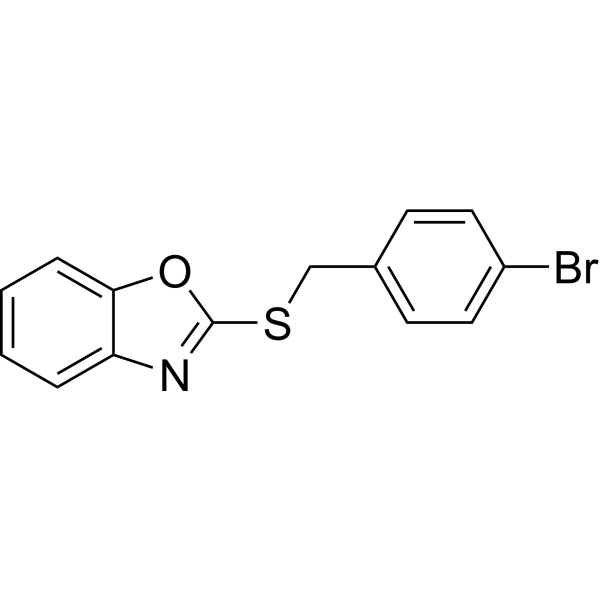
Publications Citing Use of MedChemExpress (MCE) TP0427736 hydrochloride
More

Activité biologique
Description


Chemical Information
-
CAS No. 2459963-17-6
-
Appearance Solid
-
Masse moléculaire 334.85
-
Formule C14H11ClN4S2
-
Color Light yellow to yellow
-
SMILES
CC1=CSC(C2=C(C3=CC=C4N=CSC4=C3)N=CN2)=N1.[H]Cl
-
Livraison
Room temperature in continental US; may vary elsewhere.
-
Stockage
Powder -20°C 3 years 4°C 2 years In solvent -80°C 6 months -20°C 1 month


Publications (2)
-
Journal Impact Factor
-
Most Recent
-
J Clin Invest
Myostatin regulates energy homeostasis through autocrine- and paracrine-mediated microenvironment communications. [Abstract]2024 Jun 18;134(16):e178303. PMID: 38889010 -
Commun Biol
Wnt11 mediates fibroblast-smooth muscle cell interaction to promote neurogenic bladder fibrosis in rats. [Abstract]2026 Feb 9;9(1):194. PMID: 41663583


Solvant et solubilité
In Vitro:
H2O : 3.33 mg/mL (9.94 mM; ultrasonic and warming and heat to 60°C)
DMSO : 2 mg/mL (5.97 mM; ultrasonic and warming and heat to 60°C; Hygroscopic DMSO has a significant impact on the solubility of product, please use newly opened DMSO)
Please refer to the solubility information to select the appropriate solvent. Once prepared, please aliquot and store the solution to prevent product inactivation from repeated freeze-thaw cycles.
Storage method and period of stock solution: -80°C, 6 months; -20°C, 1 month. When stored at -80°C, please use it within 6 months. When stored at -20°C, please use it within 1 month.
* Note: If you choose water as the stock solution, please dilute it to the working solution, then filter and sterilize it with a 0.22 μm filter before use.
Please refer to the solubility information to select the appropriate solvent. Once prepared, please aliquot and store the solution to prevent product inactivation from repeated freeze-thaw cycles.
Storage method and period of stock solution: -80°C, 6 months; -20°C, 1 month. When stored at -80°C, please use it within 6 months. When stored at -20°C, please use it within 1 month.
* Note: If you choose water as the stock solution, please dilute it to the working solution, then filter and sterilize it with a 0.22 μm filter before use.
Concentration (start) × Volume (start) = Concentration (final) × Volume (final)


Pureté et documentation
-
Fiche technique (279 KB)
-
SDS (396 KB)
- English - EN (396 KB)
- Français - FR (396 KB)
- Deutsch - DE (396 KB)
- Norwegian - NO (396 KB)
- Español - ES (396 KB)
- Swedish - SV (396 KB)
- Italian - IT (396 KB)
- Korean - KR (396 KB)
- Portuguese - PT (396 KB)
-
Instruction de manipulation (2659 KB)
Références


Complete Stock Solution Preparation Table
Please refer to the solubility information to select the appropriate solvent. Once prepared, please aliquot and store the solution to prevent product inactivation from repeated freeze-thaw cycles.
Storage method and period of stock solution: -80°C, 6 months; -20°C, 1 month. When stored at -80°C, please use it within 6 months. When stored at -20°C, please use it within 1 month.
| Optional Solvent | Concentration Solvent Mass | 1 mg | 5 mg | 10 mg | 25 mg |
|---|---|---|---|---|---|
| DMSO / H2O | 1 mM | 2.9864 mL | 14.9321 mL | 29.8641 mL | 74.6603 mL |
| 5 mM | 0.5973 mL | 2.9864 mL | 5.9728 mL | 14.9321 mL |
* Note: If you choose water as the stock solution, please dilute it to the working solution, then filter and sterilize it with a 0.22 μm filter before use.


TP0427736 hydrochloride Related Classifications
HY-118528A Related Classifications
 Powered by Bioz