



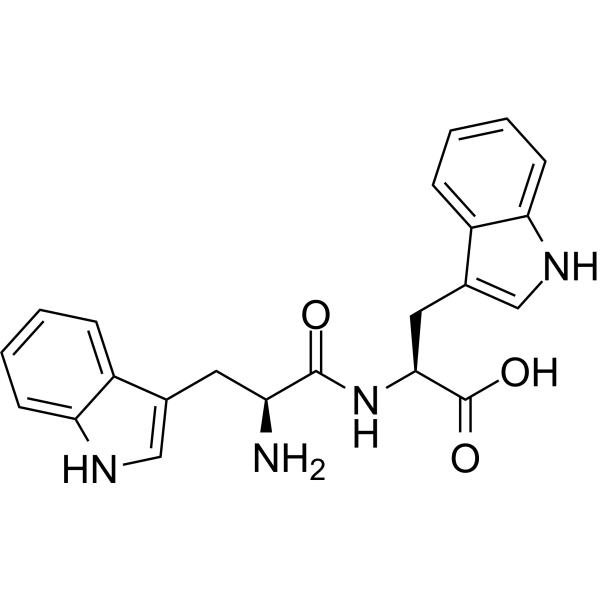
Tryptophyltryptophan

Based on 1 Customer Validation
Tryptophyltryptophan (NSC 524592) is a polypeptide that can be found by peptide screening. Peptide screening is a research tool that pools active peptides primarily by immunoassay. Peptide screening can be used for protein interaction, functional analysis, epitope screening, especially in the field of agent research and development.
商品は「研究用試薬」です。人や動物の医療用・臨床診断用・食品用の製品ではありません。
研究用途以外に使用した場合、当社は一切の責任を負いかねます。
- 純度 : 99.49%
- CAS 番号: 20696-60-0
- 分子式: C22H22N4O3
- 分子量:390.44
-
保管条件:
Sealed storage, away from moisture.
Powder -80°C, 2 years , -20°C, 1 year* In solvent : -80°C, 6 months; -20°C, 1 month (sealed storage, away from moisture)

To place orders, for customer services and technical support, please contact: MedChemExpress USA
Tel: 609-228-6898 E-mail: [email protected] [email protected]


-
 生物活性
生物活性
-
化学情報
-
溶剤 & 溶解度
- プロトコル
- 純度とドキュメンテーション
- 参考文献
-
 Help & FAQs




生物活性
製品説明
Cellular Effect
|
Cell Line

|
Type | Value | Description | References |
|---|---|---|---|---|
| MDCK | IC50 |
0.25 mM
Compound: 68
|
Binding affinity to human PEPT1 assessed as inhibition of [14C]Gly-Sar uptake in MDCK cells
Binding affinity to human PEPT1 assessed as inhibition of [14C]Gly-Sar uptake in MDCK cells
|
[PMID: 16759105] |


化学情報
-
CAS 番号 20696-60-0
-
性状 Solid
-
分子量 390.44
-
分子式 C22H22N4O3
-
Color White to off-white
-
別名
NSC 524592
-
配列
Trp-Trp
-
シーケンスの短縮
WW
-
輸送条件
Room temperature in continental US; may vary elsewhere.
-
保管条件
Sealed storage, away from moisture
Powder -80°C 2 years -20°C 1 year * In solvent : -80°C, 6 months; -20°C, 1 month (sealed storage, away from moisture)


溶剤 & 溶解度
体外:
DMSO : 100 mg/mL (256.12 mM; Need ultrasonic; Hygroscopic DMSO has a significant impact on the solubility of product, please use newly opened DMSO)
Please refer to the solubility information to select the appropriate solvent. Once prepared, please aliquot and store the solution to prevent product inactivation from repeated freeze-thaw cycles.
Storage method and period of stock solution: -80°C, 6 months; -20°C, 1 month (sealed storage, away from moisture). When stored at -80°C, please use it within 6 months. When stored at -20°C, please use it within 1 month.
Please refer to the solubility information to select the appropriate solvent. Once prepared, please aliquot and store the solution to prevent product inactivation from repeated freeze-thaw cycles.
Storage method and period of stock solution: -80°C, 6 months; -20°C, 1 month (sealed storage, away from moisture). When stored at -80°C, please use it within 6 months. When stored at -20°C, please use it within 1 month.
濃度 (開始) × 体積 (開始) = 濃度 (終了) × 体積 (終了)

プロトコル
-
Pull-down
The pull-down assay is an in vitro technique used to detect physical interactions between two or more proteins and an invaluable tool for confirming a predicted protein-protein interaction or identifying novel interacting partners. This method typically involves the use of affinity purification with various wash and elution steps.
-
Immunoprecipitation
Immunoprecipitation (IP) is an experimental method that uses the principle of antibody specific binding to purify and enrich target proteins.
-
Protocol for Bimolecular Fluorescence Complementation (BiFC) Assay
Bimolecular fluorescence complementation detects protein-protein proximity in living or fixed cells by fusing two candidate interaction partners to nonfluorescent N- and C-terminal fragments of a fluorescent protein; when the partners interact or remain close enough, the fluorescent fragments complement, mature, and generate a fluorescent signal at the site of the protein complex. The BiFC readout is fluorescence intensity and subcellular localization of the reconstituted fluorophore, which reflects formation or stabilization of a protein complex rather than direct biochemical binding kinetics; BiFC is therefore useful for mapping where interactions occur in cancer cells, neurons, macrophages, organoid-derived cells, or drug-screening systems, but results should be validated by independent assays such as co-IP or Western blot. BiFC signal formation is delayed by fluorophore maturation and can stabilize otherwise transient complexes, so it is not a real-time reversible interaction assay
-
Co-Immunoprecipitation
Co-immunoprecipitation technology can verify protein interaction based on the specific immune reaction between antibodies and antigens.
-
Protocol for Yeast Two-Hybrid (Y2H) Assay
The yeast two-hybrid assay detects binary protein-protein interactions by separating a transcription factor into a DNA-binding domain fused to a "bait" protein and a transcriptional activation domain fused to a "prey" protein; if bait and prey interact in yeast, the transcription factor is reconstituted and activates reporter genes such as HIS3, ADE2, lacZ, MEL1, or other selectable/readable reporters. The readout is yeast growth on selective medium and/or reporter activity, which reflects proximity-dependent transcriptional activation in the yeast nucleus rather than direct biochemical binding in the original mammalian, tumor, neuronal, macrophage, or organoid context. Because yeast two-hybrid can generate false positives and false negatives, interaction claims should be validated using independent assays such as co-immunoprecipitation, Western blot, immunofluorescence colocalization, BiFC, pull-down, or mammalian two-hybrid assays.


純度とドキュメンテーション
-
データシート (274 KB)
-
SDS (585 KB)
- English - EN (585 KB)
- Français - FR (585 KB)
- Deutsch - DE (585 KB)
- Norwegian - NO (585 KB)
- Español - ES (585 KB)
- Swedish - SV (585 KB)
- Italian - IT (585 KB)
- Korean - KR (585 KB)
- Portuguese - PT (585 KB)
-
取扱説明書 (2659 KB)
参考文献


Complete Stock Solution Preparation Table
Please refer to the solubility information to select the appropriate solvent. Once prepared, please aliquot and store the solution to prevent product inactivation from repeated freeze-thaw cycles.
Storage method and period of stock solution: -80°C, 6 months; -20°C, 1 month (sealed storage, away from moisture). When stored at -80°C, please use it within 6 months. When stored at -20°C, please use it within 1 month.
| Optional Solvent | Concentration Solvent Mass | 1 mg | 5 mg | 10 mg | 25 mg |
|---|---|---|---|---|---|
| DMSO | 1 mM | 2.5612 mL | 12.8061 mL | 25.6121 mL | 64.0303 mL |
| 5 mM | 0.5122 mL | 2.5612 mL | 5.1224 mL | 12.8061 mL | |
| 10 mM | 0.2561 mL | 1.2806 mL | 2.5612 mL | 6.4030 mL | |
| 15 mM | 0.1707 mL | 0.8537 mL | 1.7075 mL | 4.2687 mL | |
| 20 mM | 0.1281 mL | 0.6403 mL | 1.2806 mL | 3.2015 mL | |
| 25 mM | 0.1024 mL | 0.5122 mL | 1.0245 mL | 2.5612 mL | |
| 30 mM | 0.0854 mL | 0.4269 mL | 0.8537 mL | 2.1343 mL | |
| 40 mM | 0.0640 mL | 0.3202 mL | 0.6403 mL | 1.6008 mL | |
| 50 mM | 0.0512 mL | 0.2561 mL | 0.5122 mL | 1.2806 mL | |
| 60 mM | 0.0427 mL | 0.2134 mL | 0.4269 mL | 1.0672 mL | |
| 80 mM | 0.0320 mL | 0.1601 mL | 0.3202 mL | 0.8004 mL | |
| 100 mM | 0.0256 mL | 0.1281 mL | 0.2561 mL | 0.6403 mL |


Tryptophyltryptophan 関連分類
HY-P4647 関連分類
 Powered by Bioz