



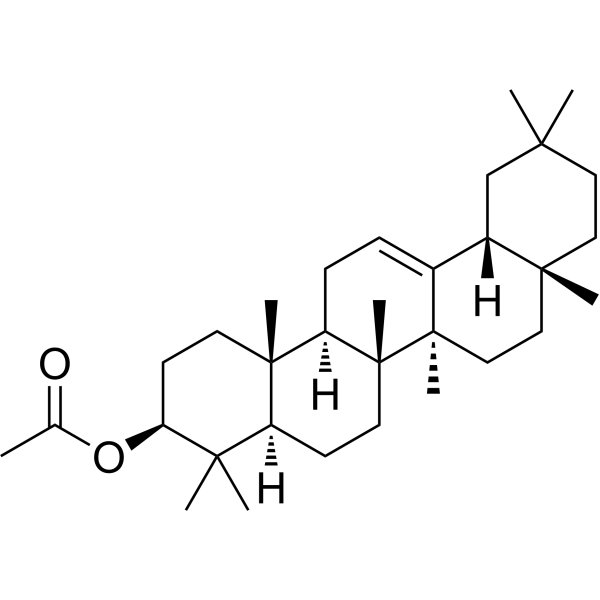
β-Amyrin acetate

Based on 1 Customer Validation
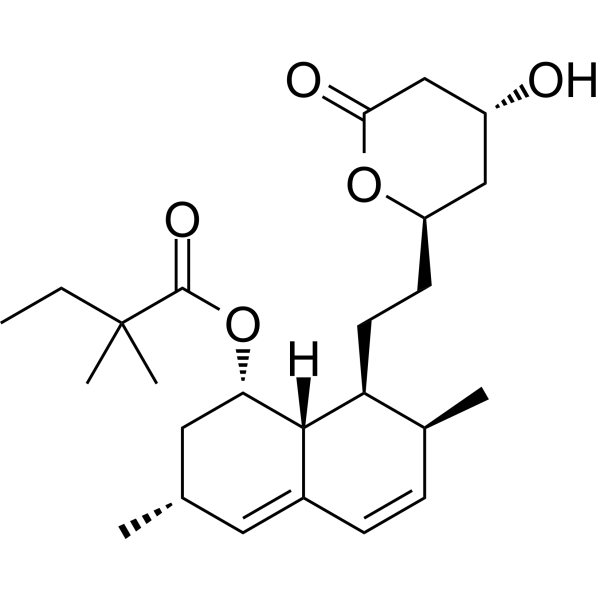
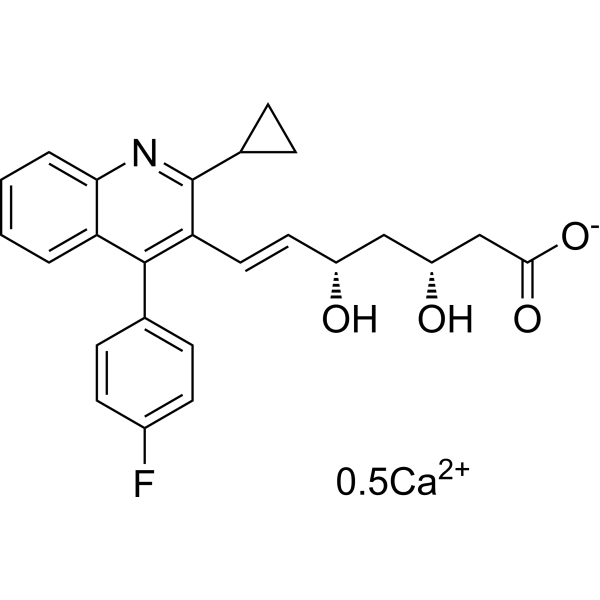
β-Amyrin acetate is a triterpenoid with potent anti-inflammatory, antifungal, anti-diabetic, anti-hyperlipidemic activities. β-Amyrin acetate can inhibit HMG-CoA reductase activity by locating in the hydrophobic binding cleft of HMG CoA reductase.
For research use only. We do not sell to patients.
- Purity : 99.98%
- CAS No.: 1616-93-9
- Formula: C32H52O2
- Molecular Weight:468.75
-
Storage:
-20°C, protect from light
* In solvent : -80°C, 6 months; -20°C, 1 month (protect from light)

To place orders, for customer services and technical support, please contact: MedChemExpress USA
Tel: 609-228-6898 E-mail: [email protected] [email protected]


-
 Biological Activity
-
Chemical Information
-
Solvent & Solubility
- Protocols
- Purity & Documentation
- References
-
 Help & FAQs




Biological Activity
Description
Cellular Effect
|
Cell Line

|
Type | Value | Description | References |
|---|---|---|---|---|
| A2780 | IC50 |
12.1 μg/mL
Compound: 5
|
Cytotoxicity against human A2780 cells
Cytotoxicity against human A2780 cells
|
[PMID: 12193040] |
| A2780 | IC50 |
12.5 μg/mL
Compound: 2
|
Cytotoxicity against human A2780 cells
Cytotoxicity against human A2780 cells
|
[PMID: 20153184] |
| A549 | GI50 |
11.4 μM
Compound: 2
|
Growth inhibition of human A549 cells by MTT assay
Growth inhibition of human A549 cells by MTT assay
|
[PMID: 20153184] |
| BMDC | IC50 |
>50 μM
Compound: 23
|
Antiinflammatory activity in C57BL/6 mouse BMDCs assessed as inhibition of LPS-stimulated IL12 production treated 1 hr before LPS challenge measured 18 hrs post stimulation by ELISA
Antiinflammatory activity in C57BL/6 mouse BMDCs assessed as inhibition of LPS-stimulated IL12 production treated 1 hr before LPS challenge measured 18 hrs post stimulation by ELISA
|
[PMID: 23484668] |
| BMDC | IC50 |
>50 μM
Compound: 23
|
Antiinflammatory activity in C57BL/6 mouse BMDCs assessed as inhibition of LPS-stimulated IL-12p40 production treated 1 hr before LPS challenge measured 18 hrs post stimulation by ELISA
Antiinflammatory activity in C57BL/6 mouse BMDCs assessed as inhibition of LPS-stimulated IL-12p40 production treated 1 hr before LPS challenge measured 18 hrs post stimulation by ELISA
|
[PMID: 23484668] |
| BMDC | IC50 |
>50 μM
Compound: 23
|
Antiinflammatory activity in C57BL/6 mouse BMDCs assessed as inhibition of LPS-stimulated TNF-alpha production treated 1 hr before LPS challenge measured 18 hrs post stimulation by ELISA
Antiinflammatory activity in C57BL/6 mouse BMDCs assessed as inhibition of LPS-stimulated TNF-alpha production treated 1 hr before LPS challenge measured 18 hrs post stimulation by ELISA
|
[PMID: 23484668] |
| BV-2 | IC50 |
>50 μM
Compound: 6
|
Inhibition of iNOS-mediated NO production in LPS-induced mouse BV2 cells
Inhibition of iNOS-mediated NO production in LPS-induced mouse BV2 cells
|
[PMID: 18926710] |
| HeLa | IC50 |
>50 μM
Compound: 3
|
Cytotoxicity against human HeLa cells by MTT assay
Cytotoxicity against human HeLa cells by MTT assay
|
[PMID: 19447618] |
| HL-60 | GI50 |
14.6 μM
Compound: 2
|
Growth inhibition of human HL60 cells by MTT assay
Growth inhibition of human HL60 cells by MTT assay
|
[PMID: 20153184] |
| HT-29 | GI50 |
12.5 μM
Compound: 2
|
Growth inhibition of human HT-29 cells by MTT assay
Growth inhibition of human HT-29 cells by MTT assay
|
[PMID: 20153184] |
| MCF7 | IC50 |
26.73 μM
Compound: 3
|
Cytotoxicity against human MCF7 cells by MTT assay
Cytotoxicity against human MCF7 cells by MTT assay
|
[PMID: 19447618] |
| SK-MEL-1 | IC50 |
>50 μM
Compound: 3
|
Cytotoxicity against human SK-MEL-1 cells by MTT assay
Cytotoxicity against human SK-MEL-1 cells by MTT assay
|
[PMID: 19447618] |
| SK-OV-3 | GI50 |
14.6 μM
Compound: 2
|
Growth inhibition of human SKOV3 cells by MTT assay
Growth inhibition of human SKOV3 cells by MTT assay
|
[PMID: 20153184] |
In Vitro
β-Amyrin acetate (50 μg/mL) inhibits heat-induced hemolysis and hypotonicity-induced hemolysis of human erythrocytes[1].
β-Amyrin acetate (5-100 μM) has HMG-CoA reductase inhibitory activity by locating in the hydrophobic binding cleft lined with residues Leu562, Gly560, Ala564, Gly569, Ser852, Leu853, Leu857, Met854, Ala856, Ser852 and Ala855 of human HMG CoA reductase[2].
β-Amyrin acetate (7.8-1000 μg/mL, 48 h) inhibits all of the Candida fungal species tested with MIC values ranging from 30 to 250 μg/mL)[4].
MedChemExpress (MCE) has not independently confirmed the accuracy of these methods. They are for reference only. Further protocols information, click here.
In Vivo
β-Amyrin acetate (intraperitoneal injection, 4 mg/100 g, daily for 6 consecutive days) shows significant anti-inflammatory activities (43.6%) in adult albino rats[3].
β-Amyrin acetate (subcutaneous injection, 4 mg/100 g, daily for 10 days ) increases the ATP-phosphohydrolase activity in liver homogenates both in normal and arthritic rats[3].
MedChemExpress (MCE) has not independently confirmed the accuracy of these methods. They are for reference only.
-
Animal Model:Xylene-induced mouse ear topical edema model[1]
-
Dosage:50 and 100 μg/ear (5 μL)
-
Administration:Applied on the anterior surface of the right ear
-
Result:Inhibited Xylene-induced ear edema in mice
-
Animal Model:Adult albino rats[3]
-
Dosage:4 mg/100g, daily for 6 consecutive days
-
Administration:Intraperitoneal injection
-
Result:Showed significant anti-inflammatory activities with mean average weight of granulation tissue of 9.2 mg after 6 days.


Chemical Information
-
CAS No. 1616-93-9
-
Appearance Solid
-
Molecular Weight 468.75
-
Formula C32H52O2
-
Color White to off-white
-
SMILES
C[C@]12[C@@](CC=C3[C@]2(CC[C@@]4([C@@]3([H])CC(C)(CC4)C)C)C)([H])[C@@]5([C@@](C(C)([C@H](CC5)OC(C)=O)C)([H])CC1)C
-
Structure Classification
-
Initial Source
-
Shipping
Room temperature in continental US; may vary elsewhere.
-
Storage
-20°C, protect from light
* In solvent : -80°C, 6 months; -20°C, 1 month (protect from light)


Solvent & Solubility
In Vitro:
Ethanol : 1 mg/mL (2.13 mM; ultrasonic and warming and heat to 60°C)
Please refer to the solubility information to select the appropriate solvent. Once prepared, please aliquot and store the solution to prevent product inactivation from repeated freeze-thaw cycles.
Storage method and period of stock solution: -80°C, 6 months; -20°C, 1 month (protect from light). When stored at -80°C, please use it within 6 months. When stored at -20°C, please use it within 1 month.
Please refer to the solubility information to select the appropriate solvent. Once prepared, please aliquot and store the solution to prevent product inactivation from repeated freeze-thaw cycles.
Storage method and period of stock solution: -80°C, 6 months; -20°C, 1 month (protect from light). When stored at -80°C, please use it within 6 months. When stored at -20°C, please use it within 1 month.
Concentration (start) × Volume (start) = Concentration (final) × Volume (final)
In Vivo:
Select the appropriate dissolution method based on your experimental animal and administration route.
- For the following dissolution methods, please ensure to first prepare a clear stock solution using an In Vitro approach and then sequentially add co-solvents:
- To ensure reliable experimental results, the clarified stock solution can be appropriately stored based on storage conditions. As for the working solution for In Vivo experiments, it is recommended to prepare freshly and use it on the same day.
- The percentages shown for the solvents indicate their volumetric ratio in the final prepared solution. If precipitation or phase separation occurs during preparation, heat and/or sonication can be used to aid dissolution.
Add each solvent one by one: 10% EtOH 40% PEG300 5% Tween-80 45% Saline
Solubility: ≥ 0.1 mg/mL (0.21 mM); Clear solution
This protocol yields a clear solution of ≥ 0.1 mg/mL (saturation unknown).
Taking 1 mL working solution as an example, add 100 μL EtOH stock solution (1.0 mg/mL) to 400 μL PEG300, and mix evenly; then add 50 μL Tween-80 and mix evenly; then add 450 μL Saline to adjust the volume to 1 mL.
Preparation of Saline: Dissolve 0.9 g sodium chloride in ddH₂O and dilute to 100 mL to obtain a clear Saline solution.
Add each solvent one by one: 10% EtOH 90% Corn Oil
Solubility: ≥ 0.1 mg/mL (0.21 mM); Clear solution
This protocol yields a clear solution of ≥ 0.1 mg/mL (saturation unknown). If the continuous dosing period exceeds half a month, please choose this protocol carefully.
Taking 1 mL working solution as an example, add 100 μL EtOH stock solution (1.0 mg/mL) to 900 μL Corn oil, and mix evenly.
In Vivo Dissolution Calculator
Please enter the basic information of animal experiments:
-
-
-
-
Recommended: Prepare an additional quantity of animals to account for potential losses during experiments.
Working solution concentration: 0.22 mg/mL

Protocols
-
Research Protocol for Inflammation-related Diseases
The NLRP3 inflammasome is a cytosolic innate immune signaling platform that integrates priming signals and danger-signal activation to promote caspase-1 activation, maturation of IL-1β and IL-18, and gasdermin D-mediated pyroptotic cell death. The core experimental logic is to determine whether inflammatory disease phenotypes are driven by increased NLRP3 expression, ASC-containing inflammasome assembly, caspase-1 cleavage, GSDMD cleavage, and extracellular release of IL-1β/IL-18 rather than by nonspecific cell injury alone. The pathway is strongly linked to inflammation-related disease phenotypes because monosodium urate crystals activate NALP3/NLRP3 inflammasome signaling in gout-like crystal inflammation, cholesterol crystals activate NLRP3 inflammasomes in atherogenesis models, and DSS-induced intestinal inflammation has been reported to involve NLRP3 inflammasome activity. However, experimental colitis studies also show context-dependent protective effects of NLRP3 inflammasome co


Purity & Documentation
-
Data Sheet (278 KB)
-
SDS (394 KB)
- English - EN (394 KB)
- Français - FR (394 KB)
- Deutsch - DE (394 KB)
- Norwegian - NO (394 KB)
- Español - ES (394 KB)
- Swedish - SV (394 KB)
- Italian - IT (394 KB)
- Korean - KR (394 KB)
- Portuguese - PT (394 KB)
-
Handling Instructions (2659 KB)
References
[1]. Nkeoma Nkasi Okoye, et al. beta-Amyrin and alpha-amyrin acetate isolated from the stem bark of Alstonia boonei display profound anti-inflammatory activity. Pharm Biol. 2014 Nov;52(11):1478-86. [Content Brief]
[2]. Ranjani Maurya, et al. β-Amyrin acetate and β-amyrin palmitate as antidyslipidemic agents from Wrightia tomentosa leaves. Phytomedicine. 2012 Jun 15;19(8-9):682-5. [Content Brief]
[4]. S Johann, et al. Antifungal activity of the amyrin derivatives and in vitro inhibition of Candida albicans adhesion to human epithelial cells. Lett Appl Microbiol. 2007 Aug;45(2):148-53. [Content Brief]


Complete Stock Solution Preparation Table
Please refer to the solubility information to select the appropriate solvent. Once prepared, please aliquot and store the solution to prevent product inactivation from repeated freeze-thaw cycles.
Storage method and period of stock solution: -80°C, 6 months; -20°C, 1 month (protect from light). When stored at -80°C, please use it within 6 months. When stored at -20°C, please use it within 1 month.
| Optional Solvent | Concentration Solvent Mass | 1 mg | 5 mg | 10 mg | 25 mg |
|---|---|---|---|---|---|
| Ethanol | 1 mM | 2.1333 mL | 10.6667 mL | 21.3333 mL | 53.3333 mL |


β-Amyrin acetate Related Classifications
HY-N2923 Related Classifications
 Powered by Bioz