



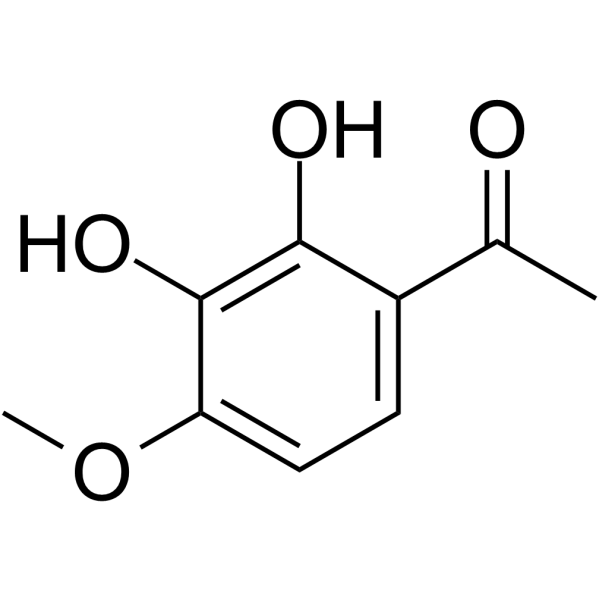
2,3-Dihydroxy-4-methoxyacetophenone

Based on 1 Customer Validation
2,3-Dihydroxy-4-methoxyacetophenone is a neuroprotective compound from Cynenchum paniculatum. 2,3-Dihydroxy-4-methoxyacetophenone improves cognitive function and may has the potential for the treatment of Alzheimer's disease research.
Nur für Forschungszwecke. Wir verkaufen nicht an Patienten.
- Reinheit : 99.53%
- CAS. Nr.: 708-53-2
- Formel: C9H10O4
- Molecular Weight:182.17
-
Speicherung:Powder -20°C, 3 years , 4°C, 2 years ; In solvent -80°C, 6 months , -20°C, 1 month

To place orders, for customer services and technical support, please contact: MedChemExpress USA
Tel: 609-228-6898 E-mail: [email protected] [email protected]


-
 Biologische Aktivität
-
Chemical Information
-
Lösungsmittel & Löslichkeit
- Protokoll
- Reinheit & Dokumentation
- Verweise
-
 Help & FAQs




Biologische Aktivität
Beschreibung
Cellular Effect
|
Cell Line

|
Type | Value | Description | References |
|---|---|---|---|---|
| HT-22 | EC50 |
10.94 μM
Compound: figure 1, R1C1
|
Neuroprotective activity in mouse HT22 cells assessed as inhibition of glutamate-induced cell death after 24 hrs by MTT assay
Neuroprotective activity in mouse HT22 cells assessed as inhibition of glutamate-induced cell death after 24 hrs by MTT assay
|
[PMID: 24210692] |
In Vitro
2,3-Dihydroxy-4-methoxyacetophenone protects HT22 cells on glutamate induced cell-death in a dose-dependent manner (EC50=10.94 μM). 2,3-Dihydroxy-4-methoxyacetophenone inhibits [Ca2+] accumulation in HT22 cells and has antioxidantive activity[1].
MedChemExpress (MCE) has not independently confirmed the accuracy of these methods. They are for reference only. Further protocols information, click here.
In Vivo
MedChemExpress (MCE) has not independently confirmed the accuracy of these methods. They are for reference only.


Chemical Information
-
CAS. Nr. 708-53-2
-
Appearance Solid
-
Molecular Weight 182.17
-
Formel C9H10O4
-
Color White to yellow
-
SMILES
CC(C1=CC=C(OC)C(O)=C1O)=O
-
Synonyms
Gallacetophenone-4-methyl ether
-
Structure Classification
-
Initial Source
-
Versand
Room temperature in continental US; may vary elsewhere.
-
Speicherung
Powder -20°C 3 years 4°C 2 years In solvent -80°C 6 months -20°C 1 month


Lösungsmittel & Löslichkeit
In Vitro:
DMSO : 100 mg/mL (548.94 mM; Need ultrasonic; Hygroscopic DMSO has a significant impact on the solubility of product, please use newly opened DMSO)
Please refer to the solubility information to select the appropriate solvent. Once prepared, please aliquot and store the solution to prevent product inactivation from repeated freeze-thaw cycles.
Storage method and period of stock solution: -80°C, 6 months; -20°C, 1 month. When stored at -80°C, please use it within 6 months. When stored at -20°C, please use it within 1 month.
Please refer to the solubility information to select the appropriate solvent. Once prepared, please aliquot and store the solution to prevent product inactivation from repeated freeze-thaw cycles.
Storage method and period of stock solution: -80°C, 6 months; -20°C, 1 month. When stored at -80°C, please use it within 6 months. When stored at -20°C, please use it within 1 month.
Konzentration (Stammlösung) × Volumen (Stammlösung) = Konzentration (Ziellösung) × Volumen (Ziellösung)
In Vivo:
Select the appropriate dissolution method based on your experimental animal and administration route.
- For the following dissolution methods, please ensure to first prepare a clear stock solution using an In Vitro approach and then sequentially add co-solvents:
- To ensure reliable experimental results, the clarified stock solution can be appropriately stored based on storage conditions. As for the working solution for In Vivo experiments, it is recommended to prepare freshly and use it on the same day.
- The percentages shown for the solvents indicate their volumetric ratio in the final prepared solution. If precipitation or phase separation occurs during preparation, heat and/or sonication can be used to aid dissolution.
Add each solvent one by one: 10% DMSO 40% PEG300 5% Tween-80 45% Saline
Solubility: ≥ 2.5 mg/mL (13.72 mM); Clear solution
This protocol yields a clear solution of ≥ 2.5 mg/mL (saturation unknown).
Taking 1 mL working solution as an example, add 100 μL DMSO stock solution (25.0 mg/mL) to 400 μL PEG300, and mix evenly; then add 50 μL Tween-80 and mix evenly; then add 450 μL Saline to adjust the volume to 1 mL.
Preparation of Saline: Dissolve 0.9 g sodium chloride in ddH₂O and dilute to 100 mL to obtain a clear Saline solution.
Add each solvent one by one: 10% DMSO 90% (20% SBE-β-CD in Saline)
Solubility: ≥ 2.5 mg/mL (13.72 mM); Clear solution
This protocol yields a clear solution of ≥ 2.5 mg/mL (saturation unknown).
Taking 1 mL working solution as an example, add 100 μL DMSO stock solution (25.0 mg/mL) to 900 μL 20% SBE-β-CD in Saline, and mix evenly.
Preparation of 20% SBE-β-CD in Saline (4°C, storage for one week): 2 g SBE-β-CD powder is dissolved in 10 mL Saline, completely dissolve until clear.
In Vivo Dissolution Calculator
Please enter the basic information of animal experiments:
-
-
-
-
Recommended: Prepare an additional quantity of animals to account for potential losses during experiments.
Please enter your animal formula composition:
-
%DMSO +
Recommended: Keep the proportion of DMSO in working solution below 2% if your animal is weak.
-
%+
-
+%Tween-80 + +
-
%Saline +
The co-solvents required include: DMSO, . All of co-solvents are available by MedChemExpress (MCE). , Tween 80. All of co-solvents are available by MedChemExpress (MCE).
Working solution concentration: 0.22 mg/mL
Method for preparing stock solution: mg drug dissolved in μL DMSO. Stock solution concentration: mg/mL.
1. Take μL DMSO stock solution;
2. Add μL .
μL , mix evenly;
3. Then add μL Tween 80, mix evenly;
4. Then add μL
Please ensure that the stock solution in the first step is dissolved to a clear state, and add co-solvents in sequence. You can use ultrasonic heating (ultrasonic cleaner, recommended frequency 20-40 kHz), vortexing, etc. to assist dissolution.

Protokoll
-
Protocol for Water Maze
The Morris Water Maze is a rodent spatial learning and memory assay in which a mouse or rat swims in opaque water to find an escape platform; in the hidden-platform version, the animal cannot see the platform and must use distal extra-maze cues to learn its fixed spatial location. The assay primarily measures hippocampus-dependent spatial learning during acquisition trials and spatial reference memory during probe trials after platform removal; readouts include escape latency, swim path length, swim speed, quadrant occupancy, platform-site crossings, and proximity to the former platform location.
-
Alzheimer’s Disease Modeling
Alzheimer’s Disease (AD) is a neurodegenerative disorder characterized by a progressive decline in cognitive functions and loss of specific types of neurons and synapses. Alzheimer's symptoms can be simulated in mice by injecting drugs (such as Aβ) or genetically modified.


Reinheit & Dokumentation
-
Data Sheet (275 KB)
-
SDS (393 KB)
- English - EN (393 KB)
- Français - FR (393 KB)
- Deutsch - DE (393 KB)
- Norwegian - NO (393 KB)
- Español - ES (393 KB)
- Swedish - SV (393 KB)
- Italian - IT (393 KB)
- Korean - KR (393 KB)
- Portuguese - PT (393 KB)
-
Handling Instructions (2659 KB)
Verweise


Complete Stock Solution Preparation Table
Please refer to the solubility information to select the appropriate solvent. Once prepared, please aliquot and store the solution to prevent product inactivation from repeated freeze-thaw cycles.
Storage method and period of stock solution: -80°C, 6 months; -20°C, 1 month. When stored at -80°C, please use it within 6 months. When stored at -20°C, please use it within 1 month.
| Optional Solvent | Concentration Solvent Mass | 1 mg | 5 mg | 10 mg | 25 mg |
|---|---|---|---|---|---|
| DMSO | 1 mM | 5.4894 mL | 27.4469 mL | 54.8938 mL | 137.2345 mL |
| 5 mM | 1.0979 mL | 5.4894 mL | 10.9788 mL | 27.4469 mL | |
| 10 mM | 0.5489 mL | 2.7447 mL | 5.4894 mL | 13.7234 mL | |
| 15 mM | 0.3660 mL | 1.8298 mL | 3.6596 mL | 9.1490 mL | |
| 20 mM | 0.2745 mL | 1.3723 mL | 2.7447 mL | 6.8617 mL | |
| 25 mM | 0.2196 mL | 1.0979 mL | 2.1958 mL | 5.4894 mL | |
| 30 mM | 0.1830 mL | 0.9149 mL | 1.8298 mL | 4.5745 mL | |
| 40 mM | 0.1372 mL | 0.6862 mL | 1.3723 mL | 3.4309 mL | |
| 50 mM | 0.1098 mL | 0.5489 mL | 1.0979 mL | 2.7447 mL | |
| 60 mM | 0.0915 mL | 0.4574 mL | 0.9149 mL | 2.2872 mL | |
| 80 mM | 0.0686 mL | 0.3431 mL | 0.6862 mL | 1.7154 mL | |
| 100 mM | 0.0549 mL | 0.2745 mL | 0.5489 mL | 1.3723 mL |


2,3-Dihydroxy-4-methoxyacetophenone Related Classifications
HY-N7509 Related Classifications
 Powered by Bioz