



3-arylisoquinolinamine derivative

Based on 1 Customer Validation
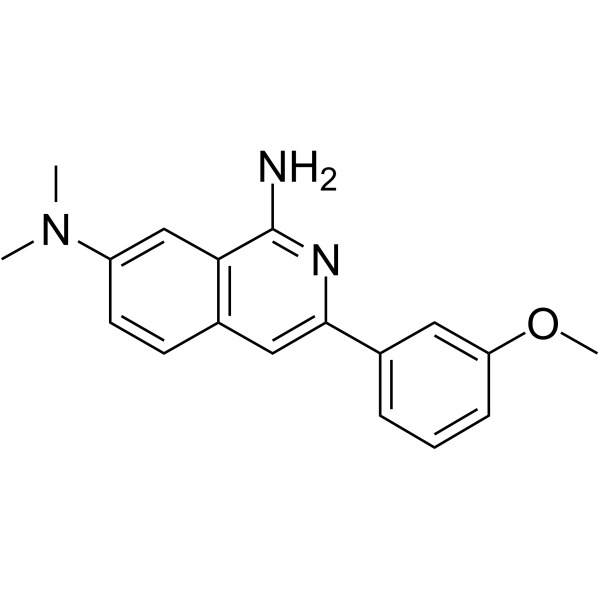
3-arylisoquinolinamine derivative is a 3-arylisoquinolinamine derivative with antitumor activity.
Nur für Forschungszwecke. Wir verkaufen nicht an Patienten.
- Reinheit : 98.20%
- CAS. Nr.: 1029008-71-6
- Formel: C18H19N3O
- Molecular Weight:293.36
-
Speicherung:Powder -20°C, 3 years , 4°C, 2 years ; In solvent -80°C, 2 years , -20°C, 1 year

To place orders, for customer services and technical support, please contact: MedChemExpress USA
Tel: 609-228-6898 E-mail: [email protected] [email protected]


-
 Biologische Aktivität
-
Chemical Information
-
Lösungsmittel & Löslichkeit
- Protokoll
- Reinheit & Dokumentation
- Verweise
-
 Help & FAQs




Biologische Aktivität
Beschreibung
IC50 & Target
IC50: 21 nM (breast MDA-MB-231), 19 nM (pancreas PANC-1), 17 nM (colon HCT 116), 19 nM (prostate PC3), 14 nM (ovary OVCAR-3), 32 nM (melanoma SK-MEL-28), 22 nM (kidney Caki-1), 32 nM (glioblastoma SNB19)[1]
In Vitro
3-arylisoquinolinamine derivative is a 3-arylisoquinolinamine derivative, extracted from the reference[1], compound 7b.3-arylisoquinolinamine derivative (7b) shows more effective activity against Paclitaxel-resistant HCT-15 human colorectal cancer cell lines when compared to the original cytotoxic cancer drug, Paclitaxel. The cell cycle dynamics is analyzed by flow cytometry. Treatment of human HCT-15 cells with 3-arylisoquinolinamine derivative (7b) blocks or delays the progression of cells from G0/G1 phase into S phase, and induces cell death. Treatment with 3-arylisoquinolinamine derivative (7b) also significantly inhibits the growth of tumors and enhances tumor regression in a Paclitaxel-resistant HCT-15 xenograft model. 3-arylisoquinolinamine derivative (7b) inhibits the cell growth at IC50 value ranges from 14 nM to 32 nM in the human cancer cells tested. In cell cycle analysis using HCT-15 cells, treatment of 1 nM of 3-arylisoquinolinamine derivative (7b) displays a significant increase in G0/G1 phase at 24 h with a decrease in G2/M phase, but the increase of G0/G1 phase at 48 h is not significant. At higher concentration of 3-arylisoquinolinamine derivative (7b) (10 nM), there are a significant increase in G0/G1 phase and decrease in G2/M phase, and an emergence of sub-G1phase, at both 24 h and 48 h. 3-arylisoquinolinamine derivative (7b) blocks or delays the progression of cells from G0/G1 phase into S phase, and induces cell death[1]. 3-arylisoquinolinamine derivative is a 3-arylisoquinolinamine derivative, extracted from the reference[1], compound 13. 3-arylisoquinolinamine derivative (compound 13) is tested in colon cancer cells and its antitumor activity is compared with Paclitaxel. 3-arylisoquinolinamine derivative (IC50: 15 nM in HCT-15 cells, 17 nM in HCT116 cells) shows potent antiproliferative activities with IC50 value in the low nanomolar range in both cells and higher antitumor activities than that of Paclitaxel against Paclitaxel-resistant HCT-15 colorectal cancer cells[2].
MedChemExpress (MCE) has not independently confirmed the accuracy of these methods. They are for reference only. Further protocols information, click here.
In Vivo
MedChemExpress (MCE) has not independently confirmed the accuracy of these methods. They are for reference only.


Chemical Information
-
CAS. Nr. 1029008-71-6
-
Appearance Solid
-
Molecular Weight 293.36
-
Formel C18H19N3O
-
Color Light yellow to yellow
-
SMILES
NC1=NC(C2=CC=CC(OC)=C2)=CC(C=C3)=C1C=C3N(C)C
-
Versand
Room temperature in continental US; may vary elsewhere.
-
Speicherung
Powder -20°C 3 years 4°C 2 years In solvent -80°C 2 years -20°C 1 year


Lösungsmittel & Löslichkeit
In Vitro:
DMSO : ≥ 50 mg/mL (170.44 mM; Hygroscopic DMSO has a significant impact on the solubility of product, please use newly opened DMSO)
* "≥" means soluble, but saturation unknown.
Please refer to the solubility information to select the appropriate solvent. Once prepared, please aliquot and store the solution to prevent product inactivation from repeated freeze-thaw cycles.
Storage method and period of stock solution: -80°C, 2 years; -20°C, 1 year. When stored at -80°C, please use it within 2 years. When stored at -20°C, please use it within 1 year.
Please refer to the solubility information to select the appropriate solvent. Once prepared, please aliquot and store the solution to prevent product inactivation from repeated freeze-thaw cycles.
Storage method and period of stock solution: -80°C, 2 years; -20°C, 1 year. When stored at -80°C, please use it within 2 years. When stored at -20°C, please use it within 1 year.
Konzentration (Stammlösung) × Volumen (Stammlösung) = Konzentration (Ziellösung) × Volumen (Ziellösung)
In Vivo:
Select the appropriate dissolution method based on your experimental animal and administration route.
- For the following dissolution methods, please ensure to first prepare a clear stock solution using an In Vitro approach and then sequentially add co-solvents:
- To ensure reliable experimental results, the clarified stock solution can be appropriately stored based on storage conditions. As for the working solution for In Vivo experiments, it is recommended to prepare freshly and use it on the same day.
- The percentages shown for the solvents indicate their volumetric ratio in the final prepared solution. If precipitation or phase separation occurs during preparation, heat and/or sonication can be used to aid dissolution.
Add each solvent one by one: 10% DMSO 40% PEG300 5% Tween-80 45% Saline
Solubility: ≥ 2.75 mg/mL (9.37 mM); Clear solution
This protocol yields a clear solution of ≥ 2.75 mg/mL (saturation unknown).
Taking 1 mL working solution as an example, add 100 μL DMSO stock solution (27.5 mg/mL) to 400 μL PEG300, and mix evenly; then add 50 μL Tween-80 and mix evenly; then add 450 μL Saline to adjust the volume to 1 mL.
Preparation of Saline: Dissolve 0.9 g sodium chloride in ddH₂O and dilute to 100 mL to obtain a clear Saline solution.
In Vivo Dissolution Calculator
Please enter the basic information of animal experiments:
-
-
-
-
Recommended: Prepare an additional quantity of animals to account for potential losses during experiments.
Please enter your animal formula composition:
-
%DMSO +
Recommended: Keep the proportion of DMSO in working solution below 2% if your animal is weak.
-
%+
-
+%Tween-80 + +
-
%Saline +
The co-solvents required include: DMSO, . All of co-solvents are available by MedChemExpress (MCE). , Tween 80. All of co-solvents are available by MedChemExpress (MCE).
Working solution concentration: 0.22 mg/mL
Method for preparing stock solution: mg drug dissolved in μL DMSO. Stock solution concentration: mg/mL.
1. Take μL DMSO stock solution;
2. Add μL .
μL , mix evenly;
3. Then add μL Tween 80, mix evenly;
4. Then add μL
Please ensure that the stock solution in the first step is dissolved to a clear state, and add co-solvents in sequence. You can use ultrasonic heating (ultrasonic cleaner, recommended frequency 20-40 kHz), vortexing, etc. to assist dissolution.

Protokoll
-
Subcutaneous Cell-Line-Derived Xenograft
Subcutaneous cell-line-derived xenograft (CDX) models are established by implanting cultured human cancer cell lines into immunodeficient mice, where the injected cells form localized tumors that can be monitored in vivo as a measure of tumorigenic potential, growth kinetics, and treatment response. These models are widely used in oncology research because they allow reproducible tumor formation and enable comparative assessment of tumor growth between different cell lines or genetic manipulations in a controlled in vivo microenvironment. Subcutaneous implantation of cancer cells in immunodeficient mice is a standard approach for evaluating tumor growth behavior and therapeutic response across multiple cancer types, including prostate, esophageal, pancreatic, and colon cancer models.


Reinheit & Dokumentation
-
Data Sheet (274 KB)
-
SDS (251 KB)
- English - EN (251 KB)
- Français - FR (251 KB)
- Deutsch - DE (251 KB)
- Norwegian - NO (251 KB)
- Español - ES (251 KB)
- Swedish - SV (251 KB)
- Italian - IT (251 KB)
- Korean - KR (251 KB)
- Portuguese - PT (251 KB)
-
Handling Instructions (2659 KB)
Verweise


Complete Stock Solution Preparation Table
Please refer to the solubility information to select the appropriate solvent. Once prepared, please aliquot and store the solution to prevent product inactivation from repeated freeze-thaw cycles.
Storage method and period of stock solution: -80°C, 2 years; -20°C, 1 year. When stored at -80°C, please use it within 2 years. When stored at -20°C, please use it within 1 year.
| Optional Solvent | Concentration Solvent Mass | 1 mg | 5 mg | 10 mg | 25 mg |
|---|---|---|---|---|---|
| DMSO | 1 mM | 3.4088 mL | 17.0439 mL | 34.0878 mL | 85.2195 mL |
| 5 mM | 0.6818 mL | 3.4088 mL | 6.8176 mL | 17.0439 mL | |
| 10 mM | 0.3409 mL | 1.7044 mL | 3.4088 mL | 8.5220 mL | |
| 15 mM | 0.2273 mL | 1.1363 mL | 2.2725 mL | 5.6813 mL | |
| 20 mM | 0.1704 mL | 0.8522 mL | 1.7044 mL | 4.2610 mL | |
| 25 mM | 0.1364 mL | 0.6818 mL | 1.3635 mL | 3.4088 mL | |
| 30 mM | 0.1136 mL | 0.5681 mL | 1.1363 mL | 2.8407 mL | |
| 40 mM | 0.0852 mL | 0.4261 mL | 0.8522 mL | 2.1305 mL | |
| 50 mM | 0.0682 mL | 0.3409 mL | 0.6818 mL | 1.7044 mL | |
| 60 mM | 0.0568 mL | 0.2841 mL | 0.5681 mL | 1.4203 mL | |
| 80 mM | 0.0426 mL | 0.2130 mL | 0.4261 mL | 1.0652 mL | |
| 100 mM | 0.0341 mL | 0.1704 mL | 0.3409 mL | 0.8522 mL |


3-arylisoquinolinamine derivative Related Classifications
HY-32364 Related Classifications
 Powered by Bioz