



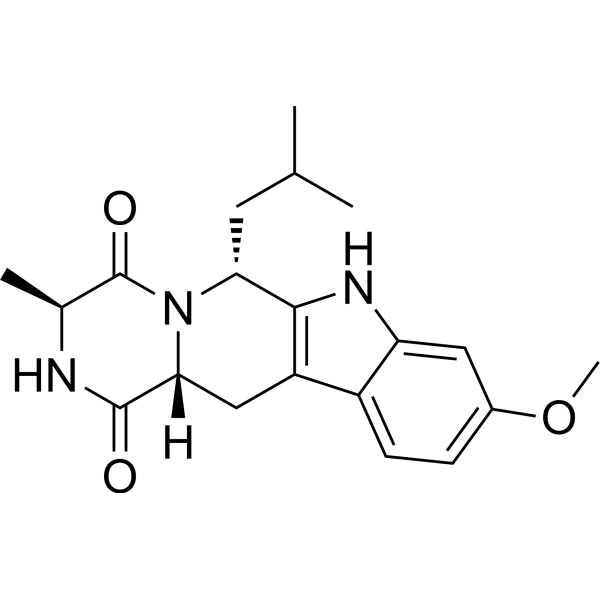
(6R)-ML753286

Based on 1 Customer Validation
(6R)-ML753286 is an isomer of ML753286 (HY-116494). ML753286 is an orally active and selective BCRP (Breast cancer resistance protein) inhibitor with an IC50 of 0.6 μM. ML753286 has high permeability and low to medium clearance in rodent and human liver S9 fractions, and is stable in plasma cross species.
For research use only. We do not sell to patients.
- Purity : 98.0%
- Formula: C20H25N3O3
- Molecular Weight:355.43
-
Storage:Powder -20°C, 3 years , 4°C, 2 years ; In solvent -80°C, 6 months , -20°C, 1 month

To place orders, for customer services and technical support, please contact: MedChemExpress USA
Tel: 609-228-6898 E-mail: [email protected] [email protected]


-
 Biological Activity
-
Chemical Information
-
Solvent & Solubility
- Protocols
- Purity & Documentation
- References
-
 Help & FAQs




Biological Activity
Description
In Vitro
ML753286 has IC50 values of >30, 0.6, and 39.0 μM for the inhibition of P-gp-, BCRP-, and OATP mediated transport, respectively[1].
MedChemExpress (MCE) has not independently confirmed the accuracy of these methods. They are for reference only.
In Vivo
MedChemExpress (MCE) has not independently confirmed the accuracy of these methods. They are for reference only.


Chemical Information
-
Appearance Solid
-
Molecular Weight 355.43
-
Formula C20H25N3O3
-
Color White to off-white
-
SMILES
COC1=CC=C2C(NC3=C2C[C@]4(N([C@@H]3CC(C)C)C([C@@H](NC4=O)C)=O)[H])=C1
-
Shipping
Room temperature in continental US; may vary elsewhere.
-
Storage
Powder -20°C 3 years 4°C 2 years In solvent -80°C 6 months -20°C 1 month


Solvent & Solubility
In Vitro:
DMSO : 25 mg/mL (70.34 mM; Need ultrasonic; Hygroscopic DMSO has a significant impact on the solubility of product, please use newly opened DMSO)
Please refer to the solubility information to select the appropriate solvent. Once prepared, please aliquot and store the solution to prevent product inactivation from repeated freeze-thaw cycles.
Storage method and period of stock solution: -80°C, 6 months; -20°C, 1 month. When stored at -80°C, please use it within 6 months. When stored at -20°C, please use it within 1 month.
Please refer to the solubility information to select the appropriate solvent. Once prepared, please aliquot and store the solution to prevent product inactivation from repeated freeze-thaw cycles.
Storage method and period of stock solution: -80°C, 6 months; -20°C, 1 month. When stored at -80°C, please use it within 6 months. When stored at -20°C, please use it within 1 month.
Concentration (start) × Volume (start) = Concentration (final) × Volume (final)


Purity & Documentation
-
Data Sheet (274 KB)
-
SDS (251 KB)
- English - EN (251 KB)
- Français - FR (251 KB)
- Deutsch - DE (251 KB)
- Norwegian - NO (251 KB)
- Español - ES (251 KB)
- Swedish - SV (251 KB)
- Italian - IT (251 KB)
- Korean - KR (251 KB)
- Portuguese - PT (251 KB)
-
Handling Instructions (2659 KB)
References


Complete Stock Solution Preparation Table
Please refer to the solubility information to select the appropriate solvent. Once prepared, please aliquot and store the solution to prevent product inactivation from repeated freeze-thaw cycles.
Storage method and period of stock solution: -80°C, 6 months; -20°C, 1 month. When stored at -80°C, please use it within 6 months. When stored at -20°C, please use it within 1 month.
| Optional Solvent | Concentration Solvent Mass | 1 mg | 5 mg | 10 mg | 25 mg |
|---|---|---|---|---|---|
| DMSO | 1 mM | 2.8135 mL | 14.0675 mL | 28.1349 mL | 70.3373 mL |
| 5 mM | 0.5627 mL | 2.8135 mL | 5.6270 mL | 14.0675 mL | |
| 10 mM | 0.2813 mL | 1.4067 mL | 2.8135 mL | 7.0337 mL | |
| 15 mM | 0.1876 mL | 0.9378 mL | 1.8757 mL | 4.6892 mL | |
| 20 mM | 0.1407 mL | 0.7034 mL | 1.4067 mL | 3.5169 mL | |
| 25 mM | 0.1125 mL | 0.5627 mL | 1.1254 mL | 2.8135 mL | |
| 30 mM | 0.0938 mL | 0.4689 mL | 0.9378 mL | 2.3446 mL | |
| 40 mM | 0.0703 mL | 0.3517 mL | 0.7034 mL | 1.7584 mL | |
| 50 mM | 0.0563 mL | 0.2813 mL | 0.5627 mL | 1.4067 mL | |
| 60 mM | 0.0469 mL | 0.2345 mL | 0.4689 mL | 1.1723 mL |


(6R)-ML753286 Related Classifications
HY-116494A Related Classifications
 Powered by Bioz