



Bromfenac sodium hydrate

Based on 1 Customer Validation
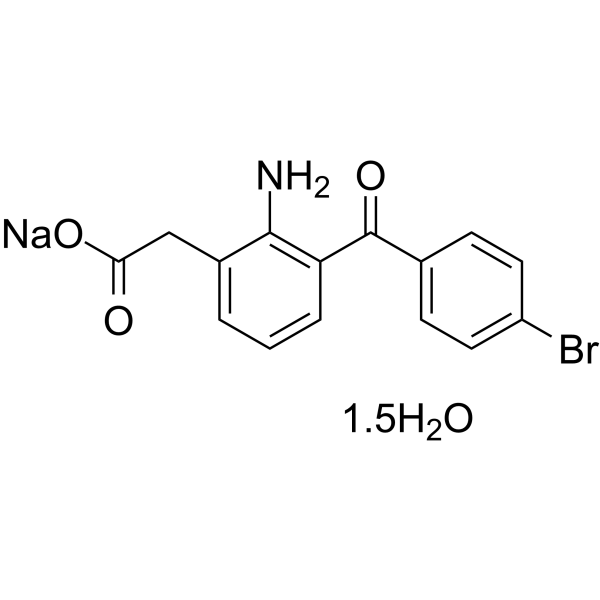
Bromfenac sodium hydrate (Bromfenac monosodium salt sesquihydrate) is a potent and orally active inhibitor of COX, with IC50s of 5.56 and 7.45 nM for COX-1 and COX-2, respectively. Bromfenac sodium hydrate can be used in ocular inflammation research.
For research use only. We do not sell to patients.
- Purity : 99.94%
- CAS No.: 120638-55-3
- Formula: C15H14BrNNaO4.5
- Molecular Weight:383.17
-
Storage:
4°C, sealed storage, away from moisture
* In solvent : -80°C, 6 months; -20°C, 1 month (sealed storage, away from moisture)

To place orders, for customer services and technical support, please contact: MedChemExpress USA
Tel: 609-228-6898 E-mail: [email protected] [email protected]


-
 Biological Activity
-
Chemical Information
-
Solvent & Solubility
- Protocols
- Purity & Documentation
- References
-
 Help & FAQs




Biological Activity
Description
IC50 & Target
[1]|
COX-1 5.56 nM (IC50) |
COX-2 7.45 nM (IC50) |
In Vitro
Bromfenac (0-80 μg/mL; 24 h) can inhibit transforming growth factor-β2-induced epithelial-mesenchymal transition in HLEC-B3 in a concentration-dependent manner[2].
Bromfenac (80 μg/Ml; 48 h) inhibits transforming growth factor-β2-induced epithelial-mesenchymal transition in human anterior capsules[2].
MedChemExpress (MCE) has not independently confirmed the accuracy of these methods. They are for reference only. Further protocols information, click here.
-
Cell Line:Transforming growth factor-β2-treated human anterior capsules
-
Concentration:80 μg/mL
-
Incubation Time:48 hours
-
Result:Suppressed transforming growth factor-β2-induced epithelial-mesenchymal transition in primary LECs.
-
Cell Line:HLEC-B3 cells
-
Concentration:0, 20, 40, 60, and 80 μg/mL
-
Incubation Time:24 hours
-
Result:Suppressed transforming growth factor-β2-induced cell migration in HLEC-B3 cells, and exhibited inhibition of the over-expression of epithelial-mesenchymal transition markers.
In Vivo
Bromfenac (0.032-3.16%; 100 μL; rubbed onto the paws) produces dose-related anti-inflammatory activity in rats[3].
Bromfenac (0.032-1.0%; 50 μL) is 26 times more potent than indomethacin in blocking the erythema when applied directly onto the skin area exposed to UV light in guinea pigs[3].
Bromfenac (0.0032-0.1%; 50μL; rubbed onto the uninjected paw for 4 h per day and 5 days per week) produces a dose and time dependent reduction in the paw volume of both hind limbs in rats[3].
Bromfenac (0.32%; 50μL; rubbed onto the abdomen) produces significant blockade of abdominal constriction to ACh challenge in mice[3].
Bromfenac (eyedrop instillation; 1 μL (0.09%) per eye; twice-daily; 4 w) partially reduces corneal staining, and becomes so more slowly by the 4-week time point[4].
MedChemExpress (MCE) has not independently confirmed the accuracy of these methods. They are for reference only.
-
Animal Model:Male Sprague-Dawley rats (150-250 g) are injected carrageenan[3]
-
Dosage:0.0032, 0.01, 0.032, 0.1, 0.32, 1.0, 3.16% (100 or 200 μL)
-
Administration:Rubbed onto the backs before 1-72 h of injected carrageenan
-
Result:Produced significant anti-inflammatory activity when applied 1, 2, and 4 h prior to carrageenan challenge at 0.32%.
Applied 1 or 4 h prior to carrageenan challenge was active, but not when applied 24 h (or longer) prior to challenge at 0.2%.
-
Animal Model:Male injected with Salin or BTX-B[4]
-
Dosage:1 μL (0.09%) per eye
-
Administration:Eyedrop instillation; 1 μL (0.09%) per eye; twice-daily; 4 weeks
-
Result:Improved the corneal fluorescein staining score later at 4 weeks after treatment.


Chemical Information
-
CAS No. 120638-55-3
-
Appearance Solid
-
Molecular Weight 383.17
-
Formula C15H14BrNNaO4.5
-
Color Light yellow to yellow
-
SMILES
O=C(O[Na])CC1=CC=CC(C(C2=CC=C(Br)C=C2)=O)=C1N.[1.5H2O]
-
Synonyms
Bromfenac monosodium salt sesquihydrate
-
Shipping
Room temperature in continental US; may vary elsewhere.
-
Storage
4°C, sealed storage, away from moisture
* In solvent : -80°C, 6 months; -20°C, 1 month (sealed storage, away from moisture)


Solvent & Solubility
In Vitro:
DMSO : ≥ 100 mg/mL (260.98 mM; Hygroscopic DMSO has a significant impact on the solubility of product, please use newly opened DMSO)
H2O : ≥ 100 mg/mL (260.98 mM)
* "≥" means soluble, but saturation unknown.
Please refer to the solubility information to select the appropriate solvent. Once prepared, please aliquot and store the solution to prevent product inactivation from repeated freeze-thaw cycles.
Storage method and period of stock solution: -80°C, 6 months; -20°C, 1 month (sealed storage, away from moisture). When stored at -80°C, please use it within 6 months. When stored at -20°C, please use it within 1 month.
* Note: If you choose water as the stock solution, please dilute it to the working solution, then filter and sterilize it with a 0.22 μm filter before use.
Please refer to the solubility information to select the appropriate solvent. Once prepared, please aliquot and store the solution to prevent product inactivation from repeated freeze-thaw cycles.
Storage method and period of stock solution: -80°C, 6 months; -20°C, 1 month (sealed storage, away from moisture). When stored at -80°C, please use it within 6 months. When stored at -20°C, please use it within 1 month.
* Note: If you choose water as the stock solution, please dilute it to the working solution, then filter and sterilize it with a 0.22 μm filter before use.
Concentration (start) × Volume (start) = Concentration (final) × Volume (final)
In Vivo:
Select the appropriate dissolution method based on your experimental animal and administration route.
- For the following dissolution methods, please ensure to first prepare a clear stock solution using an In Vitro approach and then sequentially add co-solvents:
- To ensure reliable experimental results, the clarified stock solution can be appropriately stored based on storage conditions. As for the working solution for In Vivo experiments, it is recommended to prepare freshly and use it on the same day.
- The percentages shown for the solvents indicate their volumetric ratio in the final prepared solution. If precipitation or phase separation occurs during preparation, heat and/or sonication can be used to aid dissolution.
Add each solvent one by one: 10% DMSO 40% PEG300 5% Tween-80 45% Saline
Solubility: ≥ 2.5 mg/mL (6.52 mM); Clear solution
This protocol yields a clear solution of ≥ 2.5 mg/mL (saturation unknown).
Taking 1 mL working solution as an example, add 100 μL DMSO stock solution (25.0 mg/mL) to 400 μL PEG300, and mix evenly; then add 50 μL Tween-80 and mix evenly; then add 450 μL Saline to adjust the volume to 1 mL.
Preparation of Saline: Dissolve 0.9 g sodium chloride in ddH₂O and dilute to 100 mL to obtain a clear Saline solution.
Add each solvent one by one: 10% DMSO 90% (20% SBE-β-CD in Saline)
Solubility: ≥ 2.5 mg/mL (6.52 mM); Clear solution
This protocol yields a clear solution of ≥ 2.5 mg/mL (saturation unknown).
Taking 1 mL working solution as an example, add 100 μL DMSO stock solution (25.0 mg/mL) to 900 μL 20% SBE-β-CD in Saline, and mix evenly.
Preparation of 20% SBE-β-CD in Saline (4°C, storage for one week): 2 g SBE-β-CD powder is dissolved in 10 mL Saline, completely dissolve until clear.
For the following dissolution methods, please prepare the working solution directly:
It is recommended to prepare fresh solutions and use them promptly within a short period of time.
The percentages shown for the solvents indicate their volumetric ratio in the final prepared solution. If precipitation or phase separation occurs during preparation, heat and/or sonication can be used to aid dissolution.
Add each solvent one by one: PBS
Solubility: 33.33 mg/mL (86.98 mM); Clear solution; Need ultrasonic
In Vivo Dissolution Calculator
Please enter the basic information of animal experiments:
-
-
-
-
Recommended: Prepare an additional quantity of animals to account for potential losses during experiments.
Working solution concentration: 0.22 mg/mL
This product has good water solubility, please refer to the measured solubility data in water/PBS/Saline for details.

Protocols
-
Research Protocol for Inflammation-related Diseases
The NLRP3 inflammasome is a cytosolic innate immune signaling platform that integrates priming signals and danger-signal activation to promote caspase-1 activation, maturation of IL-1β and IL-18, and gasdermin D-mediated pyroptotic cell death. The core experimental logic is to determine whether inflammatory disease phenotypes are driven by increased NLRP3 expression, ASC-containing inflammasome assembly, caspase-1 cleavage, GSDMD cleavage, and extracellular release of IL-1β/IL-18 rather than by nonspecific cell injury alone. The pathway is strongly linked to inflammation-related disease phenotypes because monosodium urate crystals activate NALP3/NLRP3 inflammasome signaling in gout-like crystal inflammation, cholesterol crystals activate NLRP3 inflammasomes in atherogenesis models, and DSS-induced intestinal inflammation has been reported to involve NLRP3 inflammasome activity. However, experimental colitis studies also show context-dependent protective effects of NLRP3 inflammasome co


Purity & Documentation
-
Data Sheet (279 KB)
-
SDS (393 KB)
- English - EN (393 KB)
- Français - FR (393 KB)
- Deutsch - DE (393 KB)
- Norwegian - NO (393 KB)
- Español - ES (393 KB)
- Swedish - SV (393 KB)
- Italian - IT (393 KB)
- Korean - KR (393 KB)
- Portuguese - PT (393 KB)
-
Handling Instructions (2659 KB)
References
[1]. Tetsuo Kida, et al. Pharmacokinetics and efficacy of topically applied nonsteroidal anti-inflammatory drugs in retinochoroidal tissues in rabbits. PLoS One. 2014 May 5;9(5):e96481. [Content Brief]
[2]. Xiaobo Zhang, et al. Drug-eluting intraocular lens with sustained bromfenac release for conquering posterior capsular opacification. Bioact Mater. 2021 Jul 23;9:343-357. [Content Brief]
[3]. Nolan JC, et, al. The topical anti-inflammatory and analgesic properties of bromfenac in rodents. Agents Actions. 1988 Aug; 25(1-2): 77-85. [Content Brief]
[4]. Kaevalin Lekhanont, et al. Effects of topical anti-inflammatory agents in a botulinum toxin B-induced mouse model of keratoconjunctivitis sicca. J Ocul Pharmacol Ther. 2007 Feb;23(1):27-34. [Content Brief]


Complete Stock Solution Preparation Table
Please refer to the solubility information to select the appropriate solvent. Once prepared, please aliquot and store the solution to prevent product inactivation from repeated freeze-thaw cycles.
Storage method and period of stock solution: -80°C, 6 months; -20°C, 1 month (sealed storage, away from moisture). When stored at -80°C, please use it within 6 months. When stored at -20°C, please use it within 1 month.
| Optional Solvent | Concentration Solvent Mass | 1 mg | 5 mg | 10 mg | 25 mg |
|---|---|---|---|---|---|
| DMSO / H2O | 1 mM | 2.6098 mL | 13.0490 mL | 26.0981 mL | 65.2452 mL |
| 5 mM | 0.5220 mL | 2.6098 mL | 5.2196 mL | 13.0490 mL | |
| 10 mM | 0.2610 mL | 1.3049 mL | 2.6098 mL | 6.5245 mL | |
| 15 mM | 0.1740 mL | 0.8699 mL | 1.7399 mL | 4.3497 mL | |
| 20 mM | 0.1305 mL | 0.6525 mL | 1.3049 mL | 3.2623 mL | |
| 25 mM | 0.1044 mL | 0.5220 mL | 1.0439 mL | 2.6098 mL | |
| 30 mM | 0.0870 mL | 0.4350 mL | 0.8699 mL | 2.1748 mL | |
| 40 mM | 0.0652 mL | 0.3262 mL | 0.6525 mL | 1.6311 mL | |
| 50 mM | 0.0522 mL | 0.2610 mL | 0.5220 mL | 1.3049 mL | |
| 60 mM | 0.0435 mL | 0.2175 mL | 0.4350 mL | 1.0874 mL | |
| 80 mM | 0.0326 mL | 0.1631 mL | 0.3262 mL | 0.8156 mL | |
| 100 mM | 0.0261 mL | 0.1305 mL | 0.2610 mL | 0.6525 mL |
* Note: If you choose water as the stock solution, please dilute it to the working solution, then filter and sterilize it with a 0.22 μm filter before use.


Bromfenac sodium hydrate Related Classifications
HY-B1888B Related Classifications
 Powered by Bioz