



Chromafenozide
Based on 1 publication(s) in Google Scholar
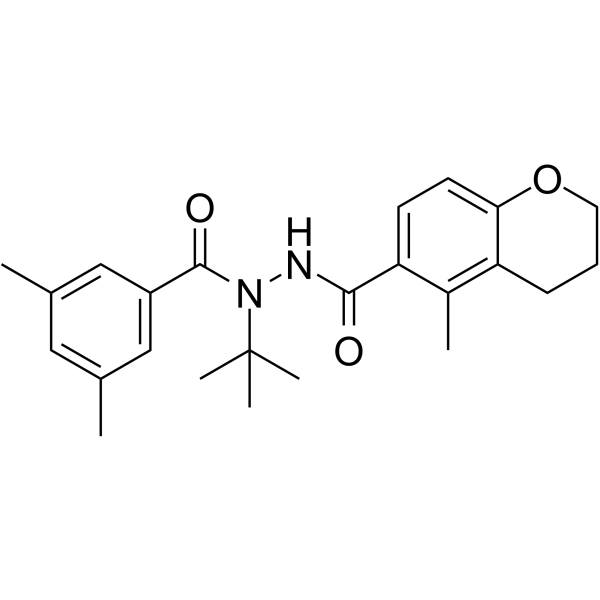
Chromafenozide is a potent partial ecdysone receptor agonist and dibenzoylhydrazine insecticide. Chromafenozide inhibits insect feeding and causes the insect to molt prematurely, leading to death. Chromafenozide shows antagonistic activity against 20-HE. Chromafenozide shows high toxicity against Spodoptera exigua and Spodoptera littoralis.
Nos produits utilisent uniquement pour la recherche. Nous ne vendons pas aux patients.
- Pureté : 99.65%
- CAS No.: 143807-66-3
- Formule: C24H30N2O3
- Masse moléculaire:394.51
-
Stockage:Powder -20°C, 3 years , 4°C, 2 years ; In solvent -80°C, 2 years , -20°C, 1 year

To place orders, for customer services and technical support, please contact: MedChemExpress USA
Tel: 609-228-6898 E-mail: [email protected] [email protected]


-
 Activité biologique
-
Chemical Information
-
Solvant et solubilité
- Pureté et documentation
- Références
-
 Help & FAQs


Publications Citing Use of MedChemExpress (MCE) Chromafenozide
More Customer Validation & Images

-
WB
-
IF


Activité biologique
Description
In Vitro
Chromafenozide (0.01-0.1 nM) reduces the luciferase activity induced by 20-HE by about half in Sf9 cells, showing antagonistic activity against 20-HE[1].
Chromfenoxate (0.1 nM-100 μM; 5 days) inhibits proliferation of both Se4 and S2 cells, with higher inhibitory activity against Se4 cells than against S2 cells[2].
MedChemExpress (MCE) has not independently confirmed the accuracy of these methods. They are for reference only.
-
Cell Line:Se4 cells
-
Concentration:0.1 nM, 1 nM, 10 nM, 100 nM, 1 μM, 10 μM, 100 μM
-
Incubation Time:5 days
-
Result:Inhibited cell proliferation and was similar to Methoxyfenozide (HY-117386) in inhibitory activity.
In Vivo
MedChemExpress (MCE) has not independently confirmed the accuracy of these methods. They are for reference only.


Chemical Information
-
CAS No. 143807-66-3
-
Appearance Solid
-
Masse moléculaire 394.51
-
Formule C24H30N2O3
-
Color White to off-white
-
SMILES
O=C(C1=CC=C2C(CCCO2)=C1C)NN(C(C3=CC(C)=CC(C)=C3)=O)C(C)(C)C
-
Synonyms
ANS118
-
Livraison
Room temperature in continental US; may vary elsewhere.
-
Stockage
Powder -20°C 3 years 4°C 2 years In solvent -80°C 2 years -20°C 1 year


Publications (1)
-
Journal Impact Factor
-
Most Recent
-
J Neurogastroenterol Motil
Role of High-affinity Choline Transporter 1 in Colonic Hypermotility in a Rat Model of Irritable Bowel Syndrome. [Abstract]2018 Oct 1;24(4):643-655. PMID: 30347940
Chromafenozide purchased from MedChemExpress. Usage Cited in: J Neurogastroenterol Motil. 2018 Oct 1;24(4):643-655. [Abstract]
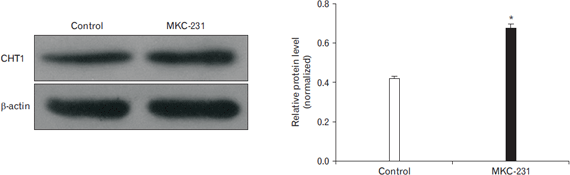
Influence of MKC-231, a choline uptake enhancer, on high-affinity choline transporter 1 (CHT1) expression and intestinal motility in vivo. Immunoblots (left) and histogram (right) for CHT1 in the colon from control and MKC-231-treated rats showing that the ratios of CHT1 to β-actin expression in control rats are significantly increased after 10 consecutive days of MKC-231 treatment.
Chromafenozide purchased from MedChemExpress. Usage Cited in: J Neurogastroenterol Motil. 2018 Oct 1;24(4):643-655. [Abstract]
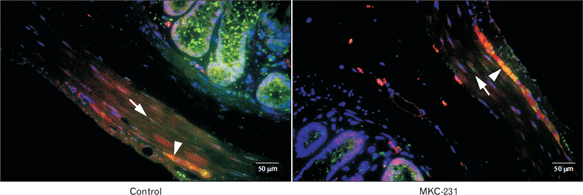
Merged pictures of immunostaining for CHT1, transmembrane member 16A (TMEM16A), and DAPI in longitudinal colonic sections from control (left) and MKC-231 rats (right) (×400) revealing that the density of CHT1 labelling in the colonic muscular layer is considerably elevated after treatment with MKC-231.


Solvant et solubilité
In Vitro:
DMSO : 250 mg/mL (633.70 mM; Need ultrasonic; Hygroscopic DMSO has a significant impact on the solubility of product, please use newly opened DMSO)
Please refer to the solubility information to select the appropriate solvent. Once prepared, please aliquot and store the solution to prevent product inactivation from repeated freeze-thaw cycles.
Storage method and period of stock solution: -80°C, 2 years; -20°C, 1 year. When stored at -80°C, please use it within 2 years. When stored at -20°C, please use it within 1 year.
Please refer to the solubility information to select the appropriate solvent. Once prepared, please aliquot and store the solution to prevent product inactivation from repeated freeze-thaw cycles.
Storage method and period of stock solution: -80°C, 2 years; -20°C, 1 year. When stored at -80°C, please use it within 2 years. When stored at -20°C, please use it within 1 year.
Concentration (start) × Volume (start) = Concentration (final) × Volume (final)
In Vivo:
Select the appropriate dissolution method based on your experimental animal and administration route.
- For the following dissolution methods, please ensure to first prepare a clear stock solution using an In Vitro approach and then sequentially add co-solvents:
- To ensure reliable experimental results, the clarified stock solution can be appropriately stored based on storage conditions. As for the working solution for In Vivo experiments, it is recommended to prepare freshly and use it on the same day.
- The percentages shown for the solvents indicate their volumetric ratio in the final prepared solution. If precipitation or phase separation occurs during preparation, heat and/or sonication can be used to aid dissolution.
Add each solvent one by one: 10% DMSO 40% PEG300 5% Tween-80 45% Saline
Solubility: ≥ 2.08 mg/mL (5.27 mM); Clear solution
This protocol yields a clear solution of ≥ 2.08 mg/mL (saturation unknown).
Taking 1 mL working solution as an example, add 100 μL DMSO stock solution (20.8 mg/mL) to 400 μL PEG300, and mix evenly; then add 50 μL Tween-80 and mix evenly; then add 450 μL Saline to adjust the volume to 1 mL.
Preparation of Saline: Dissolve 0.9 g sodium chloride in ddH₂O and dilute to 100 mL to obtain a clear Saline solution.
In Vivo Dissolution Calculator
Please enter the basic information of animal experiments:
-
-
-
-
Recommended: Prepare an additional quantity of animals to account for potential losses during experiments.
Please enter your animal formula composition:
-
%DMSO +
Recommended: Keep the proportion of DMSO in working solution below 2% if your animal is weak.
-
%+
-
+%Tween-80 + +
-
%Saline +
The co-solvents required include: DMSO, . All of co-solvents are available by MedChemExpress (MCE). , Tween 80. All of co-solvents are available by MedChemExpress (MCE).
Working solution concentration: 0.22 mg/mL
Method for preparing stock solution: mg drug dissolved in μL DMSO. Stock solution concentration: mg/mL.
1. Take μL DMSO stock solution;
2. Add μL .
μL , mix evenly;
3. Then add μL Tween 80, mix evenly;
4. Then add μL
Please ensure that the stock solution in the first step is dissolved to a clear state, and add co-solvents in sequence. You can use ultrasonic heating (ultrasonic cleaner, recommended frequency 20-40 kHz), vortexing, etc. to assist dissolution.


Pureté et documentation
-
Fiche technique (274 KB)
-
SDS (398 KB)
- English - EN (398 KB)
- Français - FR (398 KB)
- Deutsch - DE (398 KB)
- Norwegian - NO (398 KB)
- Español - ES (398 KB)
- Swedish - SV (398 KB)
- Italian - IT (398 KB)
- Korean - KR (398 KB)
- Portuguese - PT (398 KB)
-
Instruction de manipulation (2659 KB)
Références
[1]. Toya T, et al. Potent and selective partial ecdysone agonist activity of chromafenozide in Sf9 cells. Biochem Biophys Res Commun. 2002 Apr 12;292(4):1087-91. [Content Brief]
[3]. Morou E, et al. A new dibenzoylhydrazine with insecticidal activity against Anopheles mosquito larvae. Pest Manag Sci. 2013 Jul;69(7):827-33. [Content Brief]
[4]. Sardar SW, et al. Residual characteristics and safety assessment of the insecticides spiromesifen and chromafenozide in lettuce and perilla. Sci Rep. 2022 Mar 18;12(1):4675. [Content Brief]


Complete Stock Solution Preparation Table
Please refer to the solubility information to select the appropriate solvent. Once prepared, please aliquot and store the solution to prevent product inactivation from repeated freeze-thaw cycles.
Storage method and period of stock solution: -80°C, 2 years; -20°C, 1 year. When stored at -80°C, please use it within 2 years. When stored at -20°C, please use it within 1 year.
| Optional Solvent | Concentration Solvent Mass | 1 mg | 5 mg | 10 mg | 25 mg |
|---|---|---|---|---|---|
| DMSO | 1 mM | 2.5348 mL | 12.6739 mL | 25.3479 mL | 63.3697 mL |
| 5 mM | 0.5070 mL | 2.5348 mL | 5.0696 mL | 12.6739 mL | |
| 10 mM | 0.2535 mL | 1.2674 mL | 2.5348 mL | 6.3370 mL | |
| 15 mM | 0.1690 mL | 0.8449 mL | 1.6899 mL | 4.2246 mL | |
| 20 mM | 0.1267 mL | 0.6337 mL | 1.2674 mL | 3.1685 mL | |
| 25 mM | 0.1014 mL | 0.5070 mL | 1.0139 mL | 2.5348 mL | |
| 30 mM | 0.0845 mL | 0.4225 mL | 0.8449 mL | 2.1123 mL | |
| 40 mM | 0.0634 mL | 0.3168 mL | 0.6337 mL | 1.5842 mL | |
| 50 mM | 0.0507 mL | 0.2535 mL | 0.5070 mL | 1.2674 mL | |
| 60 mM | 0.0422 mL | 0.2112 mL | 0.4225 mL | 1.0562 mL | |
| 80 mM | 0.0317 mL | 0.1584 mL | 0.3168 mL | 0.7921 mL | |
| 100 mM | 0.0253 mL | 0.1267 mL | 0.2535 mL | 0.6337 mL |


Chromafenozide Related Classifications
HY-17533 Related Classifications
 Powered by Bioz